Alluvial tin wash plant solution (placer cassiterite gravity recovery): Alluvial tin ore is one of the most profitable tin resources available today, because mining cost is extremely low and no expensive rock crushing or grinding is needed. Drawing on decades of metallurgical experience, GravityMineral supplies a complete, turnkey alluvial tin wash plant built entirely around efficient gravity separation technology — delivering 0.02–5 mm cassiterite recovery at 20–300 t/h.
Our alluvial tin processing plant recovers cassiterite through strict screening, vigorous clay washing and multi-stage gravity separation. This reagent-free placer cassiterite gravity separation route offers clear advantages: equipment investment more than 40% lower than a hard-rock plant, energy use cut by about 60%, zero environmental pollution, and a payback period typically under 12 months. It is the ideal solution for inland riverbed deposits, terraces and coastal tin sands processing alike.
What Is Alluvial Tin Ore (Placer Cassiterite)?
Alluvial tin ore refers to placer deposits formed on river flats, terraces or coasts after long-term weathering, water transport and deposition of primary tin-bearing rock. Natural sorting has already liberated the cassiterite (SnO₂) from the gangue and given it a clean surface, so the expensive crushing and grinding required for primary hard-rock tin ore is completely unnecessary. That is exactly why an alluvial tin wash plant costs so little to build and run.
The barrier in placer tin processing is not the principle — it is whether the ore is washed thoroughly and whether the size classification is precise. Too often, fine cassiterite is lost with the slurry because clay was never broken down or because coarse and fine sand were processed together. GravityMineral's standard alluvial tin gravity process therefore uses a modular circuit of "washing and screening — size-by-size roughing — shaking table cleaning", exploiting cassiterite's high specific gravity (about 6.9–7.1 g/cm³) to reject light silica sand efficiently and produce a 65% Sn tin concentrate.
20 yearsGravity separation equipment manufacturing
50+ countriesAlluvial tin wash plants exported and commissioned
500+ projectsPlacer and hard-rock processing experience base
35%China market share in gravity separation equipment
Alluvial Tin Wash Plant Flowsheet: Four Stages
GravityMineral's engineers designed this circuit for alluvial tin mining equipment to break the clay bond first, reject barren gravel, and then extract heavy cassiterite systematically by particle size. The same layout works for riverbed tin, terrace tin and coastal tin sands.
Stage 1: Screening and Intensive Washing
Run-of-mine ore is first classified and washed to remove sticky clay and oversize debris, creating ideal conditions for gravity separation.
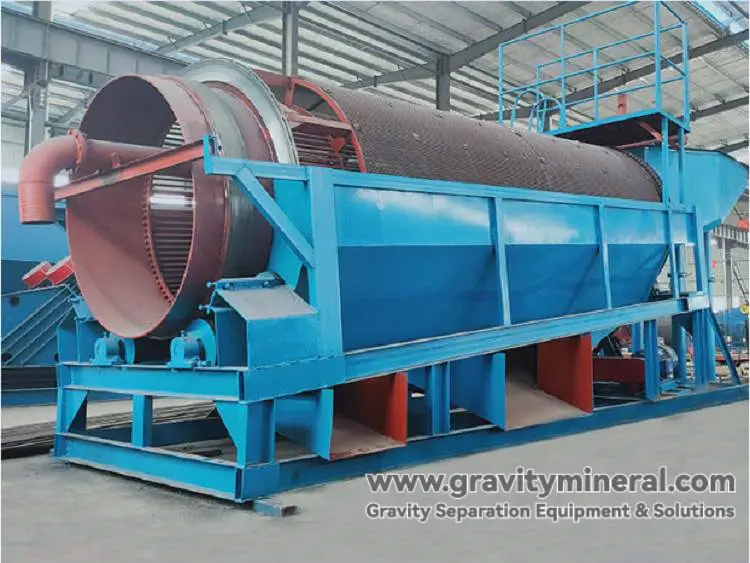
- Loose sandy material: fed directly to a trommel screen to remove barren gravel and roots — the low-cost option inside a wash plant.
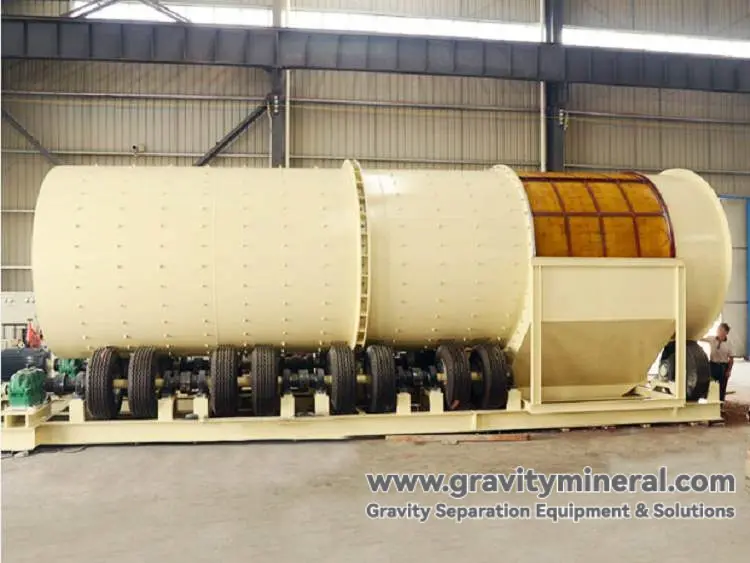
- Highly sticky clay material: fed to a rotary scrubber for deep, vigorous washing, dissolving the clay balls that would otherwise trap and carry away tin particles. If your deposit is lateritic, this stage decides the whole project's economics.
Stage 2: Roughing and Upgrading (the Core of Placer Tin Processing)
A classified gravity strategy is used. The washed sand is fed to equipment matched to its size range, never mixed:
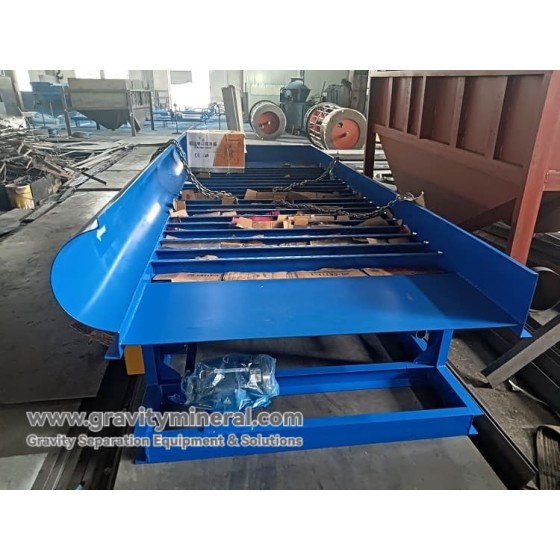
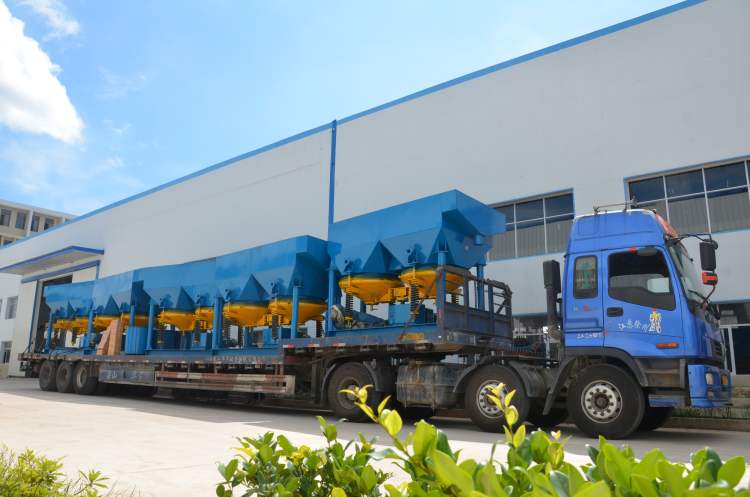
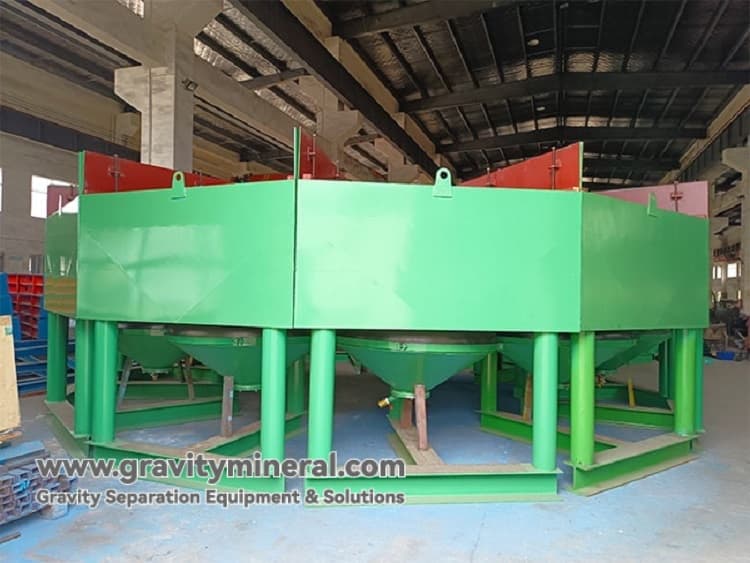
- Coarse fraction (+0.5 mm): fed to sawtooth-wave jigs. Jigs offer enormous throughput and efficiently recover coarse cassiterite.
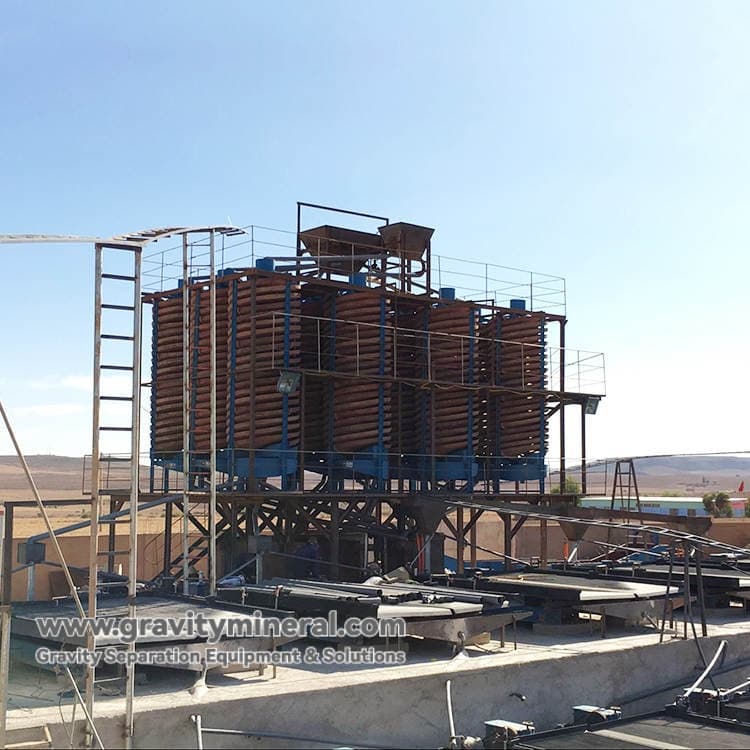
- Fine fraction (−0.5 mm): fed to an array of FRP spiral concentrators. Spirals act as high-capacity roughers with excellent recovery on fine tin sand and consume no power.
Stage 3: Separation and Cleaning on Shaking Tables
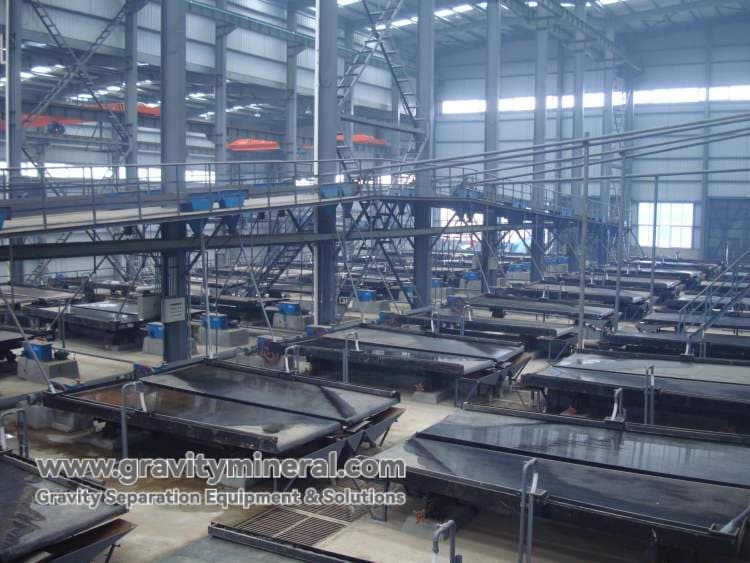
The mixed rougher concentrate from the jigs and spirals is pumped to 6-S shaking tables. Using their precise visible separation, the tables perform multi-stage duty (roughing, cleaning and scavenging). By arranging several tables in series or parallel, a high-purity commercial-grade tin concentrate of 65% Sn or above is guaranteed.
Stage 4: Tailings and Water Management (Dry Stacking)
Barren tailings are collected on belt conveyors and hauled for backfill. Slime-bearing tailings water is pumped to a thickener and filter press to separate slurry from water. This achieves dry tailings stacking and lets clear water be recirculated to the scrubber, greatly reducing environmental impact and water consumption.
Core Equipment Configuration for an Alluvial Tin Wash Plant
The essence of cassiterite recovery is washing and desliming, followed by classified gravity separation. The table below lists the core alluvial tin mining equipment and its duty stations; exact models are confirmed by GravityMineral engineers against your feed grade, clay content, cassiterite size distribution and target throughput.
| Process stage |
Recommended equipment |
Technical features |
| Screening and debris removal |
Trommel screen |
Simple structure, high throughput and strong wear resistance; the standard first stage of a placer tin wash plant. |
| Sticky clay washing |
Rotary scrubber |
Deep washing action with internal lifters that dissolves clay balls and releases the tin; essential for lateritic deposits. |
| Coarse pre-concentration |
Sawtooth-wave jig |
High capacity, high recovery and stable operation on the +0.5 mm fraction. |
| Fine roughing |
FRP spiral concentrator |
No power required, extremely simple to operate, low investment; ideal for fine tin sand recovery. |
| Separation and purification |
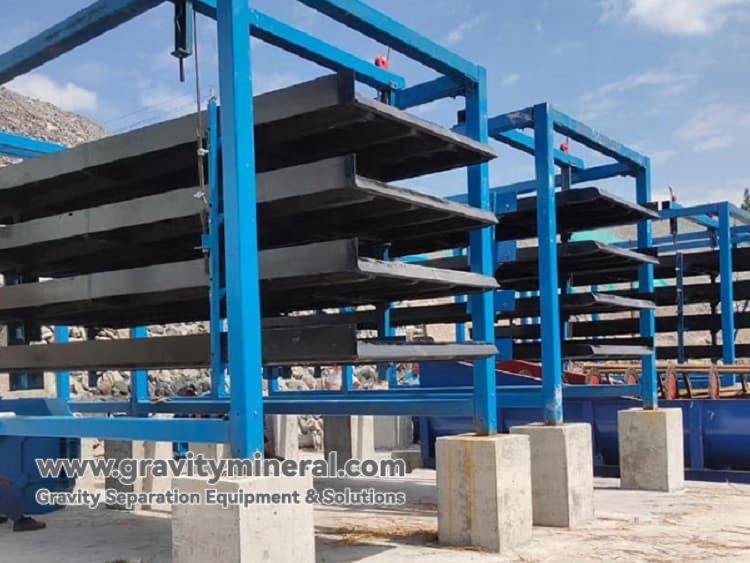
6-S shaking table |
Extremely high separation precision and upgrading ratio; produces a 65% Sn concentrate in one pass. |
| Tailings handling |
Thickener and filter press |
Excellent dewatering performance and dry tailings stacking, with water recirculated to the wash circuit. |
Technical Advantages and Adaptability of the Alluvial Tin Processing Plant
Project advantages
- Fast payback: equipment investment 40%+ lower than a hard-rock plant, because no crushing or grinding is required.
- Low energy use: energy consumption reduced by roughly 60%; typical payback under 12 months.
- Wide size range: efficient recovery across 0.02–5 mm, from coarse cassiterite to fine tin sand.
- Flexible configuration: modular design supports fixed plants and a fully mobile tin wash plant on wheeled or tracked chassis.
- Capacity range: 20–300 t/h, scalable in stages without rebuilding.
Environmental and system advantages
- Zero pollution: purely physical gravity separation with zero chemical reagents — no cyanide, no flotation chemicals.
- Dry tailings stacking: lowers environmental risk and meets strict permitting requirements.
- Water recirculation: wash water is continuously recirculated after thickening and filtration, cutting water consumption sharply.
- Simple operation: spiral concentrators run without power, and the whole circuit tolerates fluctuating feed grades.
- Upgrade path: a dryer plus three-disc high-intensity magnetic separator can be added later for dry iron removal to lift concentrate grade to 65% Sn or above.
Why Build Your Cassiterite Recovery Plant with GravityMineral
Alluvial tin projects are low-investment, but if the washing is incomplete and the classification imprecise, large amounts of fine cassiterite leave with the slurry — and the plant never pays back. The mineral processing industry does not lack equipment — what it lacks is a partner that understands placer tin gravity separation and on-site conditions alike, and can make the flowsheet fit together as one system.
| Common problem |
GravityMineral's solution |
| High clay content and clay coatings cause cassiterite losses |
A rotary scrubber with high-pressure water jets breaks up the mud completely first, delivering clean pulp to the jigs and spirals. |
| Coarse and fine fractions processed together, so recovery falls short |
Strict classification: coarse to jigs (+0.5 mm), fine to spiral concentrators (−0.5 mm), treated in stages for full-range recovery. |
| Remote sites with poor infrastructure and unreliable power |
Modular mobile wash plants, zero-power spiral concentrators and diesel generator sets sized to the site. |
| Design institute drawings and equipment supply are disconnected, so interfaces mismatch |
Equipment manufacturing, flowsheet design and on-site commissioning sit in one closed-loop team — the interfaces never clash. |
- 20 years focused on gravity separation: two decades of building spiral concentrators, jigs and shaking tables — which equipment suits which ore condition, which flowsheet suits which size fraction, all backed by retrievable historical experience.
- Full process coverage: GravityMineral supplies the complete alluvial tin mining equipment set — scrubbers, trommel screens, jigs, spirals, shaking tables, thickeners and filter presses.
- 50+ countries, 500+ global projects: coastal tin sands in Southeast Asia, inland riverbed alluvial tin in Africa and tin operations in South America are the best test of equipment reliability and adaptability.
- Six official credentials: ISO9001, S-certified supplier, National High-Tech Enterprise, Jiangxi Provincial SRDI (specialised, refined, distinctive and innovative) SME, "Contract-Honoring and Credit-Worthy AA Enterprise", and "Major Taxpayer".
Alluvial Tin Wash Plant Price and Investment Reference
How much does an alluvial tin wash plant cost? There is no single figure — for the same throughput, differences in feed grade, clay content, cassiterite size distribution and site power/water conditions change both the equipment configuration and the total cost considerably. GravityMineral does not quote "paper prices" detached from the ore; instead we cost the full picture against the following structure:
- Equipment investment: washing and screening stage (scrubber / trommel screen), gravity stage (jigs / spiral concentrators), cleaning stage (shaking tables) and dewatering stage. No crushing or grinding equipment is needed, so overall investment is about 40% of a hard-rock tin plant.
- Free process design: flowsheet design, equipment selection and plant layout drawings are completed by GravityMineral's in-house design team — no external design institute, saving hundreds of thousands of dollars on medium and large projects.
- Civil works and installation labour: civil construction and general installation labour are organised locally by the client, with GravityMineral engineers providing on-site technical supervision — saving airfares, visas, accommodation and high day rates of sending a domestic crew overseas.
- Operating cost (OPEX): zero reagents and no chemicals in the gravity stage; spiral concentrators use no power, so overall operating cost is extremely low and payback is typically under 12 months.
- Lead time and funding rhythm: core standard equipment takes about 40–60 days to manufacture; a full EPC turnkey project typically reaches target production 7–12 months after contract effectiveness.
Tell GravityMineral your ore type, feed grade, target throughput (tonnes per hour), feed size and site conditions, and our engineers will draw on a 500+ global project database to issue a transparent equipment selection list and quotation — one document showing which circuit, which equipment and what cost.
From Process Design to Production Targets: GravityMineral's Service Workflow
GravityMineral does more than sell equipment: we provide a full-cycle service covering mineral analysis, flowsheet design, equipment manufacturing and on-site installation and commissioning. An alluvial tin project typically advances through the following milestones:
- Requirement review (3–7 days): provide ore type, feed grade, target throughput, feed size and site conditions; GravityMineral proposes a preliminary direction at no charge.
- Process design and selection quotation (7–15 days): engineers combine orebody conditions with the 500+ global project database to fix the placer tin gravity route and issue the equipment selection scheme, with selection and quotation delivered together.
- Drawing design (7–15 days): flowsheet diagram, equipment list, plant layout drawing and civil works condition drawings, completed by the in-house design team — design is never outsourced and fees never stack.
- Equipment manufacturing (40–60 days): scheduled across two in-house manufacturing bases, with quality control from raw material to factory test run.
- Shipping and logistics (30–60 days) + on-site installation and commissioning (60–150 days): engineers supervise installation on site, carry out single-machine and linked-circuit test runs and operator training — delivery is complete only when commissioning meets the targets.
A conventional mineral processing EPC turnkey project typically reaches target production 7–12 months after contract effectiveness. For more detail, see full-cycle mineral processing services and delivery timeline estimates.
Related Gravity Separation Solutions
Beyond alluvial tin wash plants, GravityMineral's solution library covers the main hard-rock and placer ore types, so we can match historical experience from similar scenarios:
Alluvial Tin Wash Plant: Frequently Asked Questions (FAQ)
Q1: How do I choose between a trommel screen and a rotary scrubber for tin ore?
A: It depends entirely on your soil matrix. If the tin is mixed with loose river sand and gravel, a standard trommel screen is enough to wash the rock and size the sand. If the deposit contains heavy, sticky laterite clay, a rotary scrubber is essential. The scrubber uses internal lifters to tumble the rock violently, working like an industrial washing machine to break up the clay balls. Clay left intact will simply carry your cassiterite into the tailings pond.
Q2: Why combine jigs and spiral concentrators instead of using one type?
A: Placer deposits contain cassiterite of very different particle sizes. Jigs are excellent at capturing coarse, heavy tin (+0.5 mm), but fine tin sand (−0.5 mm) tends to wash straight through. Spirals capture fine heavy sand superbly, but coarse particles disrupt the flow pattern. By splitting the feed — coarse to jigs, fine to spirals — maximum recovery is achieved across every size range.
Q3: How much does an alluvial tin wash plant cost?
A: Because alluvial tin needs no expensive crushing or grinding equipment, overall investment is only about 40% of a primary hard-rock plant. The actual cost depends on throughput (tonnes per hour) and clay content. Once GravityMineral understands the ore conditions, we issue a transparent equipment list and quotation covering the scrubber, jigs, spiral concentrators, shaking tables and dewatering equipment.
Q4: My site is beside a river with difficult terrain — do you offer a mobile tin wash plant?
A: Yes. GravityMineral supplies modular mobile tin wash plants mounted on wheeled or tracked chassis with integrated diesel generator sets. No plant civil works are needed and the unit can be relocated as the mining area advances — ideal for flexible extraction from inland riverbeds and scattered alluvial tin deposits.
Q5: How is slime water handled, and does it pollute the environment?
A: No. GravityMineral installs a thickener and filter press at the end of the circuit. After thickening and settling, the slurry is filter-pressed into dry cake for stacking, while the clear water returns to the scrubber. This achieves zero discharge and dry tailings stacking, saves a significant amount of water and fully meets modern environmental requirements.
Q6: How is the concentrate upgraded to 65% Sn?
A: Placer deposits often carry heavy minerals such as magnetite and ilmenite. If the mixed rougher concentrate from the shaking tables has a high iron content, a dryer plus a three-disc high-intensity magnetic separator can be added for dry iron removal, lifting the tin concentrate to the commercial standard of 65% Sn or above.
Q7: Indonesia and Malaysia have long rainy seasons — will weather affect the plant?
A: Taking Southeast Asian conditions into account, GravityMineral equipment can be supplied with anti-corrosion coating and motors fitted with high-grade waterproof and moisture-proof protection. For muddy rainy seasons, anti-slip walkways or tracked chassis can also be configured so the plant keeps running reliably in bad weather.
Q8: Can I buy a single shaking table, or do I have to buy the whole line?
A: Single units can be supplied. GravityMineral supports modular purchasing: you can start with a washing + jigging set and add the spiral concentrator and shaking table stages later when budget allows. Because the interfaces are reserved in the original design, expansion does not require rebuilding — you simply add equipment in proportion.
EPC Turnkey: End-to-End Alluvial Tin Wash Plant Engineering
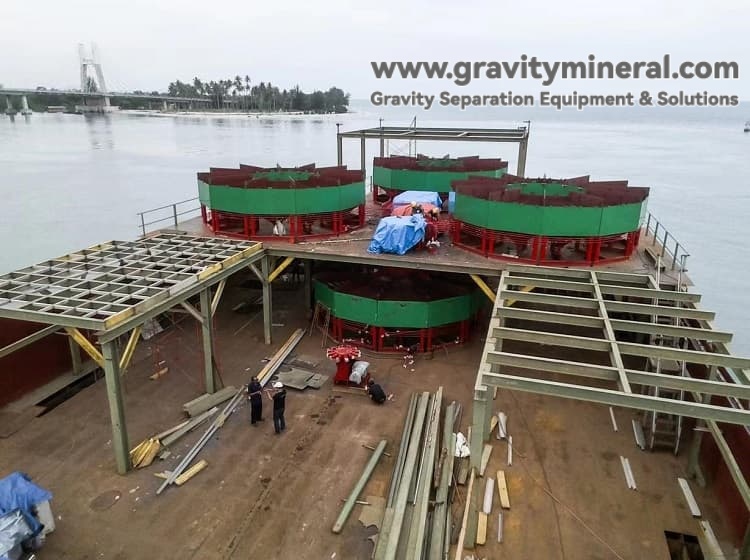
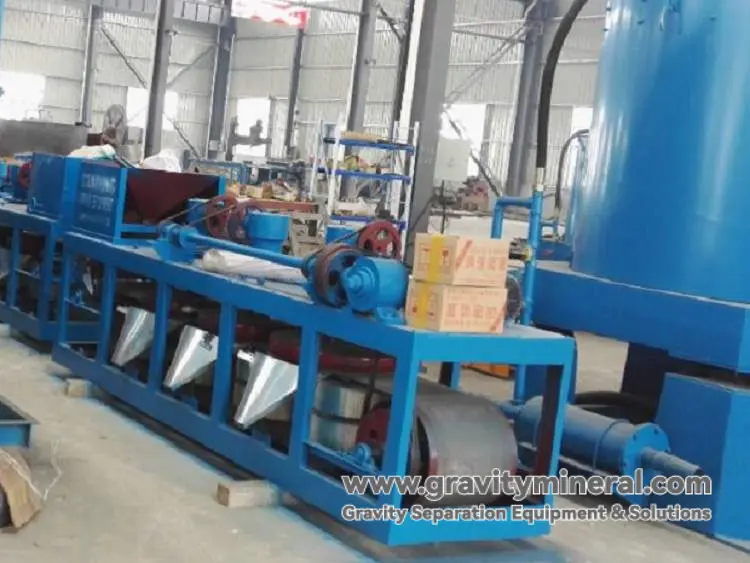
Because alluvial tin mining needs no crushing and no chemical reagents, equipment investment is low and the payback period is typically under 12 months. GravityMineral provides end-to-end technical support for your alluvial tin wash plant and, where a fixed plant is not practical, for a mobile cassiterite recovery unit:
- Consultation and process design: a flowsheet designed around your cassiterite size distribution and clay content, with optimum equipment specifications.
- Equipment manufacturing and supply: durable, modular alluvial tin mining equipment produced at GravityMineral's two in-house manufacturing bases.
- Installation, commissioning and training: engineers deployed worldwide to supervise installation, commission to the target recovery and train your operators — delivery is complete only when commissioning meets the targets.
- After-sales and optimisation: quality responsibility during the warranty period; after warranty, spare parts supply, technical consultation and process optimisation, with response within 24 hours.
Talk to the GravityMineral engineering team for a customised alluvial tin wash plant layout proposal and equipment quotation.