Linear Vibrating Screen (ZKB Series) | High-Precision Dry Powder and Granule Screening
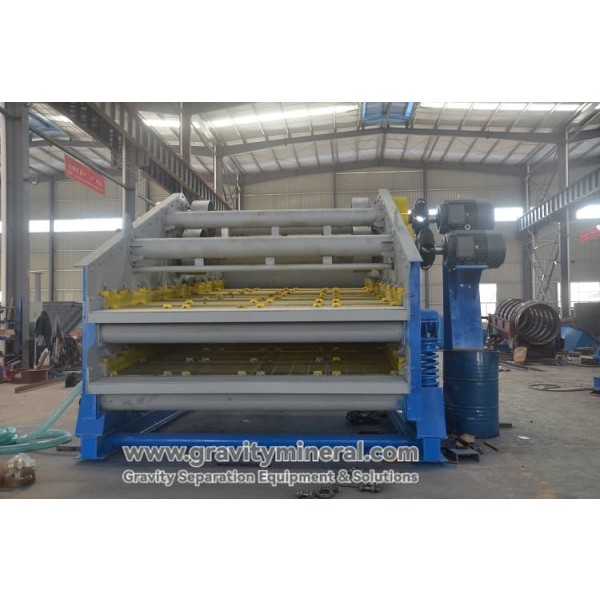
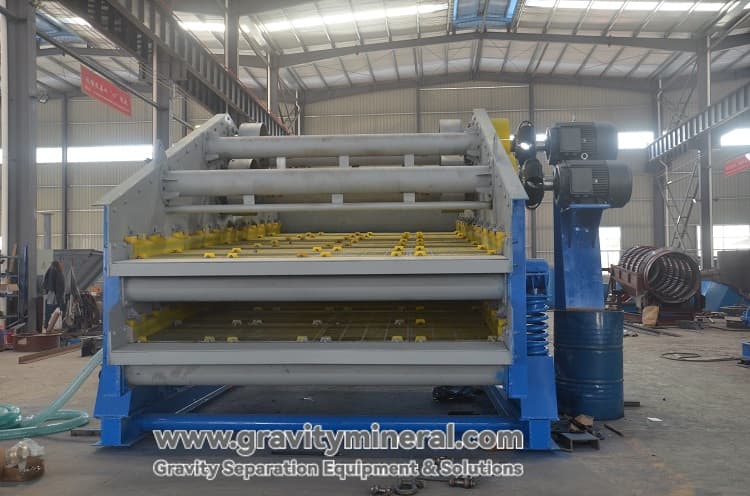
The linear vibrating screen (also called linear motion vibrating screen, horizontal vibrating screen or high-frequency linear vibrating screen) is a high-efficiency screening machine driven by two vibrating motors, designed for precise screening, classification and dewatering of fine to medium-grain powders and granular materials. Unlike inclined circular screens handling heavy rock, this machine uses a linear throwing motion to spread material evenly across the screen surface, making it especially good at handling dry powders in the 0.074 mm to 5 mm range without easily blinding the mesh.
A fully enclosed structure prevents dust leakage, with low energy consumption, high output, simple structure, easy maintenance and automatic discharge. It is widely used in mineral processing, coal washing, plastics, abrasives, chemicals and building materials, providing an environmentally friendly, low-noise, high-precision classification solution for fine-particle separation. In mineral processing lines, it often serves as the screening and classification node in flowsheets such as alluvial gold gravity separation plants and Ti-Zr placer gravity + magnetic/electric separation solutions.
How a Linear Vibrating Screen Works
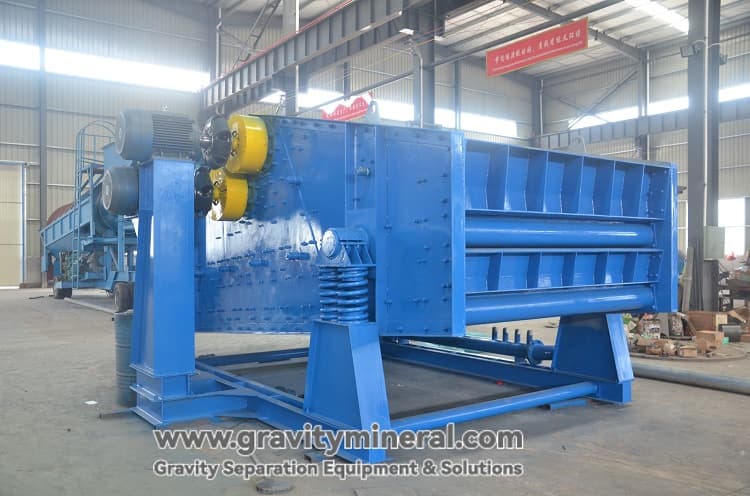
The ZKB series is driven by twin exciters. When the two exciters rotate synchronously in opposite directions, the exciting forces generated by their eccentric blocks cancel each other in the direction parallel to the motor axes and combine into one resultant force perpendicular to the axes, so the screen's motion trajectory is a straight line. The two motor axes are inclined relative to the screen surface; under the combined action of the exciting force and the material's own weight, material is thrown up and moves forward in a jumping linear motion along the screen, achieving screening and classification.
- Twin-motor drive: Two identical vibrating motors (or exciter shafts) are mounted horizontally and rotate synchronously in opposite directions.
- Linear excitation: The centrifugal forces from the eccentric blocks cancel in the parallel direction and add up in the perpendicular direction, forming a single strong linear driving force.
- Material motion: Driven by this force, material on the screen continuously makes linear jumping motions, being thrown upward and forward.
- Multi-stage classification: As material advances, particles smaller than the mesh openings fall to the lower screen decks while oversize continues to the discharge chute at the end. The machine can be configured with 1 to 4 screen decks, producing several sizes of oversize and undersize discharged from separate outlets; the finest screening can reach 400 mesh, separating up to 7 different particle sizes.
Technical Features
- High screening precision: The linear throwing motion spreads material evenly across the full screen width, maximizing screening area and achieving precise multi-stage classification.
- Environmentally friendly enclosed structure: A fully sealed cover completely blocks fine dust from escaping during dry powder screening, with no dust leakage and a clean, safe working environment.
- No weld deformation: The heavy screen box and crossbeams are joined with high-strength bolts (cold riveting) instead of welding, eliminating thermal stress and greatly reducing the risk of frame cracking under continuous vibration.
- Stable twin-motor drive: Equipped with two synchronous vibrating motors or block eccentric exciters connected by flexible tire couplings, ensuring smooth starting, low noise (<75 dB) and highly reliable operation.
- Easy maintenance and long life: Simple structure, long screen mesh life and convenient maintenance, suitable for automated operation in production lines.
- Low energy consumption: The high-frequency linear vibrating screen uses little energy and works efficiently, reducing running cost while maintaining throughput.
Applications and Complete-Line Integration
Thanks to its precision and enclosed design, the linear vibrating screen is widely used for screening dry powdered materials in chemicals, food, plastics, pharmaceuticals, metallurgy, glass, building materials, grain, fertilizer, abrasives and ceramics, and is also an indispensable screening and classification machine in mineral processing lines:
| Application |
Typical Materials |
Matching Process / Production Line |
| Alluvial gold and placer screening |
Placer gold, gravel, coarse sand |
Alluvial gold gravity separation plant solution |
| Coastal placer and Ti-Zr sand screening |
Ilmenite, zircon sand, rutile |
Coastal placer mineral processing plant solution, Ti-Zr placer gravity + magnetic/electric separation solution |
| Barite and tantalum-niobium screening |
Barite, tantalum-niobium ore, wolframite |
Barite gravity separation plant solution, Tantalum-niobium gravity-magnetic plant solution |
| Chromite and ilmenite screening |
Chromite, ilmenite, manganese ore |
Chromite gravity + magnetic separation solution, Ilmenite gravity + magnetic separation solution |
| Tailings and solid waste screening |
Legacy tailings, incinerator bottom ash (IBA) |
Bottom ash gravity sorting solution, heavy placer gravity + magnetic + electrostatic solution |
| Coal washing and aggregate screening |
Clean coal, quartz sand, dry aggregate powder |
Combined with a rotary scrubber to form a wash-and-screen line |
In a typical flowsheet, the linear vibrating screen often works together with gravity equipment such as a jig separator, spiral chute, 6-S shaking table and centrifugal concentrator, forming a “screening-gravity” combined process; in crushing and grinding circuits it can form closed-circuit screening with jaw crushers and ball mills.
ZKB Series Linear Vibrating Screen Technical Specifications
The following standard parameters are for reference. Actual capacity depends on material bulk density, moisture and required mesh size. Multi-deck configurations (1 to 4 decks) are available, with a vibration direction angle typically of 45°.
| Model |
Decks |
Mesh size (mm) |
Feed size (mm) |
Capacity (t/h) |
Double amplitude (mm) |
Vibration angle (°) |
Power (kW) |
| ZKB0936 |
1 |
5~25 |
<100 |
40 |
6~8 |
45 |
3×2 |
| 2ZKB1020 |
2 |
8~25 |
<100 |
60 |
6~8 |
45 |
3×2 |
| ZKB1025 |
1 |
8~25 |
<100 |
60 |
6~8 |
45 |
3×2 |
| ZKB1225 |
1 |
8~25 |
<100 |
80 |
6~8 |
45 |
3×2 |
| ZKB1236 |
1 |
10~25 |
<100 |
100 |
6~8 |
45 |
5.5×2 |
| 2ZKB1236 |
2 |
25~50 |
<100 |
150 |
6~8 |
45 |
5.5×2 |
| 2ZKB1437 |
2 |
25~50 |
<100 |
200 |
6~8 |
45 |
5.5×2 |
| ZKB1542 |
1 |
25~50 |
<100 |
200 |
6~8 |
45 |
5.5×2 |
| ZKB1756 |
1 |
25~50 |
<300 |
300 |
6~8 |
45 |
11×2 |
| 2ZKB1756 |
2 |
25~50 |
<300 |
400 |
6~8 |
45 |
11×2 |
| ZKB1836 |
1 |
25~50 |
<300 |
400 |
6~8 |
45 |
11×2 |
| 2ZKB1848 |
2 |
25~80 |
<300 |
600 |
6~8 |
45 |
11×2 |
| ZKB1856 |
1 |
25~80 |
<300 |
500 |
6~8 |
45 |
11×2 |
| 2ZKB1856 |
2 |
25~80 |
<300 |
600 |
6~8 |
45 |
15×2 |
| ZKB1863 |
1 |
25~80 |
<300 |
500 |
6~8 |
45 |
15×2 |
| 2ZKB2065 |
2 |
25~80 |
<300 |
1000 |
6~8 |
45 |
15×2 |
| ZKB2452 |
1 |
25~80 |
<300 |
800 |
6~8 |
45 |
15×2 |
| ZKB2460 |
1 |
25~80 |
<300 |
800 |
6~8 |
45 |
15×2 |
| 2ZKB3060 |
2 |
25~80 |
<300 |
1000 |
6~8 |
45 |
22×2 |
| ZKB3675 |
1 |
25~80 |
<300 |
1500 |
6~8 |
45 |
22×2 |
From a Single Linear Screen to Complete Screening Lines, No Outsourcing
The screening precision of a linear vibrating screen depends on how well amplitude, vibration frequency, mesh size and material moisture are matched. GravityMineral has focused on gravity separation and screening systems for 20 years, with equipment produced at our own two manufacturing bases and process and mechanical engineers working in one team——the linear screen's deck count, vibration direction angle and motor power are set from process data and share the same source as the complete-line design drawings, avoiding the problem of “screening equipment not matching the gravity/crushing circuit”.
- In-house manufacturing base: Core equipment is produced at GravityMineral's own two manufacturing bases, with full quality control from raw material purchasing through machining, assembly and no-load test running; every machine has strict inspection records before delivery.
- ISO9001 quality system: The company is ISO9001 certified, with products from an S-certified supplier and national high-tech enterprise qualifications.
- Complete-line interface matching: The linear vibrating screen's capacity is calculated together with jaw crushers, ball mills, jig separators and shaking tables to reduce blockages and tailings losses.
- Global delivery experience: Products have been exported to 50+ countries, with familiarity in logistics and customs clearance across Africa, Southeast Asia, South America, the Middle East, Central Asia, South Asia and Australia; a 500+ global case library provides references for screening equipment selection.
- Delivery and after-sales: Engineers attend site to guide installation and commissioning, lead single-machine and linked test runs and train customer personnel; 1-year warranty with long-term spare parts and process optimization support.
- Flexible cooperation models: Buy equipment only, request drawing design only, hire engineers for on-site commissioning only, or choose full-process EPC turnkey delivery, all to your schedule and budget.
Linear Vibrating Screen FAQ
Q1: How much does a linear vibrating screen cost? How is the price calculated?
Price depends on deck size (width×length), number of screen decks, motor power and whether it is dust sealed; the ZKB series spans widely from ZKB0936 to ZKB3675. Small single-deck machines cost less, large double-deck multi-motor units more; provide your material and capacity for an engineer's quotation.
Q2: What is the difference between a linear vibrating screen and a circular vibrating screen? How to choose?
For screening large, heavy, coarse rock (such as crushed granite from a jaw crusher), choose a circular vibrating screen; for fine powder below 5 mm, sand, or high precision and dust control, choose a linear vibrating screen. Decide by particle size and whether enclosed dust control is needed.
Q3: What capacity does a linear vibrating screen handle? How to select the model?
Capacity is about 40-1500 t/h (from about 40 t/h for the ZKB0936 to about 1500 t/h for the ZKB3675). Actual capacity depends on bulk density, moisture and mesh size; select by feed size and target capacity.
Q4: How many decks can a linear vibrating screen have? How many sizes can it separate?
It can be configured with 1 to 4 screen decks, with screening as fine as 400 mesh, separating up to 7 different particle sizes in one pass for efficient multi-stage classification.
Q5: How fine can a linear vibrating screen go? What if fine powder blocks the mesh?
It excels at screening 0.074 mm-5 mm dry powders, down to 400 mesh. The linear throwing motion spreads material evenly and moves it forward in jumps; with the right mesh and amplitude, blinding is reduced. For high-moisture material, dewater or dry first.
Q6: Is a linear vibrating screen noisy? Does dust leak?
With twin-motor synchronous drive plus flexible tire couplings, it runs smoothly with noise below 75 dB. The fully enclosed dust cover completely blocks fine powder from escaping, with no dust leakage, protecting worker health and meeting environmental requirements.
Q7: Can a linear vibrating screen handle wet or high-moisture material?
It is mainly for dry powdered materials. Sticky high-moisture material tends to blind the mesh and reduce efficiency; dewater, dry or use a wet-type screening machine instead. Consult engineers for selection based on material characteristics.
Q8: Can a linear vibrating screen be used in mineral processing and placer gold screening?
Yes. It often works with a jig separator, spiral chute and 6-S shaking table for screening and classification before gravity recovery of placer gold, placer tin and Ti-Zr sand; see the alluvial gold gravity separation plant solution.
Q9: How often are the screen mesh and motors maintained? Are they easy to replace?
The mesh and crossbeams use high-strength bolt cold riveting with no welding thermal stress, so the frame resists cracking and the mesh lasts long; regularly check mesh wear and bolt tightness, motor bearing lubrication and amplitude, and replace the mesh according to abrasiveness. Maintenance is convenient.
Q10: Can it be custom-built? How are lead time and after-sales guaranteed?
Deck size, layer count, mesh and dust-proof structure can be custom-built to your material and capacity. Standard equipment takes about 30-60 days to manufacture, longer for custom builds, with a delivery schedule in the contract; 1-year warranty plus long-term spare parts, technical consulting and process optimization, with on-site commissioning and training, and exports to 50+ countries.
Get a ZKB Linear Vibrating Screen Selection Plan and Quote
Tell us your material name, feed size, moisture, target throughput (t/h), required mesh size and number of screening decks; GravityMineral engineers will prepare a linear vibrating screen selection plan, a screening flowsheet and a transparent quotation.
You can reach us through the contact details on our website or talk directly to a sales engineer for selection advice; representative ore samples can be sent for screening tests.