Alluvial Chrome Sand Wash Plant – Gravity & Magnetic Separation Beneficiation Line: Chromite sand (placer chromite) is a strategically important mineral resource, widely used in ferrochrome smelting, refractories and the chemical industry. Because alluvial chromite deposits occur as naturally liberated sands, mining and processing completely avoid the costly crushing and grinding circuits required by hard-rock deposits.
GravityMineral’s alluvial chrome sand beneficiation line applies an optimised “washing + gravity separation + magnetic iron removal” combined flowsheet. High-capacity spiral concentrators and jigs reject barren silica sand at very low cost, after which precision magnetic separation upgrades the chromite. The result is a commercially valuable concentrate (Cr₂O₃ ≥ 45%) delivered with minimal initial investment and a short payback period.
What is Alluvial Chrome Sand (Placer Chromite)?
Alluvial chrome sand — also called placer chromite or beach sand chromite — forms when primary chromite deposits are weathered, transported by water and redeposited over long periods, accumulating on river bars, terraces and coastal beaches. Natural hydraulic sorting has already liberated chromite from its gangue and left the grains clean, so the expensive crushing and grinding required for primary hard-rock ore are entirely unnecessary.
The core difficulty in alluvial chrome sand beneficiation is that chromite is commonly associated with high-density magnetic minerals such as magnetite and ilmenite. Gravity separation alone cannot separate chromite from these iron-bearing impurities, and the chrome-to-iron ratio (Cr/Fe) then fails to meet smelter specifications. GravityMineral’s standard placer chromite gravity beneficiation flowsheet therefore combines “washing & screening – gravity roughing and tailings rejection – magnetic upgrading”, recovering the high-value chromite while guaranteeing the final Cr/Fe ratio.
20 YearsSpecialised in gravity separation equipment manufacturing
50+ CountriesChrome sand beneficiation lines exported and commissioned
500+ ProjectsGlobal gravity separation project experience database
35%China gravity separation equipment market share
Three-Stage Chrome Sand Extraction Flowsheet
GravityMineral’s engineering design relies on zero-energy gravity equipment for bulk throughput, followed by magnetic upgrading to meet strict metallurgical Cr/Fe requirements.
Stage 1: Pre-treatment & Desliming
Raw river sand or beach sand is fed uniformly from the hopper into the washing circuit, preparing the feed for gravity separation.
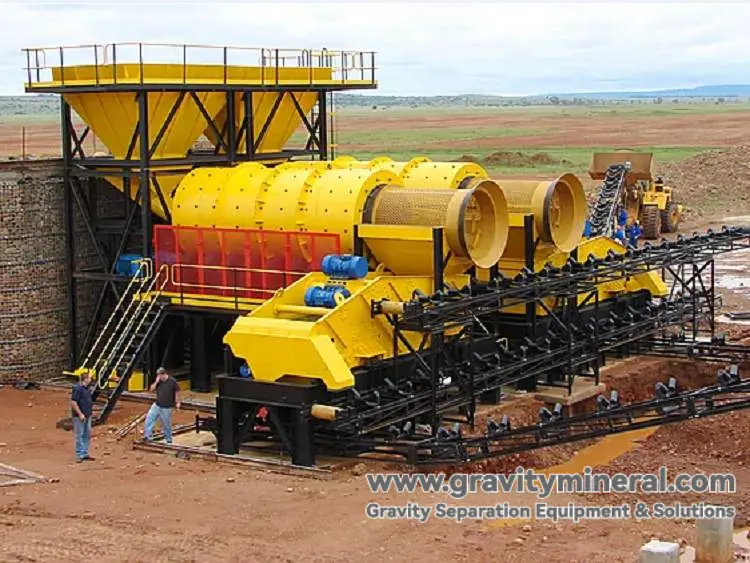
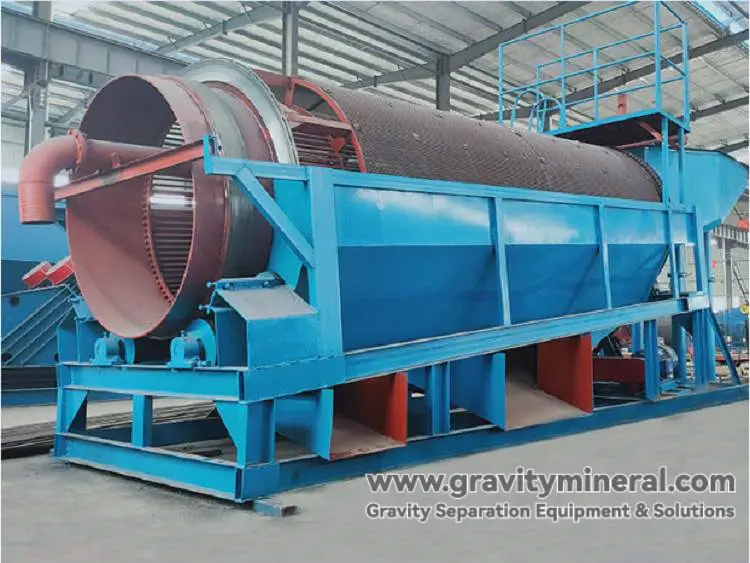
- Rotary scrubber: for sticky sand, a rotary scrubber performs intensive primary scrubbing to break up clay lumps.
- Trommel screen: a heavy-duty trommel screen carries out precise size classification, scalping oversize gravel, roots and trash.
Stage 2: Gravity Roughing (High-Capacity Concentration)
The classified sand is then fed to gravity separators selected for the target particle size (0.1 – 5 mm):
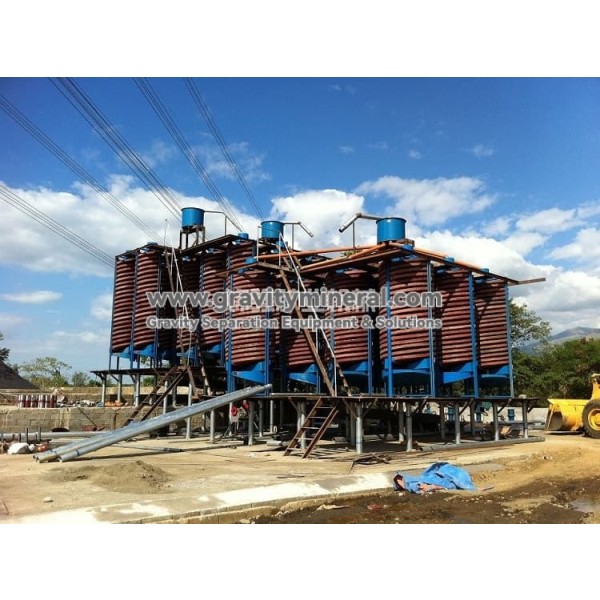
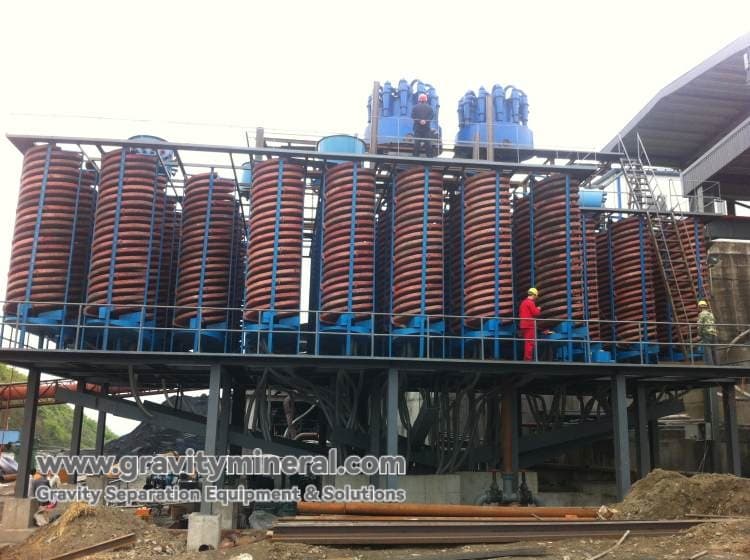
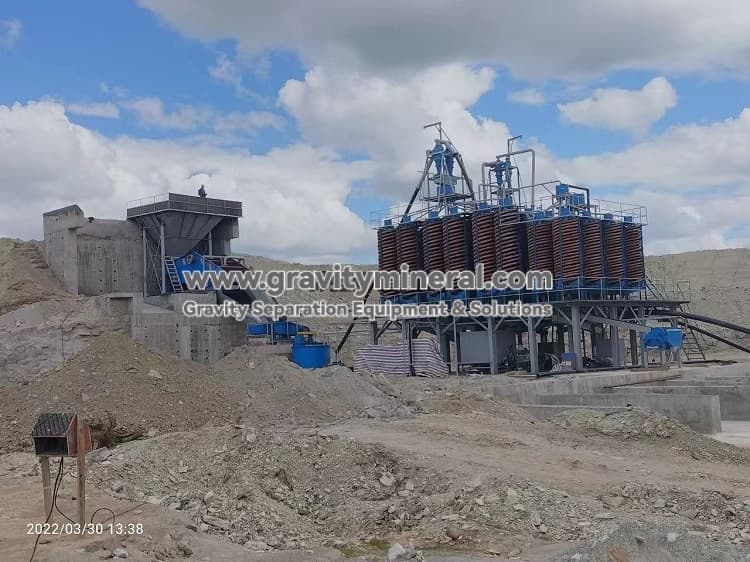
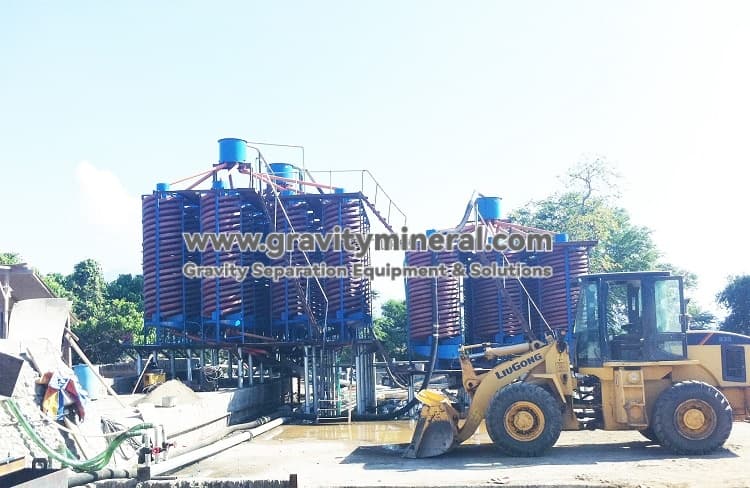
- Fine fraction (−0.5 mm): fed to an array of fiberglass spiral concentrators. Working as large roughing and scavenging units, the spirals instantly discharge light quartz sand and concentrate the heavy black chromite sand.
- Coarse fraction (+0.5 mm): where present, fed to sawtooth wave jigs for efficient recovery of coarse chromite.
Stage 3: Magnetic Separation (Iron Removal)
Gravity separation recovers the heavy minerals, but it also recovers heavy magnetic iron minerals such as magnetite, which degrade chrome concentrate value.
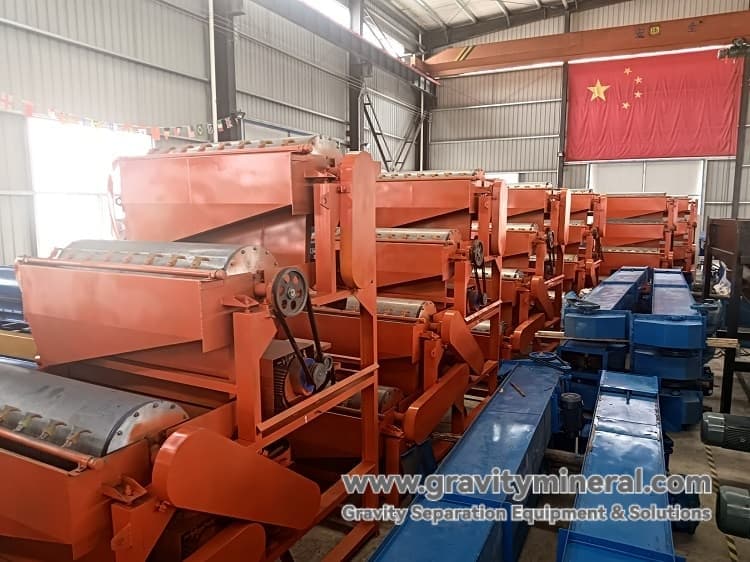
- Magnetic separation: the gravity concentrate passes over a permanent-magnet multi-roll magnetic separator.
- Purification: by adjusting the field strength (1,500 – 7,000 Gauss) the separator strips iron-bearing impurities, deeply purifying the chromite and lifting the critical chrome-to-iron ratio (Cr/Fe).
Optional circuit extension: for highly complex associated ores, a 6-S shaking table can be added for further mechanical cleaning of the concentrate, or a directional flotation circuit introduced.
Core Equipment Selection for the Chrome Sand Beneficiation Line
The technical barriers in chrome sand beneficiation are high-volume concentration in the gravity stage and precise iron removal in the magnetic stage. The table below lists the standard core equipment and duty stages of an alluvial chrome sand beneficiation line.
| Circuit Stage |
Main Equipment |
Function & Features |
| Pre-treatment & washing |
Trommel scrubber and trommel screen |
Combines scrubbing with screening to disintegrate clay and remove gravel. |
| Gravity roughing |
Fiberglass spiral concentrator (roughing & scavenging) |
No drive power required. Rapid silica rejection to upgrade chromite. |
| Coarse gravity separation |
Sawtooth wave jig |
High throughput; recovers coarse chromite grains above +0.5 mm. |
| Gravity cleaning (optional) |
6-S shaking table |
High separation precision for deep mechanical cleaning of the concentrate. |
| Magnetic separation |
Permanent-magnet multi-roll magnetic separator |
Adjustable field strength (1,500 – 7,000 Gauss) for iron impurity removal. |
Target Technical & Economic Indicators
Technical Targets
- Plant throughput: up to 20 – 500 t/h per line (expandable to 10,000 t/day).
- Target concentrate grade: Cr₂O₃ ≥ 45% (commercial metallurgical grade).
- Lower operating cost: physical separation eliminates grinding costs, cutting OPEX by 30 – 40% versus hard-rock processing.
- Return on investment (ROI): short payback period thanks to low CAPEX and OPEX.
System Advantages
- No grinding stage: the sand is naturally liberated, so costly ball mills are eliminated and initial investment drops sharply.
- Lump and coarse-grain protection: coarse chromite is recovered at low cost during gravity separation, avoiding over-crushing.
- Green production: 100% physical separation. No reagents are used and wash water can be safely recycled.
Why Choose GravityMineral for Your Alluvial Chrome Sand Wash Plant
Chrome sand projects typically suffer from fluctuating mineralogy, excess iron impurities and rapid equipment corrosion. The minerals industry is not short of equipment — what it lacks is a partner that understands both gravity concentration and magnetic iron removal and can make the whole flowsheet work as one system.
| Common Challenge |
The GravityMineral Solution |
| Excess iron impurities; Cr/Fe ratio below specification |
A permanent-magnet multi-roll separator is installed after gravity separation to strip magnetic iron minerals and guarantee the Cr/Fe ratio. |
| Rapid corrosion in high-salt, high-humidity beach environments |
Spiral chutes use a fibreglass body with corundum lining, and washing and conveying equipment can be anti-corrosion coated for harsh duty. |
| Design institute and equipment supplier work in isolation; interfaces do not match |
Equipment manufacturing, flowsheet design and on-site commissioning sit with one team, so interfaces never clash. |
- 20 years focused on gravity separation: two decades of spiral chutes, jigs and shaking tables mean we can draw on proven experience to match equipment to ore type and flowsheet to particle size.
- Full gravity + magnetic circuit coverage: GravityMineral supplies not only gravity roughing and concentration but also deep impurity-removal equipment such as permanent-magnet multi-roll separators.
- 50+ countries, 500+ projects worldwide: real sites from African chrome sand operations to Southeast Asian beach sand deposits are the best test of equipment reliability and adaptability.
- Six official certifications: ISO 9001, S-certified supplier, National High-Tech Enterprise, Jiangxi “Specialised, Refined, Distinctive and Innovative” SME, “Contract-Keeping & Credit AA-Grade Enterprise”, and “Top Taxpayer”.
Alluvial Chrome Sand Wash Plant Price & Investment Reference
There is no single quotation for a chrome sand beneficiation plant — for two lines of identical throughput, run-of-mine grade, mineral association and site conditions can drive completely different equipment sets and capital costs. GravityMineral does not quote “paper prices” detached from your ore; instead we work out the total cost with you along the following cost structure:
- Equipment investment: washing and screening (scrubber / trommel screen), gravity circuit (spiral chutes / jigs), magnetic circuit (multi-roll separators) and dewatering. Modular design allows staged investment in line with your budget.
- Free process design: flowsheet design, equipment selection and plant layout are produced by GravityMineral’s in-house design team — no external design institute required.
- Civil works and installation labour: civil contractors and general installation labour are organised locally by the customer, with GravityMineral engineers on site providing technical supervision.
- Operating cost (OPEX): the gravity circuit uses no reagents and no chemicals, so the combined gravity-magnetic flowsheet sharply reduces operating cost compared with hard-rock grinding; power, water and wear parts are the main expenditures.
- Delivery and cash-flow rhythm: core standard equipment is manufactured in about 40 – 60 days; a full EPC turnkey project typically takes 7 – 12 months from contract effectiveness to on-spec production.
Tell GravityMineral your ore type, run-of-mine grade, target throughput (t/h), feed size and site conditions, and our engineers will draw on the 500+ project database to issue a transparent equipment list and quotation.
From Process Design to On-Spec Production: The GravityMineral Service Route
GravityMineral does more than sell equipment: we provide full-cycle service covering mineral analysis, flowsheet design, equipment manufacturing through to on-site installation and commissioning. Chrome sand projects typically progress along the following milestones:
- Requirements review (3 – 7 days): you provide ore type, run-of-mine grade, target throughput, feed size and site conditions; GravityMineral returns an initial solution direction. This stage is free of charge.
- Process design and selection quotation (7 – 15 days): engineers combine the orebody conditions with the 500+ project database to fix the gravity-magnetic route, then issue the equipment selection package with the quotation at the same time.
- Engineering drawings (7 – 15 days): flowsheet, equipment list, plant layout and civil interface drawings, all prepared in-house — design is never subcontracted.
- Equipment manufacturing (40 – 60 days): scheduled across our two manufacturing bases, with full quality control from raw material to factory test run.
- Shipment and logistics (30 – 60 days) + on-site installation and commissioning (60 – 150 days): engineers supervise installation, individual and linked test runs and operator training; handover is complete only when the plant meets its targets.
A standard mineral processing EPC turnkey project normally takes 7 – 12 months from contract effectiveness to on-spec production. For more detail, see our delivery timeline estimator.
Other Gravity & Magnetic Combined Process Solutions
The core of alluvial chrome sand separation is “gravity concentration + magnetic iron removal”. If your ore also involves a complex heavy mineral association, the following solutions may be worth reviewing:
Frequently Asked Questions about Chrome Sand Processing (FAQ)
Q1: Why does chrome sand processing need a magnetic separator?
A: Gravity separation (spiral chutes and jigs) is excellent at rejecting light silica sand, but it concentrates every heavy black grain together. In alluvial deposits chromite is almost always mixed with heavy iron minerals such as magnetite. Since smelters require a high chrome-to-iron ratio (Cr/Fe), the heavy sand must be passed through a magnetic separator to remove the iron, leaving purified chromite behind.
Q2: Does this process require chemical reagents?
A: No. One of the main economic advantages of alluvial chromite is that it relies entirely on physical beneficiation. Spiral chutes and jigs use only water (with a recycling rate of up to 90%), while the magnetic separators use permanent magnets. That means zero chemical contamination, a simpler environmental permitting process and very low operating costs.
Q3: Roughly what does a complete alluvial chrome sand wash plant cost?
A: The actual cost depends on your throughput (t/h), run-of-mine grade and target concentrate specification. Once GravityMineral understands your ore conditions, we issue a transparent equipment list and quotation covering the trommel screen, spiral concentrators, jigs and magnetic separators.
Q4: If the feed clay content is high, will it affect gravity separation?
A: Yes. High clay content seriously disturbs gravity separation. GravityMineral installs a trommel scrubber or rotary scrubbing screen at the front of the circuit to wash and deslime the feed first. Only washed slurry enters the spiral chutes and jigs, so fine slime cannot coat the chromite grains and carry them into the tailings.
Q5: How is the fine slime in the tailings handled? Will it pollute the environment?
A: No. GravityMineral places a thickener and a filter press at the end of the circuit. Clay-bearing tailings water is thickened and settled, the slurry is pressure-filtered into filter cake for dry stacking, and the clear water is returned for reuse. This delivers “zero discharge” while saving a substantial amount of water.
Q6: Can you supply a single spiral chute? What if we want to expand capacity later?
A: Yes, single units are available. GravityMineral supports modular procurement: you can start with a washing plus spiral chute unit and add the magnetic and dewatering stages later as funds allow. Because the initial design reserves the connection interfaces, expansion never means starting over — you simply scale up the equipment proportionally.
Q7: Our run-of-mine grade fluctuates a lot — can your flowsheet adapt?
A: Yes. Our process design accounts for the expected ore variability and provides operating tolerance. In the gravity circuit, the throughput, stroke and slope of the spiral chutes and jigs can all be adjusted to the run-of-mine grade. Where fluctuation exceeds the normal range, our engineers set the operating parameters for each duty case during on-site commissioning.
Q8: For projects in Africa or Southeast Asia, can you send people to site for installation?
A: Yes. GravityMineral products and services have been exported to more than 50 countries. We station engineers on site to supervise equipment setting, individual and linked test runs and recovery optimisation, and to train your local operating team until the plant runs smoothly and meets specification.
EPC Turnkey: End-to-End Alluvial Chrome Sand Engineering Service
GravityMineral delivers end-to-end technical support for alluvial chrome sand projects worldwide. Our offering covers everything from small mobile washing units to large fixed beneficiation lines.
- Process design: flowsheet configuration tailored to your mineral proportions and production scale.
- Manufacturing and supply: GravityMineral manufactures and supplies the complete set of heavy washing equipment, spiral concentrators and magnetic separators.
- Installation and training: field engineers deployed worldwide to supervise installation, optimise recovery and train your operators.
- After-sales and optimisation: quality responsibility through the warranty period, then spare parts, technical consulting and process optimisation, with response within 24 hours.
Talk to the GravityMineral engineering team to unlock the full value of your chrome resource and receive a customised plant layout and equipment quotation.