Chromite Gravity Concentration Plant Solution (Gravity + Magnetic): Chromite (FeCr₂O₄) is a critical strategic mineral characterized by its high specific gravity and weak magnetism. To meet metallurgical-grade commercial specifications — typically Cr₂O₃ grade >45% and a chromium-to-iron ratio (Cr/Fe) >2.5 — a single separation method alone is rarely sufficient.
GravityMineral’s chromite gravity concentration line uses a highly optimized “gravity-led + magnetic-upgrade” combined flowsheet. Through multi-stage separation, GravityMineral recovers premium lumpy chromite early in the circuit with a sawtooth-wave jig, then routes the finer material through grinding, spiral-chute gravity concentration and a magnetic purification loop. This delivers high recovery, deep removal of iron impurities and a fast return on investment.
What Is Chromite?
Chromite is the principal ore mineral for producing metallic chromium and ferrochrome alloys, and is widely used in stainless steel, refractories and the chemical industry. It belongs to the spinel group of minerals, has a high density (4.0–4.8 g/cm³) and is weakly magnetic. It commonly occurs together with silicate gangue (such as olivine and serpentine) and with magnetite.
Because of the clear density contrast, gravity concentration is the most economical and core primary method for chromite recovery. However, gravity separation alone cannot remove dense magnetic iron minerals, which leaves the chromium-to-iron ratio (Cr/Fe) short of specification. GravityMineral’s standard chromite gravity concentration flowsheet therefore adopts a combined “gravity roughing and tailings rejection + magnetic iron removal and upgrading” circuit — recovering high-premium lumpy chromite while ensuring the final concentrate reaches a Cr/Fe ratio ≥ 2.5.
20 YearsFocused on gravity concentration equipment manufacturing
50+ CountriesChromite gravity lines exported and commissioned
500+ ProjectsGlobal gravity concentration project experience base
35%Share of the Chinese gravity concentration equipment market
Four-Stage Chromite Gravity Concentration Flowsheet
Given the significant price premium of coarse “lumpy chromite” in international markets, GravityMineral’s flowsheet is rigorously designed to avoid over-crushing.
Stage 1: Crushing and Closed-Circuit Screening
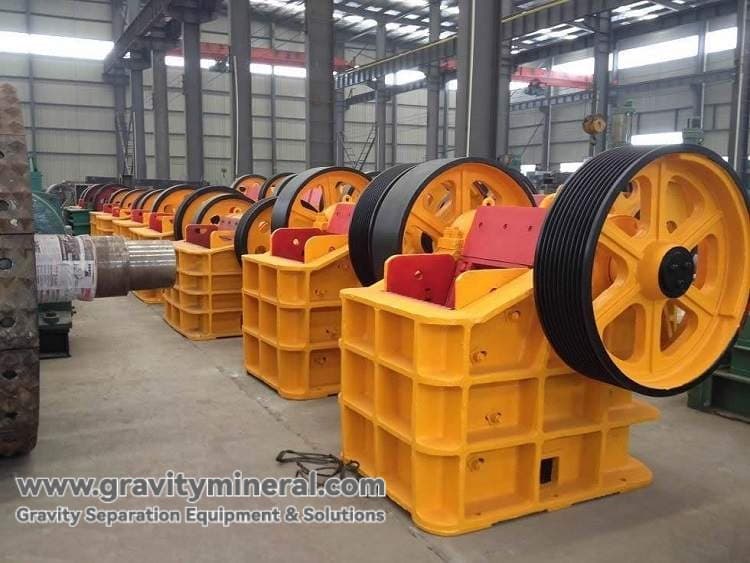
Run-of-mine ore is primarily crushed in a jaw crusher, then fed to a circular vibrating screen that splits the feed into two separate streams: >5 mm and <5 mm. Oversize rock is finely reduced on a double-roll (toothed-roll) crusher — a step that minimizes dust generation and prevents over-grinding — and returned to the screening stage to form a closed circuit.
Stage 2: Lumpy Chromite Gravity Recovery (Coarse-Gravity)
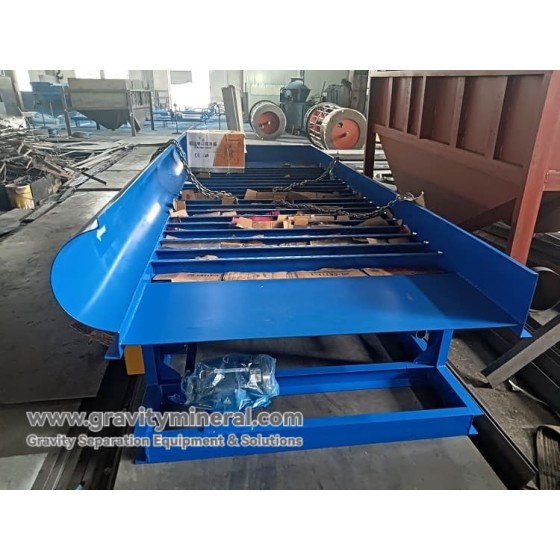
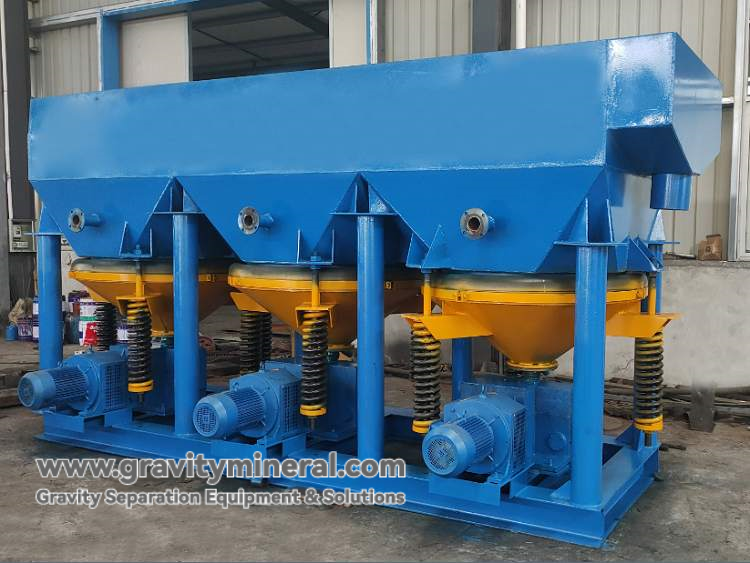
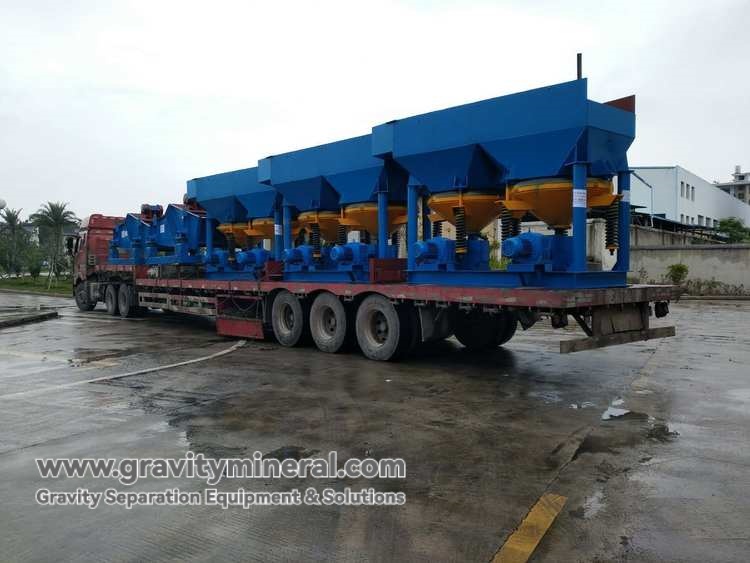
The +5 mm size fraction is highly valuable. This fraction needs no grinding and is fed directly to a sawtooth-wave jig for gravity concentration. Through its pulsating water action, the jig instantly and effectively recovers coarse lumpy chromite concentrate, maximizing your commercial return.
Stage 3: Fine Chromite Grinding and Gravity Capture (Fine-Gravity)
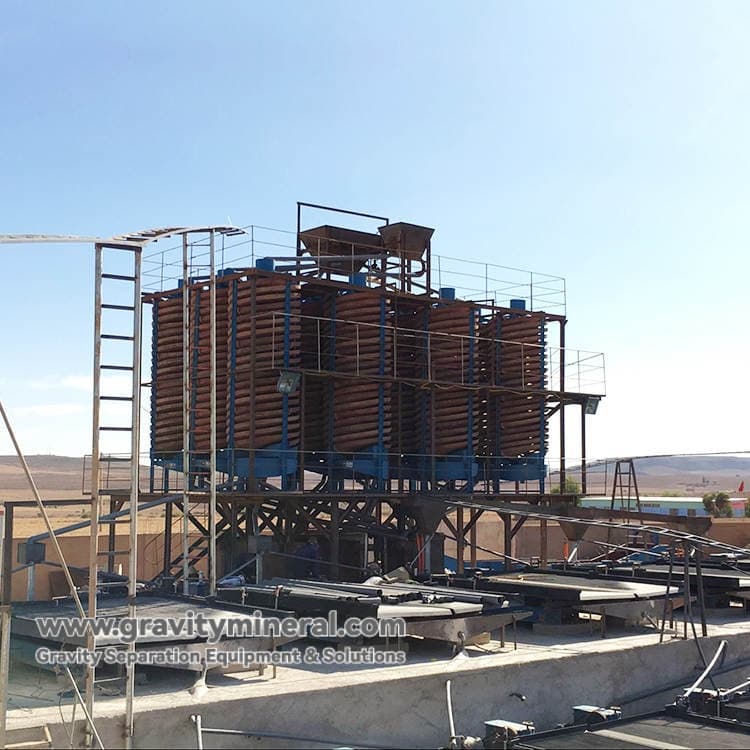
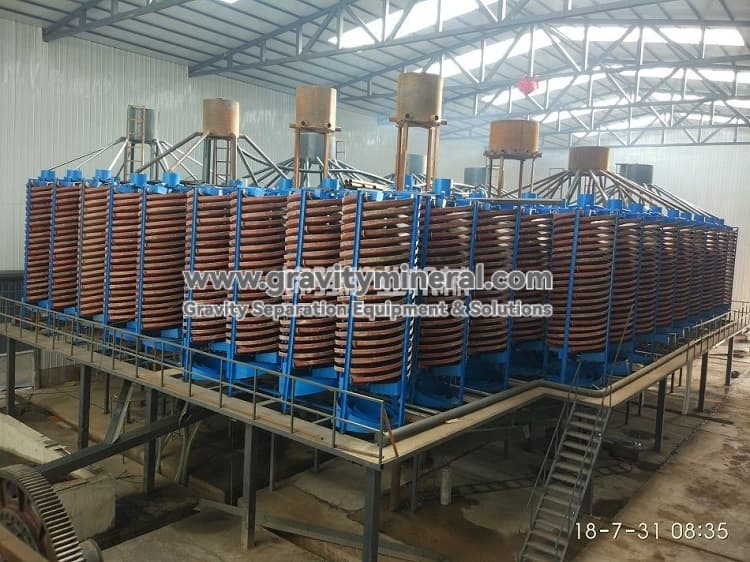
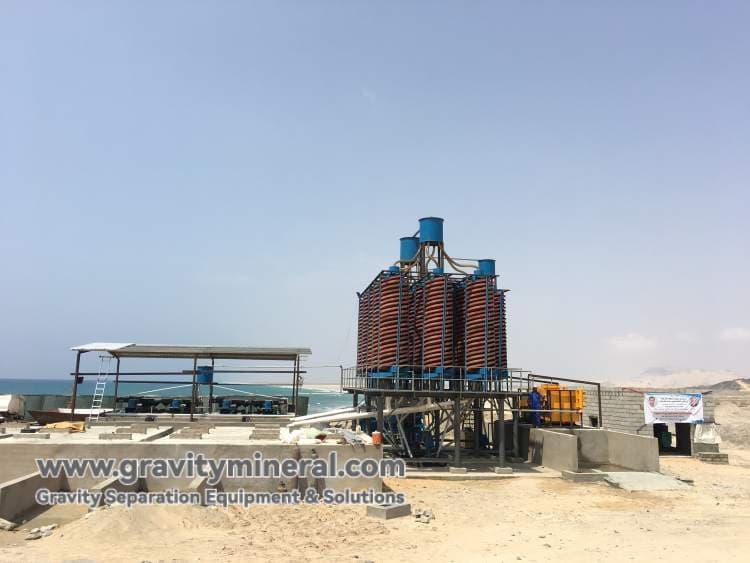
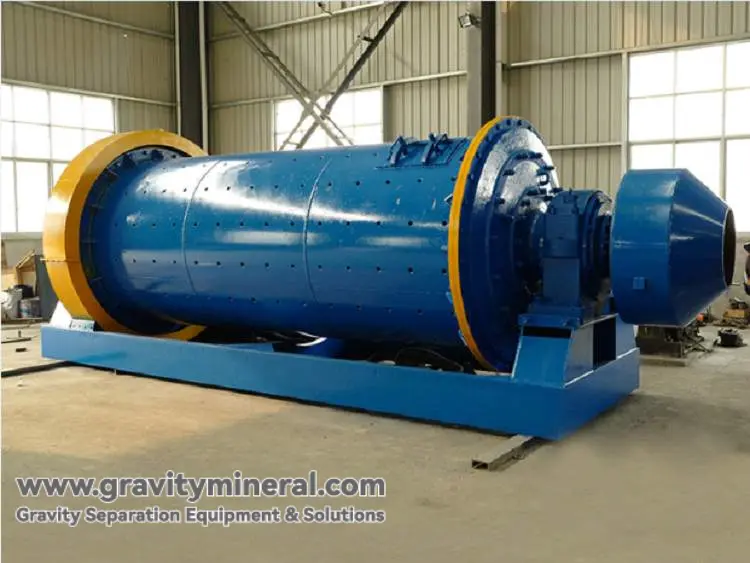
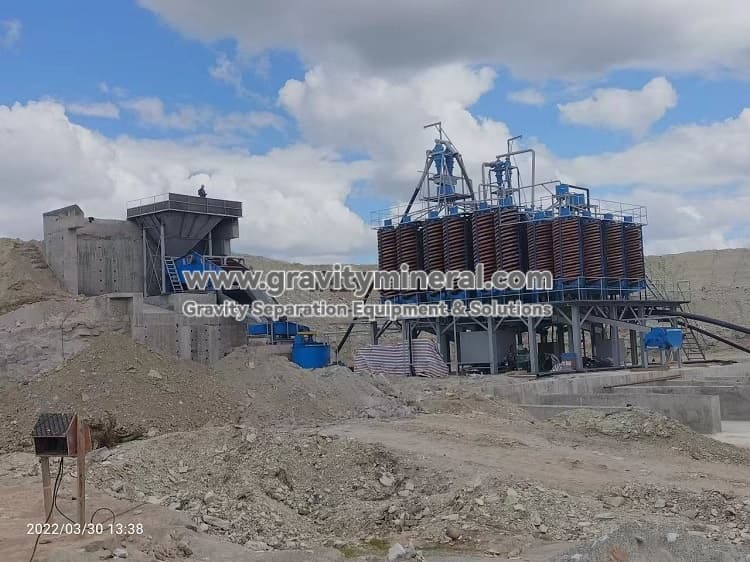
The -5 mm fraction goes to a ball mill operating in closed circuit with a high-frequency screen. Ground to -2 mm, the material is fed to an array of fiberglass spiral chutes. As high-capacity gravity roughing units, the spiral chutes use centrifugal and gravitational forces to separate fine dense chromite from lighter silica and gangue.
Stage 4: Magnetic Upgrading (Improving the Cr/Fe Ratio)
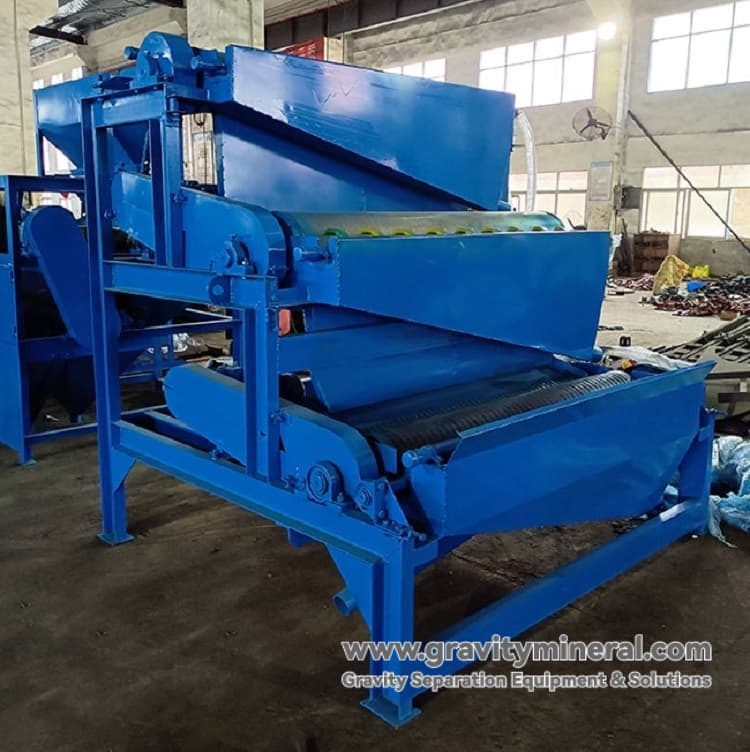
Gravity concentration recovers chromite but also recovers dense magnetic iron minerals, which lowers the commercial value of the product. The gravity concentrate is processed on a medium-intensity magnetic separator. This dedicated machine strips out residual iron impurities, deeply purifies the chromite and markedly raises the final chromium-to-iron ratio (Cr/Fe).
Core Equipment Configuration and Selection for the Chromite Gravity Line
The technical hurdle in chromite gravity concentration lies in controlling the crushing size (to protect the lumps) and in the precise coordination of the gravity stages, with magnetic separation serving only as an iron-removal safeguard. The table below lists the typical core equipment and duty stages of a chromite gravity concentration line.
| Process Stage |
Main Equipment |
Function and Features |
| Crushing |
Jaw crusher, double-roll crusher |
Two-stage closed-circuit crushing. The double-roll crusher prevents excessive dust. |
| Grinding and Classification |
Ball mill, high-frequency screen |
Liberates fine chromite crystals while strictly controlling the particle size. |
| Gravity Concentration |
Sawtooth-wave jig, fiberglass spiral chute |
The jig recovers premium lumpy chromite; the spiral chutes handle bulk recovery of the fine sand. |
| Magnetic Upgrading |
Medium-intensity magnetic separator |
Deep purification. Removes magnetic iron minerals and raises the Cr/Fe ratio. |
| Auxiliary Equipment |
Belt conveyor, slurry pump |
Ensures process consistency and stability, and automated material handling. |
Plant Technical and Economic Indicators
Target Technical Indicators
- Throughput: 15 to 100 t/h (fully customizable to the mine life).
- Feed grade: Designed to process low-to-medium-grade ore (Cr₂O₃ 25%–35%).
- Final concentrate grade: Cr₂O₃ ≥ 45%.
- Chromium-to-iron ratio: Cr/Fe ≥ 2.5 (metallurgical grade).
System Advantages
- High recovery: Compared with a single-method circuit, the combined gravity-magnetic loop raises overall recovery by 3% to 5%.
- Lump protection: A “more crushing, less grinding” gravity flowsheet recovers high-premium lumpy chromite early.
- Green operation: Gravity concentration uses no reagents, with a high water-recirculation rate, meeting modern environmental requirements.
Why Build Your Chromite Gravity Plant with GravityMineral
Chromite projects typically face highly variable mineralogy, easy over-crushing of the lumps, and excess iron impurities. The mineral processing industry is not short of equipment — what it lacks is a partner who understands both gravity upgrading and magnetic iron removal and can make the flowsheet work as one.
| Common Challenge |
The GravityMineral Solution |
| High-premium lumpy chromite is over-crushed |
Two-stage closed-circuit crushing plus double-roll crushing; the +5 mm fraction is screened out and sent straight to the jig for gravity recovery, with no grinding. |
| Excess iron, Cr/Fe ratio below spec |
A medium-intensity magnetic separator is installed after gravity concentration to deeply remove magnetic iron and ensure Cr/Fe ≥ 2.5. |
| Design institute and equipment maker disconnected, interfaces mismatched |
Equipment manufacturing, flowsheet design and on-site commissioning are closed-loop within one team, so interfaces never conflict. |
- 20 years focused on gravity concentration: We have built spiral chutes and jigs for 20 years, with a track record of matching equipment and flowsheets to ore type and size by the book.
- End-to-end gravity/magnetic coverage: GravityMineral supplies not only gravity roughing and upgrading but also deep-removal equipment such as medium-intensity magnetic separators.
- 50+ countries, 500+ global projects: Real sites such as African chromite and South American chrome-sand operations are the best proving ground for equipment reliability and adaptability.
- Six official credentials: ISO9001, S-certified supplier, National High-Tech Enterprise, Jiangxi “Specialized, Refined, Distinctive and Innovative” SME, “Contract-Abiding, Reputation-AA Enterprise” and “Top Taxpayer.”
Chromite Gravity Line Price and Investment Reference
There is no one-size-fits-all quote for a chromite processing plant — for two lines of the same throughput, the feed grade, degree of liberation and site conditions can differ vastly, so the equipment configuration and cost vary enormously. GravityMineral does not quote “phantom prices” detached from the orebody; instead we work out your total cost of ownership against the cost structure below:
- Equipment investment: Crushing and screening stage (jaw crusher / double-roll crusher / circular vibrating screen), gravity stage (jig / spiral chutes), magnetic stage (medium-intensity magnetic separator) and dewatering stage. Modular design allows phased investment to suit your budget.
- Free process design: Flowsheet design, equipment selection and layout, and plant-general-arrangement drawings are produced in-house by the GravityMineral design team — no need to hire a separate design institute.
- Civil works and installation labor: Civil construction and general installation labor are organized locally by the customer, with GravityMineral engineers on site providing technical supervision.
- Operating cost (OPEX): Gravity concentration uses no reagents or chemicals; compared with a full flotation flowsheet, the combined gravity-magnetic circuit cuts operating cost substantially, with power, water and wear parts the main outlays.
- Lead time and cash-flow cadence: Core standard equipment takes about 40–60 days to manufacture; a full EPC turnkey project typically runs 7–12 months from contract effective date to on-spec production.
Tell GravityMineral the ore type, feed grade, target throughput (t/h), feed size and site conditions, and our engineers will draw on the 500+ global project base to issue a transparent equipment list and quotation.
From Process Design to On-Spec Production: The GravityMineral Service Flow
GravityMineral does not just sell equipment; we provide full-lifecycle service from mineral analysis and flowsheet design through equipment manufacturing to on-site installation and commissioning. A chromite gravity project advances through the following milestones:
- Requirements discussion (3–7 days): Provide the ore type, feed grade, target throughput, feed size and site conditions; GravityMineral gives an initial solution direction at no charge in this stage.
- Process design and selection quotation (7–15 days): Engineers combine the orebody conditions with the 500+ global project base to fix the gravity-magnetic combined route, then issue the equipment selection plan with the selection and quotation delivered together.
- Engineering drawings (15–30 days): Flowsheet diagram, equipment list, plant-general-arrangement and civil-condition drawings are completed in-house by our own design team — design is never outsourced.
- Equipment manufacturing (40–60 days): Scheduled across our two manufacturing bases, with quality control from raw material to factory test run.
- Shipping and logistics (30–60 days) + on-site installation and commissioning (60–150 days): Engineers on site supervise installation, single-machine and interlocked test runs and personnel training; delivery is complete only once commissioning meets spec.
A standard mineral-processing EPC turnkey project typically takes 7–12 months from contract effective date to on-spec production. For more detail, see Estimating the delivery timeline of a mineral processing project.
Related Gravity Concentration Solutions
Beyond chromite, GravityMineral’s gravity concentration solution library covers the mainstream hard-rock and placer ores, so we can match relevant historical experience to your scenario:
Frequently Asked Questions About Chromite Processing
Q1: Why is recovering “lumpy chromite” so important?
A: Smelters prefer coarse chromite (typically 5–50 mm) for ferrochrome production, because fine dust is easily blown out of the furnace. Lumpy chromite always commands a price well above fine concentrate. GravityMineral’s flowsheet uses a jig to extract this +5 mm material immediately, before a ball mill would grind it away.
Q2: Why add magnetic separation when gravity is the main method?
A: Gravity concentration (jigs and spiral chutes) is the most economical, efficient way to reject light gangue (such as silica) and recover the bulk of the heavy mineral. However, iron-rich heavy minerals tend to settle alongside chromite. Since chromite is weakly magnetic while iron is strongly magnetic, sending the gravity concentrate to a magnetic separator fully separates the iron — solving the biggest challenge in chrome mining: achieving a Cr/Fe ratio above 2.5.
Q3: Roughly how much does a complete chromite gravity plant cost?
A: The actual cost depends on your throughput (t/h), feed grade and target concentrate specification. Once we understand your ore, GravityMineral issues a transparent equipment list and quotation covering the jaw crusher, double-roll crusher, jig, spiral chutes and medium-intensity magnetic separator.
Q4: If the run-of-mine ore is very clayey, will it affect gravity concentration?
A: Yes. High clay content severely disrupts gravity concentration. GravityMineral installs a rotary scrubber or trommel screen at the front of the circuit to scrub and deslime first. Only the washed slurry is fed to the jigs and spiral chutes, preventing fine slime from coating the chromite and causing losses.
Q5: How is the fine slime in the tailings handled? Will it pollute the environment?
A: No. GravityMineral installs a thickener and a filter press at the end of the circuit. Clayey tailings water is thickened and settled, the underflow is pressed into filter cake for dry stacking, and the clarified water is returned to the ball mill for recirculation. This achieves “zero discharge” while saving a large amount of water.
Q6: Can you supply a single jig? What if I want to expand later?
A: Yes, single units are available. GravityMineral supports “modular” procurement: you can start with a crushing + jig package and later add the spiral-chute and magnetic stages when capital allows. Because the initial design reserves the interfaces, expansion needs no redesign — just add equipment proportionally.
Q7: The feed grade fluctuates a lot — can your flowsheet adapt?
A: Yes. We account for the ore-variability range and operating tolerance in the process design. Throughput, stroke and slope of the gravity stages (jigs and spiral chutes) can all be adjusted to the feed grade. If variability exceeds the normal range, our engineers set the operating parameters for each condition during on-site commissioning.
Q8: For projects in Africa / Southeast Asia, can you send people to install on site?
A: Yes. GravityMineral products and services have been exported to 50+ countries. We dispatch resident engineers to supervise equipment setting, single-machine and interlocked test runs and recovery commissioning, and to train your local operating team until the line runs smoothly and meets spec.
Global Chromite Project Installation Cases

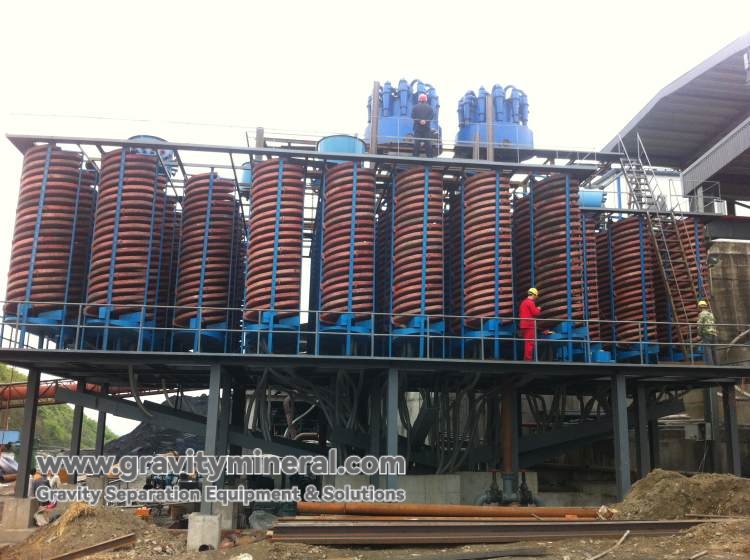
EPC Turnkey: End-to-End Chrome Gravity Concentration Engineering
GravityMineral provides comprehensive turnkey EPC solutions for your chrome mining project. From early exploration ore testing and customized processing-plant design through equipment manufacturing to on-site commissioning, we ensure your plant reaches the target Cr₂O₃ grade and Cr/Fe ratio.
- Solution design: A gravity-magnetic combined flowsheet and equipment configuration tailored to the specific characteristics of your ore sample.
- Engineering services: Production-line planning and 3D drawing design, completed in-house — saving mid- and large-scale projects hundreds of thousands of dollars in design fees.
- Equipment manufacturing and supply: Core gravity and magnetic equipment is made at GravityMineral’s two own manufacturing bases, with quality control from raw-material procurement to factory test run.
- Installation and commissioning: Engineers are dispatched worldwide to supervise installation, single-machine and interlocked test runs and recovery commissioning, and to train your operators; delivery is complete only once commissioning meets spec.
- After-sales and optimization: Quality warranty within the warranty period; spare parts, technical consulting and process optimization after it, with a response within 24 hours.
Talk to a GravityMineral metallurgical engineer to get a customized flowsheet diagram and project quotation.