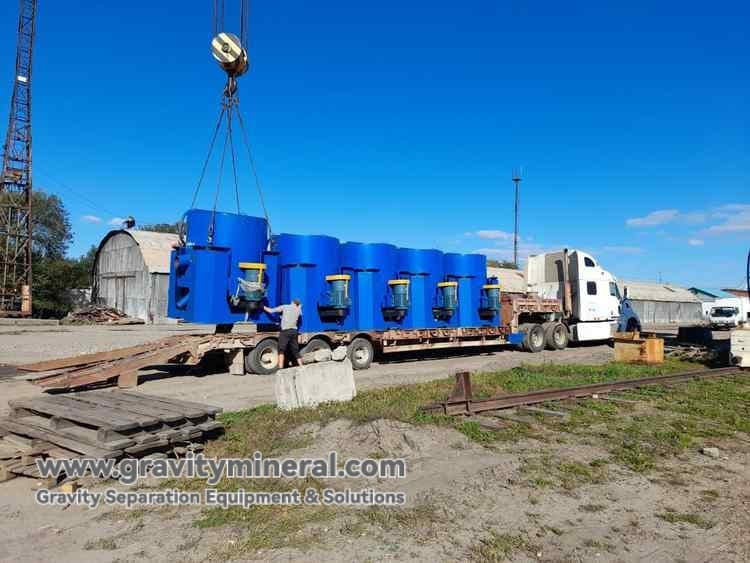
Fully Automatic Gold Centrifugal Concentrator (STLB Series) | Centrifugal Gold Separator | High-Efficiency Fine Gold Recovery Equipment
Centrifugal concentrator is an entirely new type of gravity separation machine, mainly used to capture fine and ultra-fine heavy minerals that conventional gravity equipment such as sluices or jig separators cannot recover. The basic principle of a fully automatic discharge gravity separator is to use centrifugal force to amplify the force acting on mineral particles, thereby separating heavy particles from light ones.
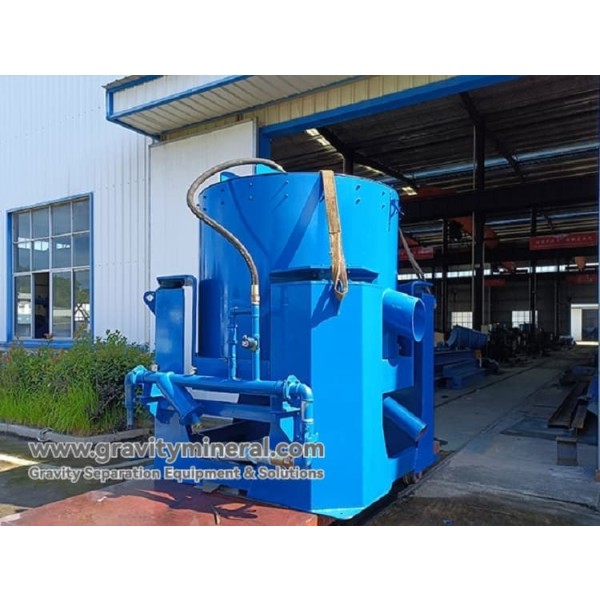
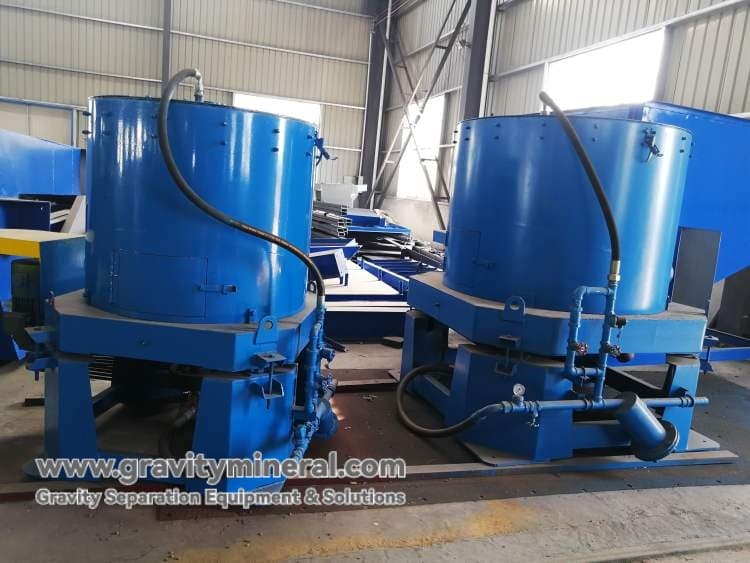
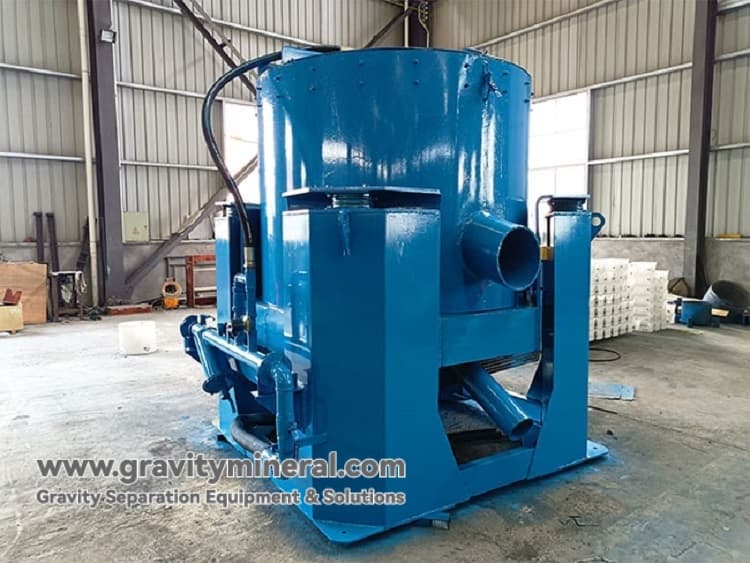
As a mature gold centrifugal concentrator, the machine adopts a conical concentrating cone structure, driven to high speed by an electric motor and surrounded by pressurized backwash water. Material entering the unit for screening is generally ore ground by a ball mill or the overflow slurry of a hydrocyclone; the slurry is introduced from above the cone down to its bottom, where rows of ribs form grooves, and the centrifugal force generated by rotation throws the minerals into the grooves.
This gravity centrifugal concentrator is a patented invention in our country. The equipment adds no chemical reagents and is environmentally friendly; it delivers clear results for native gold across a wide range of particle sizes, especially for the native gold lost in actual plant operation by other re-treatment machines such as gold carpet and jig separators. It can be used not only for alluvial gold ore but also to recover native gold from hard rock ore (replacing mercury amalgamation), and to recover gold from tailings dams. In mineral processing, a centrifugal concentrator often serves as the core fine-gold recovery unit in the alluvial gold washing plant solution and the rock gold gravity separation plant solution.
Core Advantages and System Features
- Fine gold recovery: conventional gravity equipment loses efficiency below 0.1 mm, while this machine uses strong centrifugal force to recover fine gold down to 0.04 mm. Beneficiation tests show alluvial gold recovery above 99% with a concentration ratio up to 1000 times; when recovering native gold from vein gold ore at a grinding size below 0.074 mm, free gold recovery can exceed 98%, and recovery of 0.04 mm free gold exceeds 97%.
- Fully automatic discharge system: with this new fully automatic separator, no manual cleaning of concentrate is needed at shutdown — the operator simply watches the feed and presses the run or stop button on the automatic control system; one button completes the whole job. Because the entire process is enclosed, no one can touch the concentrate discharged from the unit, preventing human-caused concentrate loss and reducing the risk of gold theft.
- Patented fluidized cone: the internal concentrating cone uses a special ribbed-groove design together with a precise backwash water control system. This technology fluidizes the mineral bed, prevents agglomeration and ensures heavy gold particles sink into the collection ring. Thanks to the backwash water, only heavy mineral particles overcome its friction and remain in the grooves to form concentrate, while light minerals, subjected to less centrifugal force, cannot overcome the backwash water, are flushed out of the grooves and overflow from the top of the cone under the continuous water flow, becoming tailings.
- Zero-chemical eco-friendly operation: no organic chemical reagents of any kind are added; the machine runs on electricity and clean water only, meeting strict international environmental standards and “mercury-free mining” regulations.
- Vibration damping and durable design: because of the centrifugal force, a fully automatic centrifugal concentrator generates considerable vibration; our products use flexible couplings in the damping section, effectively reducing the negative effects of machine vibration, improving plant precision and extending equipment life. The fully automatic unit has low cost, wear-resistant spare parts and simple maintenance.
- Compact structure: tightly designed with a small footprint, easy to integrate into the processing circuit of an existing mine plant.
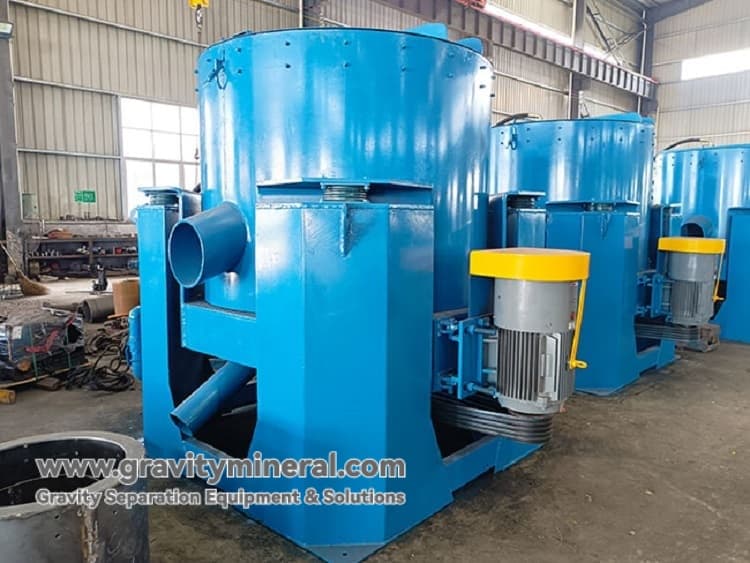
How a Gold Centrifugal Concentrator Works
The equipment consists of a rotating inner cone (concentrating bowl) and a fixed pressurized water jacket. Slurry is introduced from above the concentrating cone down to the bottom, where rows of ribs inside the cone form grooves:
- High-speed rotation: the inner cone rotates at high speed, generating enormous centrifugal force acting on the inner wall of the bowl. The force pushes the slurry outward and upward along the wall.
- Slurry feeding: the screened slurry is injected through a central pipe into the bottom of the rotating cone.
- Fluidization (backwash water): high-pressure clean water is injected through micro-holes in the cone wall. This “backwash water” keeps the material bed loose (fluidized).
- Gold capture: because gold is far denser than sand, it resists the backwash water and is retained in the ribbed ring structure of the cone to form concentrate. Light minerals, receiving less centrifugal force, cannot overcome the backwash water; they are flushed out of the grooves and, driven by the continuous water flow, overflow from the top of the cone to become tailings.
Applications and Complete Line Configuration
The gold centrifugal concentrator is mainly used for gravity recovery of fine gold and often serves as a key link in a gravity separation circuit:
| Application |
Typical minerals |
Matched process / production line |
| Alluvial and placer gold |
Fine free gold |
Alluvial gold washing plant solution |
| Hard-rock gold grinding circuit |
Free gold in hard-rock ore |
Rock gold gravity separation plant solution |
| Tailings reprocessing |
Fine gold lost by conventional gravity equipment |
heavy alluvial gravity-magnetic separation plant |
In terms of installation, the separator is usually placed after a trommel screen to capture all fine gold before the tailings enter the sluice; in hard-rock gold mines it can be installed directly in a ball mill closed circuit to recover free gold immediately before overgrinding or cyanide leaching. The high-grade rough concentrate discharged has already been greatly reduced in volume and is usually moved to a secure vault, where a 6-S shaking table separates pure gold powder from residual black sand.
STLB Series Technical Parameters and Specifications
The full centrifugal concentrator range covers capacities from the STLB20 (for laboratory testing and final cleaning) to the STLB100 (for high-tonnage industrial plants):
| Model |
STLB20 |
STLB30 |
STLB60 |
STLB80 |
STLB100 |
| Capacity (t/h) |
0-0.6 |
2-3 |
8-12 |
40-45 |
60-80 |
| Backwash water consumption (m³/h) |
2-3 |
3-5 |
7-10 |
30-36 |
50-60 |
| Slurry water consumption (m³/h) |
1.5-4 |
5-7 |
8-12 |
40-45 |
60-80 |
| Feed density (%) |
0-50 |
| Feed size (mm) |
0-3 |
0-3 |
0-5 |
0-5 |
0-6 |
| Concentrate flush cycle |
Hard-rock gold every 1-3 hours, alluvial gold every 2-6 hours |
| Concentrate discharged each time (kg) |
2 |
3-5 |
10-20 |
40-50 |
70-80 |
| Power (kW) |
0.75 |
1.5 |
4 |
11 |
18.5 |
| Weight (kg) |
205 |
380 |
1100 |
2300 |
3700 |
| Overall dimensions (mm) |
914×700×900 |
1160×885×1165 |
1820×1450×1700 |
2476×2032×2018 |
2849×2085×2426 |
From a Single Centrifugal Concentrator to Complete Line Systems, With Full Accountability
The performance of a centrifugal concentrator depends on the match between upstream grinding fineness, feed density and backwash water pressure. GravityMineral has focused on gravity separation equipment for 20 years, with equipment produced at two owned manufacturing bases and process and mechanical engineers working in one team——the cone speed, backwash water volume and capacity of each separator are set from the actual ore type and capacity requirement and share the same source as the complete-line design drawings, avoiding the disconnect of “equipment that does not fit the process once it arrives”.
- Own manufacturing bases: core equipment is produced at GravityMineral's two owned manufacturing bases, with full quality control from raw material procurement through machining, assembly and no-load test running, and strict inspection records for every machine before it leaves the factory.
- ISO9001 quality system: the company is ISO9001 certified, and its products hold S-certified supplier, national high-tech enterprise and other qualifications.
- Complete-line interface matching: trommel screens, ball mills, centrifugal units, shaking tables and sluices are capacity-matched as one system, reducing blockages and tailings loss.
- Global delivery experience: products have been exported to 50+ countries, with familiarity in logistics and customs clearance for major markets in Africa, Southeast Asia, South America, the Middle East, Central Asia, South Asia and Australia.
- Delivery and after-sales: engineers provide on-site installation and commissioning guidance, with a 1-year warranty and long-term spare parts and process optimization support.
Centrifugal Concentrator FAQ
Q1: How much does a centrifugal concentrator cost? How is the price calculated?
The price depends on the model (STLB20 to STLB100), processing capacity and whether it has fully automatic discharge. The small STLB20 costs less while the industrial STLB100 costs more; provide the ore type, feed size and target capacity for a transparent quotation from our engineers.
Q2: How does a centrifugal concentrator differ from sluices, jig separators and shaking tables? How to choose?
Ordinary sluices and jig separators use a 1G conventional gravity field and lose obvious efficiency on fine gold below 0.1 mm; the 6-S shaking table offers high precision but low capacity; a centrifugal concentrator relies on high-speed rotation to generate a high-multiple centrifugal force field and can recover micro-fine gold down to 0.04mm, often used as supplementary fine-gold recovery after sluices and jigs.
Q3: How many tonnes per hour can a centrifugal concentrator handle? How to select the model?
Capacity: STLB20 approx. 0-0.6 t/h (laboratory / final cleaning), STLB30 approx. 2-3 t/h (small scale), STLB60 approx. 8-12 t/h (small and medium plants), STLB80 approx. 40-45 t/h, and STLB100 approx. 60-80 t/h (large industrial plants). Select by feed size, density and target recovery.
Q4: How fine a gold particle can a centrifugal concentrator recover? How high is the recovery?
It recovers fine gold down to 0.04mm. Alluvial gold recovery is over 99% with a concentration ratio up to 1000 times; for vein gold ore ground to <0.074 mm, free gold recovery is over 98% and 0.04 mm free gold reaches over 97%.
Q5: How often is the concentrate discharged (flushed)? How is the concentrate handled?
It depends on grade: flush hard-rock gold every 1-3 hours and alluvial gold every 2-6 hours. The highly enriched rough concentrate discharged is greatly reduced in volume and is usually moved to a secure vault, where a 6-S shaking table separates pure gold powder from residual black sand.
Q6: What is the difference between a fully automatic discharge model and a standard model?
A standard model requires manual cleaning of concentrate at shutdown; the fully automatic model only needs the operator to watch the feed and press the run/stop button, with enclosed operation and no manual contact with the concentrate, reducing human-caused loss and the risk of gold theft.
Q7: Are chemical reagents needed? Can it replace mercury amalgamation?
No chemical reagents are needed; the machine runs on electricity and clean water only, using centrifugal force plus backwash water to separate, meeting environmental and "mercury-free mining" regulations, and it can replace mercury amalgamation to recover native gold from hard rock ore.
Q8: What are the water and power consumption? Does the machine vibrate much?
Taking the STLB60 as an example: slurry water 8-12m³/h, backwash water 7-10m³/h and power only 4kW, making it a water- and energy-saving physical gravity separator. Centrifugal force creates considerable vibration, so the machine uses flexible couplings in the damping section to reduce vibration, improve separation precision and extend service life.
Q9: What are the limits on feed size and density? How is it configured in the circuit?
Feed size: STLB20/30 0-3mm, STLB60/80 0-5mm, STLB100 0-6mm; feed density 0-50%. In alluvial gold circuits the separator is placed after the trommel screen and before the sluice to capture fine gold; in hard-rock gold it can be installed directly in a ball mill closed circuit to recover free gold before overgrinding or cyanidation.
Q10: Can samples be sent for testing? How are lead time and after-sales guaranteed?
Representative ore samples can be sent for a beneficiation test to determine the model and process parameters. Standard centrifugal concentrator manufacturing takes 30-60 days, longer for non-standard builds, with the delivery schedule fixed in the contract; a 1-year warranty, long-term spare parts, technical consultation and process optimization after warranty, engineers on site for commissioning and training, and exports to 50+ countries.
Get an STLB Centrifugal Concentrator Selection Plan and Quote
Tell us your ore type, head grade, feed size, target capacity (t/h), slurry density and site water/power conditions, and GravityMineral engineers will provide a centrifugal concentrator selection plan, a gravity separation flow route and a transparent quotation.
You can reach us through the contact details on our website, or contact a sales engineer directly for selection advice.