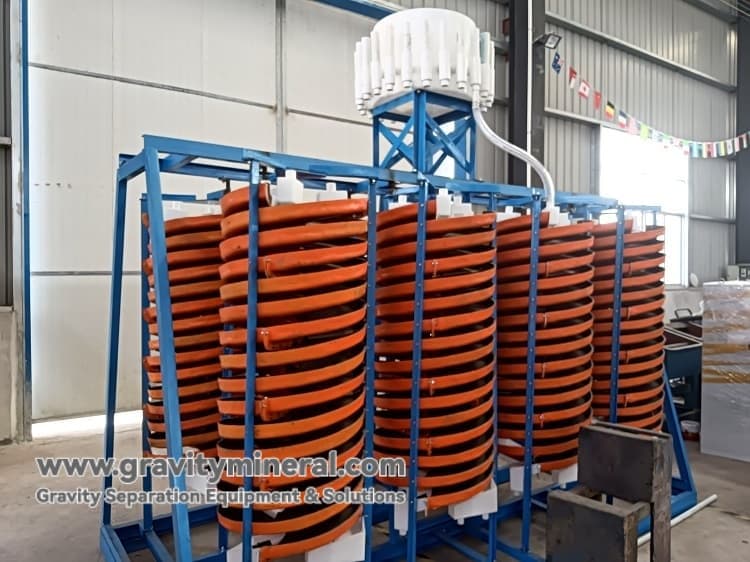
Fiberglass Spiral Chute | Zero-Energy Fine-Particle Gravity Separation Equipment
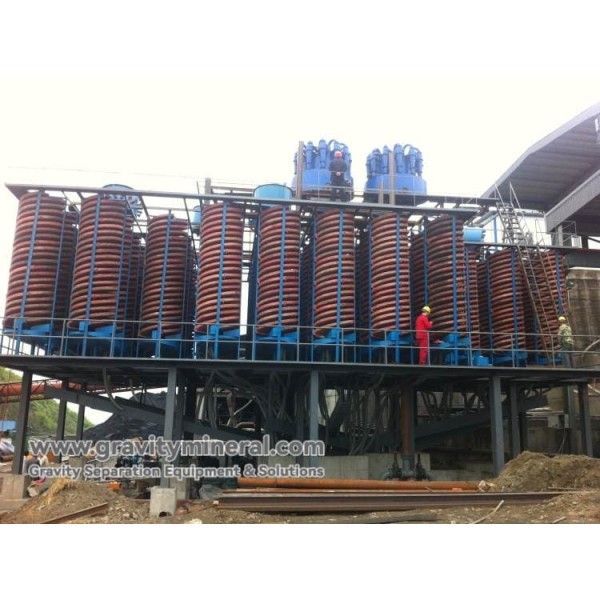
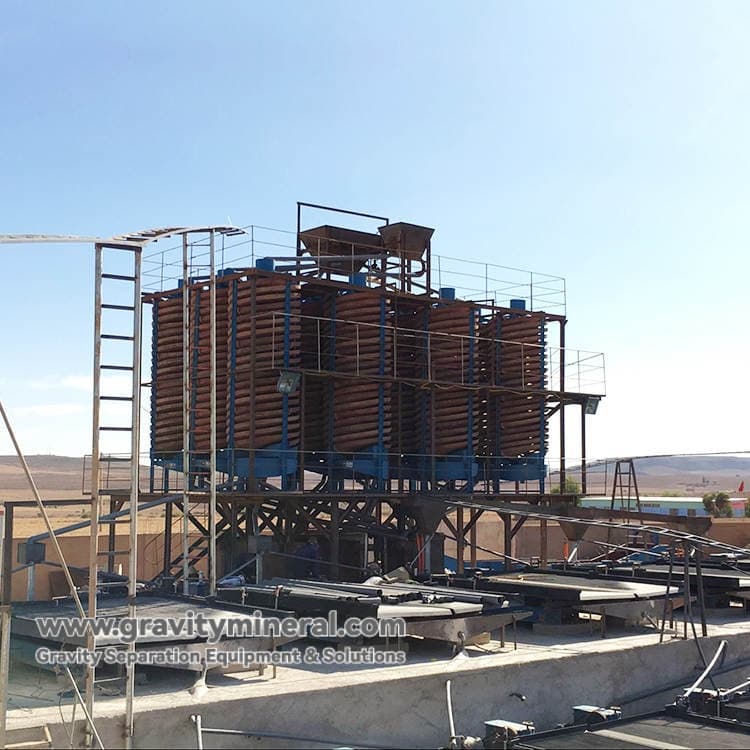
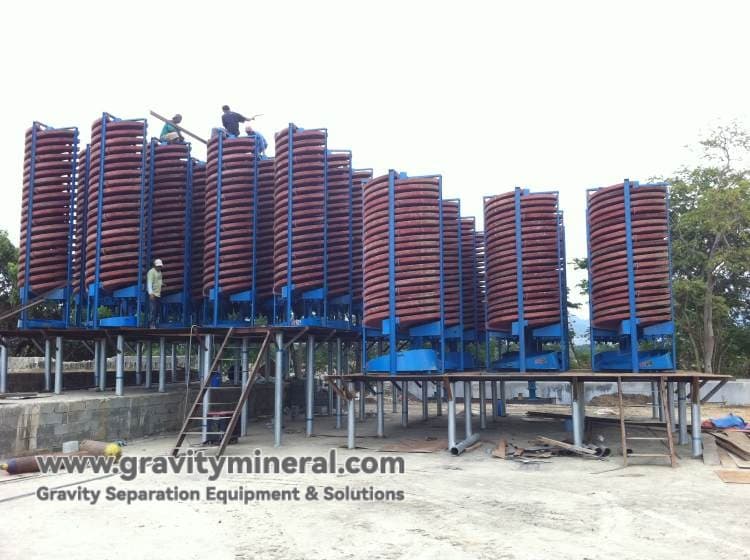
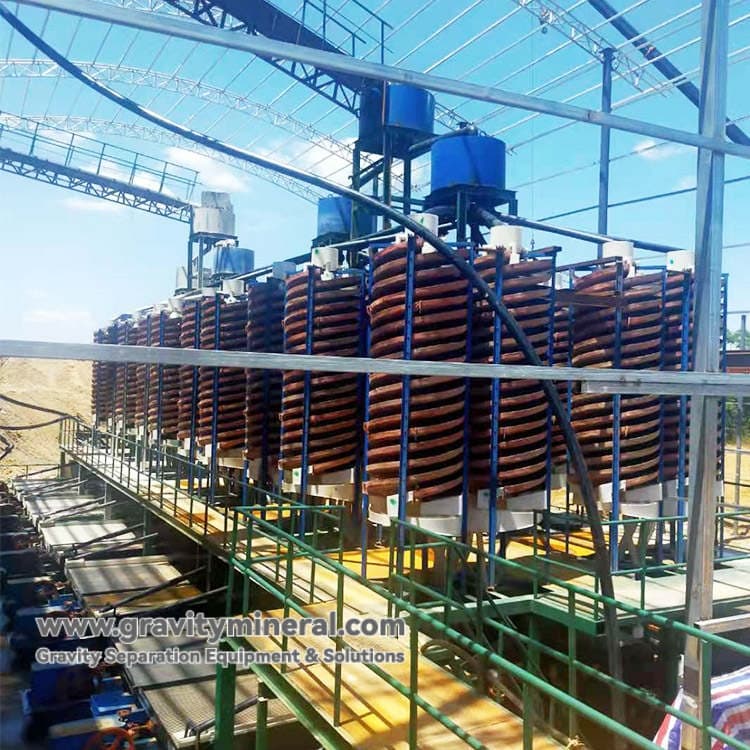
The fiberglass spiral chute is a high-efficiency gravity separator that combines the advantages of traditional spiral concentrators, shaking tables, and centrifugal concentrators into one simple, continuous operating process. This gravity spiral concentrator needs no electrical drive at all, using natural forces of gravity, centrifugal action, and water flow to separate minerals by specific gravity.
This spiral chute separator won the Ministry of Metallurgy Award for Scientific and Technological Achievement and offers excellent separation indices and a high enrichment ratio, making it especially suitable for upgrading fine particles from 0.3 mm down to 0.02 mm. In mineral processing flowsheets, it is often used as the core roughing unit in titanium-zirconium placer gravity + magnetic/electrostatic separation solutions and alluvial tin gravity recovery solutions.
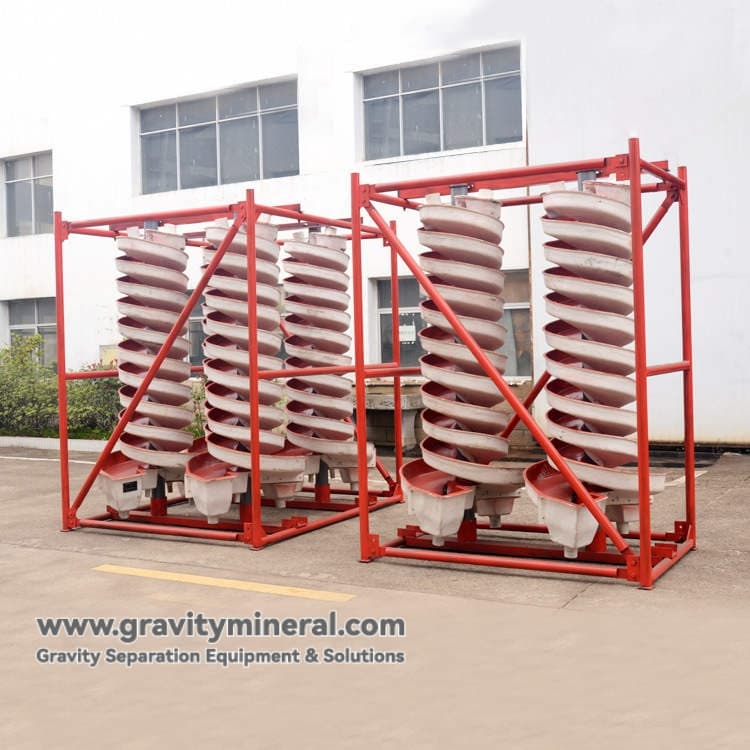
This mineral spiral separator is built from lightweight, high-strength fiberglass-reinforced plastic (FRP), giving it low weight, water resistance, rust resistance, and corrosion resistance. It adapts strongly to fluctuations in feed rate, density, size distribution, and grade, operates without noise, and is an ideal choice for large-scale heavy mineral processing.
How a Spiral Chute Works
Separation occurs naturally as slurry flows downward along the helical path of the spiral. The unit is set upright and its indexing line aligned; a sand pump delivers the ore sand to the feed inlet at the top of the spiral, and makeup water is added to adjust pulp density. The slurry then swirls naturally downward, and in the rotating sloping water film an inertial centrifugal force develops. Differences in specific gravity, particle size, and shape of the sand particles achieve mineral separation.
- Slurry feed: Slurry is pumped to the top distributor and delivered evenly into each spiral.
- Centrifugal and gravity stratification: As the slurry accelerates down the spiral, centrifugal force pushes the lighter, lower-density particles (tailings) toward the outer edge of the trough——the zone where water velocity is highest.
- Heavy mineral concentration: Denser minerals settle into the slower-moving water layer and converge inward toward the central column under friction and gravity.
- Separation and discharge: An adjustable splitter at the spiral bottom (a valve-block extraction trough) divides the slurry stream seamlessly into three separate discharge outlets: concentrate (inner), middlings (middle), and tailings (outer). Moving the valve blocks changes the extraction width of each product.
Core Advantages of the FRP Spiral Chute
- Zero-energy operation: Relying entirely on gravity and hydrodynamic force, it has no moving parts, motor, or drive train, achieving zero-energy operation and minimizing operating cost in mineral processing.
- Corundum surface treatment: The inner wall of the fiberglass spiral is coated with a wear-resistant corundum (emery) layer, which not only extends equipment life but also creates precise micro-friction that effectively captures heavy minerals.
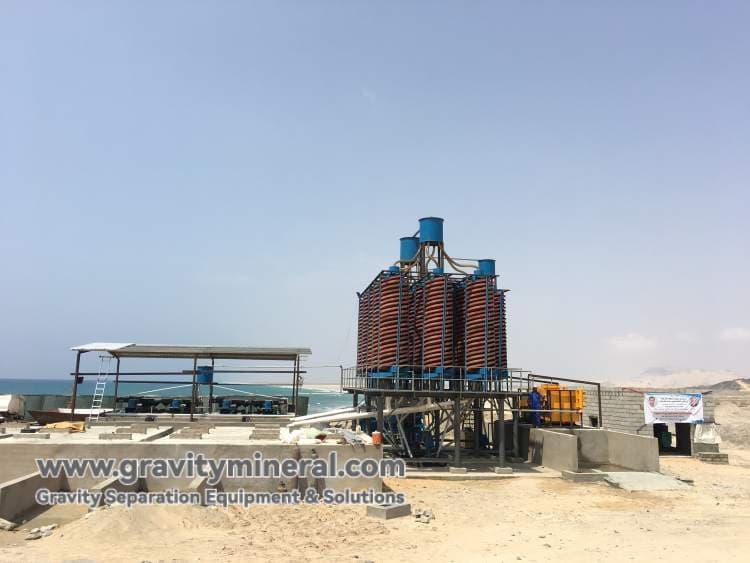
- Outstanding durability and corrosion resistance: The fiberglass-reinforced plastic (FRP) structure is completely immune to rust, making it especially suitable for offshore placer mining that uses seawater for processing.
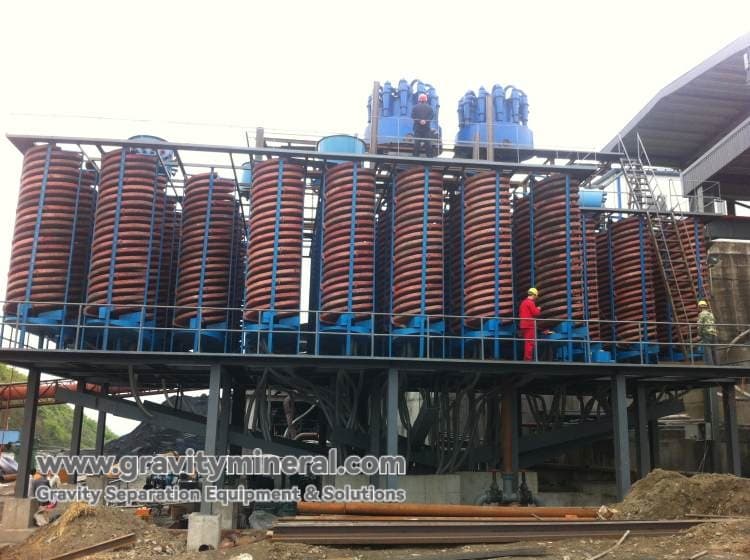
- Space-saving vertical design: The spirals stack vertically around a central column, delivering very high capacity within a small plant footprint. The structure is simple and easy to install and operate.
- Clear product separation: A multi-pipe feed distributor at the top splits the feed evenly with simple control; a valve-block extraction trough at the bottom gives stable separation and a high enrichment ratio.
Applicable Minerals and Whole-Line Integration
The spiral chute works exceptionally well on fine material (0.3-0.02 mm) with sufficient specific-gravity difference, making it the ideal unit for mining beach, riverside, sandbar, and stream placer deposits:
| Application scenario |
Typical minerals |
Supporting process / production line |
| Heavy mineral sands (HMS) separation |
Zircon, rutile, ilmenite, monazite |
coastal placer mineral processing plant solution、heavy mineral sands gravity + magnetic + electrostatic separation solution |
| Ferrous ore separation |
Fine iron ore, chromite, iron sulfide ore |
chromite gravity + magnetic separation solution、ilmenite gravity + magnetic separation solution |
| Non-ferrous and rare metal roughing |
Tungsten, tin, tantalum, niobium |
wolframite gravity separation solution、tantalum-niobium beneficiation plant solution |
| Non-metallic and environmental applications |
Phosphate rock, coal, tailings |
incinerator bottom ash sorting solution |
In a typical process flow, the spiral chute serves as a fine-particle roughing unit: upstream it can be paired with a sawtooth-wave jig separator to recover coarse heavy minerals; the rough concentrate then passes to a 6-S shaking table for cleaning; for clay-rich placer feed, washing and desliming can use a spiral log washer or a rotary scrubber; and a linear vibrating screen can be added at the screening stage.
SLL Series Fiberglass Spiral Chute Technical Specifications
We offer spirals with diameters from 400 mm (for laboratory and fine testing) to 2000 mm (for high-capacity industrial plants). Note: the pitch-to-diameter ratio is the pitch divided by the spiral diameter; different pitches can be supplied to match the settling dynamics of specific minerals.
| Model / specification |
SLL-2000 |
SLL-1500 |
SLL-1200 |
SLL-900 |
SLL-600 |
SLL-400 |
| Spiral diameter (mm) |
2000 |
1500 |
1200 |
900 |
600 |
400 |
| Pitch (mm) |
1200 |
900/800/680/540 |
900/720/540 |
675/540/405 |
450/360/270 |
240/180 |
| Pitch-to-diameter ratio |
0.6 |
0.48/0.36 |
0.75/0.6/0.45 |
0.75/0.6/0.45 |
0.75/0.6/0.45 |
0.6/0.45 |
| Cross slope |
9° |
9° |
9° |
9° |
9° |
9° |
| Number of starts |
3 |
4 |
4 |
4 |
2 |
2 |
| Feed size (mm) |
2.00-0.04 |
0.8-0.037 |
0.3-0.03 |
0.3-0.03 |
0.2-0.02 |
0.2-0.02 |
| Feed density (%) |
30-55 |
30-60 |
25-35 |
25-55 |
25-55 |
25-55 |
| Capacity (t/h) |
7-10 |
6-8 |
4-6 |
2-3 |
0.4-0.8 |
0.15-0.2 |
| Overall dimensions (L×W×H) |
2120×2120×5600 |
1600×1600×5300 |
1360×1360×5230 |
1060×1060×4000 |
700×700×2600 |
460×460×1500 |
| Weight (kg) |
900 |
800 |
600 |
400 |
150 |
50 |
From a Single Spiral Chute to Complete Gravity Separation Lines, No Outsourced Responsibility
The separation performance of a spiral chute depends on how well pitch, feed density, capacity, and the specific-gravity difference of the ore are matched. GravityMineral has spent 20 years in gravity separation and gravity concentration equipment, with equipment built in two owned manufacturing bases and process and mechanical engineers working in one team——the spiral diameter, pitch, and number of starts are set from process data and share the same source as the whole-line design drawings, avoiding the problem of “a roughing unit whose capacity is mismatched with the cleaning unit”.
- Own manufacturing bases: Core equipment is produced at two GravityMineral-owned manufacturing bases, with full quality control from raw material procurement through machining, assembly, and no-load test running. Every unit has strict inspection records before it leaves the factory.
- ISO9001 quality system: The company is ISO9001 certified, and its products hold S-certified supplier, national high-tech enterprise, and other qualifications.
- Whole-line interface matching: The spiral chute is capacity-matched with the sawtooth-wave jig separator, 6-S shaking table, and wet magnetic separator as one system, reducing blockages and tailings losses.
- Global delivery experience: Products have been exported to more than 50 countries, with familiar logistics and customs clearance procedures across Africa, Southeast Asia, South America, the Middle East, Central Asia, South Asia, and Australia; a library of more than 500 global cases provides references for spiral chute selection.
- Delivery and after-sales: Engineers provide on-site guidance for installation and commissioning, leading single-machine and interlocked test runs and training customer personnel; one-year warranty, with long-term spare parts and process optimization support.
- Flexible cooperation models: Buy equipment only, commission drawing design only, hire engineers for on-site commissioning only, or choose full-process EPC turnkey, all arranged around your schedule and budget.
Fiberglass Spiral Chute FAQ
Q1: How much does a fiberglass spiral chute cost? How is the price calculated?
Price depends on the spiral diameter, pitch, number of starts, and capacity; the SLL series spans from the SLL-400 (laboratory / fine testing) to the SLL-2000 (high-capacity industrial). Quotation is by diameter and number of starts; we recommend providing ore type, particle size, and capacity for an engineer's quotation.
Q2: What is the difference between a spiral chute, a shaking table, and a jig? Which should you choose?
The spiral chute is zero-energy, compact vertically, and treats fine particles (0.3-0.02 mm), suiting fine roughing / scavenging; a jig suits coarse material (up to 30 mm) for roughing; a 6-S shaking table offers the highest precision for cleaning. The common combination is "chute roughing + shaking table cleaning".
Q3: Does a spiral chute need power? Does it use electricity?
Not at all. With no moving parts, motor, or drive train, it separates naturally by gravity, centrifugal force, and water flow and runs at zero energy. All that is needed is one sand pump to deliver slurry to the top and makeup water to adjust density, giving extremely low operating cost.
Q4: How many tons per hour can a spiral chute handle? How do you select the model?
Capacity ranges from about 0.15-10 t/h (SLL-400 around 0.15-0.2 t/h up to SLL-2000 around 7-10 t/h). Selection depends on ore type, feed size, feed density, and target capacity: choose SLL-400/600 for small tests, and SLL-1200/1500/2000 for industrial plants.
Q5: How fine can a spiral chute separate? Which minerals suit it?
It is especially suited to upgrading fine minerals of 0.3-0.02 mm. It is used for zircon, rutile, ilmenite, monazite, fine iron / chromite ore, tungsten, tin, tantalum-niobium, phosphate rock, coal, and tailings, and is an ideal unit for beach placer sand; see the coastal placer mineral processing plant solution.
Q6: Can a spiral chute recover coarse gold?
The spiral is optimized for fine minerals (typically <2 mm); if there is coarse gold, a jig or a coarse-gold sluice must be installed upstream. The spiral excels at capturing the fine flour gold missed by roughing and is often paired with a jig.
Q7: Why use fiberglass (FRP)? Can it process ore with seawater?
FRP is lightweight, waterproof, rustproof, corrosion-resistant, and noiseless, and adapts strongly to fluctuations in feed rate, density, and size; the spiral inner wall is treated with a corundum (emery) wear-resistant coating for high hardness and strong heavy-mineral capture. It is completely immune to rust, making it especially suitable for nearshore placer processed with seawater.
Q8: What are the number of starts and what benefit do they bring?
The number of starts is the count of independent spiral troughs wound around the central column. For example, the SLL-1200 is "4-start" (four flow paths around one column), which quadruples the capacity per column footprint and saves even more plant space through vertical stacking.
Q9: What feed density is right for a spiral chute? How do you adjust the concentrate width?
Feed density is about 25%-60% (depending on model and particle size), and the multi-pipe distributor at the top splits the feed evenly; the valve-block extraction trough at the spiral bottom divides the slurry into concentrate, middlings, and tailings. Moving the valve block changes each product's extraction width, making adjustment simple and the enrichment ratio high.
Q10: Can the pitch be customized? How are delivery and after-sales guaranteed?
Different pitches can be selected (pitch-to-diameter ratio 0.36-0.75) to match the settling characteristics of the mineral. Standard spiral chutes have a manufacturing cycle of about 30-60 days, with longer lead times for custom builds and a delivery schedule written into the contract; a one-year warranty applies, followed by long-term spare parts, technical consultation, and process optimization, with engineers on site for commissioning and training. More than 50 countries have taken delivery.
Get an SLL Series Fiberglass Spiral Chute Selection Plan and Quotation
Tell us your ore type, feed size, target capacity (tons per hour), feed density, and site utilities. GravityMineral engineers will provide a fiberglass spiral chute selection plan, a gravity separation flowsheet route, and a transparent quotation.
You can reach us through the contact details on our website, or contact the sales engineer directly for selection advice; representative ore samples can also be sent for mineral processing tests.