Three-Disc Magnetic Separator | Dry High-Intensity Separator for Weakly Magnetic Minerals
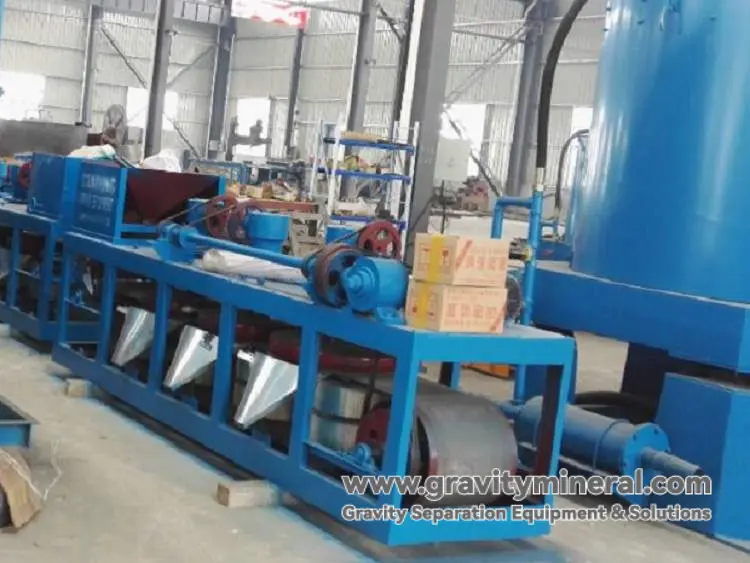
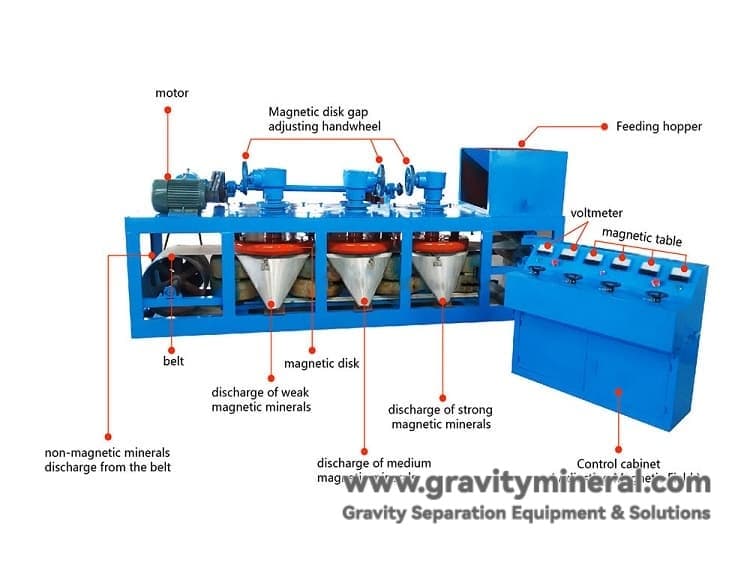
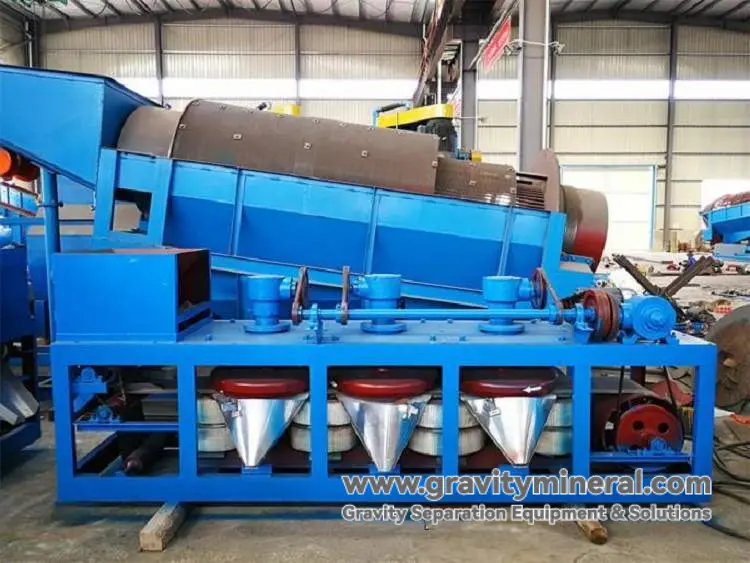
The three-disc magnetic separator (also called the three-disc belt magnetic separator or dry high-intensity magnetic separator) is a highly specialized precision mineral separation machine. Its main body consists of an “E”-shaped magnetic circuit, rotating discs suspended above the magnetic system, and a vibrating trough (or belt). Designed for dry separation and purification of complex weakly magnetic heavy mineral sands, its three independently rotating discs can separate up to four different minerals in a single pass.
It is the global standard machine for treating ilmenite, tantalum-niobium ore, rare-earth ore (monazite), and mixed tungsten-tin ore. By independently adjusting the excitation current (field strength) and the physical induction distance of each disc, the operator can precisely set the field strength required at each stage to extract a specific mineral, achieving one-pass separation of multiple minerals.
Beyond rare-metal concentration, this dry high-intensity magnetic separator also performs effectively in iron removal and purification of valuable non-metallic minerals such as quartz sand and feldspar, and is widely used in dry separation of ilmenite, monazite, tungsten-tin ore, tantalite, and other magnetic and non-magnetic minerals. In mineral processing flows it commonly serves as the core cleaning unit in the titanium-zirconium placer gravity-magnetic-electric separation solution and the tantalum-niobium processing plant solution.
Three-Disc Magnetic Separator Working Principle
Separation is a continuous multi-stage operation. The feed must be completely dry before entering the machine, and minerals are separated by adjusting the excitation current of each disc to form magnetic fields of different strengths.
- Pre-treatment stage: Dry sand is conveyed by a stainless-steel vibrating trough and first passes beneath a weakly magnetic drum, which immediately removes strongly magnetic minerals such as magnetite and prevents them from blocking the downstream high-intensity discs.
- First disc (medium-intensity field): The remaining sand enters the first rotating disc, normally set to a medium-intensity field, which extracts medium-magnetic minerals such as ilmenite. The rotating disc carries the minerals out of the field zone and drops them into a collection chute.
- Second and third discs (progressively stronger): The material continues through the second and third discs, whose field strength increases stage by stage (up to 18,000 gauss). These discs extract weakly magnetic minerals such as garnet, monazite, and tantalite.
- Non-magnetic discharge: Material remaining on the trough at the end (such as zircon, quartz, and cassiterite) falls from the trough end into the non-magnetic tailings box, completing the separation and purification of magnetic from non-magnetic minerals.
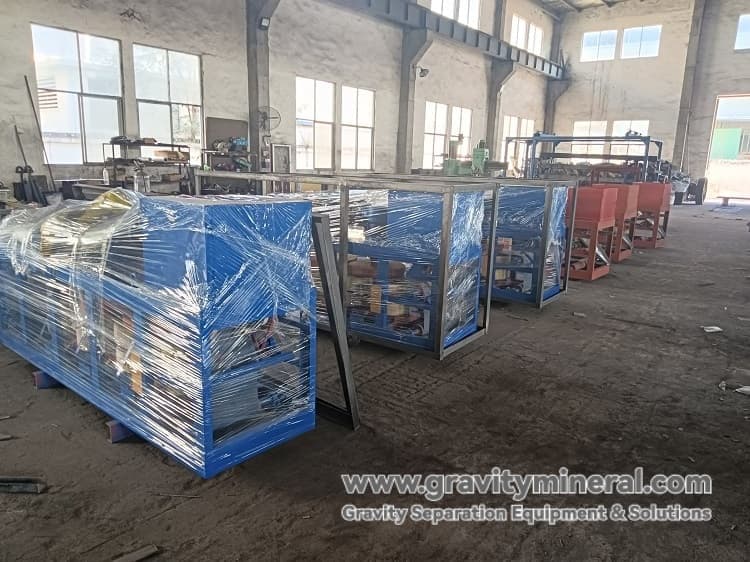
Core Technology and System Features
| System Component |
Technical Feature |
| Ore feeding device |
Equipped with a vibrating feeder and screening pre-treatment device to ensure a thin, even, continuous single layer of dry ore enters the magnetic field. |
| Weakly magnetic drum (pre-cleaner) |
A primary low-intensity drum (0.3-0.5 T) at the feed inlet removes highly magnetic minerals such as magnetite, preventing them from blocking the downstream high-intensity discs. |
| Three-disc system |
Three rotating discs; the field strength of each disc is independently adjustable over the range 0.8 to 1.5 tesla (8,000 - 15,000 gauss). |
| Electromagnetic coils |
Heavy-duty oil-cooled electromagnetic coils allow continuous operation without overheating (temperature rise ≤65°C), maintaining a stable field strength. |
| Structural advantages |
Reasonable structure, small footprint, simple operation and maintenance; separates strongly magnetic, weakly magnetic and non-magnetic minerals in one pass, suited to dry operation in water-scarce mining areas. |
Typical Applications and Complete Line Integration
The three-disc magnetic separator suits dry cleaning of titanium ore, tungsten-tin ore, chromite, niobium-tantalum ore, limonite, zircon, rutile, monazite, andalusite, kyanite, feldspar, quartz, and other metallic minerals with differing magnetism, as well as iron removal from non-metallic materials:
In process integration, the three-disc magnetic separator is usually the final stage of dry cleaning. Upstream it can be paired with a fiberglass spiral chute or 6-S shaking table for gravity roughing, with the rough concentrate dried before entering the three-disc separator; for material containing strongly magnetic minerals, a wet magnetic separator can be used for pre-concentration. If the material shows conductor/non-conductor differences, a high-tension electrostatic separator can complete the final separation.
Three-Disc Magnetic Separator Specifications
The following are standard specifications for the 3PC-600 model; other sizes can be customized on request.
| Model / Parameter |
3PC-600 Specification |
| Magnetic field strength |
18000 Gs |
| Disc count / diameter / speed |
3 / 600 mm / 86 r/min |
| Processing capacity |
100 - 500 kg/h (depends on mineral properties and feed size) |
| Optimal feed size |
≤ 2 mm (material must be completely dry) |
| Coil parameters |
8 excitation coils, coil temperature <80 °C, rated current 1.3-1.8 A |
| Motor power / excitation power |
2.2 kW / 1.6 kW |
| Power supply |
Three-phase 380 V (custom voltage available) |
| Feed width / dimensions / weight |
300 mm / 3200×900×1200 mm / 2400 kg |
From a Single Three-Disc Magnetic Separator to Complete Magnetic-Electric Lines - Full Responsibility, No Outsourcing
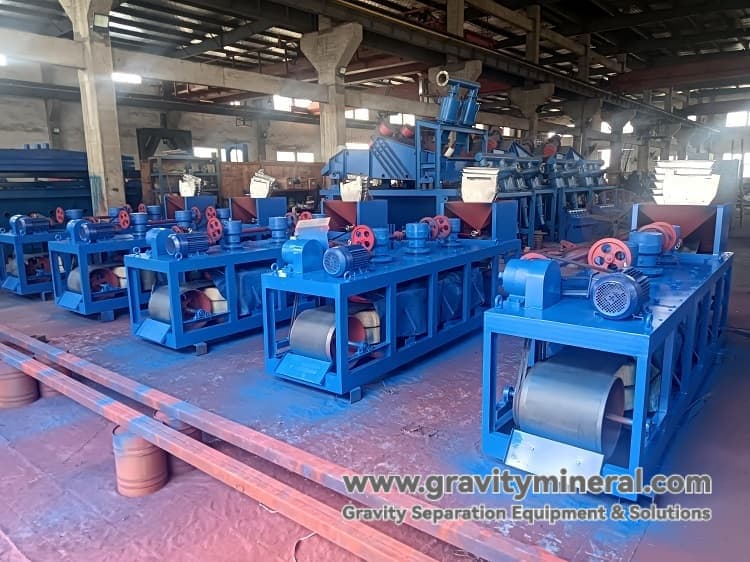
The separation accuracy of the three-disc magnetic separator depends on the match between feed dryness, size distribution, disc field strength, and induction distance. GravityMineral has focused on gravity concentration and magnetic-electric separation equipment for 20 years, with all machines produced at our own two manufacturing bases. Process and mechanical engineers work on the same team——the disc material, coil power, and control system are set according to process data and share the same source as the complete-line design drawings, avoiding the problem of “magnetic separation equipment not matching the gravity separation flow”.
- Own manufacturing bases: Core equipment is produced at GravityMineral's two own manufacturing bases, with full quality control from raw material procurement through machining, assembly, and no-load test runs. Every machine undergoes strict inspection before leaving the factory.
- ISO9001 quality system: The company is ISO9001 certified, and its products hold S-certified supplier, national high-tech enterprise, and other qualifications.
- Complete-line interface matching: The three-disc magnetic separator, fiberglass spiral chute, 6-S shaking table, and high-tension electrostatic separator are capacity-matched as one system, reducing blockages and incomplete separation.
- Global delivery experience: Products have been exported to 50+ countries, and we are familiar with logistics and customs clearance in major markets across Africa, Southeast Asia, South America, the Middle East, Central Asia, South Asia, and Australia; a 500+ global case library provides references for three-disc magnetic separator selection.
- Delivery and after-sales: Engineers supervise installation and commissioning on site, lead single-machine and integrated test runs, and train customer personnel; 1-year warranty, with long-term spare parts and process optimization support.
- Flexible cooperation models: Buy equipment only, commission drawing design only, hire engineers for on-site commissioning only, or opt for full-process EPC turnkey - all arranged to your pace and budget.
Three-Disc Magnetic Separator FAQ
Q1: How much does a three-disc magnetic separator cost? How is the price calculated?
Price depends on disc diameter, field strength, coil power, and capacity; the standard 3PC-600 handles 100-500 kg/h. Smaller machines cost less and large custom machines more; provide your material, size, and separation requirements for a transparent engineer's quote.
Q2: What is the difference between a three-disc magnetic separator, a wet magnetic separator, and a permanent-magnetic roller separator? How do you choose?
The three-disc type is an electromagnetic dry separator whose field strength can be independently adjusted to separate multiple minerals in one pass, but the material must be completely dry; a wet magnetic separator separates in slurry with high throughput; a permanent-magnetic roller separator needs no excitation and uses little energy. A three-disc magnetic separator is preferred when the target is dry separation of several weakly magnetic minerals in one pass. For dry separation of multiple weakly magnetic minerals, choose the three-disc type.
Q3: Must the material be dry before feeding? Are there moisture requirements?
It must be completely dry. This is a dry magnetic separator; if the material contains moisture, surface tension makes fine particles stick together and prevents precise separation. Optimal feed size is ≤2 mm, and material must be dried and screened before feeding.
Q4: How much can a three-disc magnetic separator handle per hour? How do you select a model?
The standard 3PC-600 handles 100-500 kg/h (depending on mineral properties and feed size), with a 300 mm feed width. Multiple units can run in parallel if more output is needed; final sizing is confirmed by engineers against target capacity and mineral type.
Q5: What is the field strength? Is it adjustable? How many minerals can be separated at once?
The three discs provide 0.8-1.5 tesla (8,000-15,000 gauss), up to a maximum of 18,000 gauss; the excitation current of each disc is independently adjustable and, combined with induction-distance adjustment, allows one-pass separation of multiple minerals including strongly magnetic, weakly magnetic and non-magnetic types (up to four minerals).
Q6: Why is there a weakly magnetic drum at the inlet? Can it remove magnetite?
The weakly magnetic drum (0.3-0.5 T) at the inlet acts as a safety pre-cleaner, preferentially removing highly magnetic minerals such as magnetite so they cannot strongly attach to the discs and cause blockages or even damage, protecting the downstream high-intensity discs.
Q7: Do the coils overheat? Can the machine run continuously?
Equipped with heavy-duty oil-cooled electromagnetic coils, temperature rise is ≤65 °C and coil temperature <80 °C, allowing continuous operation without overheating and maintaining a stable field; the 8 excitation coils have a rated current of 1.3-1.8 A, supporting continuous production.
Q8: Which minerals can the three-disc magnetic separator treat? Ilmenite and monazite?
It suits cleaning of ilmenite, monazite, tantalum-niobium ore, mixed tungsten-tin ore, chromite, limonite, zircon, rutile, and garnet and iron removal from quartz sand, feldspar, and kaolin; see the titanium-zirconium placer gravity-magnetic-electric separation solution.
Q9: How is the three-disc magnetic separator integrated into a flow? What comes before and after?
It usually serves as the final stage of dry cleaning: upstream a spiral chute or 6-S shaking table performs gravity roughing, and the dried rough concentrate enters the three-disc separator; material containing strongly magnetic minerals can first pass a wet magnetic separator, and conductor/non-conductor differences can be finished with a high-tension electrostatic separator.
Q10: Can it be custom-built? How are lead time and after-sales guaranteed?
The disc diameter, field strength, coil power, and supply voltage can be customized for your material. Standard machines have a 30-60 day manufacturing cycle, longer for custom builds, with a delivery schedule written into the contract; 1-year warranty, long-term spare parts, technical consultation and process optimization after warranty, on-site engineer commissioning and training, and exports to 50+ countries.
Get a Three-Disc Magnetic Separator Selection Plan and Quote
Tell us your material name, feed size, moisture content, target capacity (kg/h or t/h), and the minerals to be separated, and GravityMineral engineers will provide a three-disc magnetic separator selection plan, magnetic-electric separation flow route, and transparent quotation.
Contact us through the website or speak directly with a sales engineer for selection advice; representative ore samples can be sent for magnetic separation tests.