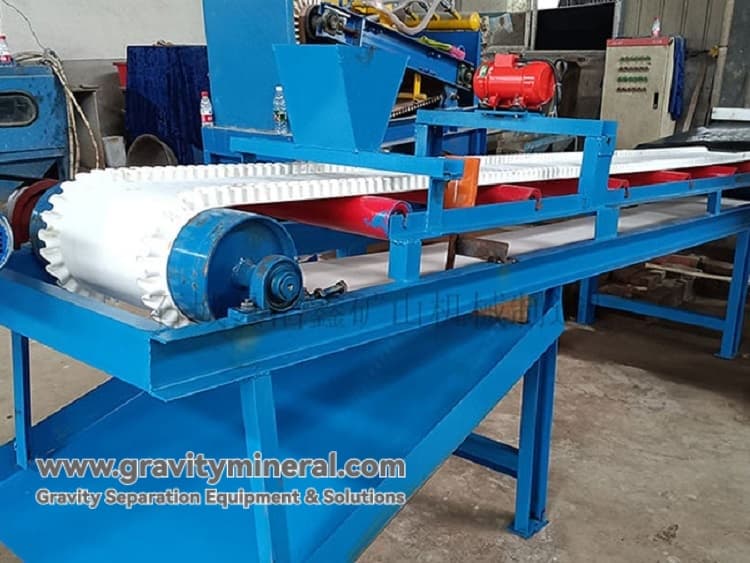
Suspended Vibrating Blanket Concentrator | Fine Mineral Vibrating Sluice Recovery Equipment
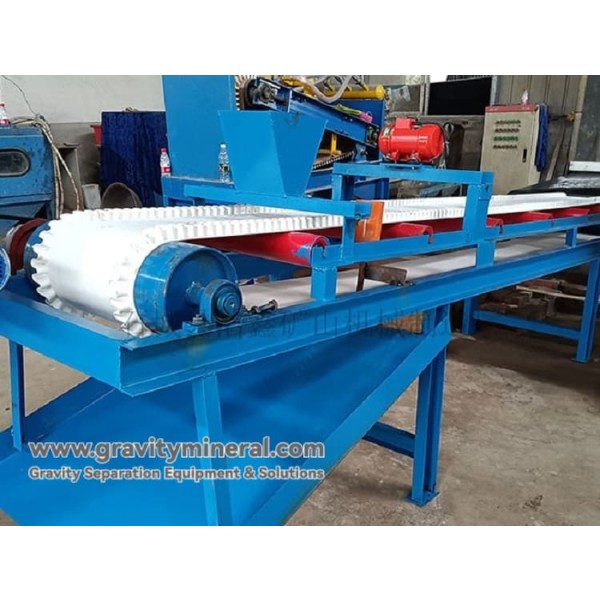
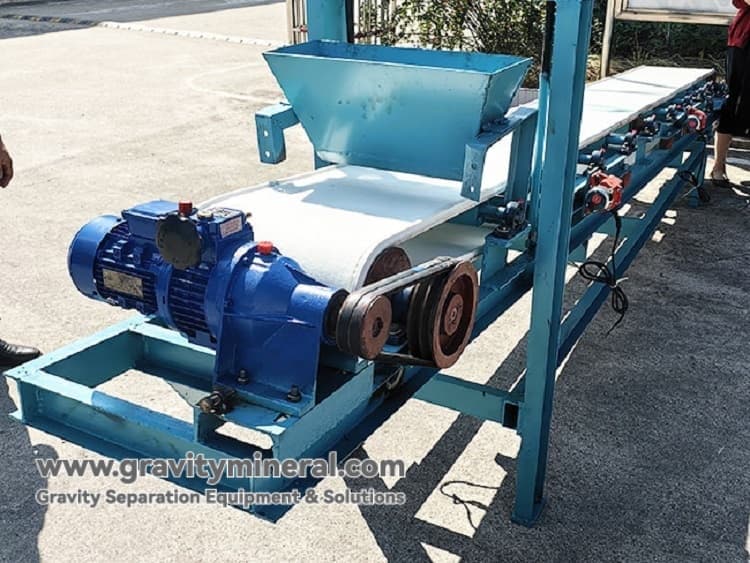
Suspended Vibrating Blanket Concentratoris an innovative breakthrough in fine mineral recovery. Based on the traditional miner's sluice, the unit integrates a suspended high-frequency reciprocating drive. This dynamic vibration completely solves the long-standing "compaction" problem of sluice carpets——the hardening of the carpet caused by heavy black sand.
By continuously keeping the mineral bed loose, this vibrating gold-panning carpet machineallows ultrafine heavy minerals to sink continuously into the carpet fibers. Designed for the efficient recovery of material below -80 mesh (0.18 mm)and finer, it is a tool for capturing fine gold, tungsten, tin and rare earth elements.
This fine-gold sluice boxoperates entirely on physical gravity and vibration——with zero chemical additives——making it an ideal eco-friendly solution for tailings reprocessing and primary fine-particle concentration.
What Is Suspended Vibrating Blanket Concentration? Why Can't Fine Mineral Recovery Work Without It?
The suspended vibrating blanket concentrator is a fine-particle recovery unit in gravity separation, with high-frequency dynamic vibration + carpet fiber interception as its core principle. Traditional miner's sluice carpets rely entirely on water flow to keep sand and gravel moving; once the flow slows, the carpet is filled with heavy black sand and hardens (compaction), letting ultrafine particles slide straight through and be lost. The suspended high-frequency reciprocating drive continuously disturbs the mineral bed, completely solving compaction and allowing ultrafine heavy minerals to sink steadily into the carpet fibers.
In tailings recovery and fine-particle treatment, conventional jigs and fixed sluices struggle to capture -80 mesh (below 0.18 mm)"invisible" minerals. Here the vibrating blanket relies on the combined action of gravity, hydrodynamics and mechanical vibration to raise the recovery rate of -0.074 mm (200 mesh) minerals by 40%, making it a key means of recovering fine gold, tungsten, tin and rare earths.
The reason suspended vibrating blanket concentrators can be used for alluvial gold, tungsten-tin reprocessing and tailings scavenging is that the suspended high-frequency reciprocating drive + anti-compaction carpet design plays a key role. Compared with static sluices and heavy jigs, it combines ultrafine particle capture with significantly lower labor and energy costs, making it the most widely used vibrating blanket equipment for fine-particle gravity recovery today.
Core Technology and System Advantages
- Anti-compaction / anti-clogging design: The suspended vibration mechanism generates high-frequency micro-vibration, effectively preventing the gold-catching carpet from being clogged by high-density iron sand and keeping the "trap" for capturing particles clear at all times.
- Ultrafine particle capture: Specially targets the "invisible" gold that conventional jigs and standard sluices cannot capture. It raises the recovery rate of -0.074 mm (200 mesh) minerals by 40%.
- Combined force field: Through the synergistic action of gravity, hydrodynamic flow and mechanical vibration, it achieves material stratification far beyond that of static sluices.
- Automation and economy: Compared with manual sluice cleaning, it can cut labor costs by 80%. The optimized suspended drive system can reduce energy consumption by 60% versus heavy jigs.
- Zero-chemical, eco-friendly: Operating entirely on physical gravity and vibration with no chemical reagents added, it is an environmentally friendly solution for tailings reprocessing and fine-particle concentration.
- Modular, multi-specification: Available in multiple specifications including 1200 mm and 1400 mm widths and 6000-10000 mm lengths, customized to target output; the optimal feed density of all models is below 35%.
Vibrating Blanket Concentration Principle: Three Steps to Fine-Particle Capture
The unit relies on the synergy of suspended vibration and carpet fibers to continuously concentrate ultrafine heavy minerals:
- Suspended vibration loosening: A high-speed reciprocating drive creates high-frequency micro-vibration in the carpet, keeping the mineral bed continuously loose and flowing and eliminating compaction and clogging.
- Combined-force stratification: Gravity, hydrodynamic flow and mechanical vibration act together to press ultrafine heavy minerals progressively deep into the carpet fibers.
- Fine-particle concentration: Light quartz sand is continuously discharged with the water flow and vibration, leaving only high-concentration deposits of fine gold, tungsten, tin and rare earths for periodic clean-up and recovery.
Applications and Complete-Line Integration
Vibrating blanket concentrators are widely used in tailings recovery or fine-particle recovery. Typical application scenarios are as follows:
| Application Scenario |
Typical Mineral |
Process / Production Line |
| Fine Gold and Rare Earths |
Fine alluvial gold, monazite, tantalum-niobium ore |
Efficient recovery of fine minerals that standard equipment cannot handle |
| Tungsten-Tin Reprocessing |
-80 mesh cassiterite and wolframite ultrafine particles |
Primary Tin Ore Gravity Concentration Solution · Wolframite Gravity Concentration Solution |
| Tailings Recovery |
Lost valuable minerals, valuable heavy-mineral components |
Placed at the end of the plant as a "scavenging unit" to capture valuable minerals before waste enters the tailings pond |
| Alluvial Gold Plant |
River placer gold, alluvial fine gold |
Alluvial Gold Gravity Separation Production Line Solution · withcentrifugal concentratorsfor coordination |
| Environmental Purification |
Heavy-metal impurities in quartz sand and kaolin |
Decontamination treatment of quartz sand and kaolin to remove heavy-metal impurities |
If the ore is complexly associated or finely disseminated, engineers can determine the combined process flow and equipment interfaces based on ore sample test data, avoiding capacity mismatches between equipment from different suppliers. Common associated gravity equipment includes fiberglass spiral chutes、6-S shaking table、sawtooth-wave jigsandcentrifugal concentrators; final cleaning can be followed by triple-disc magnetic separatorsandhigh-tension electrostatic separatorsto complete combined magnetic-electrical cleaning.
Technical Parameters and Specifications
We manufacture equipment in various lengths and widths to meet your required output. The optimal feed density of all models is below 35%.
| Model (Width×Length) |
Capacity (t/d) |
Motor Power (kW) |
Feed Size (mm) |
Weight (kg) |
Overall Dimensions (L×W×H mm) |
| 1200 × 6000 |
50 - 72 |
2.2 |
5 - 100 |
1300 |
7600 × 1500 × 1100 |
| 1200 × 8000 |
50 - 72 |
2.2 |
5 - 100 |
2100 |
9600 × 1500 × 1100 |
| 1200 × 10000 |
50 - 72 |
3.0 |
5 - 100 |
2800 |
11600 × 1500 × 1100 |
| 1400 × 6000 |
70 - 90 |
3.0 |
5 - 100 |
2200 |
7600 × 1700 × 1100 |
| 1400 × 8000 |
70 - 90 |
3.0 |
5 - 100 |
2900 |
9600 × 1700 × 1100 |
| 1400 × 10000 |
70 - 90 |
4.0 |
5 - 100 |
3100 |
11600 × 1700 × 1100 |
Key Components and Operating Parameters
| Component / Specification |
Technical Details |
| Suspended drive system |
Suspended high-frequency reciprocating drive producing high-frequency micro-vibration to prevent compaction and clogging |
| Gold-catching carpet |
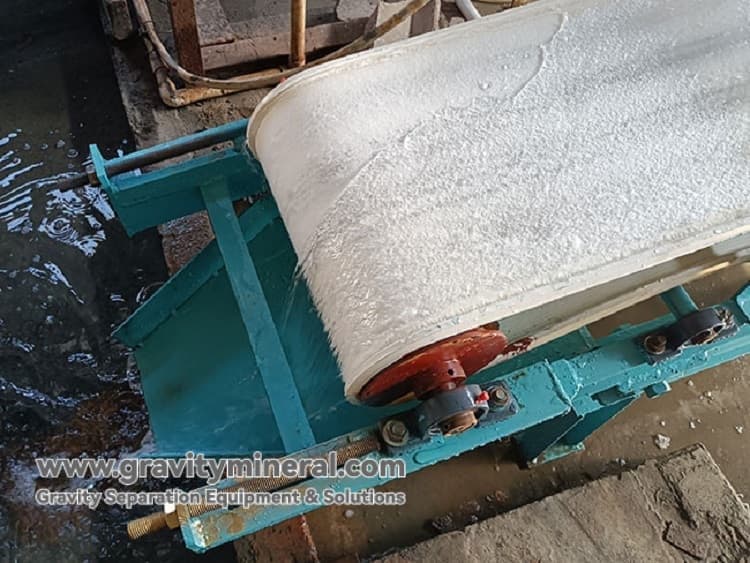
Miner's moss (gold-catching carpet) fiber interception, continuously capturing ultrafine heavy minerals below -80 mesh |
| Feed density |
Optimal feed density below 35% |
| Feed size |
5 - 100 mm (feed size range) |
| Recovery size |
Below -80 mesh (0.18 mm); 40% higher recovery of -0.074 mm (200 mesh) |
| Motor power |
2.2 - 4.0 kW (graded by model) |
| Operating mode |
Pure physical gravity + vibration, zero chemical additives, eco-friendly operation |
| Recovery and cleaning |
Periodically stop feeding, keep the water clear, remove and rinse the gold-catching carpet into a trough for further cleaning |
From a Single Machine to Complete-Line Integration, With No Outsourced Responsibility
GravityMineral has focused on gravity separation for 20 years, with a market share of about 35% and products exported to over 50 countries and regions. The company owns two in-house manufacturing bases and an in-house design team; core equipment is self-produced and processes are designed in-house, so the responsibility chain has no gaps. A suspended vibrating blanket concentrator is rarely used in isolation — its recovery rate depends on upstream screening size, feed density and downstream cleaning interfaces. The length, width and feed density of the vibrating blanket are set according to process data and share the same source as the complete-line design drawings, avoiding the disconnect of "equipment that doesn't fit the flow once purchased."
- In-house manufacturing base: Core equipment is produced at GravityMineral's two in-house manufacturing bases, with full quality control from raw material procurement through machining, assembly and no-load test runs; every machine has strict inspection records before leaving the factory.
- ISO9001 quality system: The company is ISO9001 certified, and its products have earned qualifications such as S-certified supplier and National High-Tech Enterprise.
- Complete-line interface matching: Jigs, shaking tables, spiral chutes, centrifuges and the vibrating blanket have unified throughput calculations, reducing blockages and idle running and avoiding capacity mismatches between suppliers.
- Global delivery experience: Products have been exported to over 50 countries, with familiarity in logistics and customs clearance for major markets including Africa, Southeast Asia, South America, the Middle East, Central Asia, South Asia and Australia.
- Delivery and after-sales: ISO9001 full-process quality control, on-site engineers guiding installation and commissioning, a one-year warranty, and long-term spare parts and process optimization support.
Suspended Vibrating Blanket Concentrator FAQ
Q1: How is gold recovered from the gold-catching carpet?
Periodically stop feeding and keep the water clear. Remove the gold-catching carpet (miner's moss) from the sluice and rinse it thoroughly into a trough. Then transfer the highly concentrated material in the trough to a 6-S shaking tableor gold pan for final cleaning.
Q2: What does "-80 mesh" mean?
Mesh refers to the number of openings per square inch of screen. "-80 mesh" means particles smaller than 0.177 mm (177 microns). Such particles are extremely fine, resembling powdered sugar. Traditional sluices struggle to capture gold particles this fine, so a vibrating blanket concentrator is indispensable.
Q3: How does a suspended vibrating blanket concentrator differ from a traditional sluice carpet?
A traditional sluice carpet relies entirely on water flow to keep sand and gravel moving; once the flow slows, it compacts and hardens, causing fine gold loss. This unit uses suspended high-frequency reciprocating transmission to continuously disturb the mineral bed, completely solving the compaction problem and allowing ultrafine heavy minerals to sink steadily into the carpet fibers.
Q4: How fine a material can a suspended vibrating blanket handle?
Designed for the recovery of -80 mesh (below 0.18 mm)material, it can raise the recovery rate of -0.074 mm (200 mesh) minerals by 40%, making it a key unit for capturing fine gold, tungsten, tin and rare earth elements.
Q5: Are there requirements for feed density and particle size?
The optimal feed density of all models is below 35%, with a feed size range of 5-100 mm. Excessive density impairs stratification and capture; it is recommended to determine the optimal feed density during the test stage.
Q6: Can a suspended vibrating blanket serve as a tailings scavenging unit?
Yes. The unit is often placed at the end of the plant as a "scavenging unit", capturing lost valuable minerals before waste is sent to the old tailings pond. Common associated equipment includes fiberglass spiral chutes、6-S shaking tableandcentrifugal concentrators。
Q7: What routine maintenance does the unit need?
Regularly check the drive and motor operation of the suspended drive system, and the compaction and wear of the gold-catching carpet fibers; periodically remove and rinse the carpet. Compared with manual sluice cleaning, it can cut labor costs by 80%, and the suspended drive can reduce energy consumption by 60% versus heavy jigs.
Q8: Which models of suspended vibrating blanket are available? How do I select?
Available in 1200 mm and 1400 mm widths and 6000-10000 mm lengthsin six specifications, with a capacity of 50-90 t/d. Selection mainly depends on target throughput, site dimensions and feed conditions; specific configurations should be confirmed by engineers based on ore type and capacity requirements.
Q9: How are delivery time and after-sales for the suspended vibrating blanket guaranteed?
The core manufacturing cycle for a standard vibrating blanket concentrator is about 30-60 days, and in-house base scheduling is less affected by external supply chains; non-standard customization (special sizes or materials) takes correspondingly longer, with a clear delivery schedule stated in the contract. The warranty lasts one year, with long-term spare parts supply, technical consultation and process optimization advice afterwards.
Get a Suspended Vibrating Blanket Concentrator Selection Proposal and Quotation
Tell us your ore type, feed grade, target capacity (t/d), feed size, water supply conditions and site dimensions, and GravityMineral engineers will prepare an equipment selection proposal, process flow route and transparent quotation for you.
You can reach us through the contact details on our website or contact the sales engineer for your region directly for selection advice.