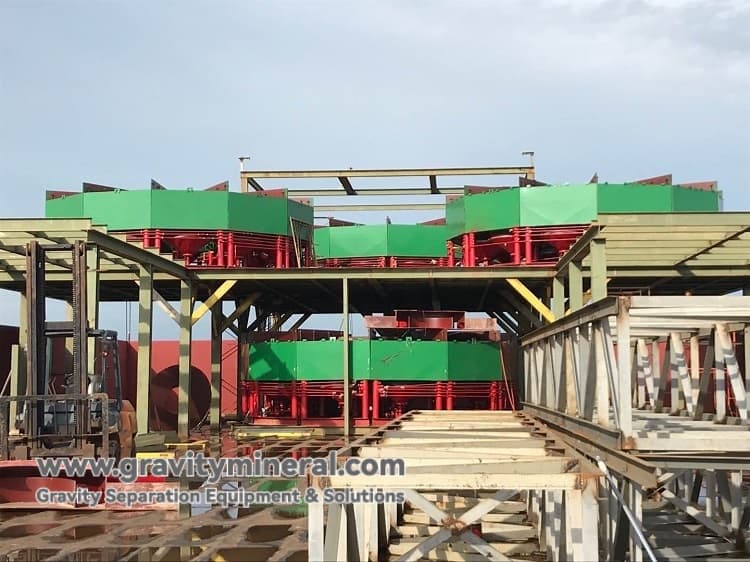
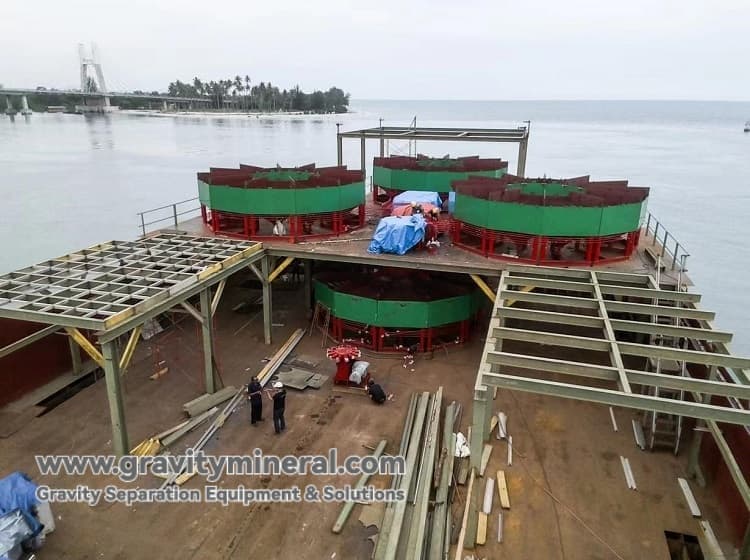
Offshore Tin Placer Gravity Concentration Plant – Dredge Mining Solution: Offshore tin placer deposits (seabed cassiterite sands) represent an increasingly vital marine mineral resource, characterized by consistent ore grades, vast recoverable reserves, and lower extraction costs compared to hard-rock mining. However, processing placer ore at sea presents unique engineering challenges, primarily constrained by limited vessel deck space and the highly corrosive marine environment.
GravityMineral pioneered a highly efficient onboard pre-concentration + onshore upgrading and purification processing model purpose-built for offshore dredge mining operations. By deploying high-capacity (300–1,500 t/h) sand extraction, screening, and jiggling systems directly aboard dredging vessels (bucket ladder or cutter suction dredgers), 99% of barren sand is immediately returned to the seabed. The resulting rough concentrate is then transported to onshore shaking table facilities for final concentration, followed by drying and three-disc magnetic separation for impurity removal. This turnkey solution has become the industry benchmark for large-scale offshore tin placer dredge gravity concentration processing lines.
What is Offshore Tin Placer Ore?
Offshore tin placer ore consists of tin-bearing alluvial and marine sediments found in ancient riverbeds and nearshore depositional environments. Prolonged exposure to wave action has achieved complete liberation of cassiterite from gangue minerals. Unlike onshore primary hard-rock tin deposits, offshore tin placer ore requires no crushing or grinding—cassiterite can be recovered directly through gravity concentration.
The core challenge of offshore tin placer gravity concentration lies in the extremely limited deck space aboard dredging vessels, the demand for exceptional seawater corrosion resistance, and the requirement for stable operation under dynamic sea conditions. GravityMineral’s standard offshore tin placer gravity concentration flowsheet adopts a modular design of “onboard jig pre-concentration + onshore shaking table upgrading + drying and magnetic separation for impurity removal,” satisfying marine engineering requirements while ensuring a final concentrate grade of Sn ≥ 60%.
20 YearsSpecialized in gravity concentration equipment manufacturing
50+ CountriesDredge tin gravity concentration lines exported and commissioned
500+ ProjectsGlobal gravity concentration project experience database
35%China gravity concentration equipment market share
Three-Stage Dredge Tin Placer Gravity Concentration Flowsheet
Our phased engineering design maximizes the purity of the final commercial-grade tin concentrate while minimizing the required footprint of the offshore dredge mining platform.
Stage 1: Onboard Pre-Concentration System
Operates directly aboard the dredging vessel, instantly discharging barren sand back to the sea.
- Slurry Pumping: High-power, corrosion-resistant slurry pumps extract seabed ore slurry. The intake is fitted with a debris screen to block large shells and rock fragments.
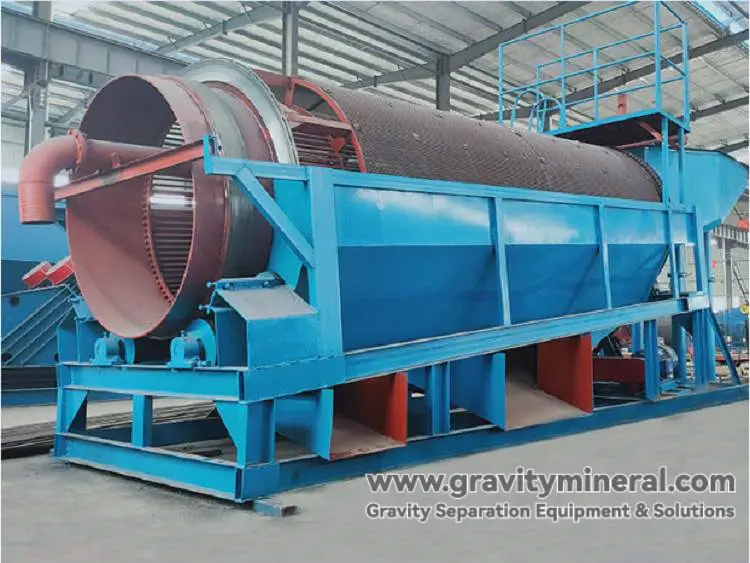
- Onboard Screening: The slurry is pumped into a dual-deck, corrosion-protected marine trommel screen for rapid particle size classification.
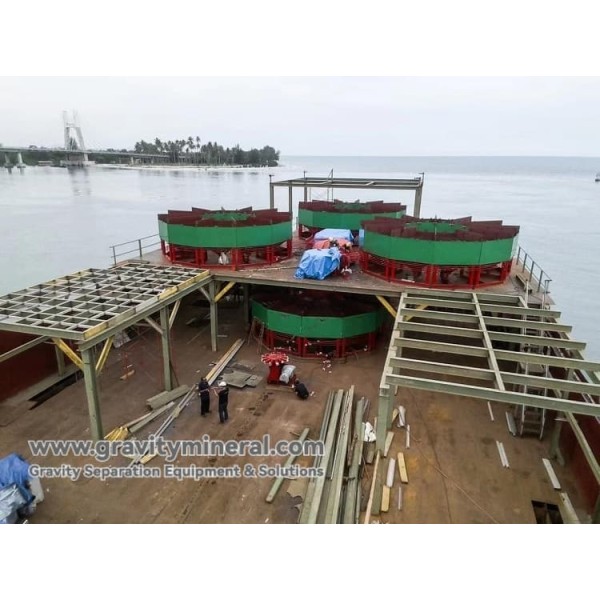
- Specific Gravity Separation: Classified slurry feeds marine-grade mineral separators. A hydraulic radial jig recovers coarse particles (5–10 mm), while a sawtooth wave jig captures fine particles (0.5–5 mm). Heavy tin concentrate is stored in the vessel hold; light sand is discharged back to the sea.
Stage 2: Onshore Wet Concentration System
Conducted onshore, producing high-grade mixed concentrate via shaking tables.
- Concentrate Transfer: Rough jig concentrate is transported to the onshore processing facility.
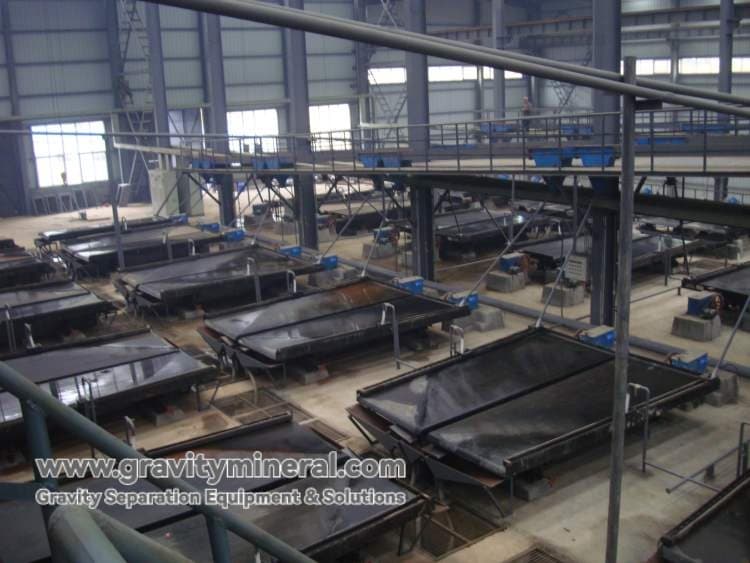
- Shaking Table Concentration: The rough concentrate is processed through a large parallel array of 6-S shaking tables, which perform precision density separation to reject residual heavy gangue minerals.
- Tailings Dewatering: Onshore tailings can be processed through an optional filter press for dry-stack disposal, protecting the local coastline.
Stage 3: Drying & Magnetic Purification
Dry magnetic separation ensures the final product meets metallurgical-grade specifications.
- Drying: Shaking table concentrate enters an indirect rotary dryer (80–120 °C) for moisture removal, preparing the material for high-intensity magnetic separation.
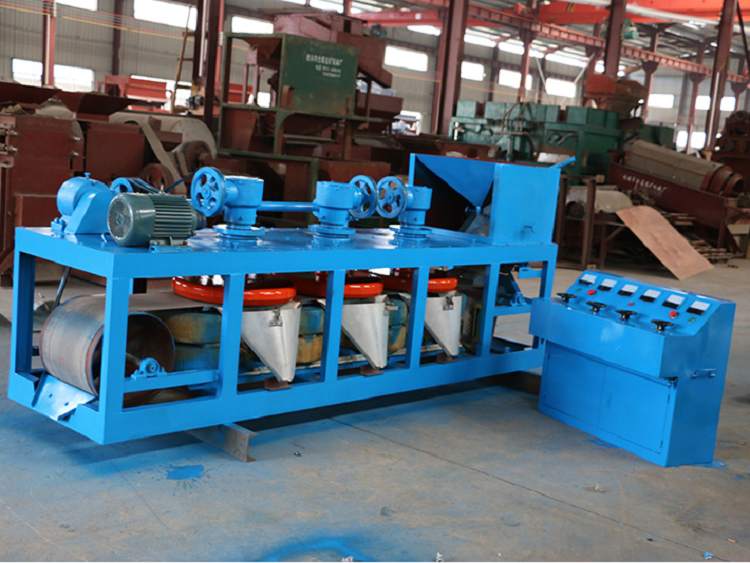
- High-Intensity Magnetic Separation: Dried material is fed into a three-disc magnetic separator, using high-intensity magnetic fields to deeply remove associated minerals such as magnetite and ilmenite.
- Final Product: The system consistently produces premium, commercial-grade tin concentrate (Sn ≥ 60%).
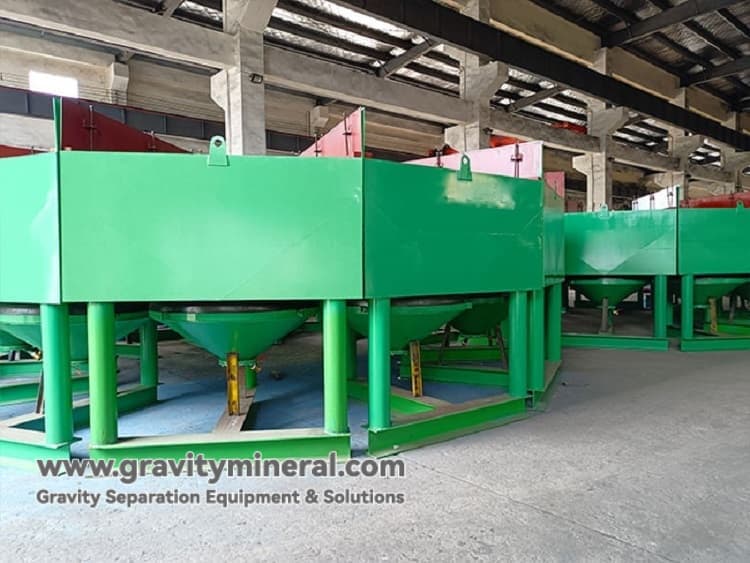
Core Equipment Configuration – Offshore Tin Placer Gravity Concentration Line
The key barriers to offshore tin placer gravity concentration are extreme space compression aboard the vessel and resistance to salt-spray corrosion. The table below lists the standard core equipment and operational stages for a dredge tin gravity concentration processing line.
| Operational Zone |
Primary Equipment |
Technical Features |
Processing Capacity |
| Offshore (Dredge) |
Heavy-Duty Slurry Pump |
Corrosion-resistant design with heavy-duty debris screen at intake. |
300 – 1,500 t/h |
| Offshore (Dredge) |
Marine Trommel Screen |
Dual-deck construction, fully treated for seawater corrosion resistance. |
Matched to pump |
| Offshore (Dredge) |
Hydraulic Radial Jig |
High throughput, wave-swell tolerant, instantly recovers coarse-grained (5–10 mm) cassiterite. |
Vessel-dependent |
| Offshore (Dredge) |
Sawtooth Wave Jig |
Efficient recovery of fine-grained (0.5–5 mm) cassiterite, compact footprint. |
Vessel-dependent |
| Onshore |
6-S Shaking Table Array |
Multiple units in parallel for final high-grade wet concentration. |
Parallel configuration |
| Onshore |
Indirect Rotary Dryer |
80–120 °C. Dries shaking table concentrate in preparation for magnetic separation. |
Custom-matched |
| Onshore |
Three-Disc Magnetic Separator |
Magnetic field up to 18,000 Gs. Deep removal of magnetite and other impurities. |
Custom per capacity |
| Onshore |
Filter Press (Optional) |
Tailings dewatering to prevent coastal water pollution. |
Ancillary design |
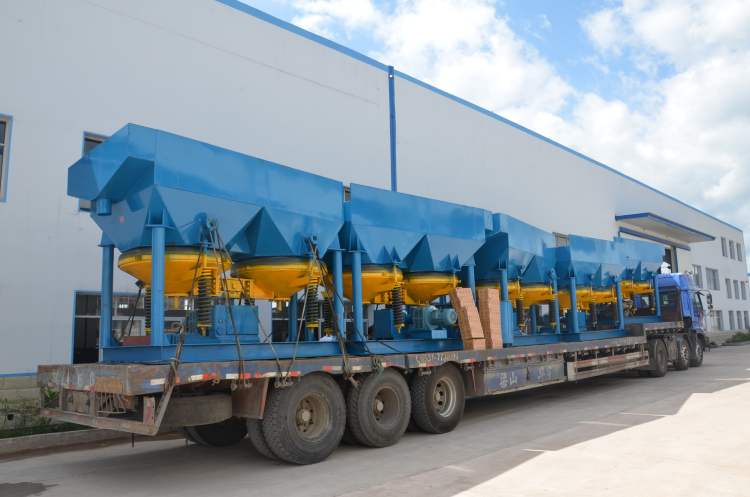
Technical Advantages & Adaptability
Project Performance Metrics
- High Processing Capacity: Vessel-mounted systems at 300–1,500 t/h, flexibly configured to vessel dimensions.
- High ROI: Seawater is used directly as process water; tailings are discharged instantly back to sea, reducing operating costs by over 60% compared to onshore processing.
- Final Concentrate Grade: Sn ≥ 60% commercial-grade tin concentrate after drying and magnetic separation.
- Wave-Tolerant Stability: Gravity concentration equipment features a simple mechanical design with exceptional resistance to wave-induced vessel motion.
Marine-Grade Corrosion Protection & Environmental Compliance
- Superior Corrosion Resistance: Heavy-duty anti-corrosion coatings, marine-grade alloys, and fiberglass-reinforced polymer (FRP) components.
- Dry Stack Tailings: Onshore tailings are dewatered via filter press and dry-stacked, safeguarding the coastline.
- Water Recycling: Process water in the onshore concentration stage is fully recycled, dramatically reducing freshwater consumption.
Why Choose GravityMineral for Dredge Tin Placer Gravity Concentration Lines
Offshore tin placer mining typically faces pain points including restricted vessel deck space, wave-induced vessel motion, and severe high-salinity corrosion. The mineral processing industry does not lack equipment—it lacks a partner who masters both gravity concentration flowsheet design and marine-grade equipment fabrication, ensuring seamless integration across the entire processing chain.
| Common Challenge |
GravityMineral Solution |
| Limited dredge deck space cannot accommodate extensive equipment |
Adopts a phased “onboard jig pre-concentration + onshore shaking table upgrading” design, drastically reducing vessel-mounted equipment footprint. |
| Severe seawater corrosion rapidly degrades standard equipment |
Full suite of marine-grade anti-corrosion engineering (protective coatings, marine alloys, FRP components). |
| Wave-induced vessel motion destabilizes separation performance |
Deploys wave-tolerant hydraulic radial jigs and shaking tables, ensuring continuous operation even in adverse sea states. |
| Rough concentrate has high iron content, limiting market value |
Onshore upgrading stage includes a rotary dryer and three-disc high-intensity magnetic separator for deep iron removal, upgrading tin concentrate to Sn ≥ 60%. |
- 20 Years Focused on Gravity Concentration: Two decades of dedicated manufacturing in spiral concentrators, jigs, and shaking tables—with a proven track record matching equipment selection and flowsheet design to specific ore conditions and particle sizes.
- Full Marine-Grade Corrosion Protection: From slurry pumps and trommel screens to jigs, all equipment features heavy-duty anti-corrosion coatings and marine-grade alloy construction.
- 50+ Countries, 500+ Global Projects: Real-world installations in Southeast Asian offshore dredge tin mining, African alluvial tin, and South American placer tin deposits serve as the ultimate proving ground for equipment reliability and adaptability.
- Six Official Certifications: ISO 9001, S-Certified Supplier, National High-Tech Enterprise, Jiangxi Province Specialized & Innovative SME, AA-Grade Contract-Honoring Enterprise, Top Taxpayer.
Dredge Tin Placer Gravity Concentration Line – Pricing & Investment Reference
Investment in offshore tin placer mining projects has no uniform quotation—even lines with identical throughput vary enormously in equipment configuration and capital cost depending on head grade, sea conditions, vessel dimensions, and site conditions. GravityMineral does not quote “inflated prices” detached from actual ore conditions. Instead, we calculate the total cost of ownership across the following cost structure:
- Equipment Investment: Marine stage (heavy-duty slurry pumps, marine trommel screens, jigs), onshore upgrading stage (6-S shaking tables), drying & magnetic separation stage (rotary dryer + three-disc magnetic separator), tailings handling stage (filter press).
- Free Flowsheet Design: Process flow design, equipment selection and configuration, and plant layout drawings are completed by GravityMineral’s in-house engineering team—no external design institute required.
- Civil Works & Installation Labor: Onshore civil construction and general installation labor are organized locally by the client; GravityMineral engineers provide on-site technical supervision.
- Operating Expenditure (OPEX): Gravity concentration uses zero reagents; seawater is used directly as process water and tailings are discharged instantly, reducing OPEX by over 60% compared to onshore processing.
- Lead Time & Cash Flow: Core standard equipment fabrication takes approximately 40–60 days; full turnkey EPC projects from contract signing to commissioning typically require 7–12 months.
Provide GravityMineral with your ore type, head grade, target throughput (t/h), feed particle size, and site conditions, and our engineers will leverage the 500+ global project database to deliver a transparent equipment selection list and quotation.
From Flowsheet Design to Commissioning: GravityMineral’s Service Process
GravityMineral does not simply sell equipment—we provide full-lifecycle services spanning mineral analysis, process flow design, equipment manufacturing, and on-site commissioning. Dredge tin placer gravity concentration projects progress through the following milestones:
- Requirements Consultation (3–7 days): Provide ore type, head grade, target throughput, feed particle size, and site conditions. GravityMineral delivers a preliminary solution direction at no cost.
- Flowsheet Design & Quotation (7–15 days): Engineers integrate orebody characteristics with the 500+ global project database to finalize the gravity-magnetic combined flowsheet, issuing equipment selection plans and quotations simultaneously.
- Detailed Engineering Design (15–30 days): Process flow diagrams, equipment schedules, plant layout drawings, and civil interface drawings are completed by the in-house design team—no outsourcing.
- Equipment Manufacturing (40–60 days): Production scheduled across two proprietary manufacturing bases, with full quality control from raw material to factory acceptance testing.
- Shipping & Logistics (30–60 days) + On-Site Commissioning (60–150 days): Engineers supervise installation, individual and integrated commissioning, and operator training. Delivery is complete only when performance targets are met.
Standard mineral processing EPC turnkey projects typically require 7–12 months from contract effectiveness to target production.
Related Gravity Concentration Solutions
Beyond offshore tin placer deposits, GravityMineral’s gravity concentration solution library covers mainstream hard-rock and placer ore types, enabling us to match relevant historical experience to your scenario:
Frequently Asked Questions on Offshore Tin Mining (FAQ)
Q1: Why is the flowsheet split into onboard and onshore stages?
A: Deck space aboard a dredging vessel is extremely expensive and limited. Shaking tables—essential for final purification—occupy substantial floor area and are sensitive to wave-induced vessel motion. By using jigs onboard (compact, wave-tolerant) to reject 99% of barren sand back to the sea, we only need to transport a small volume of heavy concentrate to stable onshore shaking table facilities.
Q2: How does the equipment withstand the corrosive seawater environment?
A: Conventional mining equipment rapidly corrodes and fails upon contact with seawater and wave spray. All our offshore mining equipment—including slurry pumps, trommel screens, and jigs—is purpose-designed and manufactured with heavy-duty anti-corrosion coatings, marine-grade alloys, and FRP components to ensure long-term durability in extreme submerged conditions.
Q3: What is the approximate cost of a complete offshore tin placer gravity concentration plant?
A: Since offshore tin placer ore does not require expensive crushing and grinding circuits, total capital investment is only a small fraction of that for primary hard-rock deposits. Specific cost depends on your target throughput (t/h) and vessel dimensions. GravityMineral will provide a transparent equipment list and quotation covering slurry pumps, trommel screens, jigs, shaking tables, and magnetic separators after assessing your ore conditions.
Q4: How do jigs maintain separation performance amid vessel motion?
A: GravityMineral specifically configures hydraulic radial jigs and sawtooth wave jigs for offshore operations. These units have no complex transmission mechanisms, feature a low center of gravity, and exhibit strong resistance to vessel roll and pitch. Additionally, our commissioning engineers set the jig stroke and pulsation water frequency based on local wave amplitude during on-site tuning, ensuring stable heavy mineral capture even in adverse sea conditions.
Q5: Why add drying and three-disc magnetic separation after the onshore shaking table stage?
A: Offshore tin placer deposits commonly contain associated magnetite and ilmenite. While shaking tables can separate heavy minerals by specific gravity, they cannot completely remove iron-bearing gangue. The concentrate must first be dried to remove moisture, then fed into a three-disc high-intensity magnetic separator to exploit magnetic susceptibility differences and reject iron minerals—thereby upgrading tin concentrate to a commercial-grade standard of Sn ≥ 60%.
Q6: Does discharging tailings back to the sea cause environmental pollution?
A: No. Gravity concentration is a purely physical separation process with zero chemical reagent addition. The tailings returned to the sea are ordinary beach sand from which cassiterite and heavy minerals have been removed, containing no toxic substances and fully compliant with modern marine environmental regulations.
Q7: Southeast Asia has long monsoon seasons—will offshore equipment be affected?
A: Considering the Southeast Asian climate profile, GravityMineral equipment can receive additional anti-corrosion coating treatment, and motors are equipped with high-grade waterproof and moisture-proof protection. During monsoon seasons with elevated wave heights, we recommend suspending operations when sea conditions exceed safe wind and wave thresholds. All vessel-mounted equipment features a modular quick-release design, enabling rapid resumption of production once conditions improve.
Q8: How is the rough concentrate transferred from the vessel to shore?
A: The rough concentrate enriched by onboard jigs occupies an extremely small volume (less than 1% of the feed ore). It can be packed in sealed bulk bags (FIBCs) or transferred periodically to the onshore base via small barges or helicopters. Due to the minimal volume, logistics costs are negligible.
Global Offshore Tin Mining Project Installations
EPC Turnkey: End-to-End Marine Gravity Concentration Engineering Services
GravityMineral provides complete turnkey solutions for offshore placer tin mining operations worldwide:
- Process & Vessel Design: Customized flowsheet planning and layout design tailored to your offshore mining platform.
- Equipment Manufacturing & Supply: Marine-grade pumps, screening equipment, and jigs, complemented by onshore shaking tables, dryers, and magnetic separators.
- Commissioning & Training: Global engineer deployment for vessel installation supervision, system commissioning, and operator training. Delivery is complete only when performance targets are met.
- After-Sales & Optimization: Quality warranty coverage, followed by spare parts supply, technical consultation, and process optimization post-warranty, with response within 24 hours.
Contact GravityMineral’s marine metallurgy specialists today for a customized offshore plant layout and equipment quotation.