







How Can the Combined Exogenous Gold Re-grinding and Cyanidation Process Improve Recovery Rates? Professional Solutions to Help You Extract Gold Efficiently
First, the conclusion: The key to improving the recovery rate of exogenous gold (free gold—that is, gold found in ore fractures or gangue that is not tightly bound to host minerals) does not lie in the cyanidation stage itself, but rather in whether coarse-grained gold has been recovered in advance, prior to cyanidation.Early recovery via gravity separation, with cyanidation serving as a backup—this two-pronged approach is generally more reliable than relying solely on whole-ore cyanidation. In many processing plants, recovery rates have remained persistently low over the long term, and the problem often stems from a failure to clearly define the boundaries of this division of labor.
Key Conclusions at a Glance
- Exogenous gold exhibits uneven grain size distribution; coarse-grained free gold is recovered early via gravity separation, while fine-grained gold is handled by cyanide leaching as a backup. This constitutes the fundamental division of labor in the gravity separation combined with cyanide leaching process for exogenous gold.
- Integrating the gravity separation stage into the grinding circuit to recover coarse-grained gold before it is overground reduces losses during cyanidation—this is a critical step in improving exogenous gold recovery rates
- Gravity concentration concentrates can be directly monetized, shortening the cash recovery cycle and, to a certain extent, offsetting the costs of the subsequent cyanidation stage
- The configuration of process stages and the matching of equipment interfaces often have a greater impact on final performance indicators than the performance of individual machines.
- The extent of recovery rate improvement depends on the ore\'s density differences and mineral distribution characteristics; it must be based on mineral processing test data and should not deviate from pre-set targets based on ore properties
Industry Background: What Are the Bottlenecks in Recovery Rates at Exogenic Gold Processing Plants?
A typical characteristic of exogenic gold ore is that gold exists primarily in a free state, with particle sizes ranging from several millimeters to several micrometers. Coarse-grained gold is relatively easy to liberate as individual particles, while fine-grained gold is often associated with gangue or sulfide minerals. This mixed distribution of coarse and fine particles makes it difficult for a single process to effectively handle all particle sizes.
Whole-ore cyanidation is effective for fine-grained gold, but coarse-grained gold dissolves relatively slowly in leaching tanks and is prone to being lost with the tailings when the retention time is insufficient.Pure gravity separation has limited recovery capacity for ultrafine gold, and centrifugal separators primarily handle coarser fine-grain fractions. The real challenge for exogenic gold processing plants is not determining which process is superior, but rather identifying which process stage should handle each specific grain size.
Another source of loss that is easily overlooked is overgrinding. Gold minerals are brittle; when grinding time is too long, coarse gold is ground into fine slurry, making it difficult to recover via gravity separation, while cyanide leaching efficiency decreases due to the gold being encapsulated in the slurry.Profit losses caused by overgrinding are common in both bedrock gold and placer gold processing plants and are a priority issue that must be avoided in the combined gravity separation and cyanide leaching process for exogenic gold.
Technical Principle: The Division of Labor Between Early Recovery in Gravity Separation and Cyanidation as a Backup
Gravity separation utilizes the density difference between gold and gangue minerals for separation.Gold has a density of approximately 19.3 g/cm³, while common gangue minerals typically range from 2.6 to 3.0 g/cm³, resulting in a significant density difference. Coarse, free-standing gold in exogenic deposits exhibits favorable density conditions, and jigs, shaking tables, and centrifugal separators all possess proven separation capabilities.
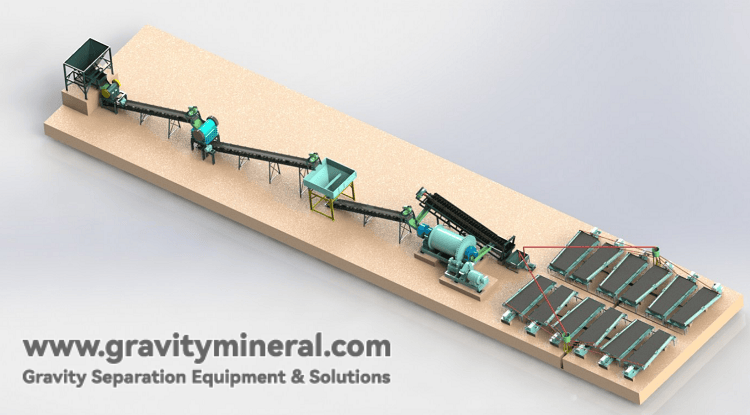
By integrating the gravity separation stage into the grinding circuit, the underflow from the classifier first undergoes roughing in a jig, and the rough concentrate is then sent to a shaking table for fine concentration, producing a gold concentrate that is directly monetized. The gravity tailings are combined with the classifier overflow and fed into the cyanide leaching stage to recover fine-grained and entrapped gold.
The core of this integrated process lies in clearly defined boundaries of division of labor: coarse-grained gold that can be recovered at low cost via gravity separation is not sent to the cyanidation stage; the cyanidation stage processes only the portion that cannot be recovered by gravity separation, thereby reducing reagent consumption and leaching time.The key to improving recovery rates in the combined gravity-cyanidation process for exogenic gold lies in how accurately this boundary is defined.
Process Flow: Step-by-Step Breakdown
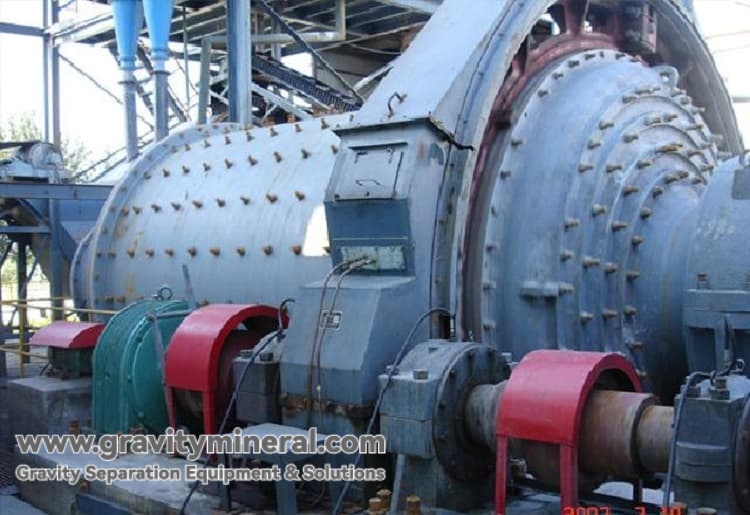
Step 1: Crushing and Grinding. The ore is coarsely crushed by a jaw crusher, then medium- and fine-crushed by a cone crusher before entering a ball mill or rod mill.The grinding fineness is determined based on beneficiation tests; for exogenic gold, it is typically necessary to balance the requirements of individual liberation and the prevention of over-grinding. Rod mills are relatively gentle on brittle gold minerals and should be prioritized when conditions permit.
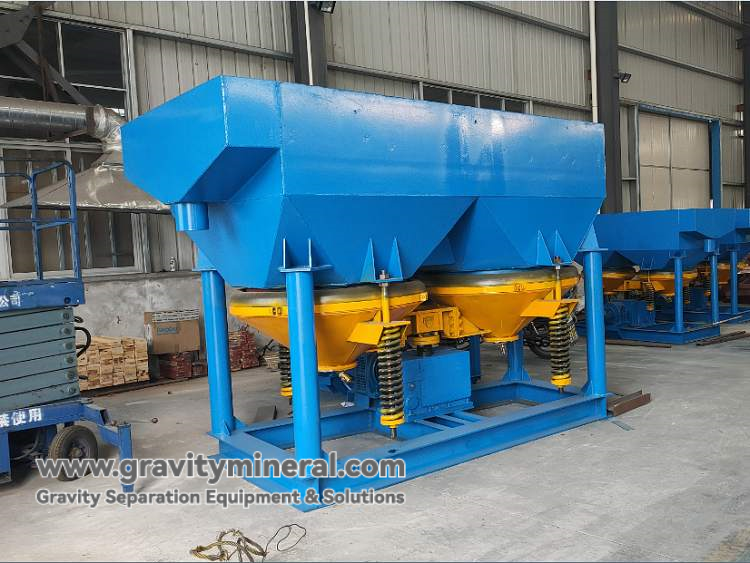
Step 2: Gravity Separation—Early Recovery Stage. The sand fraction from the classifier enters a sawtooth-wave jig for roughing. The jig stroke and stroke rate are adjusted based on the density difference of the ore and the feed particle size.The rough concentrate from the jigging process is sent to a 6-S shaking table for fine selection; the shaking table\'s incline and stroke rate are set in accordance with the feed particle size to produce qualified gold concentrate. A centrifuge may be added to recover ultrafine gold from the fine fraction.
Step 3: Cyanide leaching of gravity separation tailings. The gravity separation tailings are combined with the overflow from the classifier, dewatered in a thickener, and then fed into the leaching tank. Sodium cyanide concentration, leaching time, and pH are controlled based on test data.When the content of associated sulfide minerals is high, a flotation desulfurization stage may be added prior to leaching to reduce the consumption of cyanide by sulfides. The choice between carbon-in-leach (CIL) or carbon-in-pulp (CIP) processes depends on site conditions.
Step 4: Concentrate dewatering and tailings treatment. The gold concentrate from gravity separation is processed via a dewatering screen and filter press before being transported off-site for sale. Cyanide tailings are either dry-discharged via filter press or sent to a tailings pond, with the filtrate recycled for reuse.
Comparison of Processes: Differences Between Standalone Cyanidation and Gravity Separation Combined with Cyanidation
| Comparison Criteria | Single-stage whole-ore cyanidation | Gravity Separation Combined with Cyanidation |
|---|---|---|
| Coarse-grain gold recovery | Leaching rate is relatively slow; significant losses occur when residence time is insufficient | Early recovery in jigging and shaking tables improves coarse gold recovery conditions |
| Fine-grain gold recovery | High leaching efficiency; this is the process\'s strongest stage | The cyanidation stage acts as a safety net, with efficiency comparable to that of single-stage cyanidation |
| Risk of overgrinding | Requires grinding to a relatively fine particle size, posing a relatively high risk of overgrinding and slime formation | After early recovery in the gravity separation stage, the ore can be ground to a slightly coarser size to reduce the risk of overgrinding |
| Chemical Consumption | Since the entire ore volume is leached, sodium cyanide consumption is relatively high | Leaching of tailings only results in relatively lower reagent consumption |
| Product Form | All-in-one gold; cash recovery cycle is affected by the smelting process | Gravity-concentrated gold concentrate can be priced directly, resulting in relatively faster cash flow |
| Process Complexity | Relatively simple | Involves an additional gravity separation stage, but the equipment is mature and operations are controllable |
It should be noted that this comparison is not intended to dismiss cyanidation. Cyanidation\'s ability to recover fine-grain gold is difficult for gravity separation to replace; the two processes are complementary. The key to improving recovery rates in the combined gravity separation and cyanidation process for exogenic gold lies precisely in this division of labor.
Equipment Configuration Reference
| Process Stage | Core Equipment | Configuration Key Points |
|---|---|---|
| Primary Crushing | Jaw Crusher | Select based on the maximum feed size and processing capacity of the raw ore |
| Medium and Fine Crushing | Cone Crusher or Hammer Crusher | Must be compatible with the discharge size of the primary crusher and the feed size of the mill |
| Grinding and Classification | Ball mill or rod mill paired with a spiral classifier | Grinding fineness is determined by testing; rod mills help prevent over-grinding |
| Gravity Separation—Rough Concentration | Sawtooth-wave jig | Adjustable stroke and frequency to accommodate a wide range of feed particle sizes |
| Gravity Concentration—Scavenging | 6-S shaking table | Incline and stroke rate are adjusted in conjunction to set the feed particle size |
| Recovery of Fine Particles | Centrifugal ore separator | Coverage of finer-grained gold minerals |
| Leaching | Leaching Tanks and Carbon-in-Leach Tanks | Sodium cyanide concentration and pH controlled based on test results |
| Dewatering | Thickener and filter press | Separate processing of concentrate and tailings |
Equipment selection is not necessarily about choosing the most expensive option; interface compatibility is more important. The processing capacities of the jig and shaking table must be aligned; material blockages or idle operation in intermediate stages will result in hidden waste.When the same team is responsible for both process design and equipment manufacturing, it is easier to align the production capacities of the crushing, grinding, gravity separation, and dewatering stages, thereby reducing system incompatibilities caused by piecing together equipment from different suppliers.
Economic Analysis: The Cost Implications Behind Higher Recovery Rates
| Indicators | Single-stage cyanidation | Gravity Separation Combined with Cyanidation | Rationale for Changes |
|---|---|---|---|
| Coarse-Grain Gold Recovery | Benchmark | Typically improved | Early recovery of coarse-grained free gold via gravity separation |
| Sodium Cyanide Consumption per Unit | Benchmark | Tending to decrease | Reduced leach ore volume and lower sulfide interference |
| Energy consumption for grinding | Baseline | May decrease moderately | After early recovery in gravity separation, the grinding fineness can be appropriately coarsened |
| Product cash collection cycle | Relatively long | Somewhat shorter | Gold concentrate can be priced and sold directly |
| Process investment | Relatively low | Increased investment in the gravity separation section | Equipment is mature, and incremental investment is relatively manageable |
The above directions for change are for reference only; the specific extent of adjustments must be determined based on the properties of the ore and test results. The potential for improving recovery rates depends on the density difference and the distribution of embedded particle sizes; it is not advisable to set targets without considering the specific characteristics of the ore.
Case Study: An Exogenic Gold Deposit in Yunnan
At a certain exogenic gold deposit in Yunnan, the gold grain size distribution is uneven, with a high proportion of coarse-grained gold. The original process involved whole-ore cyanidation, and recovery rates had long remained at a relatively low level; one of the main reasons was the insufficient residence time of coarse-grained gold in the leaching tanks.
The modification plan incorporated a jig for roughing and a shaking table for scavenging into the grinding circuit; the gravity concentration gold concentrate is directly monetized, while the gravity tailings are fed into the cyanide leaching process.Following the retrofit, the overall recovery rate improved, sodium cyanide consumption per unit decreased, and revenue from the gravity gold concentrate helped offset operating costs to some extent.
The key to this case lies not in the sophistication of the equipment, but in the placement of the gravity separation section. By positioning it within the grinding circuit to recover coarse-grained gold before it is ground to a fine size, the results are typically better than when the section is placed before or after grinding. When it comes to improving recovery rates in combined gravity separation and cyanidation processes for exogenic gold, the choice of location is often more critical than the selection of equipment.
Common Technical Issues
Conclusions and Recommendations
The core logic behind improving recovery rates in the combined gravity separation and cyanidation process for exogenic gold can be summarized as follows: coarse-grain gold is recovered early via gravity separation, fine-grain gold is recovered as a backup via cyanidation, and the gravity separation stage is integrated into the grinding circuit to prevent over-grinding. The configuration of process stages and the matching of equipment interfaces often have a greater impact on final performance indicators than the performance of individual machines.
If exogenous gold ore samples are available, it is recommended to first conduct mineral processing tests to determine the grain size distribution and density differences of the gold before finalizing the location of the gravity separation stage and equipment configuration. Building a plant without experimental data carries risks not in the cost of equipment, but in whether the performance targets can be met.