







How to Choose a Supplier for a Complete Production Line of Gold Ore Processing Equipment for Reclaimed Gold Mines with a Daily Processing Capacity of 300 Metric Tons?
Complete Production Line for a 300-Metric-Ton-Per-Day Gravity Concentration Gold Mine
A complete production line centered on jigging machines, spiral chutes, centrifugal separators, and shaking tables, which separates gold from gangue based on density differences; the focus is on process integration, not the length of the equipment list.
I. What Is This Solution?
Key Points of the Solution: A complete production line that relies on density differences to separate gold from gangue, with jigging machines, spiral chutes, centrifugal separators, and shaking tables as the core equipment.
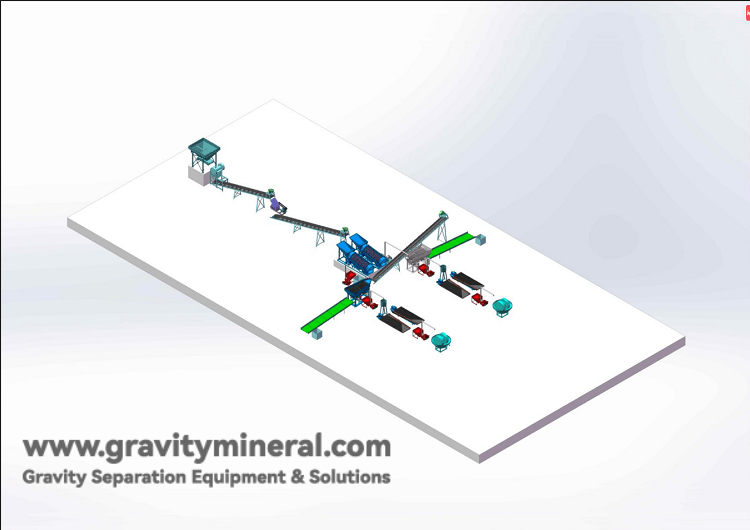
With a daily processing capacity of 300 metric tons—equivalent to a feed rate of approximately 12 to 13 metric tons per hour—this is classified as a medium-scale operation. The complete production line for gravity gold ore processing consists of four sequential stages: crushing and screening, grinding and classification, gravity separation, and concentrate dewatering.Even for the same 300-metric-ton capacity, the configuration differs significantly between re-washing and screening of placer gold ore and the crushing and grinding of lode gold ore. Therefore, the focus of a “complete” solution lies in process matching, not in the length of the equipment list.
II. What Problems to Solve
Key Points of the Solution: This solution primarily addresses three issues: the loss of coarse-grained free gold in tailings, uncontrollable chemical costs, and operational conflicts and accountability gaps resulting from piecemeal integration of equipment from multiple manufacturers.
In the grinding circuit, gold particles that have already been liberated end up in the tailings along with the slurry, which is the direct cause of low recovery rates. By installing gravity separation equipment in the gravity separation line at the grinding discharge or at the classification and sand settling stage, coarse gold particles can be intercepted as early as possible. Gravity separation does not consume reagents; its cost structure is simpler than that of flotation and is not affected by fluctuations in reagent prices.
An even more insidious problem lies with the supplier chain: when equipment is procured from different manufacturers, individual units may function properly, but when integrated, their processing capacities do not match, chute gradients are misaligned, and when problems arise, suppliers pass the blame onto one another. By having a single supplier coordinate the project—with equipment manufactured according to process drawings and interfaces and production capacities aligned from the design stage—there are no gaps in accountability.This solution is suitable for rock gold and placer gold deposits with a significant amount of coarse-grained free gold, as well as oxidized ores with moderate clay content and a low proportion of sulfide-encased gold.
III. Core Components and Principles
Key Points of the Solution: Four process stages arranged in series, with the core focus on particle size coordination and capacity matching between stages.
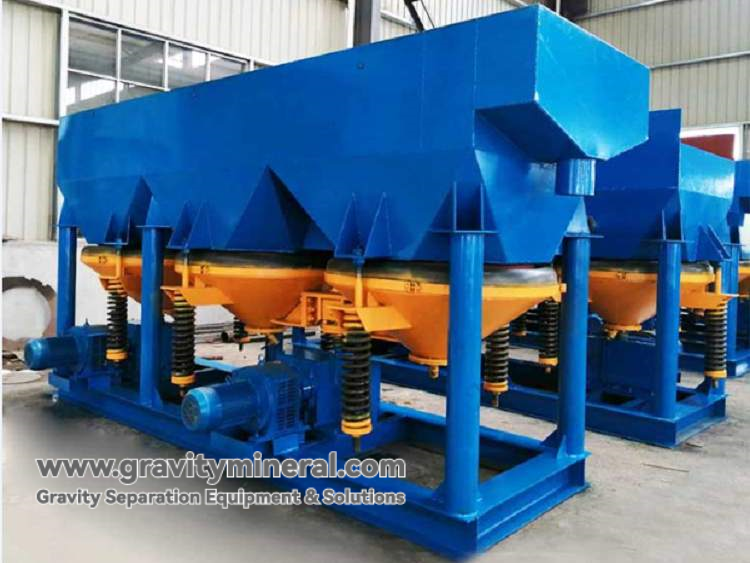
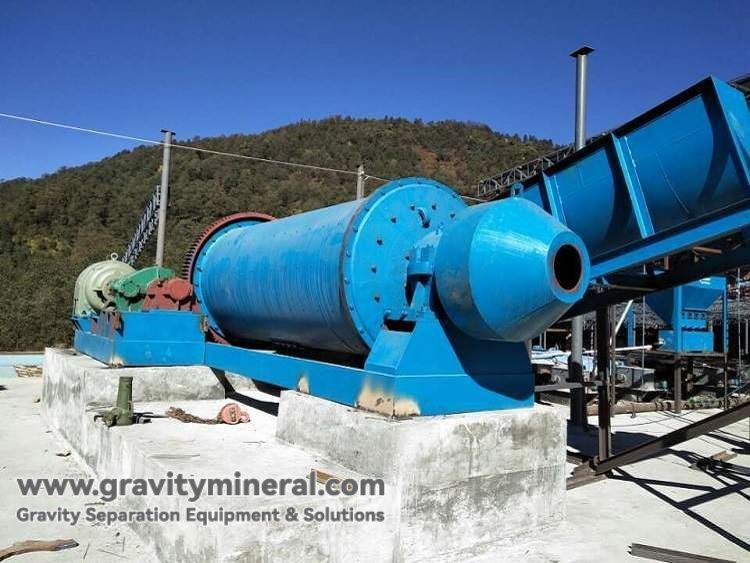
Crushing and screening reduce the ore to grinding size, adhering to the principle of “more crushing, less grinding,” where energy consumption in the crushing stage offsets energy savings in the grinding stage. Grinding and classification determine whether gold can be liberated; the ball mill and classifier operate in a closed-circuit configuration, with fineness determined by testing based on the grain size of the gold distribution.Gravity separation is the core process: the jig handles coarse particles for roughing; the spiral chute performs roughing or scavenging of medium- and fine-grained material; the centrifuge captures fine particles; and the shaking table performs final concentration to produce high-grade concentrate.A typical configuration involves feeding the mill discharge to the jig first, sending the tailings to the centrifuge, and combining the two concentrate streams for processing on the shaking table. Concentrate dewatering is accomplished using thickeners and filtration equipment.
The sorting logic of a complete gravity gold ore processing production line is to ensure that every particle of liberated gold is captured by the equipment matched to its specific particle size; the key lies in the coordination between particle size fractions, not in the selection of individual machines.
IV. Why Choose It
Key Features of the Solution: The process advantages include chemical-free operation, stable recovery of coarse-grain gold, and low environmental compliance requirements; whether these advantages can be fully realized depends on the supplier\'s ability to provide a closed-loop solution.
First, the operating cost structure is simple, with the main costs being electricity consumption and wear parts, and it is not affected by reagent prices. Second, the recovery of coarse free gold has been proven over the long term, allowing for significant operational flexibility when feed conditions fluctuate. Third, there are no reagent residues, tailings water treatment is brief, and water recycling rates are high.
Fourth, closed-loop accountability. A single supplier handles design, manufacturing, and commissioning; equipment is built according to process drawings; interface capacities are aligned from the design stage; design is not outsourced; and costs are not layered, avoiding situations where “the equipment arrives but no one knows how to commission it.”
The difference between a patchwork of equipment from multiple manufacturers and a complete production line lies not in the price of individual units, but in whether interface compatibility, capacity alignment, and accountability are centralized within a single team.
5. Applicable Scenarios and Limitations
Key Points of the Solution: Suitable for gold deposits with a significant proportion of coarse-grained free gold and moderate clay content; ore with fine-grained gold that is finely disseminated or encapsulated by sulfides should not rely solely on gravity separation.
Scenarios with Good Results: Alluvial gold deposits in riverbanks, terraces, and ancient riverbeds; sections of quartz vein-type rock gold deposits with a high proportion of coarse-grained gold; and oxidized ores with moderate or low clay content.Gravity separation is widely applied in alluvial gold deposits along riverbanks in regions such as Ghana and Sudan in Africa, as well as in tin and zirconium-titanium sand deposits in Southeast Asia.
Scenarios requiring caution: ores containing very fine gold grains encased in pyrite or arsenic-bearing minerals; highly clay-rich ores with high silt content, which require pre-washing to remove silt or the adoption of a combined processing flow; and difficult-to-process gold ores containing arsenic and carbon, where gravity separation can only recover the coarse-grained fraction.Another often-overlooked point: gravity separation is extremely sensitive to particle size distribution; mixing coarse and fine particles significantly reduces recovery efficiency. The effectiveness of the gravity separation stage is directly determined by the adequacy of upstream classification equipment—this is also the root cause of problems that often arise when multiple plants are pieced together haphazardly.
VI. Implementation
Key Points of the Plan: Determine the process flow through testing; determine equipment configuration based on the process flow; clarify responsibility boundaries with suppliers; monitor integration during installation; and monitor tailings grade during production.
Step 1: Take representative ore samples to conduct beneficiation tests to determine the relationship between gold particle size distribution, liberation degree, and grinding fineness, as well as the separability indicators for gravity separation.Selecting equipment without ore sample data is equivalent to investing based on guesswork. Step 2: Determine the process based on test results: if coarse-grained gold predominates, place the jig upstream; if fine-grained gold predominates, a centrifuge is essential; if clay content is high, ore washing and desliming are indispensable.
Step 3: Evaluate suppliers based on their scope of responsibility. Clarify the basis for grinding fineness, how the processing capacities of the jig and shaking table are matched, and who will lead the installation and commissioning. Suppliers capable of handling design, manufacturing, and commissioning simultaneously leave less room for passing the buck.Step 4: During installation, monitor equipment leveling, chute gradients, and pump sump liquid levels. Have an engineer familiar with gravity separation processes on-site to confirm the positioning of core equipment. During integrated commissioning, run water first, then ore.Step 5: After production begins, monitor fluctuations in grinding fineness, concentrate grade, and tailings gold grade; the tailings grade is the most direct indicator of whether gold is being lost.
To determine whether the right complete production line of gravity separation equipment has been selected for a gold mine, consider two factors: the recovery rates in the mineral processing test report, and whether the responsibilities for design, manufacturing, and commissioning are all covered under a single contract.
VII. Key Considerations for Supplier Selection
Key Considerations for Proposals: Evaluate the supplier\'s experience with gravity separation processes, in-house manufacturing capabilities, whether design is completed internally, and the thoroughness of on-site commissioning.
Regarding process expertise, assess whether the supplier can provide targeted process recommendations based on the ore characteristics during the communication phase; regarding manufacturing capabilities, verify whether core equipment is produced at the supplier\'s own facilities and whether delivery schedules and customization requirements are guaranteed; regarding design capabilities, confirm whether test protocols, process flows, and layout diagrams are completed in-house to prevent discrepancies between drawings and equipment;On-site commissioning: Verify whether the supplier can station an engineer familiar with gravity separation processes on-site to lead integrated commissioning tests until performance indicators stabilize.
Taken together, these four points point to the same conclusion: the value of a supplier for a complete heavy-medium gold ore processing production line lies not in a longer list of equipment, but in consolidating the responsibilities for testing, design, manufacturing, and commissioning into a single team—thereby minimizing coordination losses as a 300-metric-ton-per-day production line progresses from blueprints to operation.
VIII. Conclusion
Selecting a complete production line for a 300-metric-ton-per-day gravity gold ore processing plant boils down to three key points: The process route must be determined by mineral processing tests, not based on experience alone;Equipment configuration should be determined by the number of process stages and particle size transitions, not pieced together based on a quote sheet; The supplier should be evaluated based on the scope of responsibility, specifically whether design, manufacturing, and commissioning are all handled by a single entity as specified in the contract.
Selecting a complete production line for gravity gold ore processing essentially involves aligning three key factors: the properties of the ore, the logic of the process flow, and the supplier\'s responsibilities. Only when these three elements are aligned can a 300-metric-ton-per-day production line lay the foundation for stable operation.