







How to Set Up a Complete Gravity Gold Processing Line? A Detailed Explanation of Mineral Processing Solutions Using Chutes, Jigging, and Shaking Tables
Key Conclusions
- Particle size dictates equipment order: coarse gold is trapped by the sluice, mid-size by the jig, fine gold refined by the shaking table — get the order wrong and a large share of the fine gold ends up in the tailings.
- The sluice is a roughing/scavenging stage only, not a final cleaner; its tailings must feed the next stage, otherwise the recovery of the whole gravity gold line can't improve.
- The jig is the mid-section of the sluice–jig–shaking-table flowsheet. If the stroke, frequency, and feed density aren't kept steady, no amount of cleaning on the shaking table downstream can win it back.
- The shaking table has low throughput; its feed must be reduced in volume and upgraded in grade. If the middlings band isn't cut cleanly, you lose on both grade and recovery.
- For high-clay ore, without washing and desliming up front, both the sluice and the jig are effectively working for the sludge.
When gravity-separating low-grade gold ore, the biggest worry isn't that the equipment is expensive — it's that the flowsheet is wrong. Taken individually, everyone knows how to run a sluice, a jig, and a shaking table. But strung together into one complete gravity gold recovery line, if any link is off — the sequence, the size matching, the water split — the indicators stall just below the passing line and won't climb. The equipment list looks great on paper; the moment you start up, the fine gold all runs into the tailings.
Below, we break down the sluice-jig-shaking-table flowsheet the way you'd actually build the line.
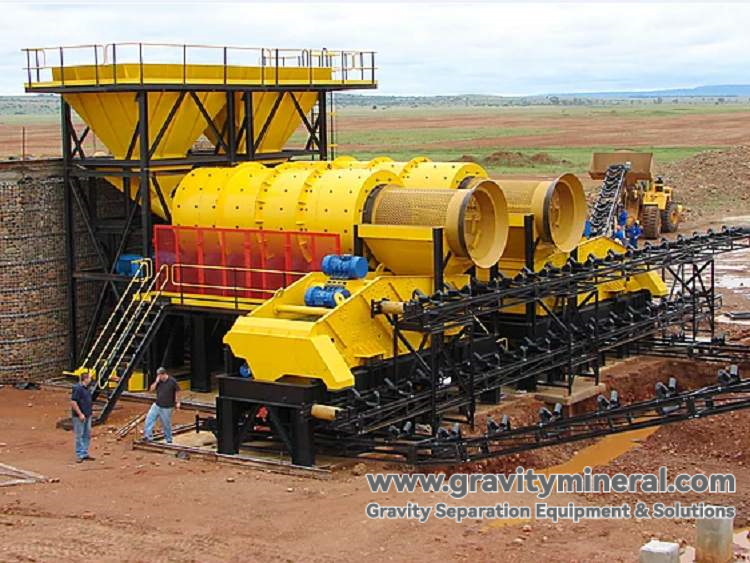
Start With Particle Size: Which Size Fraction the Gold Falls In Determines How the Line Is Arranged
The premise of gravity concentration is density difference, but what really binds you is particle size. The coarser the gold, the more relaxed the separation; once the gold gets fine, the equipment selection has to change accordingly.
The sluice is friendliest to coarse gold, especially a fixed sluice or vibrating sluice: recovery is ideal when gold is coarser than 0.2mm, but fine-particle losses are also noticeable. The jig sits in the middle — it handles a wide size range and suits coarse-to-mid-size gold well, yet once the gold drops into the micro-fine fraction, the jig alone can't clean it out. The shaking table is the finishing stage: its effective concentrating range covers the fine sizes, it delivers a high enrichment ratio, and it suits cleaning — but its throughput is small, so it can't serve as the main rougher.
So arranging a gravity gold recovery line is essentially intercepting by size fraction, stage by stage. The sluice and jig up front trap the coarse gold that can be caught, and the shaking table at the back recovers the fine gold and produces the concentrate. Reverse the order, or leave out the buffer in between, and the fine gold cycles through the system until it finally shows up as elevated tailings grade. Many plants fail not because the equipment is bad, but because they set the flowsheet on guesswork without a particle-size analysis. When coarse and fine particles are mixed into the same jig, the bed stratification is bound to be disturbed — and that's not something you can fix by tuning parameters.
The Sluice Leads: Hold the Roughing/Scavenging Role
The sluice is so simple in structure that it seems there's nothing to say — yet on-site problems often come precisely from it being "too simple."
A fixed sluice suits small throughputs or placer scenarios and is enough for recovering the coarser gold. A vibrating sluice loosens the bed with pulsations at the bottom, catching fine gold a little better than a fixed sluice, with feed size usually kept below 20mm. But no matter which type, in the sluice-jig-shaking-table flowsheet the sluice is positioned as roughing, not final cleaning.
A sensible arrangement puts the sluice at the very front of the gravity gold recovery line: the pulp goes in, it traps what it can, the coarse concentrate it cuts goes straight to a centrifugal concentrator or a shaking table for cleaning, and the sluice tailings feed the jig to sweep up the mid-size gold that didn't have time to settle. This lightens the sluice's load and stabilizes the jig's feed.
If the run-of-mine ore is high in clay, it's best to add a rotary scrubber or trommel screen before the sluice to strip off the clay and gravel. When clay coats the gold particles going into the sluice, the gold can't settle and rides out with the overflow. This is the most easily overlooked detail on site, and often the real reason many placer gravity lines can't reach target indicators.
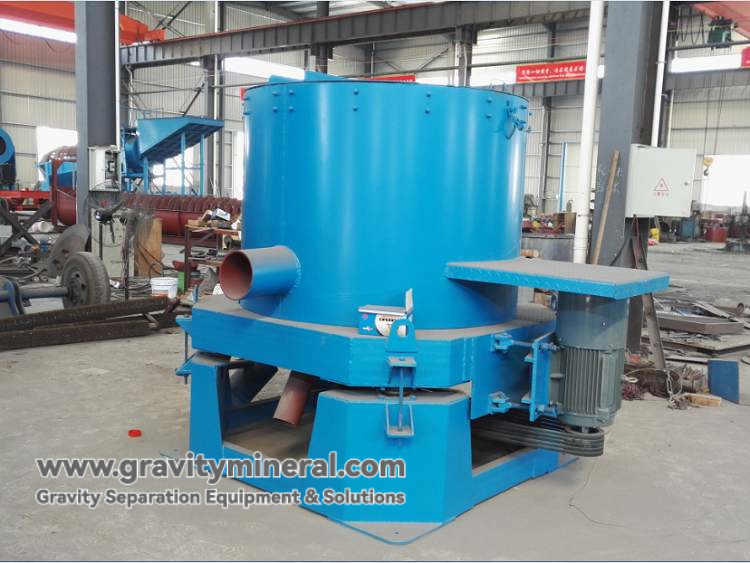
The Jig Holds the Middle: The Waist of the Gravity Gold Line Must Stay Steady
The jig is the waist of this line. It takes the sluice tailings, re-concentrates the mid-size gold, and meanwhile feeds the shaking table a pulp whose grade has already been lifted.
The sawtooth jig's jigging area, feed size, and capacity have to match the ore density and feed rate, with enough room to adjust stroke and frequency. If the stroke is too large, the bed churns too violently and fine gold rides off with the water; if it's too small, the bed won't loosen and heavy minerals can't sink. Tuning a jig on site is essentially aligning how loose the bed is with the size distribution of the feed.
Another easy mistake: feed-rate fluctuation. If the jig simply takes whatever the sluice sends, the bed can't stay stable. Add a buffer mixing tank in between — or at least keep the feed density within a narrow band — and only then will the jig's separation efficiency come out.
Where jig concentrate goes depends on its grade. High enough, and it merges straight into the final concentrate; otherwise it goes back to the shaking table for another pass. If the jig tailings still run a high gold grade, first check whether the feed size range is too wide, then check the stroke and frequency, and only last suspect the equipment itself.
The Shaking Table Finishes the Job: The Cleaning Stage Determines the Line's Concentrate Grade
The shaking table is the line's highest-precision separator, and also its lowest-throughput one. Its place can only be at the very end, doing the cleaning.
The 6-S shaking table's area, feed size, and capacity mean it can't take a big tonnage. Feed the table jig tailings directly and, once the mass gets large, the deck is buried and the bands never separate. So the table's feed should be the classified fine portion of the jig concentrate or the sluice coarse concentrate — small in volume, but with a solid grade base.
Shaking-table operation comes down to the transverse deck slope and the wash-water rate. Slope too steep and the concentrate band narrows, dropping recovery; too flat, and the middlings band blends into the concentrate, dropping grade. The same goes for wash-water rate. Tuning a table on site is essentially finding an acceptable balance between recovery and grade — there's no standard answer, only the answer that suits this particular ore.
The handling of table middlings is too often glossed over. Recycling the middlings for another pass is the easiest option, but if the middlings carry a lot of locked particles, sending them back just spins them around the system. Where conditions allow, stockpiling the middlings separately or sending them to regrind pays off better than blind recycling.
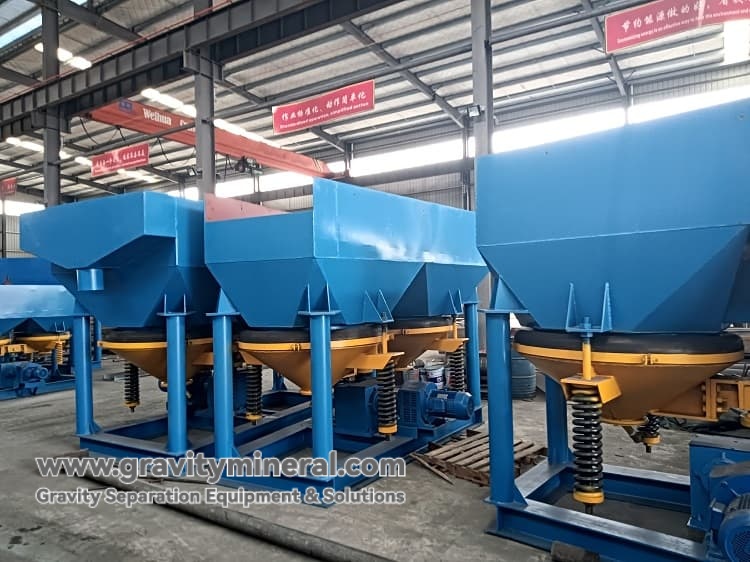
Comparing the Configuration Logic of the Sluice, Jig, and Shaking Table Flowsheet
Stringing the three units together, the core idea is: sluice roughing → jig mid-stage enrichment → shaking table cleaning. This isn't the only arrangement, but for most small-to-medium gravity gold lines it's one with a relatively high fault tolerance.
| Stage | Equipment | Core Role | Key Control Points | Common Mistakes |
|---|---|---|---|---|
| Roughing | Sluice (fixed / vibrating) | Traps the coarser gold | Desliming before feed, slope & water rate | Used as a final cleaner; tailings never treated |
| Mid-stage | Jig | Enriches mid-size gold; reduces volume & upgrades grade for the table | Stroke & frequency matched to feed size | Feed-rate fluctuation; bed unstable |
| Cleaning | Shaking table | Produces high-grade gold concentrate | Transverse slope & wash-water rate | Overloaded feed; bands don't separate |
It should be noted that this configuration's results can't be generalized. The alluvial gold wash-plant flowsheet and the rock-gold scenario differ greatly, and clay content, gold liberation, and feed size distribution all affect the final outcome. Run the same sluice-jig-shaking-table flowsheet on a different ore and the indicators can differ by a wide margin. So do a particle-size analysis and a beneficiation test first, then set the flowsheet — far steadier than buying equipment first and patching the flowsheet later.
A Few Technical Issues You Can't Dodge On Site
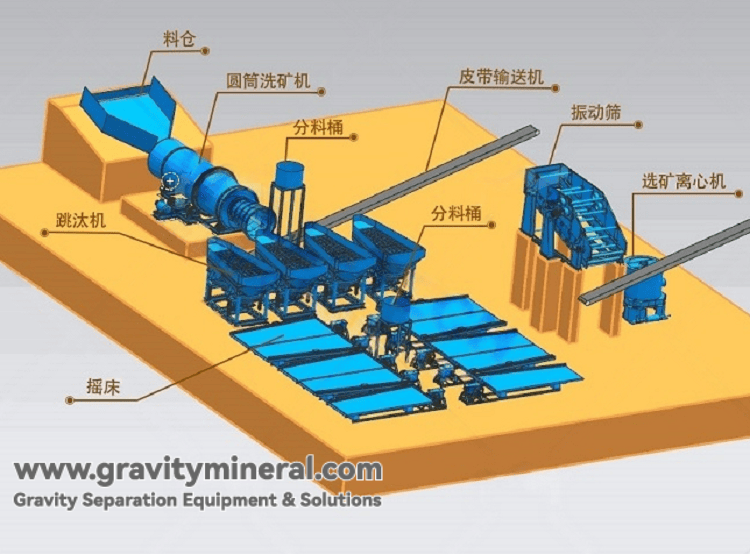
Two Things Worth Settling Before You Build the Line
The first is equipment order. The core of the sluice-jig-shaking-table flowsheet isn't how advanced the machines are, but whether each stage is fed with the particle size it should be handling. Feed the wrong size to the wrong stage and no quality of equipment will produce the indicators. Before building a gravity gold line, first produce a screen analysis of the ore and see which size fractions the gold concentrates in, then fix the upper and lower feed limits for each stage.
The second is the interface between equipment and flowsheet. The flowsheet sets the tonnage and particle size for each stage; the equipment selection sets the actual throughput capability. If the two don't match, the intermediate stages will choke or idle. Jig capacity mismatched with shaking-table capacity is the most common problem in piecemeal assembly. So sequence and interface must be aligned at the drawing stage — don't wait until the equipment arrives to change things.
If you have screen-analysis data for your ore and your current tailings grade, send them over. We'll do the particle-size matching analysis first, then discuss how to arrange the sluice, jig, and shaking table.
Send us your ore data and get a customized flowsheet.