







How to Configure a Yanjin Gravity Concentration Production Line? A Complete Solution from a Gravity Concentration Equipment Manufacturer
Rock gold and placer gold represent two distinct technical approaches. Placer gold can be extracted simply by panning, whereas gold particles in rock gold are often embedded in gangue and sulfides; unless they are ground to the point of individual liberation, gravity separation equipment cannot achieve optimal separation efficiency.Many projects have simply copied the sand gold sluice box approach when configuring gravity separation production lines for rock gold. Although equipment has been invested in, recovery results have been unsatisfactory—the crux of the problem lies in “liberation.”
When configuring a gravity separation production line for rock gold, the key lies not in the number or unit price of the equipment, but in whether the transition between the crushing and grinding stage and the gravity separation and recovery stage is reasonable. The following discussion, covering equipment configuration, process flow, and the selection of manufacturer proposals, explains the logic behind configuring a complete set of gravity separation equipment and the criteria for evaluating manufacturer proposals.
Prerequisite for Rock Gold Gravity Separation: Adequate Gold Particle Liberation Is Essential for Effective Separation
Gold in rock gold ore is mostly embedded in host minerals such as quartz, pyrite, and arsenopyrite in the form of visible or microscopic gold.For gravity separation to be effective, gold particles must be liberated from their host minerals. If the grinding fineness is insufficient, the gold remains encapsulated within the ore, making it difficult to capture even at high centrifugal separator speeds; conversely, if grinding is excessive, the gold particles become muddied, making recovery via gravity separation equally challenging.
In practice, the grinding fineness is typically controlled so that 60% to 75% of the material is within the -200 mesh range; the specific value is determined by beneficiation tests based on the size of the gold particles, and should not be set directly based on experience. The configuration logic for the entire gravity separation system can be summarized by one principle: “crush more, grind less; recover as early as possible.”The crushing stage reduces the ore to the grinding feed size; the grinding stage exposes the gold particles; and the gravity separation stage prioritizes the recovery of already liberated free gold at a coarser particle size.The earlier the recovery occurs, the smaller the over-grinding loss; this is also the practical advantage of a gravity separation production line for rock gold over all-floatation or all-leaching routes in terms of coarse-grain gold recovery.
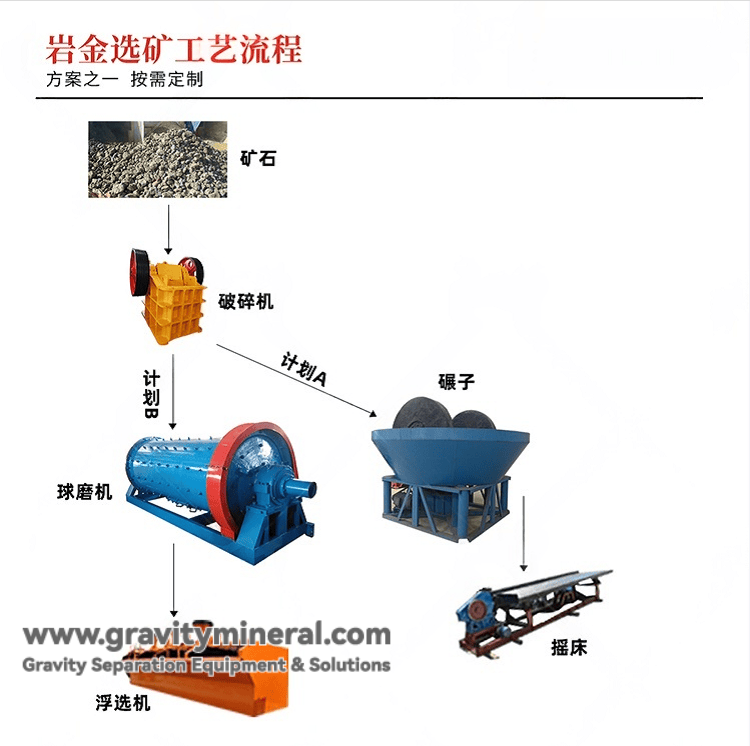
Complete List of Gravity Separation Equipment
The table below lists the core equipment configuration for a conventional gravity separation production line for ore gold, based on a daily processing capacity of 100 to 200 metric tons of raw ore; actual project configurations should be proportionally adjusted according to scale.
| Process Stage | Equipment Name | Function | Configuration Highlights |
|---|---|---|---|
| Feed | Vibrating Feeder | Ensures uniform feeding and prevents material buildup in the crusher | Trough with wear-resistant liners; variable-frequency speed control |
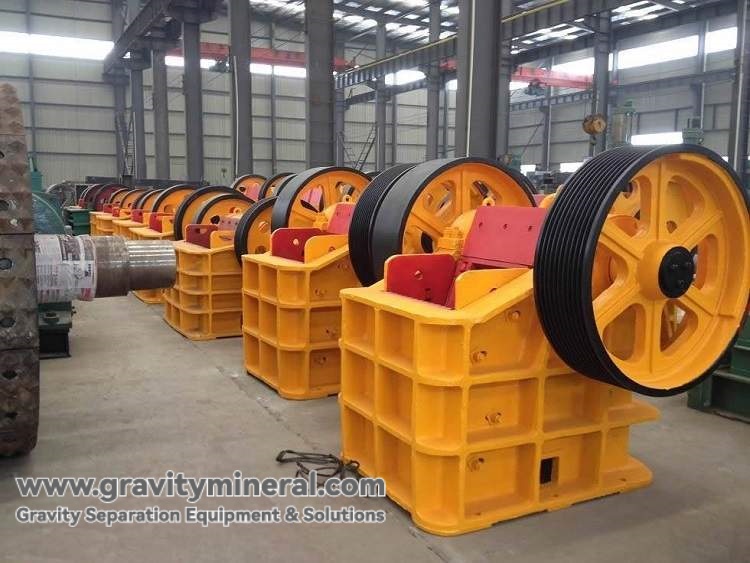
| Primary Crushing | Jaw Crusher | Crushes raw ore to a size suitable for fine crushing | Feed size is determined based on ore block size; discharge opening is adjustable |
| Fine Crushing | Jaw Fine Crusher or Hammer Crusher | Further reduces particle size in preparation for grinding | Together with primary crushing, this forms a two-stage crushing process to control the feed size for grinding |
| Grinding | Ball mill and spiral classifier | Grinding and liberation, with closed-circuit control of return sand | Coarse grinding in a grid-type ball mill; return of classified material to the mill |
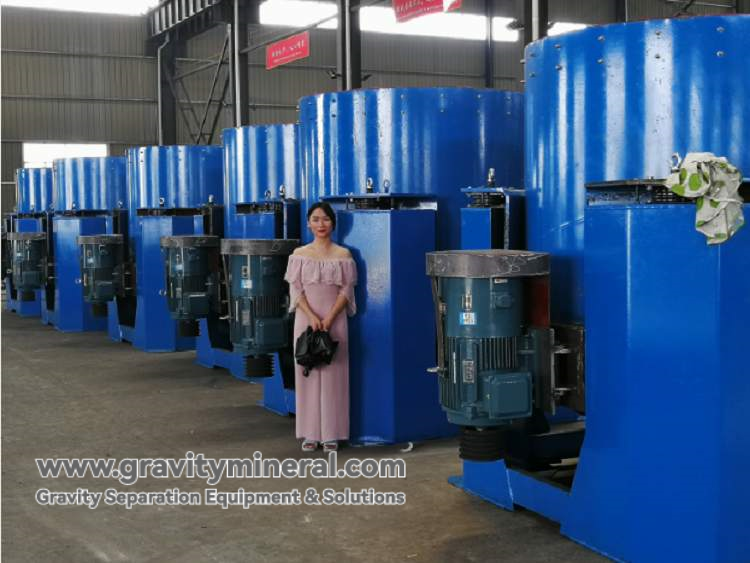
| Rough Selection | Centrifugal Concentrator | Prioritize recovery of liberated coarse-grain free gold | Processing capacity is matched to the mill\'s discharge rate, with a margin of safety |
| Sweep Selection | Chutes or gold-retaining mats | Recover residual gold particles from the centrifugal tailings | Lay out the gold-trapping mat and flush it during each shift |
| Enrichment | Shaking tables | To upgrade the grade of coarse concentrate and separate heavy minerals | 6-S shaking table, for processing small volumes of coarse concentrate |
| Auxiliary | Pumps, Piping, Chutes | Slurry Conveyance | Maximize the use of gravity flow to reduce the need for pumping |
The key to the coordination of the entire gravity separation system lies in the division of labor between the centrifugal separator and the shaking table.The centrifugal concentrator is responsible for capturing and concentrating the liberated gold particles into a rough concentrate; the shaking table is responsible for upgrading the grade by removing gangue from the rough concentrate. A chute connects the roughing stage to the scavenging stage, allowing the slurry to flow by gravity, thereby reducing the number of pumping operations and minimizing potential failure points.
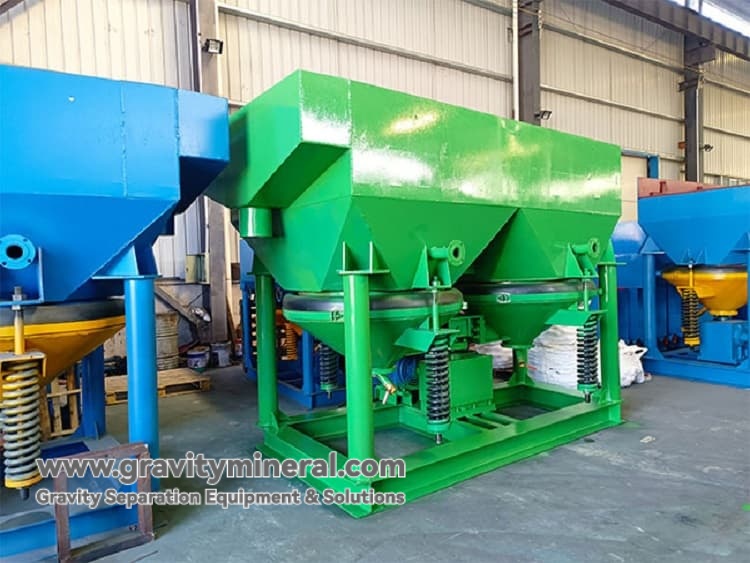
It should be noted that the equipment list itself is not complex; gravity separation equipment such as jigs, shaking tables, and spiral chutes is already quite mature in domestic manufacturing.What truly reflects the quality of a manufacturer\'s design is the “configuration”: whether a residue screen is installed before the mill discharge enters the centrifugal concentrator, how the concentration of the centrifugal concentrate entering the shaking table is controlled, and what the chute slope should be. These details determine whether a gravity beneficiation production line for rock gold will operate stably or experience frequent blockages.
Process Flow: The Sequential Logic of the Five-Stage Process
Stage 1: Two-stage crushing. The ore is coarsely crushed by a jaw crusher and then finely crushed to achieve the required feed size for the mill. The principle here is to prioritize uniformity over fineness; excessive fluctuations in particle size will affect mill operating conditions, which in turn will impact the stability of feed to the centrifugal concentrator.
Stage Two: Closed-Circuit Grinding. The ball mill and spiral classifier form a closed circuit, with the classifier returning the underflow to the mill for regrinding, while the qualified overflow enters the gravity separation section. The purpose of the closed circuit is to balance liberation and prevent over-grinding; the grinding fineness is controlled based on the percentage of -200 mesh particles determined by beneficiation tests.
Third stage: centrifugal rough concentration. The mill overflow enters the centrifugal concentrator, which uses centrifugal force to concentrate gold particles from the slurry.Centrifugal separators are more efficient at capturing free gold than conventional sluices, particularly for fine-grained gold. Feed concentration and rinse water pressure are two key parameters that require close attention; any change in either parameter will affect recovery efficiency.
Stage 4: Chute Sweep. The centrifuge tailings are processed through a gold-retaining mat or chutes to capture residual gold particles. The sweep process serves as a safety net; if omitted, the tailings grade is likely to increase.The gold-retaining mat is flushed on a per-shift basis; the flushing solution is fed into the shaking table for further processing, ensuring that the gold remains within the water circuit.
Section 5: Shaking Table Concentration. The centrifugal rough concentrate and the sweep concentrate are combined and fed into the shaking table, where they are separated based on density differences to produce a gold concentrate. Although the feed rate to the shaking table is low, the operation requires precision; the stroke, stroke frequency, and lateral water flow must be carefully adjusted and stabilized.
Once the entire rock gold gravity beneficiation production line has completed its process, the tailings are settled and the clear water is reused; there is no chemical treatment room, and no burden of tailings water treatment. Recovery rates are significantly influenced by ore properties and liberation degree, with marked differences between different ore bodies; specific indicators should be based on beneficiation test data and should not be summarized by a single figure.
How to Evaluate a Manufacturer\'s Proposal: Three Dimensions
When selecting a manufacturer for a complete gravity separation system, a common pitfall is comparing unit prices based solely on equipment lists. While price differences between individual units can be calculated, any disparity in recovery efficiency once the entire line is operational will result in long-term losses far exceeding the initial price difference. To evaluate a manufacturer\'s proposal, consider the following three dimensions.
First, does the manufacturer have mineral processing testing capabilities? The grain size distribution, clay content, and associated mineral composition of gold-bearing ores vary from deposit to deposit. A manufacturer with testing capabilities will request that representative ore samples be sent for gravity separation feasibility testing. Only after obtaining data on the liberation size and process flow will they configure the equipment.Approaches that simply provide a standard configuration list without inquiring about the ore\'s properties should be treated with caution. Manufacturers specializing in gravity separation typically have mineral analysis facilities; test data serves as the basis for subsequent equipment selection and process design, and this step has the greatest impact on the suitability of the entire gravity separation system.
Second, does the equipment layout align with the flow path of the slurry? In a gravity separation line—from the grinding mill to the centrifugal separator and then to the shaking table—the slurry should ideally be conveyed by gravity flow utilizing elevation differences. If the layout includes multiple pumping stations, it indicates that the site conditions have not been fully utilized, which will lead to increased power consumption and failure rates down the line.For manufacturers where process design and equipment manufacturing are handled by the same team, mechanical engineers are aware of upstream feed rates and downstream separation requirements during the manufacturing phase, resulting in a higher degree of interface compatibility.
Third, the supply of wear parts and after-sales response. The drums of centrifugal separators, the bed surfaces of shaking tables, and the gold-retaining mats in chutes are all consumable parts. Whether a manufacturer can maintain a stock of spare parts and how long it takes to ship them has a greater practical impact than minor differences in the unit price of the equipment.Domestic mineral processing equipment manufacturing is relatively concentrated in the Ganzhou area, where the spare parts supply chain is relatively mature, and delivery times to most mining areas are short. Manufacturers with their own production facilities produce core equipment in-house, offering better control over delivery times and quality compared to the reseller model.
In terms of investment, for a heavy-medium separation line processing approximately 100 metric tons of gold-bearing rock per day, equipment costs vary widely depending on the crushing ratio, automation level, and degree of customization; therefore, it is not appropriate to use a fixed figure as a benchmark.Civil engineering and installation costs are billed separately. The above range does not include the flotation or leaching stages following grinding. If the ore contains encapsulated gold, the heavy media separation tailings must be fed into a flotation or leaching process; therefore, interfaces and space should be reserved during line configuration.
Applicable Scenarios and Process Limitations
Gravity separation is not suitable for all rock gold ores. When ore properties are compatible, gravity separation lines offer relatively lower investment costs, reduced environmental impact, and a shorter commissioning cycle; when properties are incompatible, forcing the use of gravity separation makes it difficult to achieve expected performance metrics.
Situations suitable for gravity separation: Coarse gold grain distribution, where grinding to -200 mesh (approximately 60% by weight) is sufficient to liberate a significant amount of free gold; low clay content in the ore, resulting in good slurry flowability; and mining areas with strict environmental requirements where the use of chemical reagents is not feasible.Some overseas rock gold mines adopt this physical separation route, which eliminates the burden of tailings water treatment.
Situations where gravity separation cannot be completed on its own: Gold is encapsulated as very fine particles within sulfides, making it difficult to fully liberate even with ultra-fine grinding. For such ores, the gravity separation stage should be positioned to pre-recover coarse-grain gold, followed by flotation or leaching processes as a backup; one should not expect gravity separation alone to achieve high recovery rates.In other cases, ore contains a large amount of clay; after grinding, the slurry viscosity is too high, reducing the separation efficiency of centrifugal separators. In such situations, a pre-treatment step for ore washing or desliming must be added at the front end, or the equipment configuration must be adjusted to accommodate the clay-laden conditions.
Configuration Recommendations: Proceed Step by Step
If a rock gold mine plans to implement a gravity separation line, proceed in the following order to minimize trial-and-error.
-
First, conduct mineral processing tests. Select a manufacturer with the necessary testing facilities to complete gravity separation feasibility tests, establish the relationship between grinding fineness and recovery efficiency, and determine the optimal liberation size. The cost of these tests is minimal compared to the cost of selecting the wrong equipment; this step should not be omitted.
-
Determine equipment specifications based on the test data. Match the processing capacity of the centrifugal separator to the mill\'s discharge rate, allowing for a 10% to 15% margin; avoid configuring equipment at the upper limit. Determine the number of shaking tables based on the volume of rough and concentrate; providing a few extra tables can reduce operational load, while insufficient configuration may make it difficult to guarantee concentrate grade.
-
Request layout drawings from the manufacturer. Pay close attention to the slurry flow path, maintenance access, and chute angles. Chutes that are too gentle are prone to ore accumulation, while those that are too steep reduce the efficiency of gold particle retention; these issues can be identified during the drawing review phase.Process design, plant layout, and civil engineering condition drawings should be completed by the manufacturer\'s in-house team. This prevents discrepancies between the design and the equipment and reduces the additional costs associated with hiring a separate design firm.
-
Reserve interfaces for tailings reprocessing. If gravity separation tailings still have recovery value, the locations, piping, and space for subsequent flotation or leaching should be reserved in advance. Manufacturers whose product lines cover gravity separation, magnetic separation, flotation, and leaching can integrate these interfaces within a single production line, eliminating the need for piecemeal retrofitting.
The configuration of a gravity separation production line for ore-type gold ultimately boils down to one thing: recovering liberated gold as early as possible at the appropriate particle size using properly matched equipment. While the equipment list can serve as a reference, the grinding fineness and process integration must be determined based on the specific characteristics of the ore.The selection of the entire gravity separation equipment set and the manufacturer\'s proposed solution should be based on mineral processing test data, rather than a comparison of equipment catalogs.
If you need a configuration calculation for a rock-gold gravity separation production line tailored to the specific properties of your ore, please provide information such as the raw ore grade, grain size distribution, and processing capacity. We will then develop a proposal based on test data, which is a more reliable approach than selecting equipment by comparing catalogs.