







EPC Turnkey Solutions for Gravitational Separation Equipment Manufacturers in the Alluvial Gold Mining Industry: A Complete Record from Ore Sample to Gold Ingot
Key Conclusions
-
The cost threshold for gravity separation in placer gold mines does not depend on the unit price of equipment, but rather on how well the process flow matches the ore body. Using the same process flow for alluvial and fluvial deposits will result in significant differences in performance metrics.
-
The core value of an EPC turnkey solution for placer gold gravity separation equipment lies not in “selling equipment as a package,” but in the general contractor\'s full responsibility for the final production targets, freeing mine owners from the hassle of shuffling blame between equipment suppliers, installation crews, and commissioning engineers.
-
Fine-grained gold is a hidden drain on profits. The ultrafine particle size that jigging machines cannot recover can be significantly recovered through centrifugal separation, and the difference in recovery rates directly impacts year-end financial results.
-
For alluvial placer gold mines with a daily processing capacity of 200–500 metric tons, equipment investment generally ranges from 1.5 to 3 million yuan, with the specific amount varying based on ore body conditions, site conditions, and the level of configuration.
You have an exploration report for a placer gold deposit in your hands, with the grade clearly stated and reserves sufficient to keep operations running for five to eight years.But as you stand at the mine site and take a look around, the questions popping into your head have little to do with the mineral processing itself: Where will the water come from? How will electricity be supplied? Who will install the equipment once it\'s purchased? And who will be responsible if it doesn\'t work properly after installation?
You\'re not alone in this situation. In the placer gold mining industry, many mine owners understand the ore, but few understand the processing plant. When you ask equipment suppliers, the ones selling jigging machines claim they\'re a cure-all, while those selling centrifuges say fine-grain gold will all be lost without them. The more you ask, the less you know who to listen to.
The problem is that you\'re asking the wrong people. Equipment suppliers are only responsible for the equipment itself—not for your recovery rate. The person you really need to find is the one who signs off on the final production targets. An EPC (Engineering, Procurement, and Construction) turnkey solution for placer gold gravity separation equipment essentially consolidates the responsibilities for design, procurement, and construction into a single person.
What Does EPC Actually Cover—and What Doesn\'t?
EPC stands for Engineering, Procurement, and Construction. In the alluvial gold mining industry, its actual meaning is a bit more complex than the literal definition.
The first task for the general contractor is to take samples from your mine to conduct feasibility tests. The mud content in alluvial placer gold deposits, the grain size distribution of gold particles, and the presence of interfering associated heavy minerals—these data determine the logic behind the selection of all subsequent equipment. Skipping the tests and applying a one-size-fits-all solution is like trying to make a key while blindfolded.
Only after the tests are completed and the process flow diagram is finalized does the equipment list follow. Decisions such as the processing capacity of the jig, the number of centrifuges to install, and whether to use double-deck shaking tables are all based on data—not made on a whim.
During the construction and installation phases, the EPC contractor\'s oversight of progress and quality runs much more smoothly than if the mine owner were to manage it themselves. Design, procurement, and construction can proceed concurrently, saving significant time compared to the mine owner having to coordinate separately with design institutes, equipment manufacturers, and construction crews.
However, EPC is not a panacea. The general contractor cannot handle matters such as mining rights procedures, environmental impact assessment approvals, or tailings pond site selection on your behalf. If you view EPC as “pay the money and worry about nothing,” you\'ll face plenty of disputes down the road.
To be frank: what you\'re buying with an EPC contract is certainty and clear accountability. If the recovery rate falls short, you hold the general contractor accountable. If there are issues with equipment compatibility, you hold the general contractor accountable. If you purchase equipment piecemeal and assemble the system yourself, when problems arise, you\'ll first have to determine whether the issue lies with the equipment, the installation, or the operation—and this process of pinpointing the cause alone could consume an entire production season.
The category your mine falls into determines what the process will look like
Alluvial gold deposits are not all the same. Alluvial, fluvial, slope-deposited, and residual types—with different formation conditions—differ by orders of magnitude in processing difficulty.
Alluvial placer gold deposits have been transported long distances by rivers. The gold grains are well-rounded and highly separable, and the clay content is typically low. A three-stage process—screening, jigging, and shaking table—can yield good results. This is the easiest type to handle.
Alluvial placer gold deposits are the product of short-distance transport by mountain torrents. They exhibit poor sortability, with grain sizes ranging from gravel over ten centimeters to silt-sized clay all mixed together, and generally have a high clay content.If this type of ore is fed directly into gravity separation without first being washed to remove silt, clumps of clay will clog the jig bed, completely blocking the gold particles\' settling pathways, resulting in recovery rates significantly lower than expected.
Alluvial and residual deposits contain a higher proportion of fine-grained gold; a single chute or jig alone is generally insufficient to recover it, so a centrifuge must be added after roughing to remove the fine particles.
Simply put, the genesis type of your ore body determines the length of your equipment list more than the grade figure does. Ore with a high grade but high clay content may actually yield less than ore with a lower grade but better separability.
How to Configure the Equipment: Placing Coarse, Medium, and Fine Separation in Their Proper Places
The equipment configuration for a placer gold gravity processing line is divided into four stages based on function: ore washing and screening, roughing and concentration, fine recovery, and fine purification.
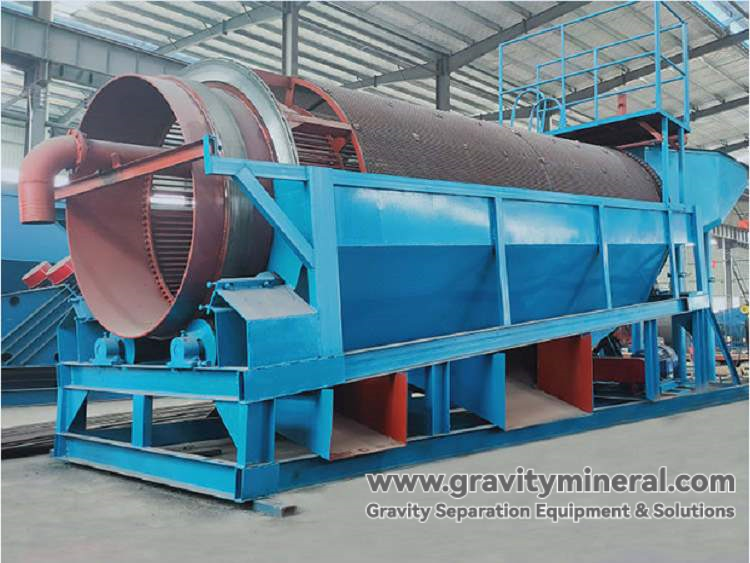
The ore washing stage depends on the clay content. For low clay content, a drum screen with high-pressure water spraying is generally sufficient. For higher clay content, a drum washer or scrubber must be added to break up the clay clumps before screening. This step cannot be skipped; any money saved on equipment here will be more than offset by reduced recovery rates later on.
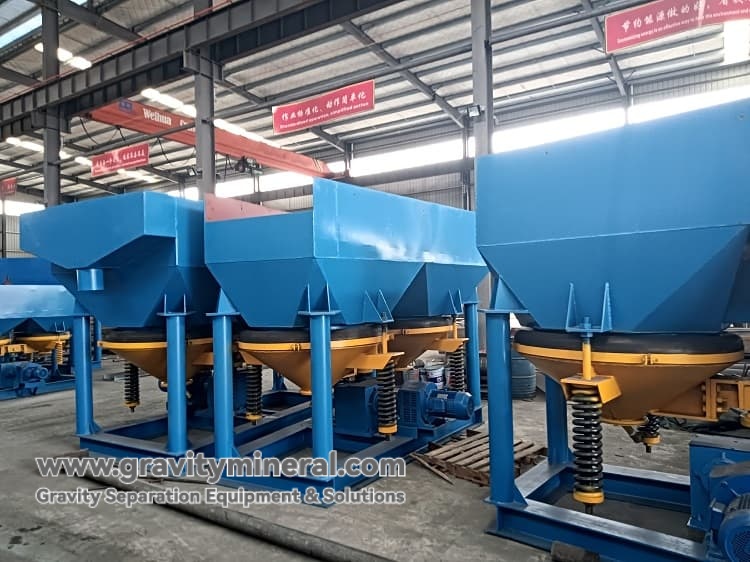
The mainstay of the roughing stage is the jig. It has a high throughput and a wide feed size range, capable of processing materials from coarse sand to fine gravel, and it initially concentrates most of the gold from vast quantities of sand and gravel. The combination of a drum screen and a jig has been used for many years on large gold dredges, and its production metrics are impressive.
However, jigging machines struggle with ultrafine gold particles. If this gold is sent directly to the tailings, the layer of fine sand in the tailings pond will glisten in the sunlight—and that is pure profit.Centrifuges are designed to fill this gap. Water-jacketed centrifuges rank among the top performers in gravity separation equipment for recovering ultrafine-grain gold; when positioned downstream of the jig as a scavenging stage, they recover the fine-grain gold that slipped through the jig\'s mesh.
Shaking table for concentrate refinement. The coarse concentrates produced by the jig and centrifuge still contain heavy minerals such as magnetite and garnet. The shaking table separates these from the gold, raising the concentrate grade to a level suitable for direct sale or smelting.
| Processing Stage | Process Stage Core Equipment | Main Tasks | Key Configuration Points |
|---|---|---|---|
| Ore Washing and Screening | Cylindrical Ore Washer/Trommel Screen | Break up mud clumps and remove large gravel | Intensive ore washing is required when the mud content is high |
| Rough Selection and Enrichment | Serrated-Wave Jig | Recovers coarse and medium-sized gold particles | Wide feed size range and high throughput |
| Sweep Recovery | Water-Jacketed Centrifuge | Recovery of fine-grain gold | Used downstream of the jig to capture residual gold |
| Concentration and purification | 6-S shaking table | Separation of heavy minerals and grade enhancement | High enrichment ratio; concentrate can be sold directly |
The configuration of stages and the coordination of production capacity among the jig, centrifuge, and shaking table are the most technically demanding aspects of an EPC turnkey solution for alluvial gold gravity separation equipment. Over-configuring wastes investment, while under-configuring prevents recovery rates from reaching optimal levels.
How to Analyze the Financials of a Pleistocene Alluvial Deposit EPC Project
Let\'s take a 300-metric-ton-per-day alluvial placer gold mine as an example. The ore body has a relatively high clay content, and gold particles range from coarse to very fine, making it a typical difficult-to-process type.
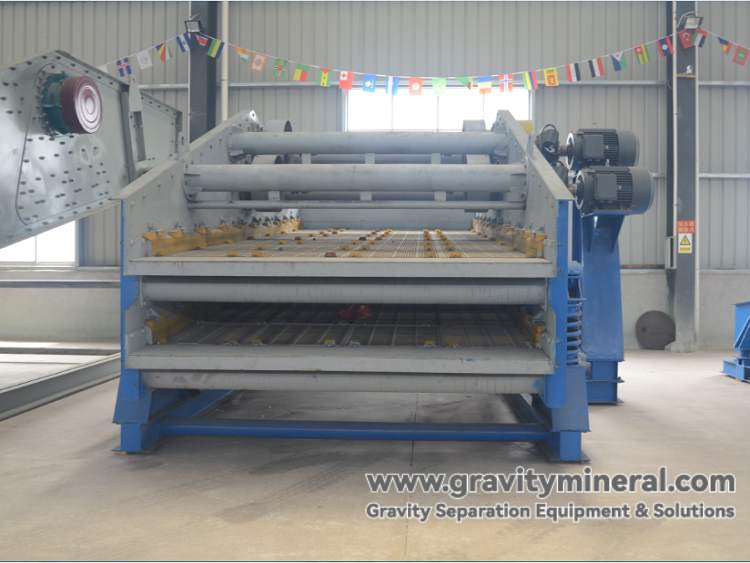
The equipment list generally includes: one cylindrical ore washer, one double-deck vibrating screen, two jigs (for roughing and scavenging), two centrifuges, four shaking tables, plus a dewatering screen, a thickener, a filter press, and the corresponding pumps, valves, and piping.
The total investment, including equipment procurement, civil engineering, installation, and electrical work, generally falls within the range of 2 to 2.8 million. This figure is slightly higher than purchasing equipment piecemeal and assembling the line yourself, but the difference primarily lies in the process design fees and general contractor management fees.The exact amount varies depending on ore body conditions, site conditions, and the depth of the configuration, so it cannot be generalized.
The largest portion of operating costs consists of electricity and labor. The total installed power of the entire line depends on the configuration; for a combination of jig, centrifuge, and shaking table, the total power ranges from several dozen to over 100 kilowatts.Electricity costs, calculated at industrial rates, amount to a few yuan per metric ton of ore. A two-shift operation requires four to six workers. Maintenance costs primarily consist of the periodic replacement of centrifuge bearings and shaking table surfaces.
Profitability depends on recovery rates and gold prices. When applied to alluvial deposits, this combined process achieves a comprehensive recovery rate in the upper-middle range of the industry. With a daily processing capacity of 300 metric tons and a raw ore grade of 0.3 g/t, daily gold production is in the range of several dozen grams.Based on current gold prices and after deducting operating costs, the payback period depends on the actual ore grade and the number of operating days.
Here\'s a point that\'s easy to overlook: for a mine processing 300 metric tons per day, every few percentage points of improvement in recovery rate translates to a substantial increase in annual gold output.That small improvement in recovery rate—squeezed out by the EPC contractor through meticulous attention to process details—translates into real money over the course of a full year of production. This is also the most tangible difference between the turnkey EPC solutions offered by manufacturers of gravity separation equipment for placer gold mines and piecemeal equipment purchases.
Who Offers These Turnkey Solutions, and How Should You Choose?
In the alluvial gold mine EPC industry, there are many manufacturers that sell equipment, but very few that can seamlessly integrate equipment, design, and on-site commissioning into a cohesive process. When selecting an EPC contractor, I recommend looking at three key factors.
First, check if they have their own manufacturing facilities. Traders who resell rebranded products are at the mercy of others when it comes to delivery times and quality. Only manufacturers that produce core equipment—such as jigging machines, shaking tables, and centrifuges—in-house can ensure seamless interface compatibility and aligned production capacity.Manufacturers like GravityMineral, with two decades of experience in gravity beneficiation, operate two major manufacturing bases that handle the entire production chain—from large-scale assembly to precision components—independently. They maintain full control over delivery times and quality, which is a prerequisite for any EPC contract.
Second, see if they\'re willing to save you the design fees. Mineral processing tests, process flow design, equipment selection and configuration, plant layout planning, and civil engineering drawings—if these tasks are outsourced to a design institute, they can easily cost hundreds of thousands of dollars for medium-to-large projects. What\'s more troublesome is that equipment manufacturers often reject the drawings produced by design institutes.With an in-house design team handling these tasks, costs aren\'t inflated, and there\'s no buck-passing when it comes to responsibility.
Third, see if the engineers actually go to the site. Equipment arriving without anyone to commission it is the most common pitfall of piecemeal procurement.Parameters such as the stroke and frequency of a jig, the slope of a shaking table, and the backwash pressure of a centrifuge must be fine-tuned on-site by someone who understands gravity separation processes using actual feed material. Delivery is only considered complete once commissioning meets the specified standards—only a company willing to include this clause in the contract is worth further discussion.
GravityMineral\'s track record in these three areas is as follows: twenty years of exclusive focus on gravity mineral processing; a leading market share in China\'s gravity separation equipment sector; products exported to over 50 countries; a portfolio of more than 500 global case studies; six official certifications; and an engineering team capable of both drafting technical drawings and traveling to job sites.These aren\'t just for show—they\'re the key factors you should use to assess whether a manufacturer\'s EPC turnkey solution for gravity separation at a placer gold mine is reliable.
Frequently Asked Questions from Mine Owners
“How much can I save by purchasing the equipment myself and assembling the processing line?”
You can save a portion of the equipment purchase cost—roughly 10 percent. But you\'ll have to bear the risk of process design errors yourself. If you buy a jig that\'s too large, you\'ll have excess processing capacity that wastes electricity; if it\'s too small, it will create a bottleneck.If a centrifuge is placed in the wrong location—performing roughing instead of scavenging—fine-grained gold will still be lost. The money you save may be lost in recovery rates within the first year alone.
“How long does an EPC project typically take?”
For a daily processing capacity of 200 to 500 metric tons, the typical timeframe from contract execution to integrated commissioning is four to six months.Ore testing takes two to three weeks; equipment manufacturing and procurement take about two months; civil engineering and installation depend on site conditions. With effective overlapping work, the timeline can be compressed to less than four months. For international projects, factoring in two to three months for ocean freight, customs clearance, and a buffer period, a total cycle of seven to twelve months is typical.
“What grade is considered acceptable for concentrate?”
The grade of concentrate from alluvial gold shaking tables varies widely, depending on the size of gold particles in the ore and the content of associated heavy minerals. For ores dominated by coarse-grained gold, the concentrate grade can be higher; for those dominated by fine-grained gold, the grade is lower, but recovery rate is the key metric to focus on.A higher concentrate grade isn\'t necessarily better; it must be appropriately matched to the ore\'s characteristics.