How are the process flow and production capacity determined for a gravity gold concentration plant production line?
Process Design and Capacity Determination: The Complete Chain from Ore Sample Testing to Equipment Selection
A practical production line plan for a gravity gold processing plant is typically based on data from representative ore sample tests, rather than equipment catalog specifications or the direct application of experience from neighboring mines. Only by properly collecting ore samples, conducting thorough tests, and aligning the capacity of each processing stage can a solid foundation for the process and production capacity be established.
Why Ore Sample Testing Is the First Step in Process Design
The processing approaches for placer gold and vein gold deposits in gravity separation are entirely different. In placer gold deposits, gold particles are often already liberated as free grains and sufficiently separated from gangue; the task of gravity separation is to concentrate high-density minerals and flush away light gangue.In vein gold deposits, gold remains embedded in gangue or sulfide minerals; it must first be ground to liberate the gold before gravity separation becomes effective. Applying a process designed for placer gold to vein gold deposits typically yields unsatisfactory recovery results.
There are also differences within alluvial gold deposits themselves. Alluvial deposits, transported long distances by rivers, contain rounded gold particles with relatively low clay content; colluvial deposits, transported short distances by mountain torrents, have a mixed grain size, and it is common for gold particles to be coated with clay;residual deposits, which result from in-situ weathering, have high clay content and uneven grain sizes; if the ore washing stage is not properly carried out, subsequent sorting processes will face significant difficulties.
Principles of Gravity Separation and the Staging Logic of Gravity Gold Processing Plant Production Lines
Gravity separation utilizes differences in mineral density to separate heavy and light minerals in a flowing medium.The density of gold typically ranges from 15–16 to 18–19 grams per cubic centimeter, while common gangue minerals have a density of just over 2 grams per cubic centimeter—a significant difference. Under the action of water flow, heavy minerals sink while light minerals are carried away. In layman\'s terms, this is similar to washing rice: when water is added and stirred, sand and gravel settle to the bottom, while light debris is washed away with the water.
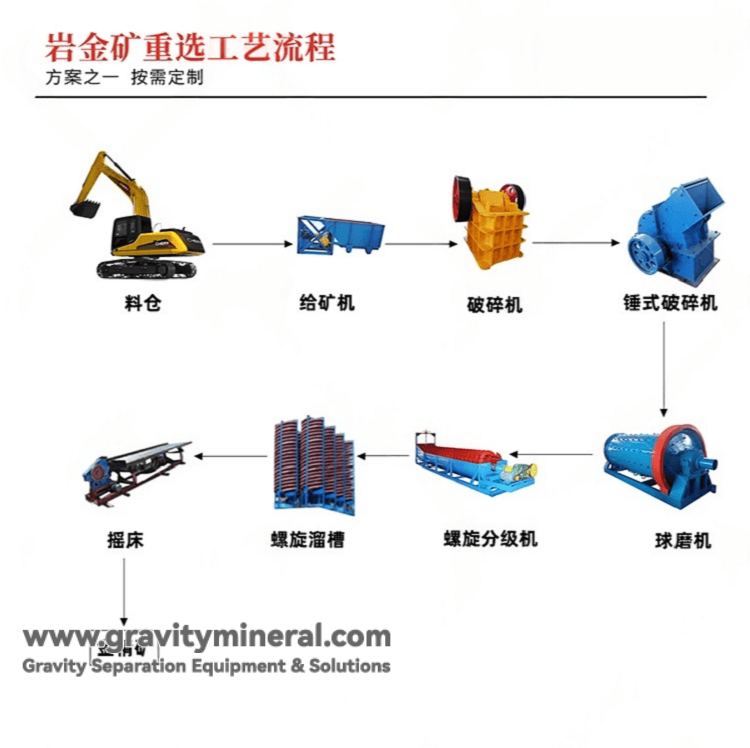
However, the actual particle size distribution of ore is not uniform; coarse, fine, and clay-coated particles coexist.Therefore, a complete gravity gold processing plant production line is typically divided into three functional sections: the ore washing and desliming section breaks up the clay to expose the gold particles; the screening section separates the material by particle size, with coarse and fine particles entering appropriate equipment respectively;the gravity concentration section performs step-by-step purification, with the roughing stage handling throughput and the scavenging stage ensuring grade.
Inadequate ore washing is a common problem
If raw ore with high clay content enters the jig without being thoroughly washed, the gold particles remain coated with a clay film, making it difficult for the water flow to separate them based on density, and fine gold particles are easily lost with the tailings. In the gravity separation of sand ore, the thoroughness of ore washing often directly determines the operational effectiveness of the entire production line.
Screening is equally critical
When coarse and fine particles are mixed during sorting, the separation efficiency of gravity separation equipment drops significantly. By pre-screening out large gravel, feeding the coarse fraction to the jig, and the medium-to-fine fraction to the shaking table or spiral chute, each stage of equipment operates within its optimal particle size range, resulting in more stable recovery rates.
How to Match Core Equipment to Ore Properties
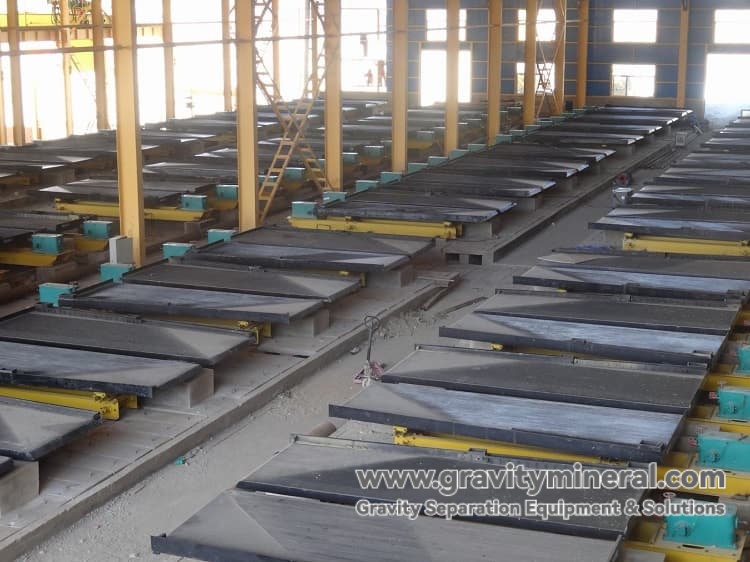
Jigging machines and spiral chutes are commonly used in the roughing stage. Jigging machines have a high throughput and are highly adaptable to coarse-grained material; spiral chutes feature a simple structure and require no power consumption, making them suitable for roughing and tailings disposal of low-grade material. Shaking tables and centrifugal separators are commonly used in the concentrating stage.Shaking tables offer high separation precision and are suitable for refining fine-grain concentrates; centrifugal separators utilize centrifugal force to enhance the recovery of fine, heavy minerals, serving as an important supplement for fine-grained slurry materials. Chute-type equipment features a simple structure and is easy to maintain, making it widely used in the rough selection of placer gold and in remote mining areas.
The principle for equipment selection is to ensure throughput in the roughing stage and separation accuracy in the concentrating stage; it is not advisable to rely on a single piece of equipment to handle everything in the intermediate stages. Gravity separation is inherently a step-by-step enrichment process: roughing handles the throughput, while concentrating improves grade. The configuration of stages and the integration of equipment must be considered holistically.
The compatibility of interfaces between equipment also affects the stability of the production line in a gravity gold processing plant.If the crushing, screening, gravity separation, and dewatering stages are supplied by different vendors, the discharge particle size, processing capacity, and slurry concentration may not align, leading to material blockages or equipment idling. When process design and equipment configuration are coordinated under a unified process philosophy, interface compatibility and production capacity alignment are better ensured.
Three Key Considerations for Production Capacity Planning
First: Mining Operations
Production capacity should be calculated based on the actual ore output of the mining site, not the design capacity. If the mining site cannot keep up with ore supply, the processing plant—no matter how large—cannot operate at full capacity.
Second: Equipment Ledger
The capacities of the ore washing, screening, roughing, cleaning, and dewatering sections must be properly matched. If the roughing section has excessive capacity but the cleaning section lacks sufficient units, concentrate processing will be delayed—effectively rendering the roughing process futile. Conversely, if the cleaning section is over-configured but the feed rate is insufficient, bed stratification will be poor, leading to reduced operational efficiency.
Book Three: Water Ledger
Heavy-medium separation requires significant water consumption, and the water recirculation capacity directly determines whether continuous production is possible. In water-scarce regions, water recirculation systems must be included in production capacity calculations to avoid being forced to reduce output after equipment installation due to insufficient water supply.
No Uniform Standard for Production Capacity Scale
Small-scale mobile processing plants prioritize flexibility and low investment, while large-scale stationary plants emphasize throughput and automation. The actual production capacity is ultimately determined by the weakest link among the three stages: mining, beneficiation, and tailings treatment. Capacity planning should be based on this “shortest plank” and scaled upward accordingly.
Common Misconceptions and Principles for Process Simplification
The more complex the process, the better. Every additional step increases the chance of tailings being re-processed and adds to water and electricity consumption. For placer gold deposits, if the gold particles are sufficiently liberated and the particle size is appropriate, a simple process consisting of ore washing, jigging, and shaking tables can produce qualified concentrate.
Copying the process from a neighboring mine. Even slight differences in gold particle size distribution, clay content, or density require adjustments to equipment selection and the number of processing stages. While a “copy-and-paste” approach saves design time, it may come at the cost of recovery rates.
Selling gravity concentration concentrate directly as a finished product. In addition to gold, gravity concentration concentrate contains associated high-density minerals such as magnetite, ilmenite, and zircon; pricing it solely as heavy sand often results in a loss. Adding a magnetic separation stage or a shaking table for final concentration can further improve the concentrate grade.
Neglecting to align equipment interfaces with production capacity. When equipment for each stage is procured separately and there is a lack of unified process coordination, issues such as mismatched interfaces and uncoordinated production capacity will gradually become apparent during post-commissioning operations. Process design, equipment selection, and production capacity calculations should be coordinated by a single team.