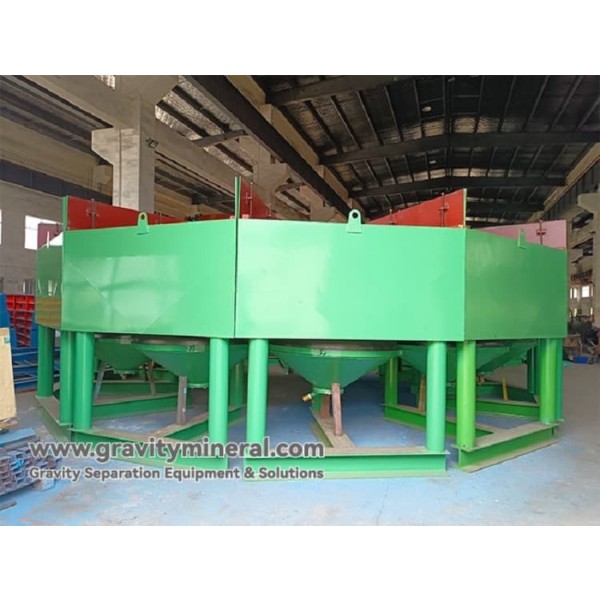
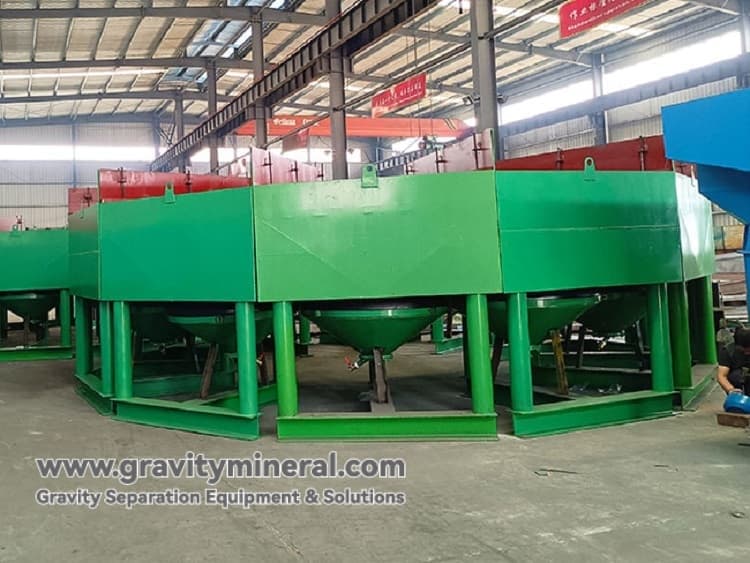
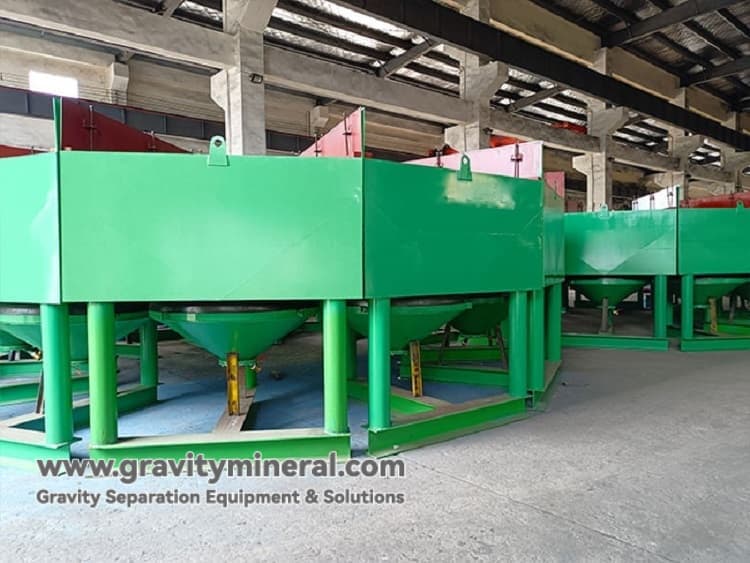
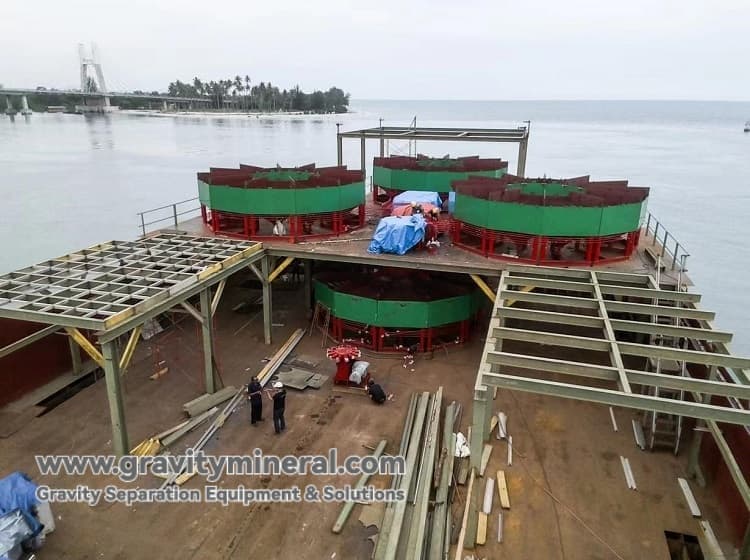
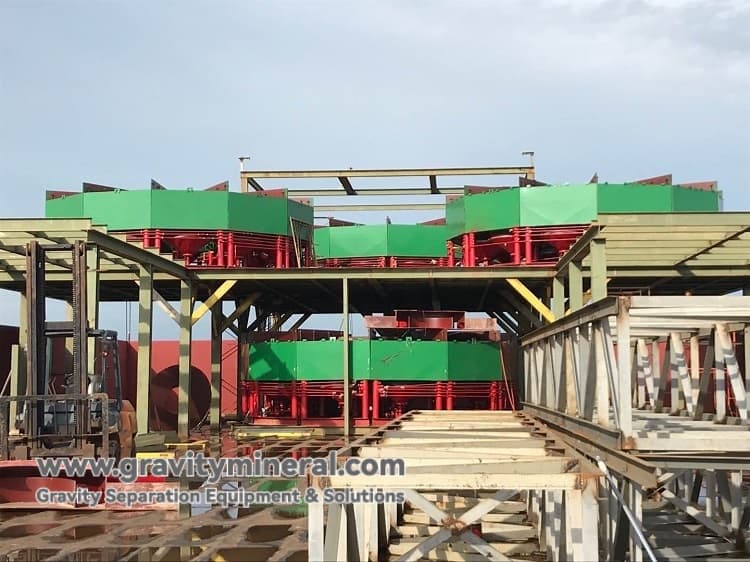
The DYTA-7750 hydraulic radial jig represents the pinnacle of modern gravity separation technology. This advanced hydraulic radial jig is a complete upgrade of conventional rectangular and circular jigs, using a mechanical-hydraulic drive system to deliver unmatched throughput and recovery.
The hydraulic system is driven by an electromagnetic variable-speed motor, producing a perfect "sawtooth wave" pulsation in the jig cone (rapid upward thrust, slow downward settling). This ideal fluid dynamics is essential for recovering fine and coarse heavy minerals, including placer gold, tin, diamonds, tungsten and hematite.
With its huge radial (circular) jigging area and extremely compact footprint, the hydraulic radial jig is unquestionably the first choice for roughing operations on gold dredgers (vessels) and large land-based placer washing plants.
Position in the full line: The DYTA hydraulic radial jig performs the roughing stage——discarding large volumes of gangue early and concentrating liberated free gold and heavy minerals into a small mass before passing them to shaking tables, spiral chutes and centrifugal concentrators for cleaning. In an alluvial gold gravity plant it is usually installed after the trommel and washer as the first gravity barrier on board or on shore; in a primary gold ore gravity plant the run-of-mine ore is first crushed by a jaw crusher、cone crusher and a ball mill for grinding, then classified by a spiral classifier, and the qualified size fraction enters this machine for early recovery of free gold, preventing coarse gold from being lost in the grinding circuit.
Core Advantages of the DYTA Hydraulic Radial Jig
- Massive power and water savings: The efficient hydraulic drive uses 55% less electricity than conventional jigs (the giant 9-chamber machine needs only 11.6 kW total). The unique pulsation technology also cuts screen-water makeup by 60%-70%.
- Sawtooth-wave pulsation technology: The cam-driven hydraulic system creates a fast upward flow and a slow downward flow, keeping the bed loose longer so ultra-fine heavy minerals settle fully and overall recovery is significantly improved.
- Compact, space-saving design: The fan-shaped (radial) chambers provide a very large jigging surface within a relatively compact footprint, making this the only sensible choice where space is severely constrained, such as floating mining vessels.
- Infinitely variable adjustment: Stroke length (20-30 mm) and frequency (0-90 strokes/min) are fully infinitely variable, allowing operators to set parameters precisely for different ore grades and feed rates.
Interface with upstream preparation: The hydraulic radial jig is sensitive to feed size uniformity and clay content, so upstream the material is normally passed through a trommel screen for sizing, desliming and removal of oversize gravel and debris; clay-rich placer ore gets an additional rotary scrubber for scrubbing and liberation, keeping the material entering the jig cone within the applicable <25mm range and avoiding screen wear-through and cone blockage.
How the Hydraulic Radial Jig Works
The heart of the DYTA hydraulic radial jig is the coupling of the "cam—hydraulics—jig cone" trio, mechanically reproducing the ideal gravity-separation flow field in four steps:
- Hydraulic drive generates pulsation: The electromagnetic variable-speed motor turns the cam and hydraulic pump, converting rotation into the up-and-down reciprocation of the jig cone. The 20-30mm stroke and 0-90 strokes/min frequency are infinitely adjustable with no pulley changes or part adjustments.
- Sawtooth flow loosens the bed: The fast upward flow instantly opens the bed and disperses the particles; the slow downward flow gives particles ample time to stratify by density, avoiding the fine heavy minerals being carried back to tailings by the "symmetrical up-and-down" action of a sine wave.
- Radial feed distribution and stratification: Pulp is fed evenly into the circular hopper by a vibrating feeder, spreading outward along the radius and forming a continuous "loosening—settling—concentration" stratification band from center to edge; heavy minerals (gold, cassiterite, tungsten, hematite) sink to the bottom while gangue floats on top.
- Screen-water makeup and discharge: Adding 1-3 m³/t of water under the screen (pressure ≥0.10 MPa) maintains bed looseness; bottom heavy minerals discharge through the central cone as rough concentrate and upper gangue leaves with the overflow as tailings, enabling continuous operation.
Compared with conventional sine-wave jigging, sawtooth pulsation has a longer "loosening time window", so capture of fine and flaky gold is markedly stronger; this is also why the hydraulic radial jig can be combined with a sawtooth-wave jig to form a two-stage gravity circuit of "coarse radial roughing + fine sawtooth cleaning"——the former handles large tonnage and rejects most tailings, the latter scavenges the fine fraction.
Hydraulic Radial Jig vs. Conventional Jigs
| Metric |
DYTA hydraulic radial jig |
Conventional rectangular jig |
| Energy use |
55% less power |
Requires high horsepower |
| Water use |
60% - 70% less |
Large makeup water demand |
| Pulsation curve |
Sawtooth wave (optimized settling) |
Sine wave (balanced push-pull) |
| Space occupied |
Highly compact (suitable for vessels) |
Large footprint, long occupied space |
Typical Applications
- Gold dredgers (cutter-suction dredgers): Their high capacity and space-saving circular design make them the main roughing equipment on floating river dredgers.
- Large placer treatment plants: High-tonnage recovery of placer gold, placer tin (cassiterite) and rough diamonds.
- Iron and manganese ore treatment: Efficiently upgrades coarse hematite and manganese ore with low water use.
When used as an on-board gold-dredger jig, a single DYTA 7750-9 can rough 150-200 t/h of feed, replacing several parallel rectangular jigs and greatly reducing vessel load and center of gravity; as a land-based placer gold rougher, choose from 3 to 12 chambers according to feed rate with room for expansion. It is also used for coarse-fraction pre-concentration in antimony, tin and tungsten gravity circuits, recovering heavy minerals early and reducing the load on downstream grinding and flotation.
Applications and Full-Line Integration
The hydraulic radial jig covers three duty groups: "placer gravity roughing + early free-gold recovery from primary ore + heavy-mineral polymetallic concentration". The table below lists typical applications and matched mineral processing circuits, production lines and solutions; click through to the corresponding process solution page:
| Application stage |
Typical duty |
Matched process / line |
Recommended chambers and stroke |
| Placer gold roughing and scavenging |
Rough concentration of free gold in river, coastal and ancient placers, rejecting large volumes of gangue |
Alluvial Gold Gravity Plant Solution |
6-9 chambers, 25-30mm stroke |
| Early free-gold recovery from primary ore |
Early capture of free gold and sulfides in the qualified size fraction after crushing and grinding |
Primary Gold Ore Gravity Plant Solution |
3-6 chambers, 20-25mm stroke |
| Heavy-mineral sand polymetallic separation |
Preliminary concentration of ilmenite, rutile, cassiterite and magnetite from heavy mineral sands |
Heavy Mineral Sand Gravity + Magnetic + Electrostatic Solution |
6-9 chambers, 20-25mm stroke |
| Coastal placer mineral processing |
Post-desliming concentration and tailings rejection of heavy-mineral rough concentrate from coastal placers |
Coastal Placer Mineral Processing Line Solution |
9-12 chambers, 25-30mm stroke |
| Wolframite gravity processing |
Density separation of gravity rough concentrate from placer and vein wolframite ores |
Wolframite Gravity Processing Solution |
4-8 chambers, 20-25mm stroke |
| Antimony and galena gravity concentration |
Gravity pre-concentration and middlings re-treatment of coarse-grained antimony and galena ores |
Antimony Beneficiation Plant Solution |
3-6 chambers, 20-25mm stroke |
Upstream and downstream equipment: a vibrating feeder ensures even distribution at the feed stage; the washing and screening stage uses a trommel screen and a spiral log washer for desliming and classification; the jig rough-concentrate cleaning stage uses a 6-S shaking table、fiberglass spiral chute、centrifugal concentrator and a suspended vibrating blanket concentrator to upgrade the rough concentrate to saleable grade; the tailings and water-recycle stage uses a GX high-efficiency thickener、inclined-tube thickener、plate-and-frame filter press to close the water loop and dry-stack tailings——this configuration directly matches the machine's water-saving advantage of "60%-70% less screen-water makeup". The classifying and dewatering stages can also use a high-frequency vibrating screen、linear vibrating screen and a dewatering screen。
Technical Specifications (DYTA Series)
Common parameters for the whole series: Stroke: 20-30mm | Frequency: 50-85 strokes/min | Max feed size: <25mm | Screen-water makeup: 1-3 m³/t | Water pressure: ≥0.10 MPa | Hydraulic pump power: 0.55 kW.
| Model |
Jigging area (m²) |
Capacity (t/h) |
Main motor power (kW) |
Weight (kg) |
| DYTA 7750-3 |
9.9 |
50 - 75 |
5.5 |
6000 |
| DYTA 7750-4 |
13.2 |
66 - 100 |
7.5 |
8000 |
| DYTA 7750-5 |
16.5 |
78 - 125 |
7.5 |
10000 |
| DYTA 7750-6 |
19.8 |
100 - 150 |
7.5 |
12500 |
| DYTA 7750-7 |
23.1 |
116 - 175 |
11 |
14200 |
| DYTA 7750-8 |
26.4 |
132 - 197 |
11 |
15800 |
| DYTA 7750-9 |
29.7 |
150 - 200 |
11 |
17500 |
| DYTA 7750-10 |
33.0 |
166 - 245 |
15 |
18000 |
| DYTA 7750-11 |
36.3 |
182 - 270 |
15 |
19200 |
| DYTA 7750-12 |
39.6 |
200 - 300 |
15 |
21000 |
Selection Guide
- Choose chamber count by feed capacity: Each chamber provides about 3.3 m² of jigging area and about 16-25 t/h capacity. For 50-75 t/h choose DYTA 7750-3; 100-150 t/h choose 7750-6; 150-200 t/h choose 7750-9; 200-300 t/h choose 7750-12. Allow 10%-15% headroom above peak feed rate when sizing.
- Choose configuration by installation site: Floating gold dredgers and space-constrained skid-mounted plants should prefer the circular (radial) layout, which has the smallest footprint for the same jigging area and a concentrated center of gravity; large land-based plants with ample building width can use a "hydraulic radial jig roughing + sawtooth jig scavenging" combination to balance recovery and investment.
- Choose stroke and frequency by size and grade: Use a long stroke (25-30mm) and low frequency for coarse free gold and cassiterite to keep the bed fully loose; use a short stroke (20-25mm) and high frequency for fine and flaky gold, with somewhat more screen-water makeup. Feed size must be kept at <25mm, since oversize wears the screen and blocks the cone.
- Calculate operating cost from water and power use: The 9-chamber hydraulic radial jig uses an 11 kW main motor plus a 0.55 kW hydraulic pump, drawing 55% less power than a conventional rectangular jig of the same capacity; water-scarce areas can adopt a closed loop of "1-3 m³/t screen-water makeup + thickener return water" to cut fresh water intake further.
Company Strength and Delivery: From a Single Hydraulic Radial Jig to Full-Line Integration, No Outsourcing of Responsibility
| Capability |
Description |
| Own manufacturing bases |
20 years of mineral processing equipment manufacturing; jig cones, fan-shaped chambers, hydraulic stations and frames are machined in-house, and chamber count (3-12), screen plates and cone openings can be customized to feed rate and size. |
| Quality system certification |
ISO9001 certified; hydraulic sealing, cam profile accuracy, cone dynamic balance and weld quality are inspected machine by machine before shipment. |
| Full-line interface matching |
Feed chutes, screen-water inlets, concentrate cone outlets and tailings overflow levels are calculated together with upstream and downstream machines, directly matching trommels, washers, shaking tables and thickening/dewatering equipment to avoid site rework. |
| Beneficiation test support |
Beneficiation tests and mineral analysis are available; chamber count, stroke, frequency and water makeup are derived from feed grade, size distribution and degree of liberation, with testing before finalizing the design. |
| Exports and references |
Products exported to 50+ countries, 500+ project references, about 35% market share in gravity equipment, including onboard packages for several gold dredgers. |
| Delivery and after-sales |
Equipment lead time 40-60 days, full-line commissioning 7-12 months, 1-year warranty, with long-term supply of wear parts such as hydraulic pumps, seals, screen plates and cams. |
We supply more than a single DYTA hydraulic radial jig: we size equipment across the whole "feeding—screening and washing—jig roughing—table/chute/centrifugal cleaning—thickening—dewatering and dry stacking" flowsheet, matching the jig's area and capacity to upstream and downstream machines so the line can be commissioned together without rework.
Hydraulic Radial Jig FAQ
Q1: How much does a hydraulic radial jig cost? How is the price calculated?
The price depends on chamber count (3-12), jigging area (9.9-39.6m²) and main motor power, as well as on-board/land-based configuration and hydraulic station setup. The DYTA 7750-3 costs less and the 7750-12 more; provide the mineral type, feed size and hourly capacity so our engineers can specify the chamber count and give a transparent quotation.
Q2: What is the difference between a hydraulic radial jig and a conventional rectangular jig? How do I choose?
The key lies in three constraints: space, water and power. For on-board or cramped sites choose the circular (radial) layout, which has the smallest footprint and a concentrated center of gravity for the same jigging area; where water and power are scarce choose hydraulic drive, which, versus conventional jigs, delivers 55% power savings and 60%-70% less screen-water makeup. Conventional rectangular jigs use a sine-wave pulsation and recover fine heavy minerals less effectively, but remain usable where space is open and budget is limited. A combined route of "radial jig roughing + sawtooth-wave jig scavenging" is also available.
Q3: How are stroke and frequency adjusted? What settings are suitable?
Stroke20-30mm and frequency 0-90 strokes/min are both infinitely variable, set directly by the electromagnetic variable-speed motor with no pulley changes.Coarse free gold and cassiterite use a long 25-30mm stroke + low frequency; fine and flaky gold use a short 20-25mm stroke + high frequency with more screen-water makeup. On site, start from "short stroke + medium frequency" and increase gradually while watching for gold losses in tailings.
Q4: Why do gold dredgers all use hydraulic radial jigs?
Dredgers are limited in both deck area and load capacity; rectangular jigs are too long and hard to lay out. DYTA arranges the jigging surface as a fan-shaped ring, providing 9.9-39.6m² large working area within a compact footprint and keeping the center of gravity amidships; an 11 kW-class main motor + 0.55kW hydraulic pump places little load on the vessel's electrical system, making it the mainstream roughing choice for floating river dredgers.
Q5: Why can screen-water makeup be cut by 60%-70% on a hydraulic radial jig? What is the power consumption?
Conventional jigs rely on large continuous water flows to keep the bed loose, and their symmetrical flow wastes water; this hydraulic radial jig uses the hydraulic system to control rising and falling flows precisely according to a sawtooth-wave curve, adding water only during the loosening window, with specific makeup of 1-3m³/t and pressure ≥0.10MPaIn terms of power, the 9-chamber hydraulic radial jig has only an 11 kW main motor + a 0.55kW hydraulic pump, using 55% less power than a conventional rectangular jig of the same capacity55% less power, so the downstream thickener and water-recycle system can also be sized smaller.
Q6: What happens if feed size of a hydraulic radial jig exceeds 25mm? How is it handled?
The maximum feed size is <25mm; oversize damages the screen, blocks the concentrate cone and causes uneven bed percolation and grade fluctuations. Screening and washing must be installed before jigging: a trommel screen removes oversize and classifies the feed, and clay-rich placer ore is then scrubbed by a rotary scrubber or a spiral log washer for scrubbing and desliming.
Q7: How do I choose a DYTA 7750 model? How many tons per hour can it treat?
Each chamber offers about 3.3m² of jigging area, corresponding to about 16-25t/h. For 50-75t/h choose the 7750-3 (9.9m², 5.5kW); 100-150t/h choose the 7750-6 (19.8m², 7.5kW); 150-200t/h choose the 7750-9 (29.7m², 11kW); 200-300t/h choose the 7750-12 (39.6m², 15kW). Allow 10%-15% headroom above peak feed; for vessel installation also check weight (6000-21000kg), hull capacity and center of gravity.
Q8: Which minerals can be processed? Placer gold, placer tin, tungsten, hematite and manganese?
Suitable for placer gold, placer tin (cassiterite), diamonds, tungsten, hematite and manganese and heavy-mineral polymetallic roughing; also used for coarse pre-concentration of antimony and galena ores, see Alluvial Gold Gravity Plant Solution、Heavy Mineral Sand Gravity + Magnetic + Electrostatic Solution。
Q9: Is hydraulic system maintenance heavy on a hydraulic radial jig? What are the wear parts and their service life?
The hydraulic station has only a 0.55kW hydraulic pump + cam mechanism, with no high-pressure relief or complex valve blocks; routine maintenance focuses on checking hydraulic oil level and quality, replacing seals and lubricating the cam. The main wear parts are screen plates, cone wear liners and seals, all supplied long-term; compared with mechanical eccentric or electromagnetically driven jigs, the main motor is one size smaller, giving lower long-term power and maintenance costs.
Q10: Can I send samples for beneficiation tests and order a full line? How are delivery and after-sales guaranteed?
Representative ore samples can be sent for beneficiation testing to determine chamber count, stroke, frequency and water makeup. We supply complete lines for "feeding—screening and washing—jig roughing—cleaning (6-S shaking table/spiral chute/centrifugal concentrator)—thickening—dewatering and dry stacking". Equipment lead time is 40-60 days, full-line commissioning 7-12 months, with a 1-year warranty, long-term wear part supply, on-site commissioning and training by engineers, exports to 50+ countries and service on 500+ projects.
Product Images
Get a Hydraulic Radial Jig Selection and Full-Line Quotation
Please provide the ore type (placer gold, placer tin, tungsten, hematite, etc.), feed grade, feed size, hourly capacity and installation setting (on-board or land-based). Our mineral processing engineers will recommend the DYTA hydraulic radial jig's chamber count, stroke and frequency, and screen-water makeup within one working day, together with a test program, full-line equipment list and quotation. You can also submit requirements through the online inquiry form on our website or arrange a visit to our jig manufacturing workshop and test bench.