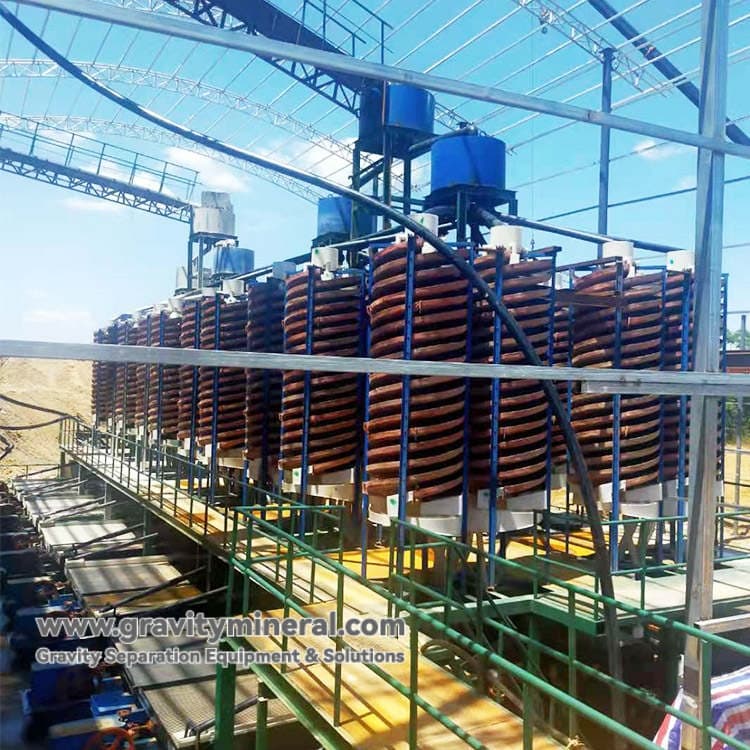
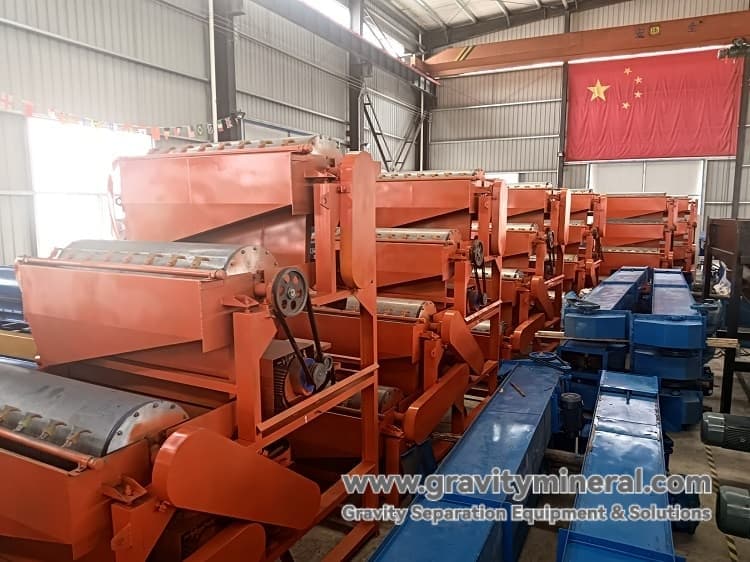
Rutile gravity–magnetic separation plant solution: Rutile (TiO₂) is a key titanium mineral resource, widely used in coatings, welding electrodes and titanium dioxide pigment production. This rutile beneficiation solution uses a combined gravity + magnetic separation flowsheet, with multi-stage separation designed to efficiently split rutile from associated minerals such as zircon and monazite.
GravityMineral's rutile beneficiation plant upgrades the ore by gravity concentration in spiral concentrators and shaking tables, then performs deep cleaning with dry magnetic separation, producing a high-quality rutile concentrate of TiO₂ ≥ 90%. It is particularly suited to beach placer sands and weathered crust rutile ores.
What Is Rutile?
Rutile is the natural mineral form of titanium dioxide (TiO₂). It crystallises in the tetragonal system and has a high specific gravity (4.2–4.3 g/cm³), commonly occurring with other heavy minerals such as ilmenite, zircon and monazite. Rutile is a key feedstock for titanium dioxide pigment and titanium metal, widely used in coatings, welding electrodes and aerospace applications.
Because the density contrast is pronounced, gravity separation is the most economical way to recover rutile. Gravity alone, however, cannot split rutile from the dense zircon and ilmenite. GravityMineral's standard rutile beneficiation process therefore uses a combined "gravity upgrading + magnetic cleaning" flowsheet: it rejects the bulk of the light silica sand while ensuring the final TiO₂ grade reaches 90% or above.
20 yearsFocused on gravity separation equipment manufacturing
50+ countriesRutile beneficiation lines exported and commissioned
500+ projectsGlobal gravity separation project experience base
35%China market share in gravity separation equipment
Three-Stage Rutile Beneficiation Flowsheet
GravityMineral's flowsheet is purpose-designed for beach placer sands and weathered crust rutile ore, exploiting the density and magnetic susceptibility contrasts for efficient separation.
Stage 1: Pre-treatment
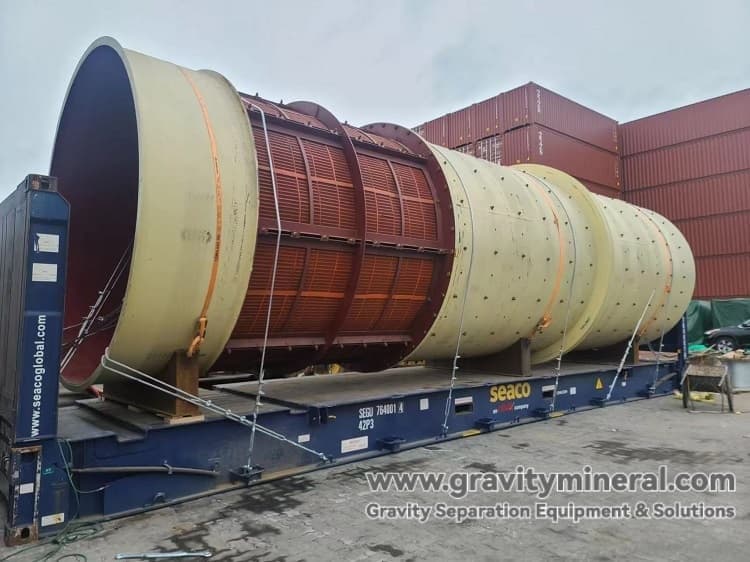
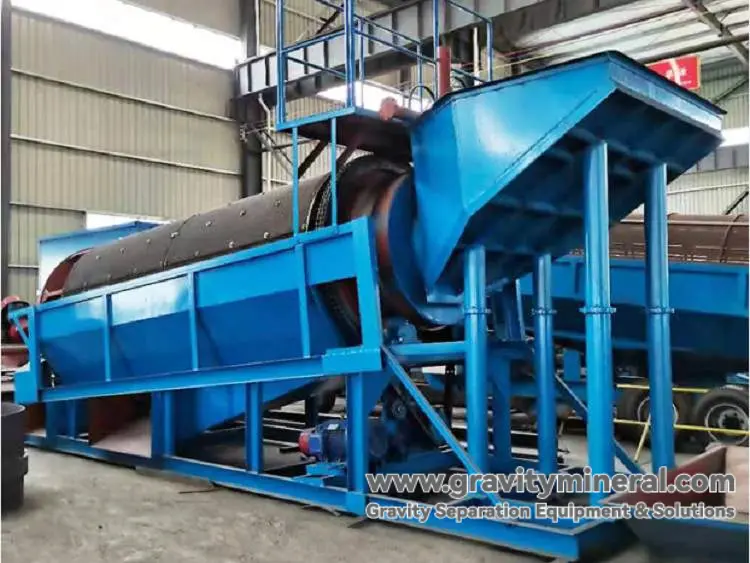
- A trommel scrubber removes shell, weed and other contaminants;
- Capacity: 20–400 t/h;
- Water consumption: 1–1.5 t per tonne of ore.
Stage 2: Gravity Upgrading
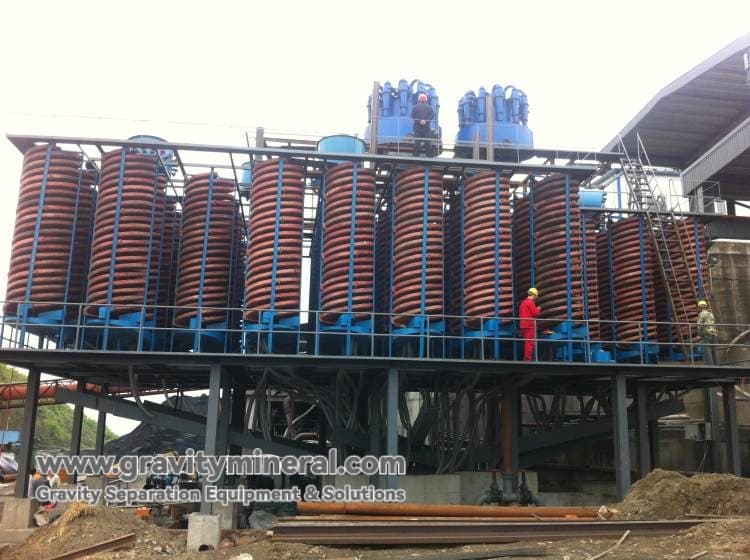
- Spiral concentrator banks for roughing and scavenging;
- Feed pulp density: 30–35%;
- Classification size: +0.074 mm;
- Optional 6-S shaking tables for the −0.5 mm fine fraction.
Stage 3: Magnetic Separation
- A wet magnetic separator removes magnetic minerals such as ilmenite (field intensity 0.12–0.8 T);
- The drying system uses indirect heating (temperature ≤120 °C);
- A dry magnetic separator performs final cleaning at 1.0–1.5 T field intensity.
Core Equipment Configuration and Selection for a Rutile Beneficiation Plant
The challenge in rutile processing lies in high-tonnage upgrading in the gravity stage and precise impurity removal in the magnetic stage. The table below lists the core equipment and duty stations used in a rutile beneficiation plant.
| Process stage |
Core equipment |
Technical parameters |
| Washing |
Trommel scrubber |
Φ2.4×6 m, capacity 50–200 t/h. |
| Gravity separation |
FRP spiral concentrator |
Capacity 2–4 t/h per unit. |
| Magnetic separation |
Wet magnetic separator |
CTB-1050, field intensity 0.12–0.8 T. |
| Drying |
Rotary dryer |
Φ1.5×12 m, indirect heating ≤120 °C. |
| Cleaning |
Dry magnetic separator |
YCBG-1216, field intensity 1.0–1.5 T. |
Target Technical and Economic Indicators
Technical targets
- Capacity: 20–500 t/d (customisable).
- Concentrate grade: TiO₂ ≥ 90%.
- Water consumption: 1–1.5 t per tonne of ore.
- Water recirculation rate: ≥ 90%.
System advantages
- Efficient separation: gravity stage recovery ≥85%, magnetic impurity removal efficiency ≥95%.
- Product quality: concentrate TiO₂ consistently ≥90%.
- Energy and environment: water recirculation ≥90%, no chemical reagents added.
- Stable and reliable: wear-resistant equipment design; simple, easy-to-operate flowsheet.
Why Build Your Rutile Plant with GravityMineral
Rutile projects typically face shifting mineral composition, difficulty separating rutile from zircon, and strict impurity limits. The mineral processing industry does not lack equipment — what it lacks is a partner that understands both gravity upgrading and magnetic cleaning, and can make the flowsheet work as one system.
| Common problem |
GravityMineral's solution |
| Rutile and zircon have similar specific gravity; gravity separation cannot split them |
A dry magnetic separator is installed after gravity separation, using rutile's weak magnetic response to separate it precisely from zircon. |
| Conductive ilmenite interferes with electrostatic separation |
A dry magnetic separator ahead of the electrostatic stage removes magnetic ilmenite first, keeping the electrostatic field clean. |
| Design institute drawings and equipment supply are disconnected, so interfaces mismatch |
Equipment manufacturing, flowsheet design and on-site commissioning sit within one closed-loop team — the interfaces never clash. |
- 20 years focused on gravity separation: two decades of building spiral concentrators and shaking tables — which equipment suits which ore condition, which flowsheet suits which size fraction, all backed by retrievable historical experience.
- Full gravity and magnetic process coverage: GravityMineral supplies not only gravity roughing and upgrading, but also deep cleaning equipment such as dry magnetic separators.
- 50+ countries, 500+ global projects: Australian heavy mineral sands, Southeast Asian beach placers and other real sites are the best test of equipment reliability and adaptability.
- Six official credentials: ISO9001, S-certified supplier, National High-Tech Enterprise, Jiangxi Provincial SRDI (specialised, refined, distinctive and innovative) SME, "Contract-Honoring and Credit-Worthy AA Enterprise", and "Major Taxpayer".
Rutile Beneficiation Plant Price and Investment Reference
There is no standard price for a rutile beneficiation plant — for the same throughput, differences in feed grade, mineral assemblage and site conditions can change the equipment configuration and capital cost considerably. GravityMineral does not quote "paper prices" detached from the ore; instead we cost the full picture against the following cost structure:
- Equipment investment: washing and screening stage, gravity stage (spiral concentrators / shaking tables), magnetic stage (wet / dry magnetic separators) and drying stage. Modular design allows staged investment to suit your budget.
- Free process design: flowsheet design, equipment selection and plant layout drawings are completed by GravityMineral's in-house design team — no external design institute required.
- Civil works and installation labour: civil construction and general installation labour are organised locally by the client; GravityMineral engineers provide on-site technical supervision.
- Operating cost (OPEX): no reagents in the gravity stage, no chemicals, high water recirculation — overall operating cost is low.
- Lead time and funding rhythm: manufacture of core standard equipment takes about 40–60 days; a full EPC turnkey project typically takes 7–12 months from contract effective date to reaching production targets.
Tell GravityMineral your ore type, feed grade, target throughput (tonnes per hour), feed size and site conditions, and our engineers will draw on a 500+ global project database to issue a transparent equipment selection list and quotation.
From Process Design to Production Targets: GravityMineral's Service Workflow
GravityMineral does more than sell equipment: we provide a full-cycle service covering mineral analysis, flowsheet design, equipment manufacturing and on-site installation and commissioning. A rutile project typically advances through the following milestones:
- Requirement review (3–7 days): provide ore type, feed grade, target throughput, feed size and site conditions; GravityMineral proposes a preliminary direction at no charge.
- Process design and selection quotation (7–15 days): engineers combine orebody conditions with the 500+ global project database to fix the gravity–magnetic route and issue the equipment selection scheme, with selection and quotation delivered together.
- Drawing design (7–15 days): flowsheet diagram, equipment list, plant layout drawing and civil works condition drawings, completed by the in-house design team — design is never outsourced.
- Equipment manufacturing (40–60 days): scheduled across two in-house manufacturing bases, with quality control from raw material to factory test run.
- Shipping and logistics (30–60 days) + on-site installation and commissioning (60–150 days): engineers supervise installation on site, carry out single-machine and linked-circuit test runs and operator training — delivery is complete only when commissioning meets the targets.
A conventional mineral processing EPC turnkey project typically takes 7–12 months from contract effective date to reaching production targets.
Other Gravity–Magnetic Combined Process Solutions
The core of rutile separation is "gravity upgrading + magnetic cleaning". If the ore you process also involves a complex heavy mineral assemblage, the following solutions may offer useful reference:
Rutile Processing: Frequently Asked Questions (FAQ)
Q1: Rutile and zircon have similar specific gravity — how are they effectively separated?
A: Rutile and zircon have very similar specific gravities (about 4.2–4.7), so gravity separation cannot split them. Rutile, however, is weakly magnetic while zircon is not. GravityMineral therefore installs a dry magnetic separator after gravity separation, using the magnetic contrast to separate rutile from zircon precisely.
Q2: Why must the material be dried before magnetic separation?
A: Dry magnetic separation requires dry, free-flowing feed. Wet material entering the separator not only blinds the gaps between the magnetic rolls but also sticks to the poles, seriously impairing separation efficiency. The gravity concentrate must therefore be dewatered in a dryer to below 0.5% moisture.
Q3: Roughly how much does a complete rutile beneficiation plant cost?
A: The actual cost depends on your throughput (tonnes per hour), feed grade and target concentrate specification. Once GravityMineral understands the ore conditions, we issue a transparent equipment list and quotation covering the scrubber, spiral concentrators, shaking tables, wet magnetic separator and dry magnetic separator.
Q4: If the feed has a high clay content, will that affect gravity separation?
A: Yes. High clay content seriously interferes with gravity separation. GravityMineral installs a trommel scrubber or trommel screen at the front of the circuit to wash and deslime first. Only washed pulp enters the spiral concentrators and shaking tables, preventing fine slimes from coating the rutile and causing losses.
Q5: How are the fine slimes in the tailings handled? Will they pollute the environment?
A: No. GravityMineral installs a thickener and filter press at the end of the circuit. After thickening and settling, the slurry is filter-pressed into dry cake for stacking, while the clear water is returned for reuse. This achieves zero discharge and saves a significant amount of water.
Q6: Can you supply a single dry magnetic separator? What if we want to expand later?
A: Yes, single units can be supplied. GravityMineral supports modular purchasing: you can start with a gravity + wet magnetic separation set and add the drying and dry cleaning stages later when budget allows. Because the interfaces are reserved in the original design, expansion does not require rebuilding — you simply add equipment in proportion.
Q7: Our feed grade fluctuates a lot — can your flowsheet cope?
A: Yes. Process design accounts for the ore's variation range and operating tolerance. Throughput, stroke and slope of the gravity stage (spiral concentrators and shaking tables) can all be adjusted to the feed grade. If variation exceeds the normal range, engineers set the operating parameters for each condition during on-site commissioning.
Q8: For projects in Africa or Southeast Asia, can you send engineers for on-site installation?
A: Yes. GravityMineral's products and services have been exported to more than 50 countries. We dispatch on-site engineers to supervise equipment positioning, single-machine and linked-circuit test runs, recovery adjustment, and to train your local operating team until the line runs stably and meets the targets.
Global Rutile Project Installation Case
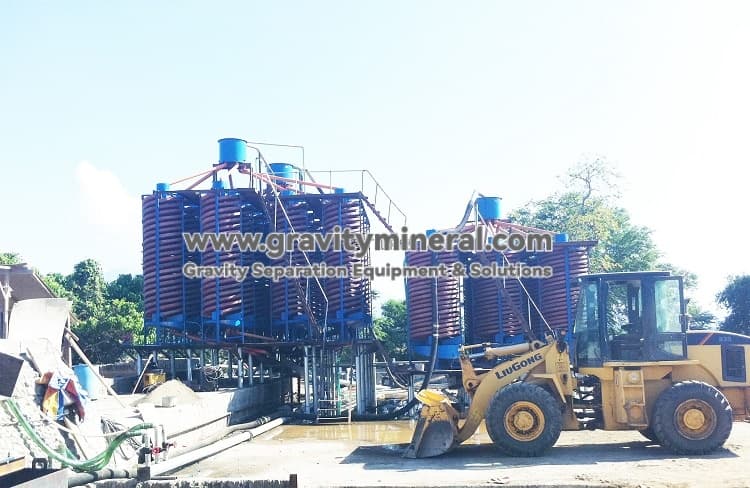
EPC Turnkey: End-to-End Rutile Beneficiation Engineering
GravityMineral provides end-to-end technical support to rutile projects worldwide. Because our flowsheet is 100% physical separation (no chemical reagents, zero wastewater discharge), environmental permitting is substantially simplified.
- Solution design: a gravity–magnetic flowsheet and equipment configuration tailored to the specific characteristics of your ore sample.
- Engineering services: production line planning and 3D drawing design completed in-house — medium and large projects can save hundreds of thousands of dollars in design fees.
- Equipment manufacturing and supply: core gravity and magnetic equipment is produced at GravityMineral's two in-house manufacturing bases, with quality control from raw material procurement to factory test run.
- Installation and commissioning: engineers dispatched worldwide to supervise installation, single-machine and linked-circuit test runs, recovery adjustment and operator training — delivery is complete only when commissioning meets the targets.
- After-sales and optimisation: quality responsibility during the warranty period; after warranty, spare parts supply, technical consultation and process optimisation, with response within 24 hours.
Talk to the GravityMineral engineering team for a customised rutile plant layout proposal and equipment quotation.