Barite (BaSO₄) gravity plant solution: Barite is an important industrial mineral whose main global application is as a weighting agent in oil and gas drilling muds. To meet the strict API (American Petroleum Institute) specification, the final barite concentrate must have a specific gravity ≥4.2 and a BaSO₄ content ≥85%.
Because barite is naturally dense and often occurs as coarse grains within waste rock, gravity separation is the most economical and most environmentally friendly method for treating it. GravityMineral's customised barite processing plant uses an efficient "crushing, screening and jigging" flowsheet to separate barite from lighter gangue, ensuring you meet API specification at the lowest possible operating cost.
What Is Barite (BaSO₄)?
Barite consists mainly of barium sulphate (BaSO₄) and is a non-metallic mineral with a very high specific gravity (4.3–4.5 g/cm³), relatively soft texture and stable chemical properties. It is widely used as a weighting agent in oil drilling muds, as a chemical filler, and in glass and radiation-shielding materials.
The core challenge in barite beneficiation is preventing over-comminution. Barite is extremely brittle, so if a ball mill were used it would rapidly turn into fine dust (slimes) that jigs cannot recover. GravityMineral's standard barite gravity process therefore uses a purely physical "crush more, grind less + staged jigging" circuit with no ball mill at all, ensuring efficient recovery of coarse barite.
20 yearsFocused on mineral processing equipment manufacturing
50+ countriesBarite gravity lines exported and commissioned
500+ projectsGlobal mineral processing project experience base
35%China market share in gravity separation equipment
Four-Stage Barite Gravity Flowsheet
To preserve the highest possible specific gravity, GravityMineral's flowsheet avoids overgrinding (which produces unrecoverable dust) and focuses on coarse gravity recovery in sawtooth-wave jigs.
Stage 1: Crushing Circuit (Crush More, Grind Less)
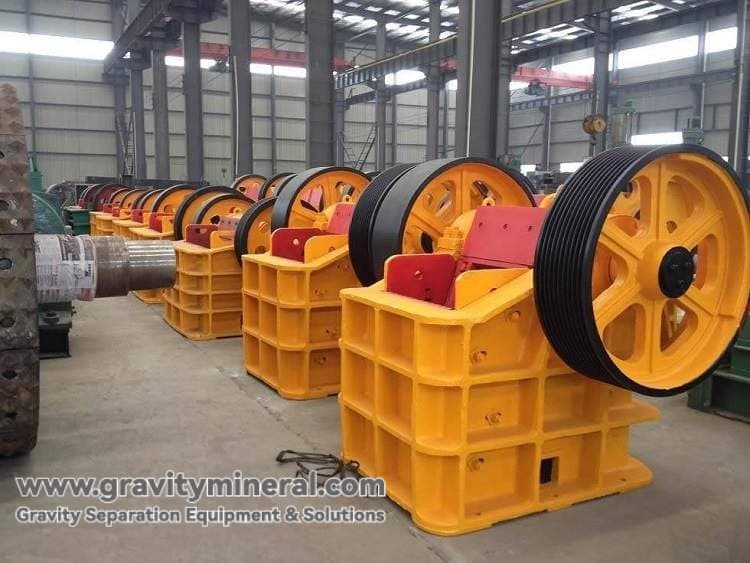
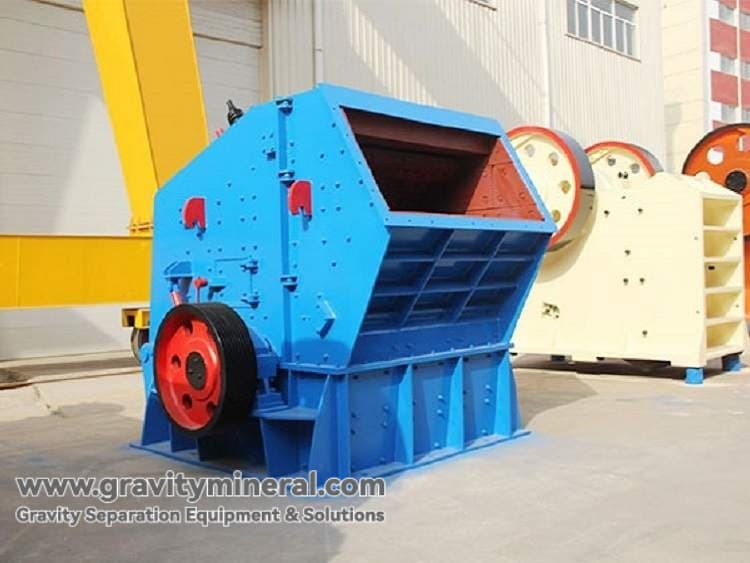
Primary barite ore is first processed in a primary jaw crusher, then a secondary cone crusher. The target is to reduce the lump rock to −20 mm, effectively separating barite from the host rock.
Stage 2: Strict Screening and Classification
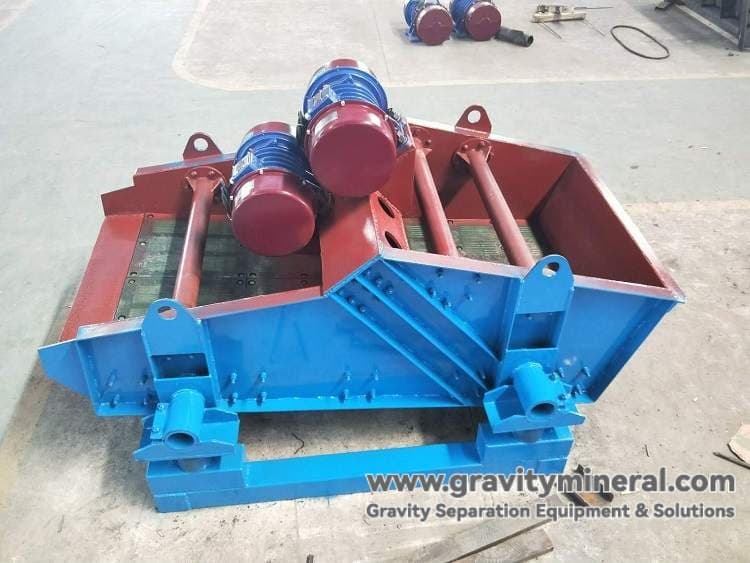
Sawtooth-wave jigs perform best on a narrow size range. The crushed ore is fed to a circular vibrating screen, which classifies the material into three fractions: +5 mm, 2–5 mm and 0.5–2 mm.
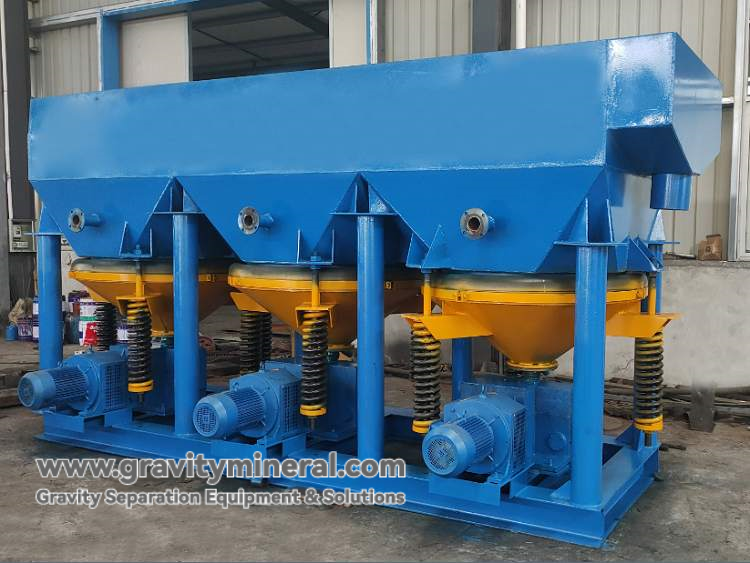
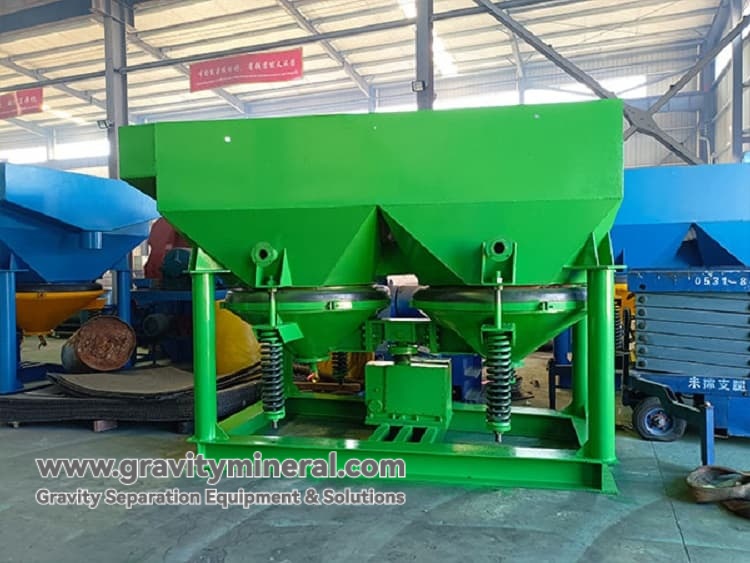
Stage 3: Jigging (the Core Recovery Stage)
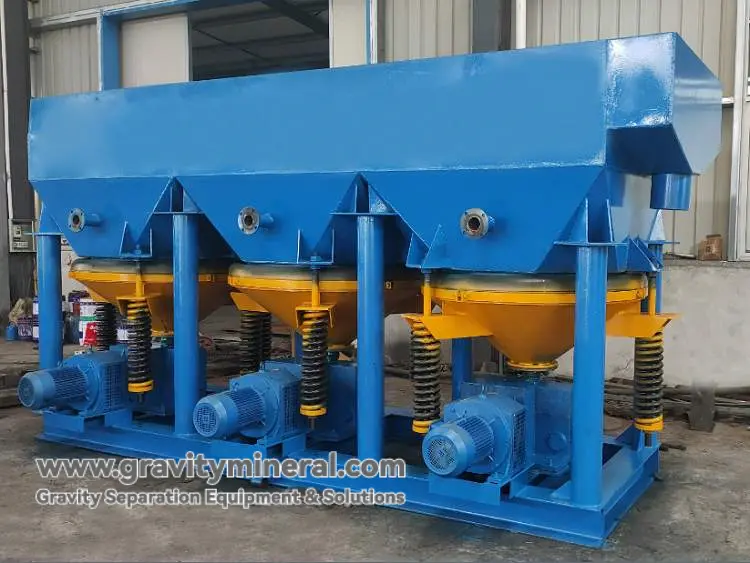
Each classified fraction is fed to a dedicated sawtooth-wave jig.
- Coarse jigs treat the +2 mm rock.
- Fine jigs treat the 0.5–2 mm sand.
The pulsating water inside the jig forces the heavy barite to settle and discharge as premium concentrate, while the lighter waste rock floats on top and is discharged as tailings.
Stage 4: Dewatering and Drying
The final barite concentrate passes over a high-frequency dewatering screen to remove excess water quickly. Depending on local climate and transport requirements, the concentrate is then sun-dried or processed through a low-temperature rotary dryer.
Core Equipment Configuration and Selection for a Barite Gravity Plant
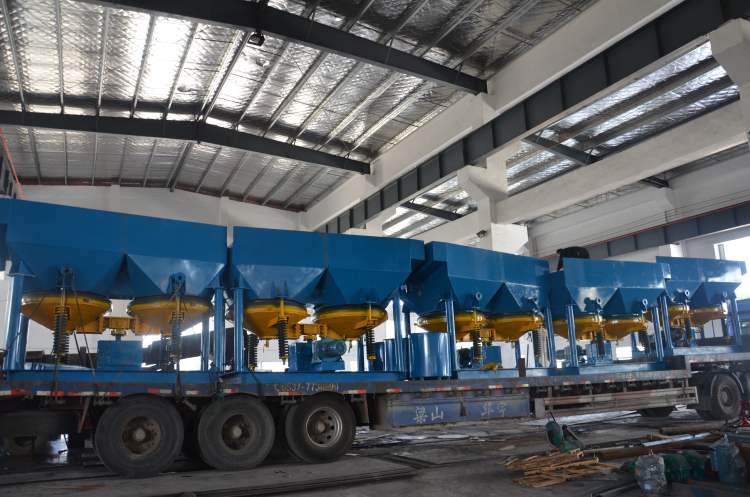
The challenge in barite processing lies in "crush more, grind less" (preventing sliming) and in jig size-fraction matching. The table below lists the core equipment and duty stations used in a barite processing plant.
| Process stage |
Main equipment |
Typical model |
Capacity |
| Primary crushing |
Jaw crusher |
PE400 × 600 |
15–50 t/h |
| Secondary crushing |
Cone crusher |
PYB 900 |
20–65 t/h |
| Screening and classification |
Circular vibrating screen |
YA 1848 |
30–100 t/h |
| Gravity separation |
Sawtooth-wave jig |
JT5-2 |
5–30 t/h per unit |
| Dewatering |
High-frequency dewatering screen |
TS 1216 |
10–40 t/h |
Plant Technical and Economic Indicators
Technical targets
- Ore type: coarse-grained, simply disseminated barite (liberation size ≥0.5 mm).
- Feed grade: BaSO₄ content ≥30%.
- Final product target: oil drilling grade (BaSO₄ ≥ 85%, specific gravity ≥ 4.2) or chemical-grade feedstock.
- Secondary application: upgrading of low-grade barite tailings.
System advantages
- Early recovery, no sliming: the "crush more, grind less + staged jigging" process stops barite from being over-comminuted in a mill at source.
- Economical investment: zero reagent consumption and low equipment cost — payback for this type of plant is typically under one year.
- Clean production: zero reagents in the gravity stage and purely physical separation, meeting modern environmental requirements.
Why Build Your Barite Plant with GravityMineral
Barite is a high-value mineral, but it is brittle — sliming from overgrinding is the biggest cause of lost profit. The mineral processing industry does not lack equipment — what it lacks is a partner that understands gravity separation and, equally, understands an anti-sliming design that keeps the ore out of a ball mill, and can make the flowsheet fit together perfectly.
| Common problem |
GravityMineral's solution |
| Barite is brittle and is easily over-comminuted and lost in grinding |
Following "crush more, grind less", we use two-stage crushing plus vibrating screens — the ore never enters a mill, so the coarse fraction is preserved. |
| Specific gravity below specification, so the product cannot command a premium price |
Staged jigs give precise control, ensuring SG ≥4.2 and BaSO₄ ≥85% — fully compliant with API specification. |
| Design institute drawings and equipment supply are disconnected, so interfaces mismatch |
Equipment manufacturing, flowsheet design and on-site commissioning sit within one closed-loop team — the interfaces never clash. |
- 20 years focused on gravity separation: two decades of building spiral concentrators and jigs — which equipment suits which ore condition, which flowsheet suits which size fraction, all backed by retrievable historical experience.
- Full gravity / magnetic coverage: GravityMineral supplies not only gravity roughing and upgrading, but also deep-processing equipment such as dewatering screens and dryers.
- 50+ countries, 500+ global projects: barite operations in Southeast Asia and Africa and other real sites are the best test of equipment reliability and adaptability.
- Six official credentials: ISO9001, S-certified supplier, National High-Tech Enterprise, Jiangxi Provincial SRDI (specialised, refined, distinctive and innovative) SME, "Contract-Honoring and Credit-Worthy AA Enterprise", and "Major Taxpayer".
Barite Processing Plant Price and Investment Reference
There is no standard price for a barite processing plant — for the same throughput, differences in feed grade, degree of liberation and site conditions can change the equipment configuration and capital cost considerably. GravityMineral does not quote "paper prices" detached from the ore; instead we cost the full picture against the following cost structure:
- Equipment investment: crushing and screening stage (jaw / cone crusher / circular vibrating screen), jigging stage and dewatering stage. Modular design allows staged investment to suit your budget.
- Free process design: flowsheet design, equipment selection and plant layout drawings are completed by GravityMineral's in-house design team — no external design institute required.
- Civil works and installation labour: civil construction and general installation labour are organised locally by the client; GravityMineral engineers provide on-site technical supervision.
- Operating cost (OPEX): zero reagents and no chemicals in the gravity stage, purely physical separation — overall operating cost is extremely low, with payback typically under one year.
- Lead time and funding rhythm: manufacture of core standard equipment takes about 40–60 days; a full EPC turnkey project typically takes 7–12 months from contract effective date to reaching production targets.
Tell GravityMineral your ore type, feed grade, target throughput (tonnes per hour), feed size and site conditions, and our engineers will draw on a 500+ global project database to issue a transparent equipment selection list and quotation.
From Process Design to Production Targets: GravityMineral's Service Workflow
GravityMineral does more than sell equipment: we provide a full-cycle service covering mineral analysis, flowsheet design, equipment manufacturing and on-site installation and commissioning. A barite project typically advances through the following milestones:
- Requirement review (3–7 days): provide ore type, feed grade, target throughput, feed size and site conditions; GravityMineral proposes a preliminary direction at no charge.
- Process design and selection quotation (7–15 days): engineers combine orebody conditions with the 500+ global project database to fix the gravity route and issue the equipment selection scheme, with selection and quotation delivered together.
- Drawing design (7–15 days): flowsheet diagram, equipment list, plant layout drawing and civil works condition drawings, completed by the in-house design team — design is never outsourced.
- Equipment manufacturing (40–60 days): scheduled across two in-house manufacturing bases, with quality control from raw material to factory test run.
- Shipping and logistics (30–60 days) + on-site installation and commissioning (60–150 days): engineers supervise installation on site, carry out single-machine and linked-circuit test runs and operator training — delivery is complete only when commissioning meets the targets.
A conventional mineral processing EPC turnkey project typically takes 7–12 months from contract effective date to reaching production targets.
Related Gravity Separation Solutions
Beyond barite, GravityMineral's gravity separation solution library covers the main hard-rock and placer ore types, so we can match historical experience from similar scenarios:
Barite Processing: Frequently Asked Questions (FAQ)
Q1: Why is no ball mill used in this flowsheet?
A: Barite is soft and breaks very easily. Fed into a ball mill, it would rapidly become fine powder (slimes). Gravity jigs cannot recover slimes, which means a large share of your product would report to the tailings pond. By using strictly staged crushing (jaw + cone) and screening, we preserve the coarse barite particle size so that jigs can capture it easily and efficiently.
Q2: Does barite processing require chemical reagents?
A: No. For coarse-grained, simply disseminated barite ore, purely physical gravity separation (water only) efficiently reaches the required 4.2 specific gravity. The process is 100% chemical-free, which greatly simplifies environmental permitting and keeps your ongoing operating cost (OPEX) extremely low.
Q3: Roughly how much does a complete barite processing plant cost?
A: The actual cost depends on your throughput (tonnes per hour), feed grade and target concentrate specification. Once GravityMineral understands the ore conditions, we issue a transparent equipment list and quotation covering the jaw crusher, cone crusher, vibrating screen, jigs and dewatering screen.
Q4: If the feed has a high clay content, will that affect gravity separation?
A: Yes. High clay content seriously interferes with gravity separation. GravityMineral installs a trommel scrubber or trommel screen at the front of the circuit to wash and deslime first. Only washed pulp enters the jigs, preventing fine slimes from coating the barite and causing losses.
Q5: How are the fine slimes in the tailings handled? Will they pollute the environment?
A: No. GravityMineral installs a thickener and filter press at the end of the circuit. After thickening and settling, the slurry is filter-pressed into dry cake for stacking, while the clear water is returned for reuse. This achieves zero discharge and saves a significant amount of water.
Q6: Can you supply a single jig? What if we want to expand later?
A: Yes, single units can be supplied. GravityMineral supports modular purchasing: you can start with a crushing + jigging set and add further jigging and dewatering stages later when budget allows. Because the interfaces are reserved in the original design, expansion does not require rebuilding — you simply add equipment in proportion.
Q7: Our feed grade fluctuates a lot — can your flowsheet cope?
A: Yes. Process design accounts for the ore's variation range and operating tolerance. Throughput, stroke and stroke rate of the jigs can all be adjusted to the feed grade. If variation exceeds the normal range, engineers set the operating parameters for each condition during on-site commissioning.
Q8: For projects in Africa or Southeast Asia, can you send engineers for on-site installation?
A: Yes. GravityMineral's products and services have been exported to more than 50 countries. We dispatch on-site engineers to supervise equipment positioning, single-machine and linked-circuit test runs, recovery adjustment, and to train your local operating team until the line runs stably and meets the targets.
Q9: What does API grade barite actually require, and how is it achieved?
A: Oil drilling grade is defined by two numbers: specific gravity ≥ 4.2 (barite SG 4.2) and BaSO₄ ≥ 85%, with tight limits on soluble alkaline earth metals and residue. A barite jig plant achieves this purely physically: two-stage crushing to −20 mm, strict screening into +5 mm / 2–5 mm / 0.5–2 mm fractions, then staged sawtooth-wave jigging that sinks the dense barite as concentrate and floats off light gangue. No ball mill is used, because grinding would slim the barite into fines a jig cannot recover — which is the single most common reason a barite plant fails to reach SG 4.2.
EPC Turnkey: End-to-End Barite Gravity Engineering
Gravity separation is the most profitable route for barite recovery. Because equipment investment is low and chemical consumption is zero, payback for these plants is typically under one year. GravityMineral provides:
- Solution design: a gravity flowsheet and equipment configuration tailored to the specific characteristics of your ore sample.
- Engineering services: production line planning and 3D drawing design completed in-house — medium and large projects can save hundreds of thousands of dollars in design fees.
- Equipment manufacturing and supply: core gravity equipment is produced at GravityMineral's two in-house manufacturing bases, with quality control from raw material procurement to factory test run.
- Installation and commissioning: engineers dispatched worldwide to supervise installation, single-machine and linked-circuit test runs, recovery adjustment and operator training — delivery is complete only when commissioning meets the targets.
- After-sales and optimisation: quality responsibility during the warranty period; after warranty, spare parts supply, technical consultation and process optimisation, with response within 24 hours.
Talk to the GravityMineral engineering team for a customised barite plant layout proposal and equipment quotation.