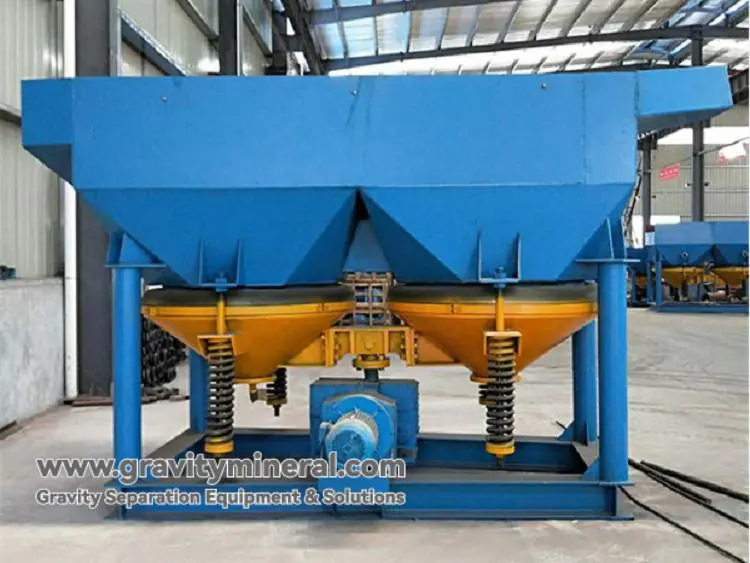
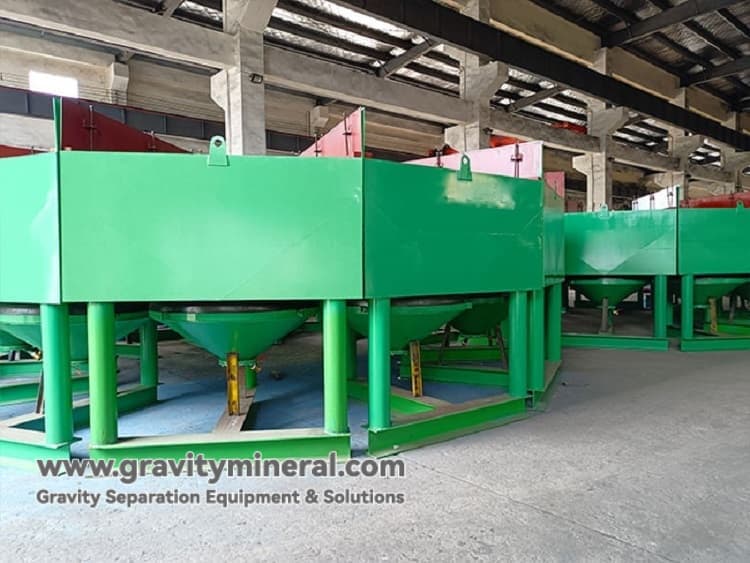
Gemstone wash plant solution (alluvial ruby, sapphire and garnet): Alluvial gemstone deposits host high-density, high-value crystals — ruby, sapphire and garnet. Processing them sets a metallurgical objective unlike any other ore: maximum recovery must be achieved without cracking or scratching fragile crystals.
GravityMineral's gemstone wash plant uses an efficient yet gentle "washing + screening + gravity separation" circuit. Because it relies on 100% physical separation — rubber-lined scrubbers, sawtooth-wave jigs and 6-S shaking tables — the structural integrity of the crystals is preserved. This turnkey alluvial gemstone processing plant uses no chemical reagents, runs at low operating cost, and handles feed from 0.5 mm up to 30 mm.
What Are Alluvial Gemstone Deposits?
Alluvial gemstone deposits (placers) are secondary deposits formed on river flats and terraces after long-term weathering, river transport and deposition of primary gemstone sources — sapphire in basalt, ruby in marble. Natural washing has already liberated the crystals completely and cleaned their surfaces, so the crushing and grinding needed for primary hard rock ore is entirely unnecessary.
The core difficulty in gemstone processing is that the crystals are extremely brittle and must never pass through a crusher. GravityMineral's standard gemstone gravity separation uses a purely physical circuit of "washing and screening — jig roughing — table cleaning", combined with hand sorting for the coarse fraction. That combination protects gem value to the maximum while efficiently rejecting light quartz gravel.
20 yearsGravity separation equipment manufacturing
50+ countriesGemstone wash plants exported and commissioned
500+ projectsAlluvial and hard rock processing experience base
35%China market share in gravity separation equipment
Three-Stage Gemstone Recovery Flowsheet
GravityMineral's flowsheet focuses on vigorous washing to dissolve clay, followed by precise, zero-impact gravity separation to capture the heavy gemstones. The same layout suits alluvial sapphire mining and alluvial ruby mining alike.
Stage 1: Gentle Washing and Screening
Gemstones are usually trapped in sticky laterite clay, which must be dissolved without crushing the stones.
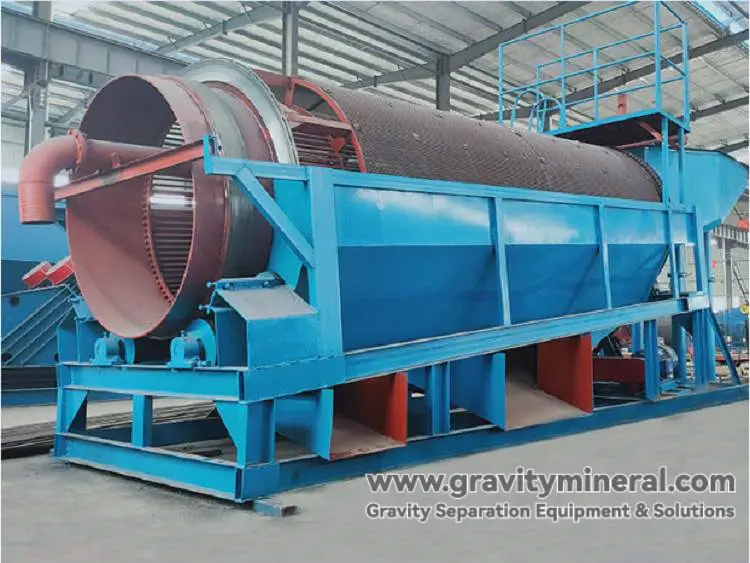
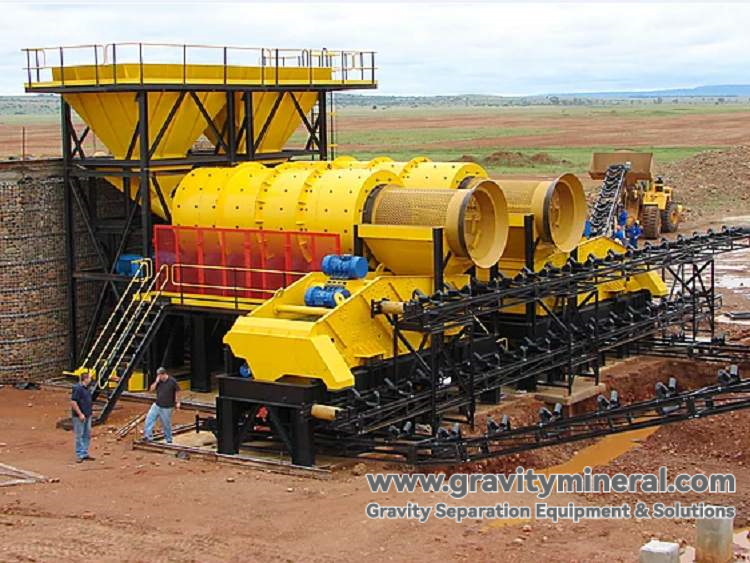
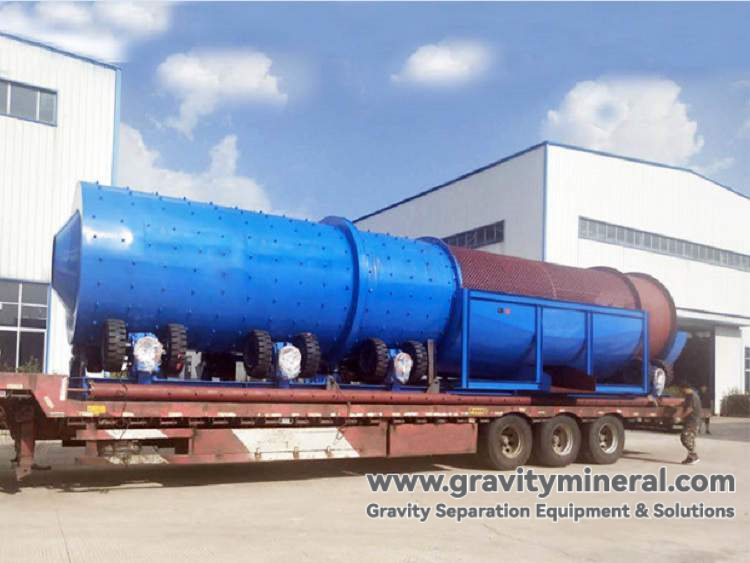
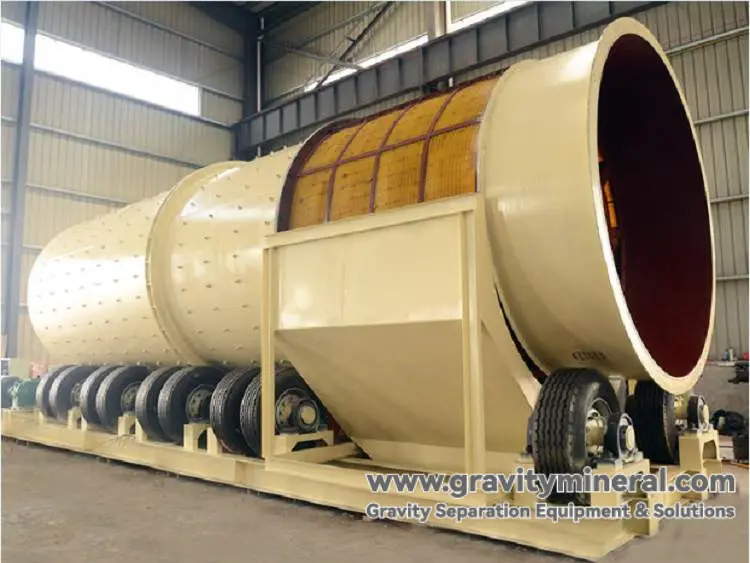
- Rotary washing: run-of-mine ore enters a rubber-lined rotary scrubber. High-pressure water jets break up the clay vigorously and clean the stone surfaces. The thick rubber lining acts as a shock absorber, preventing crystals from being cracked as they tumble inside a steel drum.
- Vibrating screening: the washed material is classified on a two-deck vibrating screen into specific size fractions (+5 mm, 5–2 mm, 2–0.5 mm and −0.5 mm).
- Hand sorting (+5 mm): the coarsest fraction (+5 mm) is conveyed to a low-speed sorting belt. Workers pick out large gemstone crystals by hand and reject coarse waste rock, maximising the value of the big stones.
Stage 2: Gravity Upgrading System
The classified, washed gravel is fed to density separators by particle size, splitting heavy gemstones from light quartz gravel.
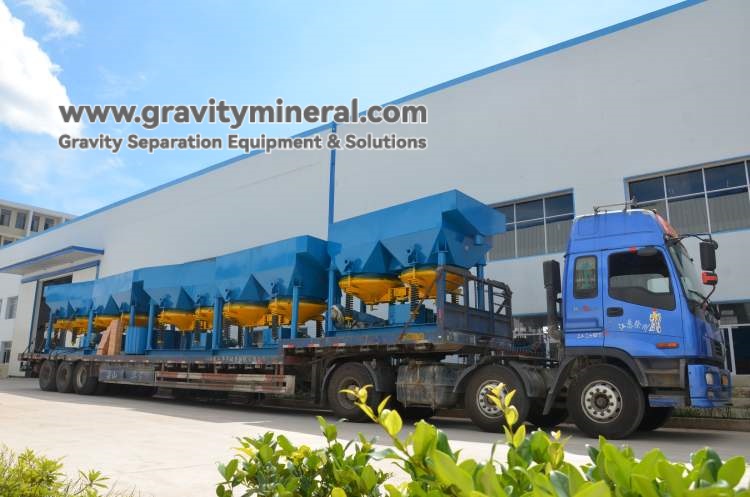
- Jigging (5–0.5 mm): the medium gravel fraction enters a sawtooth-wave jig. The pulsating bed stratifies the material easily, capturing high-density gemstones while discharging lighter vein minerals.
- Spiral roughing (−0.5 mm): the finest particles — usually garnet sand or tiny corundum — are recovered in FRP spiral concentrators, sharply reducing losses of fine valuable material.
- Table cleaning: the rougher pulp from the jigs is fed to 6-S shaking tables for final, high-precision visible separation.
Stage 3: Tailings and Water Recirculation
After separation, barren tailings are dewatered and safely stacked or used for mine backfill. Because the process uses no chemicals at all, process water is efficiently recirculated through a thickener — keeping the water recirculation rate above 85% and cutting operating cost substantially.
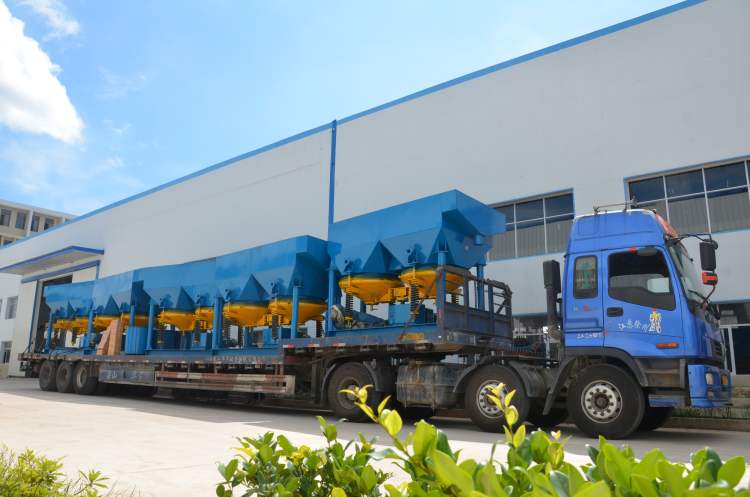
Core Equipment Configuration for a Gemstone Wash Plant
The barrier in gemstone processing is washing without damaging the crystals and separating without crushing the coarse stones. The table below lists the core equipment and duty stations used in a gemstone wash plant; exact models are fixed by GravityMineral engineers against your feed grade, gemstone size distribution and target throughput.
| Process stage |
Core equipment |
Technical features |
| Washing |
Rotary scrubber |
Rubber lined to protect gemstones. Capacity 20–300 t/h. |
| Screening and classification |
Two-deck vibrating screen |
Anti-blinding stainless steel mesh. Capacity 30–150 t/h. |
| Gravity roughing |
Sawtooth-wave jig |
Adjustable stroke for precise density separation. Capacity 5–50 t/h. |
| Fine particle recovery |
FRP spiral concentrator |
Recovers −0.5 mm fine gemstone / garnet to reduce losses. |
| Fine gravity separation |
6-S shaking table |
Corrosion-resistant FRP deck for maximum purity. Capacity 0.5–2 t/h. |
Key Performance Indicators and System Advantages
Technical targets
- Gem-grade product recovery (0.5–30 mm): 85%–95%.
- Industrial-grade recovery (−5 mm garnet / corundum): 90%–98%.
- Water recirculation rate: above 85%.
- Very low operating cost: energy use is only about one third of a dense medium separation plant.
- Feed size handled: 0.5–30 mm, with the +5 mm fraction hand sorted.
System advantages
- Crystal protection: 100% physical separation with no crusher in the circuit preserves gemstone integrity.
- Efficient recovery: jigs plus shaking tables cover the full size range, so fine garnet and micro gemstones are not lost.
- Clean production: purely physical separation with no chemicals; wash water can be safely recirculated.
- Hand-sorting integration: the coarse fraction bypasses all machinery, protecting the highest-value stones.
- Modular expansion: jig, spiral and table stages can be added in stages as throughput grows.
Why Build Your Gemstone Wash Plant with GravityMineral
Gemstone projects typically face washing damage to crystals, loss of large stones, and difficulty recovering fine garnet. The mineral processing industry does not lack equipment — what it lacks is a partner that understands gravity separation and also understands "handle with care" crystal protection, and can make the flowsheet fit together perfectly.
| Common problem |
GravityMineral's solution |
| Standard scrubbers crack ruby and sapphire |
A rubber-lined rotary scrubber absorbs impact and breaks down clay gently without damaging crystals. |
| Large gemstones are lost or damaged during mechanical separation |
The +5 mm coarse fraction is screened out and routed straight to a low-speed hand-sorting belt, guaranteeing zero mechanical loss of large stones. |
| Fine garnet and corundum cannot be recovered effectively |
FRP spiral concentrators plus 6-S shaking tables recover the −0.5 mm fine valuable material instead of losing it to tailings. |
| Design institute drawings and equipment supply are disconnected, so interfaces mismatch |
Equipment manufacturing, flowsheet design and on-site commissioning sit within one closed-loop team — the interfaces never clash. |
- 20 years focused on gravity separation: two decades of building spiral concentrators, jigs and shaking tables — which equipment suits which ore condition, which flowsheet suits which size fraction, all backed by retrievable historical experience.
- Full gravity / magnetic coverage: GravityMineral supplies not only gravity roughing and upgrading, but also dewatering screens, dryers and other downstream equipment.
- 50+ countries, 500+ global projects: gemstone placers in Southeast Asia, ruby operations in Africa and sapphire deposits in South America are the best test of equipment reliability and adaptability.
- Six official credentials: ISO9001, S-certified supplier, National High-Tech Enterprise, Jiangxi Provincial SRDI (specialised, refined, distinctive and innovative) SME, "Contract-Honoring and Credit-Worthy AA Enterprise", and "Major Taxpayer".
Gemstone Wash Plant Price and Investment Reference
How much does a gemstone wash plant cost? There is no single figure — for the same throughput, differences in feed grade, gemstone type and site conditions change both the equipment configuration and the total cost considerably. GravityMineral does not quote "paper prices" detached from the ore; instead we cost the full picture against the following structure:
- Equipment investment: washing and screening stage (rubber-lined scrubber / two-deck vibrating screen), gravity stage (jigs / spiral concentrators / shaking tables) and dewatering stage. Modular design allows staged investment to suit your budget.
- Free process design: flowsheet design, equipment selection and plant layout drawings are completed by GravityMineral's in-house design team — no external design institute required.
- Civil works and installation labour: civil construction and general installation labour are organised locally by the client; GravityMineral engineers provide on-site technical supervision.
- Operating cost (OPEX): zero reagents and no chemicals in the gravity stage, with high water recirculation — overall operating cost is extremely low.
- Lead time and funding rhythm: core standard equipment takes about 40–60 days to manufacture; a full EPC turnkey project typically reaches target production 7–12 months after contract effectiveness.
Tell GravityMineral your ore type, feed grade, target throughput (tonnes per hour), feed size and site conditions, and our engineers will draw on a 500+ global project database to issue a transparent equipment selection list and quotation — one document showing which circuit, which equipment and what cost.
From Process Design to Production Targets: GravityMineral's Service Workflow
GravityMineral does more than sell equipment: we provide a full-cycle service covering mineral analysis, flowsheet design, equipment manufacturing and on-site installation and commissioning. A gemstone project typically advances through the following milestones:
- Requirement review (3–7 days): provide ore type, feed grade, target throughput, feed size and site conditions; GravityMineral proposes a preliminary direction at no charge.
- Process design and selection quotation (7–15 days): engineers combine orebody conditions with the 500+ global project database to fix the gravity route and issue the equipment selection scheme, with selection and quotation delivered together.
- Drawing design (7–15 days): flowsheet diagram, equipment list, plant layout drawing and civil works condition drawings, completed by the in-house design team — design is never outsourced.
- Equipment manufacturing (40–60 days): scheduled across two in-house manufacturing bases, with quality control from raw material to factory test run.
- Shipping and logistics (30–60 days) + on-site installation and commissioning (60–150 days): engineers supervise installation on site, carry out single-machine and linked-circuit test runs and operator training — delivery is complete only when commissioning meets the targets.
A conventional mineral processing EPC turnkey project typically reaches target production 7–12 months after contract effectiveness.
Related Gravity Separation Solutions
Beyond gemstone placers, GravityMineral's gravity separation solution library covers the main hard-rock and placer ore types, so we can match historical experience from similar scenarios:
Gemstone Processing: Frequently Asked Questions (FAQ)
Q1: How are large rubies and sapphires prevented from breaking during washing?
A: This is the single most important design decision in a gemstone wash plant. Standard rotary scrubbers use a bare steel drum, and tumbling coarse ore inside it easily cracks fragile crystals. GravityMineral's gemstone scrubber is lined with thick industrial-grade rubber, which acts as a shock absorber while gently breaking down the clay — keeping high-value crystals intact.
Q2: Why include a hand-sorting stage at all?
A: Stones above 5 mm (+5 mm) have enormous commercial value as individual rough or cut gems. To avoid any risk of damage in mechanical separators or on a shaking table, we route the washed oversize gravel onto a low-speed picking belt. Trained workers identify and remove the largest rubies and sapphires visually, guaranteeing zero mechanical loss on your most valuable inventory.
Q3: How much does a complete gemstone wash plant cost?
A: The actual cost depends on your throughput (tonnes per hour), feed grade and target concentrate specification. Once GravityMineral understands the ore conditions, we issue a transparent equipment list and quotation covering the scrubber, vibrating screen, jigs, spiral concentrators and shaking tables.
Q4: If the feed has a high clay content, will that affect gemstone recovery?
A: Yes. High clay content seriously interferes with gravity separation. GravityMineral installs a rubber-lined scrubber at the front of the circuit to wash and deslime first. Only washed pulp enters the jigs and spiral concentrators, preventing fine slimes from coating the gemstones and carrying them to tailings.
Q5: How are the fine slimes in the tailings handled? Will they pollute the environment?
A: No. GravityMineral installs a thickener and filter press at the end of the circuit. After thickening and settling, the slurry is filter-pressed into dry cake for stacking, while the clear water returns to the scrubber. This achieves zero discharge, keeps the water recirculation rate above 85% and saves a significant amount of water.
Q6: Can you supply a single jig? What if we want to expand later?
A: Yes, single units can be supplied. GravityMineral supports modular purchasing: you can start with a washing + jigging set and add the shaking table and dewatering stages later when budget allows. Because the interfaces are reserved in the original design, expansion does not require rebuilding — you simply add equipment in proportion.
Q7: Our feed grade fluctuates a lot — can your flowsheet cope?
A: Yes. Process design accounts for the ore's variation range and operating tolerance. Throughput, stroke and slope of the gravity stage (jigs and shaking tables) can all be adjusted to the feed grade. If variation exceeds the normal range, engineers set the operating parameters for each condition during on-site commissioning.
Q8: For projects in Africa or Southeast Asia, can you send engineers on site?
A: Yes. GravityMineral's products and services have been exported to more than 50 countries. We dispatch on-site engineers to supervise equipment positioning, single-machine and linked-circuit test runs, recovery adjustment, and to train your local operating team until the line runs stably and meets the targets.
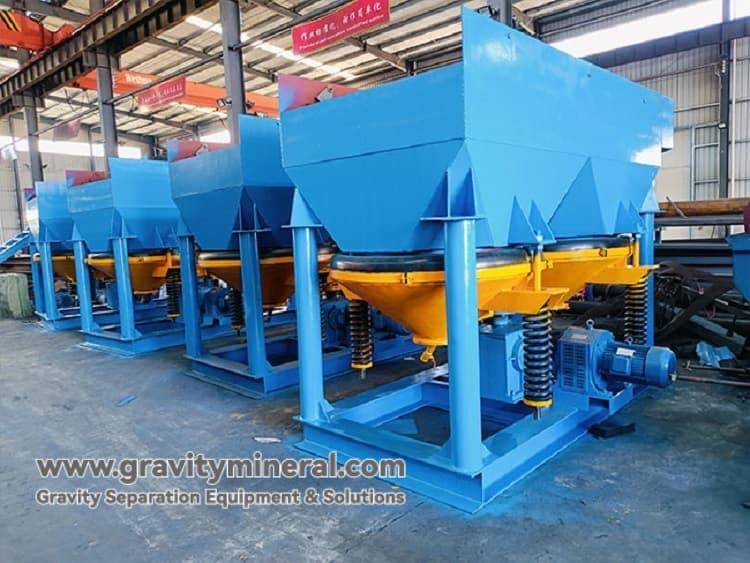
EPC Turnkey: End-to-End Gemstone Wash Plant Engineering
If you hold an alluvial ruby, sapphire or garnet mining project, GravityMineral can provide a professional, economical and highly reliable turnkey solution covering the full cycle of technical support:
- Solution design: a gravity flowsheet and equipment configuration tailored to the specific characteristics of your ore sample, with crystal protection built into every stage.
- Engineering services: production line planning and 3D drawing design completed in-house — medium and large projects can save hundreds of thousands of dollars in design fees.
- Equipment manufacturing and supply: core gravity equipment is produced at GravityMineral's two in-house manufacturing bases, with quality control from raw material procurement to factory test run.
- Installation and commissioning: engineers dispatched worldwide to supervise installation, single-machine and linked-circuit test runs, recovery adjustment and operator training — delivery is complete only when commissioning meets the targets.
- After-sales and optimisation: quality responsibility during the warranty period; after warranty, spare parts supply, technical consultation and process optimisation, with response within 24 hours.
Contact the GravityMineral technical team through our website for a tailored gemstone wash plant layout proposal and equipment quotation.