







How Should a Full-Gravity Gold Ore Beneficiation Production Line Be Configured? A Continuous Process Scheme for Gravity Concentration and Enrichment
The configuration of a full-gravity gold ore beneficiation production line may seem like a matter of an equipment list, but in essence, it is a question of matching the ore characteristics with the process flow. Whether a continuous gravity separation, concentration, and selective beneficiation process can operate smoothly depends on whether the grinding fineness is adequate, whether the equipment in the gravity separation section works in tandem, and whether the transition between concentration and selective beneficiation is stable.This article explores the configuration logic of a full-gravity gold ore beneficiation production line by examining several key areas: applicable boundaries, equipment selection, the interface between thickening and concentration, experimental validation, ore sample requirements, and common configuration pitfalls. It also highlights the details that are often overlooked when implementing a continuous gravity separation, thickening, and concentration process.
Application Limits of Full-Gravity Gold Ore Processing Lines
The physical basis of gravity separation for gold is the density difference. The density of gold is approximately 19.3 g/cm³, while that of common gangue minerals typically ranges from 2.0 to 3.5 g/cm³, representing a significant gap. As long as the gold particles have achieved individual liberation and the particle size is not too fine, gravity separation can effectively recover the gold.The advantages of a full-gravity gold ore beneficiation production line include the absence of chemical reagents, simple tailings water treatment, and a low operational threshold.
The limitations are equally clear. When gold particles are fine to ultrafine in size, or when they are encapsulated by pyrite or arsenopyrite, conventional gravity separation equipment struggles to capture them. If such ores are forcibly processed on a full-gravity gold ore beneficiation production line, the grade of the tailings often cannot be reduced.A more prudent approach is to use gravity separation to recover coarse-grained gold early on, then feed the tailings to flotation or leaching for supplementary recovery, thereby forming a combined process.
The decision is primarily based on three factors: the size distribution of embedded gold particles, the proportion of encapsulated gold, and the clay content.Sand gold or quartz vein-type oxidized ores, where gold particles are predominantly 0.1 millimeters or larger and the proportion of free gold is high, are suitable for a full-gravity gold processing line. For primary ores with fine grain size and a high proportion of encapsulated gold, a continuous gravity concentration and concentration process should be designed with provisions for integration into a combined processing flow.
How to Configure Equipment for the Gravity Separation Section
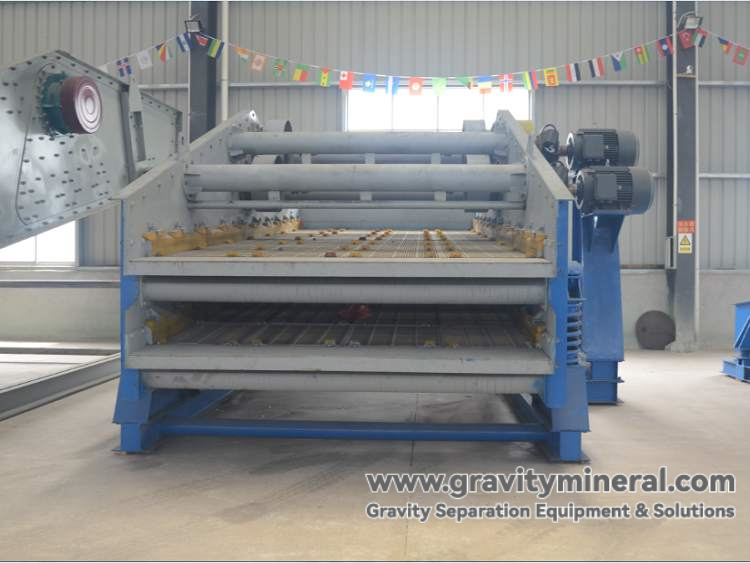
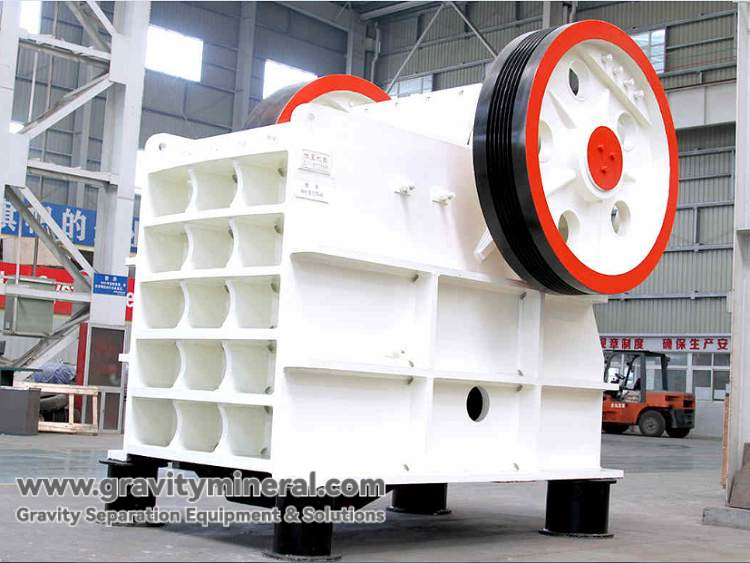
The crushing stage is determined by the scale of the operation. For small-scale lines, a two-stage closed-circuit system is used, consisting of a jaw crusher followed by a fine jaw crusher or a cone crusher, with the screen undersize product controlled below 20 mm to meet the feed requirements of the ball mill.
Grinding fineness is a key parameter for a full-gravity gold ore beneficiation production line. For placer gold or coarse-grained disseminated rock gold, a -200 mesh fraction of 50% to 65% is sometimes sufficient; for ore with finer disseminated grains, this should be increased to 70% or higher. Specific values should be determined through testing and should not be copied directly from similar mines.
The division of labor in the gravity separation section is roughly as follows:
| Processing Sections | Main Equipment | Function | Key Interfaces |
|---|---|---|---|
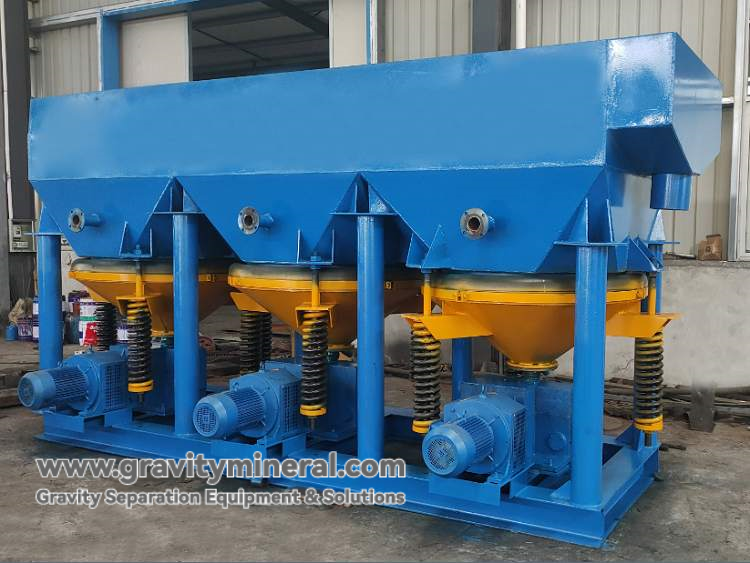
| Coarse-Grain Re-selection | Sawtooth Jig | Recovery of coarse-grained free gold from the grinding circuit | Feed particle size must not exceed the equipment\'s upper limit; stroke and frequency should be adjusted based on test results |
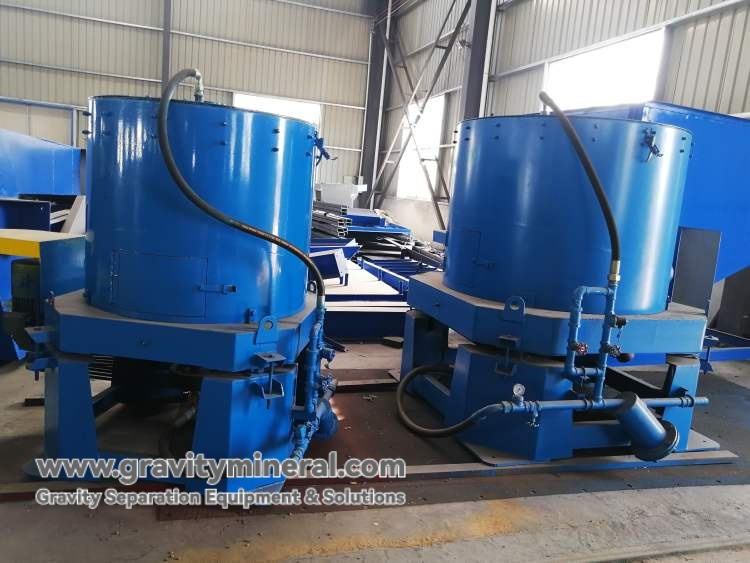
| Medium- and Fine-Grain Gravity Separation | Spiral Chutes, Centrifugal Separators | Tailings enrichment and recovery of ultrafine gold | Maintain stable backwash water pressure in the centrifuge |
| Concentration | 6-S shaking table | Production of gravity concentrate | Feed concentration and table slope adjusted according to particle size |
| Thickening and Dewatering | High-efficiency thickeners and filter presses | Concentrate enrichment and filter cake shipment | A stable underflow concentration is a prerequisite for the fine selection process |
There is more flexibility in equipment selection than one might imagine.The combination of jigging for roughing, shaking tables for concentrating, and centrifuges for scavenging has been applied in multiple gold mine cases; however, the specific number of stages and equipment specifications must be determined based on the ore characteristics. The equipment list for a continuous gravity concentration and beneficiation process should be based on test data, rather than simply copying the configuration diagrams of similar mines.
Seamless Integration of Thickening and Concentration
Gravity concentration concentrates are characterized by low yield, high grade, and high water content.Concentrates from centrifuges or shaking tables are typically dilute slurries, making it impractical to feed them directly into the fine selection stage or transport them off-site. The thickening stage serves to buffer and increase concentration; inclined-plate thickeners have a small footprint, while high-efficiency thickeners offer high throughput and relatively stable underflow concentration.
The challenge in continuous operation lies in the underflow concentration. When the thickener discharges intermittently, the underflow concentration fluctuates during the discharge cycle, causing disruption in the zone distribution on the fine-selection shaking table and resulting in fluctuations in concentrate grade.A feasible solution is to equip the underflow pump with a variable-frequency drive or to install a small buffer agitation tank between the thickener and the fine selection stage to stabilize the feed.
The quality of the thickener overflow also requires attention. The overflow contains fine silt and extremely fine gold particles, which can interfere with zone separation when recycled to the beneficiation stage. Settling the thickener overflow separately before recycling it results in only a limited increase in costs but significantly aids the stable operation of the continuous gravity concentration and beneficiation process.
Three Categories of Issues to Address in Mineral Processing Tests
The first category is process feasibility. Grinding fineness tests should be conducted in several runs, ranging from coarse to fine, to observe changes in gold liberation; for gravity separation condition tests, adjust the centrifuge\'s gravity multiple and backwash water volume to examine the relationship between concentrate grade and recovery rate.The tests must answer: To what extent can this ore be recovered using a fully gravity-based gold processing line, and does the tailings stream require supplementary recovery via a combined process?
The second category concerns the basis for equipment selection. Continuous-discharge and intermittent-discharge centrifuges operate differently; the feed concentration, throughput, and concentrate yield obtained during testing serve as reference points for scaling up and selecting industrial-scale equipment. Selecting equipment without test data often leaves very limited room for adjustment after production begins.
The third category concerns the disposition of the concentrate. No matter how high the grade of the gravity concentrate, it is unlikely to meet direct sales standards. The test report should provide the concentrate grade range and multi-element analysis to serve as a basis for deciding whether to smelt the concentrate on-site, sell it externally, or feed it into a cyanidation process.
Requirements for Ore Samples and Information
Ore samples must be representative. Collect samples at multiple points along the strike and dip of the ore body, taking several kilograms at each point; after thorough mixing and subsampling, send 20 to 50 kilograms. For mining areas with significant variations in ore type, submit separate samples for the oxidized zone and the primary zone.
Information is just as important as the ore samples. The location of the mining area, genesis type, visibility of free gold, previous beneficiation history, and range of raw ore grades should all be included. For samples labeled only as “gold ore, grade unspecified,” test conclusions often remain vague and cannot support the detailed design of a continuous process scheme involving gravity separation, concentration, and selective beneficiation.
The testing period should not be unduly compressed. Conditional testing, along with open-circuit and closed-circuit validation, typically requires two to three weeks; for samples with complex mineral characteristics, comparing grinding fineness alone may take more than a week.
Common Misconceptions in Configuring Full-Gravity Gold Ore Processing Lines
First, blindly copying configuration diagrams. While equipment lists from similar mines can serve as a reference, they cannot replace on-site testing at the specific mine. If the three parameters—grinding fineness, gold grain distribution, and clay content—differ, the equipment specifications and the number of processing stages must be adjusted accordingly.
Second, purchasing equipment from disparate suppliers. If separate suppliers are used for crushing, gravity separation, thickening, and dewatering, interface dimensions and production capacities are prone to mismatches. If the throughput of the jig does not align with that of the shaking table, material jams or idle operation may occur in intermediate stages; if the thickener underflow pump does not match the feed rate of the concentrator, continuous operation becomes difficult to maintain.The continuity of a continuous gravity separation process—from concentration to enrichment—depends on the seamless integration of the production capacities of equipment across all stages.
Third, proceeding directly to plant construction without pilot testing. Selecting equipment based on unrepresentative ore sample data is like a blind man feeling an elephant. Once investment in a full-gravity gold ore beneficiation production line is committed, the cost of rework far exceeds the expense of pilot testing.
Fourth, neglecting the thickening stage. Treating thickening as a secondary process—selecting equipment based on the minimum processing capacity—leaves insufficient room for on-site adjustments, which in turn reduces the stability of the enrichment process.
An Integrated Approach from Pilot Testing to Production Line
Separating equipment, design, and commissioning is a common pitfall when configuring a total gravity gold ore beneficiation production line.When the process is determined by the design firm, equipment is supplied by multiple vendors, and on-site installation is handled by a construction crew, it becomes difficult to assign responsibility when problems arise. A more reliable approach is to have a single team responsible for process design, equipment manufacturing, and on-site commissioning, ensuring that interface compatibility and production capacity alignment are handled internally.
GravityMineral has two decades of experience in the gravity separation field. Our in-house manufacturing facility handles equipment delivery, our in-house design team completes process calculations and plant layout, and our gravity separation engineers provide on-site guidance for installation and integrated commissioning.For medium- to large-scale projects, this eliminates the need to engage an external design institute, thereby saving on design costs and preventing discrepancies between drawings and equipment. Clients can choose from options such as single-unit equipment supply, phased collaboration, or a full turnkey solution, all of which are implemented according to the project\'s actual timeline.
The testing phase can also be seamlessly integrated. After mineral samples are shipped, feasibility tests are conducted; the test data serves as the basis for designing continuous gravity separation, concentration, and beneficiation process solutions, and testing costs can be offset against subsequent equipment or full-line cooperation agreements.
Conclusion
The configuration of a gravity gold ore beneficiation production line is determined by the ore characteristics, with parameters established through testing, and equipment selection guided by the data. The continuity of the gravity separation–concentration–refining continuous process scheme depends on three key details: the seamless integration of equipment in the gravity separation section, the stability of the concentration underflow, and the controllability of the feed to the refining stage.Where to set the grinding fineness, what range to adjust the centrifuge parameters to, and how to control the concentration of the thickener underflow—the answers to these questions lie in the test reports, not in the configuration diagrams.If you have ore samples and lab reports on hand, you should first conduct several sets of gravity separation test runs before discussing the equipment list for the full-gravity gold ore processing line; doing it the other way around often comes at a higher cost.