CTS/CTB/CTN Series Permanent Magnet Wet Magnetic Separators | Wet Separation Equipment for Strongly Magnetic Minerals
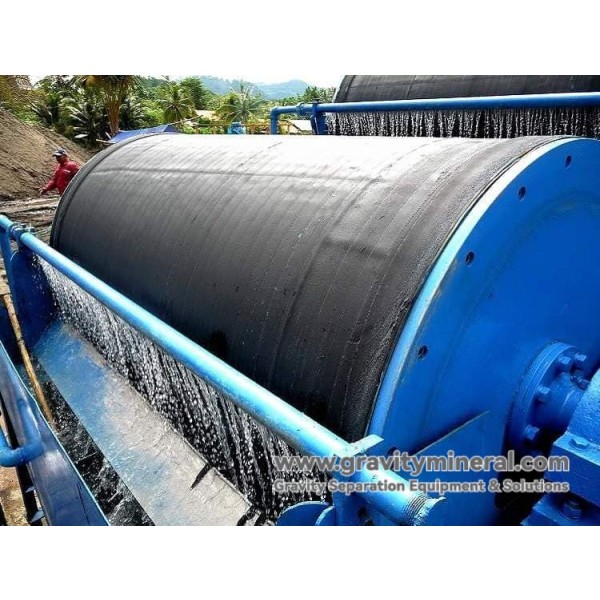
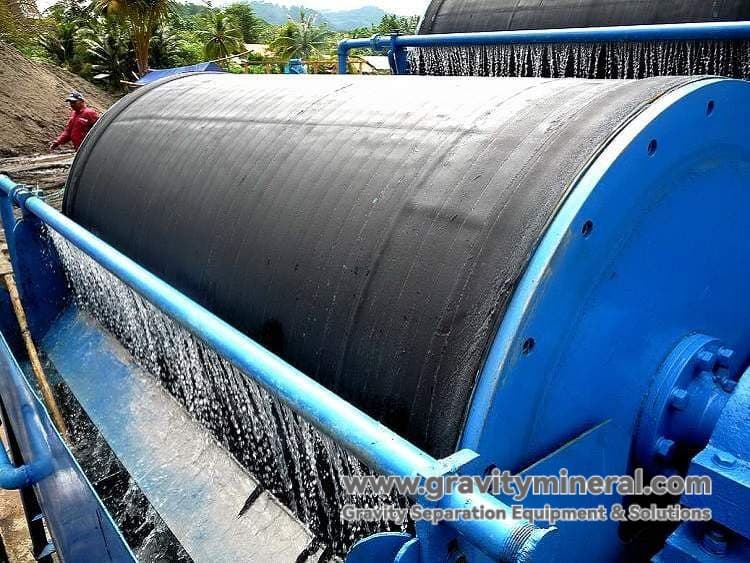
Wet magnetic separators are machines designed for continuous wet separation of fine, strongly magnetic minerals in slurry form. This wet drum magnetic separator uses NdFeB (neodymium-iron-boron) rare-earth permanent magnets with excellent field stability and a demagnetization rate below 3% after ten years.
The equipment is widely used for iron ore (especially magnetite) and manganese ore concentration, and also serves the non-metallic sector, enabling iron removal from silica sand by extracting fine iron impurities from quartz, feldspar, and kaolin to produce high-purity glass and ceramic raw materials. In addition, wet magnetic separators are used for low-intensity wet separation of fine strongly magnetic particles, or for removing strongly magnetic minerals mixed into non-magnetic minerals, such as wolframite separation.
We offer three tank configurations——co-current (CTS), countercurrent (CTN), and semi-countercurrent (CTB)——matched to particle size, feed density, and recovery targets.
Core Technology and Features
- Magnetic system: The internal magnetic system is built with NdFeB permanent magnets. Surface field intensity can be customized from 1,500 to 6,000 gauss according to ore magnetic susceptibility.
- Drum design: The rotating drum is clad in non-magnetic stainless steel or coated with wear-resistant rubber to protect it against long-term erosion by abrasive slurry.
- Speed control: A variable-frequency motor provides stepless drum speed adjustment (10-50 rpm), allowing separation time to be tuned to changes in feed grade.
- Tank lining: The internal separation tank is lined with UHMWPE (ultra-high-molecular-weight polyethylene) to resist wear from sliding sand and gravel.
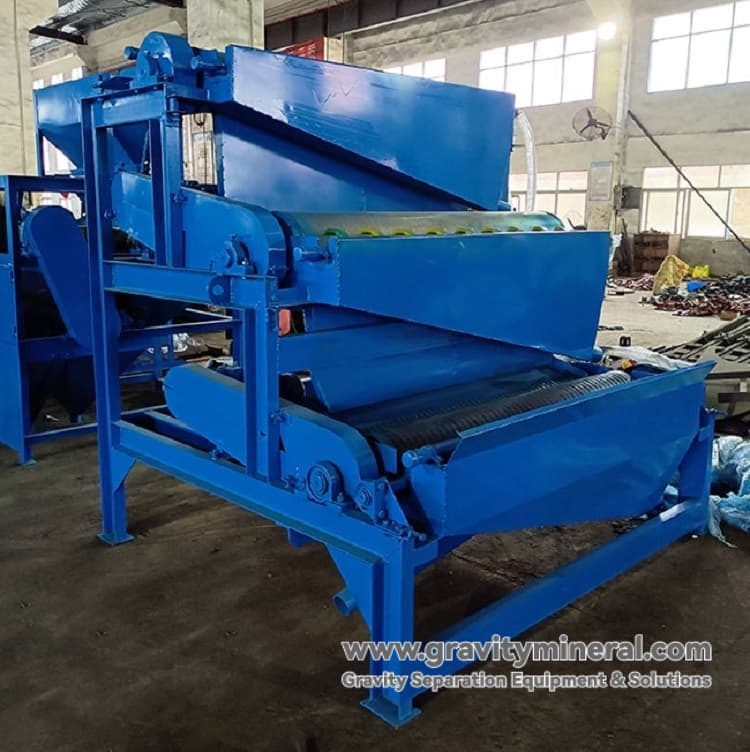
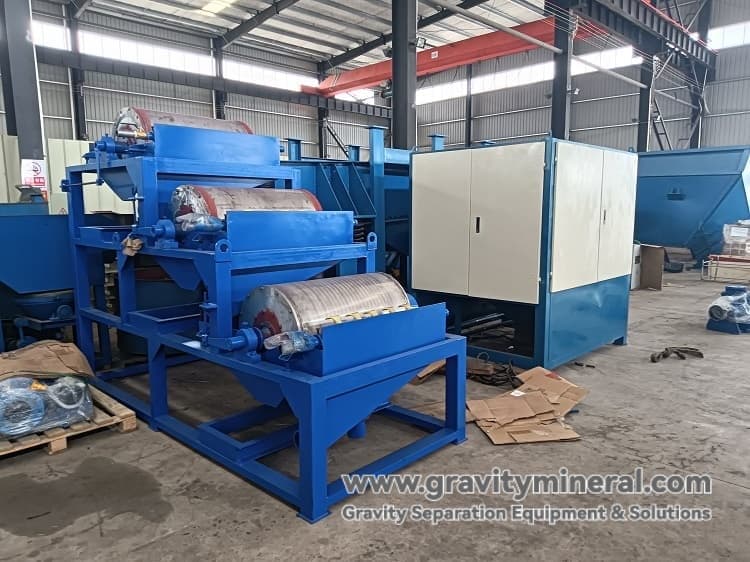
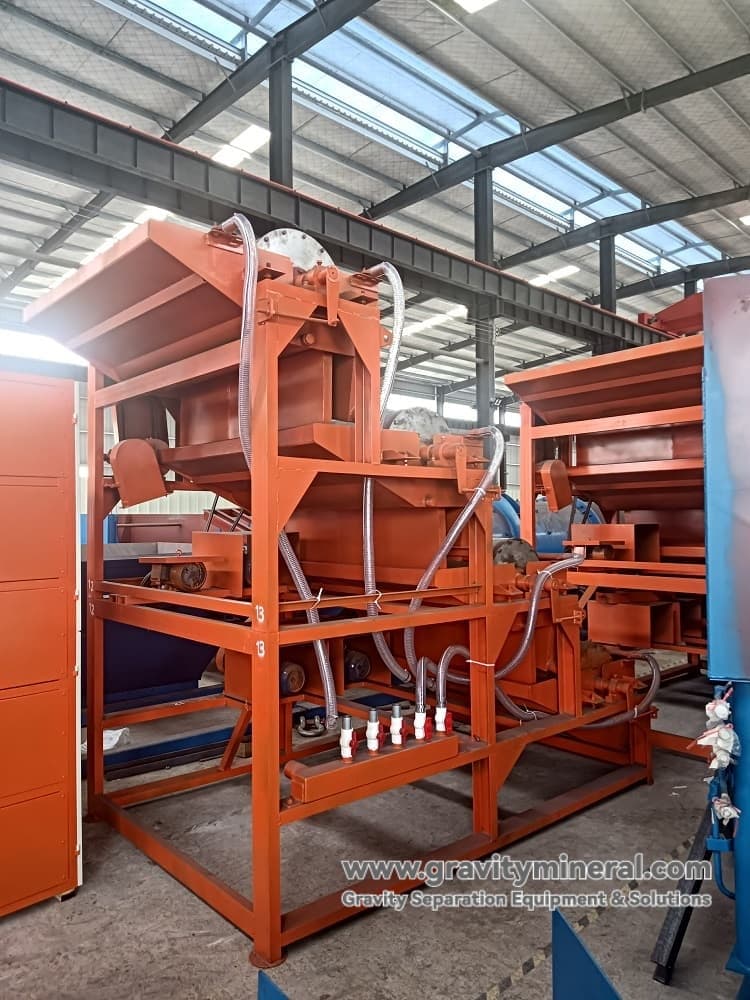
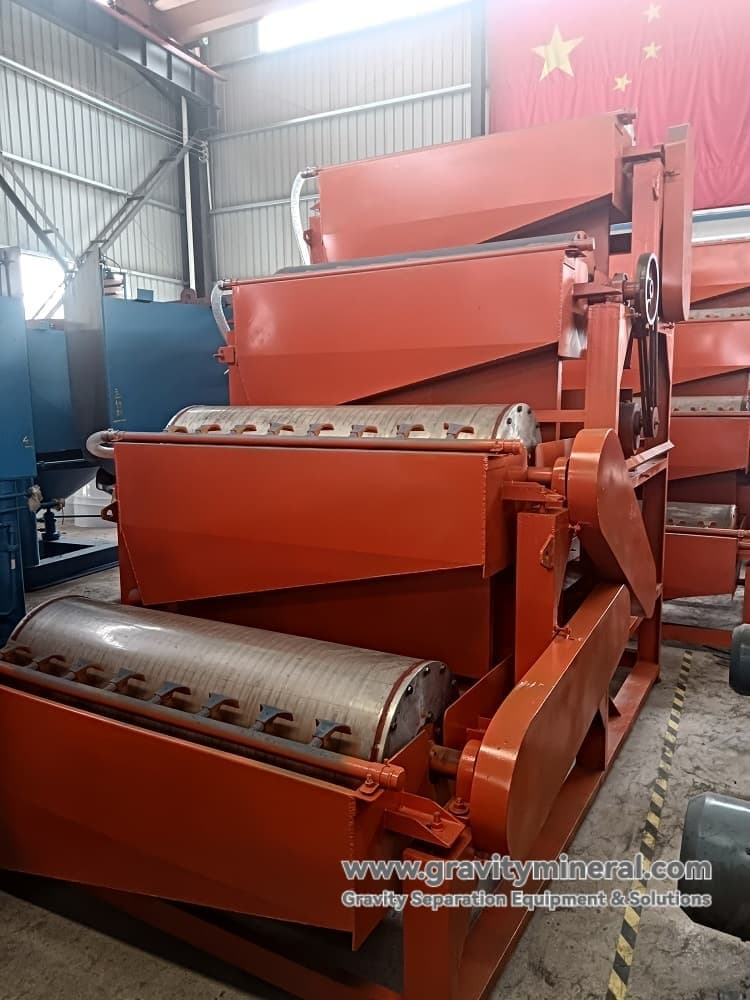
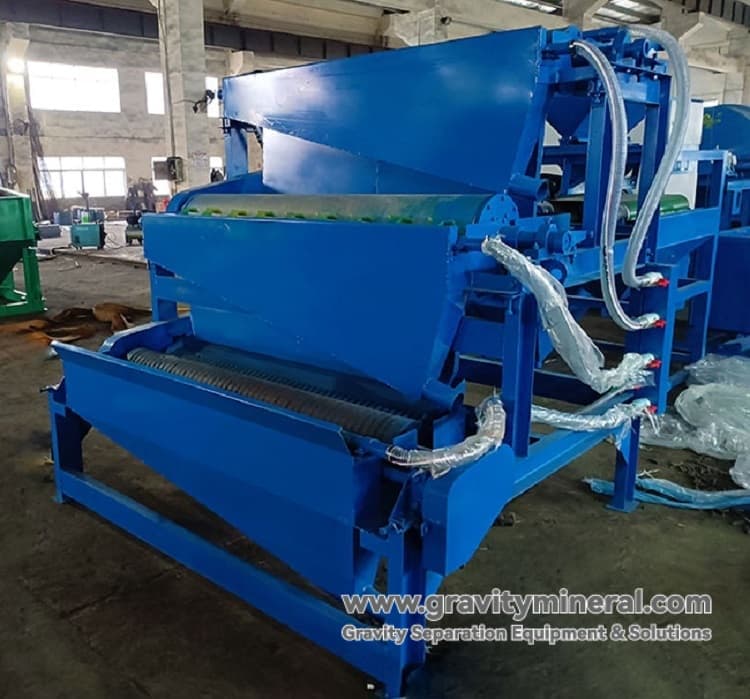
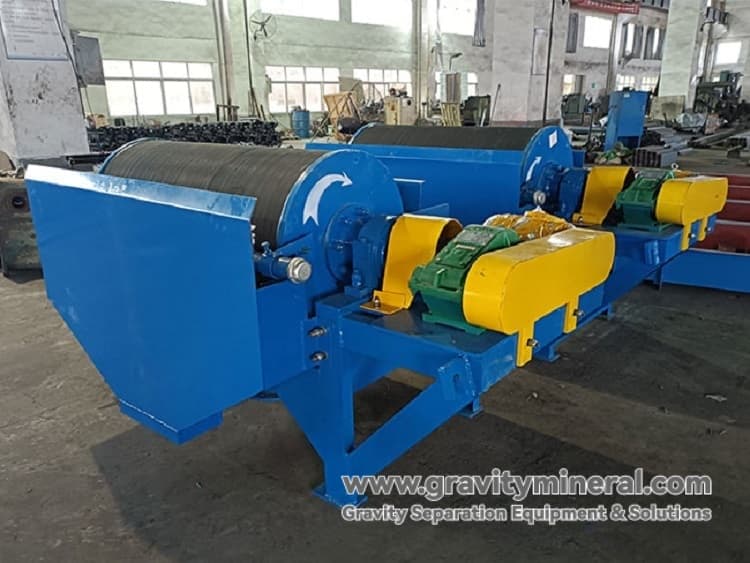
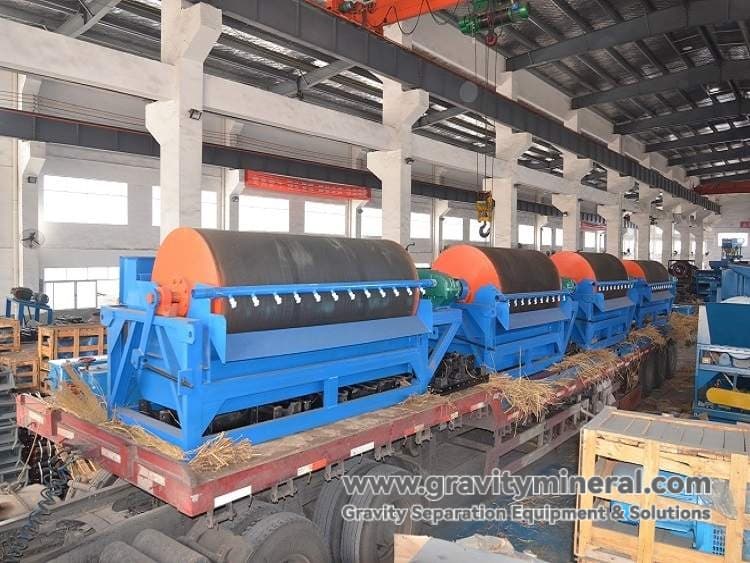
- Structure: Main components include the frame, cylinder, tank, rollers, magnetic system, magnetic roll, drive system, and magnetic system adjustment device.
How a Wet Drum Magnetic Separator Works
Separation takes place in water using a fixed magnetic arc inside the rotating drum:
- Slurry feed: Slurry flows into the tank box beneath the rotating drum.
- Magnetic attraction: Fixed magnet blocks are arranged inside the drum, covering roughly 120 to 180 degrees. As slurry passes beneath the drum, strongly magnetic particles such as magnetite are attracted and cling to the rotating drum surface.
- Non-magnetic discharge: Non-magnetic particles such as quartz or silica do not respond to the field and leave through the tailings discharge port at the bottom of the tank.
- Concentrate collection: As the drum rotates, it carries the attached magnetic particles out of the slurry and past the edge of the internal magnet blocks. Once they leave the field, high-pressure flush water jets the particles off the drum into the concentrate launder.
Tank Configurations and Selection Guide
Tank type has a direct effect on recovery; our engineers will help select the right configuration:
| Tank type |
Applicable particle size |
Typical application |
| Co-current tank (CTS) |
6 - 0 mm |
For roughing and initial concentration of coarse magnetic ores. Slurry flows in the same direction as drum rotation. |
| Countercurrent tank (CTN) |
0.6 - 0 mm |
For heavy medium recovery (ferrosilicon / magnetite) in coal washing. Slurry flows opposite to drum rotation, giving higher recovery but slightly lower grade. |
| Semi-countercurrent tank (CTB) |
0.5 - 0 mm |
General-purpose design. Suitable for ultrafine mineral cleaning, extending particle suspension time and balancing recovery with concentrate grade. |
Applications and Whole-Line Support
Wet magnetic separators serve metal mines, coal mines, and similar operations for low-intensity wet separation of fine strongly magnetic particles, or for removing strongly magnetic minerals mixed into non-magnetic minerals. Typical applications are as follows:
CTS / CTB / CTN Series Technical Specifications
| Model |
Drum size (mm) |
Geometric center of magnetic poles (mT) |
Average in scavenging zone (mT) |
Max. magnetic induction (mT) |
Capacity (t/h) |
Capacity (m³/h) |
Power (kW) |
Drum speed (r/min) |
Weight (kg) |
| CTS(B)-46 |
400×600 |
130 |
160 |
1~3 |
5 |
1.1 |
45 |
600 |
| CTS(B)-66 |
600×600 |
145 |
170 |
5~10 |
16 |
1.1 |
40 |
705 |
| CTS(B)-69 |
600×900 |
145 |
170 |
8~15 |
24 |
1.1 |
40 |
830 |
| CTS(B)-612 |
600×1200 |
145 |
170 |
10~20 |
32 |
2.2 |
40 |
990 |
| CTS(B)-618 |
600×1800 |
145 |
170 |
15~30 |
48 |
2.2 |
40 |
1330 |
| CTS(B)-712 |
750×1200 |
120 |
155 |
15~30 |
48 |
3 |
35 |
1500 |
| CTS(B)-918 |
900×1800 |
148 |
165 |
25~55 |
90 |
4 |
28 |
2900 |
| CTS(B)-924 |
900×2400 |
148 |
165 |
35~70 |
110 |
4 |
28 |
3500 |
| CTS(B)-1018 |
1050×1800 |
148 |
165 |
40~75 |
120 |
5.5 |
22 |
4000 |
| CTS(B)-1021 |
1050×2100 |
160 |
240 |
45~88 |
140 |
5.5 |
22 |
4500 |
| CTS(B)-1024 |
1050×2400 |
160 |
240 |
52~100 |
160 |
5.5 |
22 |
5000 |
| CTS(B)-1218 |
1200×1800 |
160 |
240 |
47~90 |
140 |
5.5 |
19 |
5800 |
| CTS(B)-1224 |
1200×2400 |
160 |
240 |
82~120 |
192 |
7.5 |
19 |
6200 |
From a Single Magnetic Separator to Whole-Line Support, No Outsourced Responsibility
The separation performance of a wet magnetic separator depends on feed density, drum speed, magnetic system position, and how well they match upstream grinding fineness. GravityMineral has spent 20 years in gravity separation and magnetic separation support, with equipment built in two owned manufacturing bases and process and mechanical engineers working in the same team——the magnetic circuit layout, tank configuration, and drum speed are set from process data and share the same source as the whole-line design drawings, avoiding “equipment that arrives but does not fit the flowsheet”.
- Own manufacturing bases: Core equipment is produced at two GravityMineral-owned manufacturing bases, with full quality control from raw material procurement through machining, assembly, and no-load test running. Every unit has strict inspection records before it leaves the factory.
- ISO9001 quality system: The company is ISO9001 certified, and its products hold S-certified supplier, national high-tech enterprise, and other qualifications.
- Whole-line interface matching: Ball mills, spiral classifiers, magnetic separators, and thickening / dewatering equipment are capacity-matched as one system, reducing blockages and tailings losses.
- Global delivery experience: Products have been exported to more than 50 countries, with familiar logistics and customs clearance procedures across Africa, Southeast Asia, South America, the Middle East, Central Asia, South Asia, and Australia.
- Delivery and after-sales: Engineers provide on-site guidance for installation and commissioning, with a one-year warranty and long-term spare parts and process optimization support.
Wet Magnetic Separator FAQ
Q1: How much does a wet magnetic separator cost? How is the price calculated?
Price depends mainly on drum size, capacity, field strength (gauss), and tank configuration. Small laboratory units cost less, while large production machines vary widely with magnetic system and drum specifications. We recommend providing ore type, capacity, and iron removal or recovery targets for a transparent quotation.
Q2: What is the difference between dry and wet magnetic separators? Which should you choose?
Wet separators use slurry feed and water-assisted separation, with a uniform field, large capacity, and minimal dust, suiting magnetite, heavy medium recovery, and wet iron removal from silica sand. Dry separators need no water and suit water-scarce sites and dry fine materials, but generate dust. Choose a wet magnetic separator when feed clay is high, washing is needed, or capacity is large.
Q3: What field strength (gauss) is right for a magnetic separator? How is it determined?
Strongly magnetic minerals such as magnetite need only 1,500-3,000 gauss; removing weakly magnetic iron impurities from silica / quartz sand requires 4,000-6,000 gauss. Sending an ore sample to the lab for testing is recommended to determine the exact gauss value required.
Q4: How many tons per hour can a magnetic separator handle? How do you select the model?
Capacity by model ranges from roughly 5 to 120 t/h (CTS(B)-46 around 5 t/h up to CTS(B)-1224 around 82-120 t/h). Actual throughput depends on feed density, particle size, field, and drum speed, so selection should be matched to whole-line capacity.
Q5: What feed density and drum speed are appropriate?
A feed density of 20%-35% is recommended; too low reduces capacity and raises water consumption, too high creates a thick bed and incomplete separation. Drum speed is steplessly adjustable through variable-frequency drive (10-50 rpm) and can be raised for coarse magnetite and lowered for fine weakly magnetic material.
Q6: Why is concentrate grade low or magnetic loss high in tailings? How do you fix it?
Low grade usually comes from magnetic system misalignment or incomplete drum cleaning by flush water; magnetic losses in tailings (coarse magnetic particles reporting to tailings) usually come from insufficient field, excessive feed density, or too high a drum speed. The magnetic system and flush water can be adjusted without stopping the machine, and density and speed should be rechecked.
Q7: What is the ten-year demagnetization rate of NdFeB permanent magnets? Will a magnetic separator lose its field?
This machine uses NdFeB (neodymium-iron-boron) rare-earth permanent magnets with stable field performance and a demagnetization rate below 3% over ten years. Avoid high temperatures and heavy impact; under normal use the magnetic system stays stable for years without frequent re-magnetizing.
Q8: Which magnetic separator is used for iron removal from silica sand / quartz sand?
To extract fine iron impurities from quartz, feldspar, and kaolin and obtain high-purity glass and ceramic raw materials, a medium-to-high intensity (4,000-6,000 gauss) wet magnetic separator is recommended, with multiple magnetic stages to consistently remove iron oxides and weakly magnetic impurities.
Q9: Which magnetic separator is used for magnetite beneficiation? What does the magnetic separation circuit look like?
Magnetite is strongly magnetic and is recovered efficiently by low-intensity wet magnetic separation at 1,500-3,000 gauss, typically using a "one-stage grinding — magnetic roughing — magnetic cleaning" circuit with a ball mill and classification; see also the ilmenite magnetic separation solution.
Q10: How do you choose between CTS, CTB, and CTN tanks?
The CTS co-current tank suits roughing and concentration of coarse (6-0 mm) strongly magnetic ore; the CTN countercurrent tank suits fine (0.6-0 mm) heavy medium recovery with high recovery; the CTB semi-countercurrent tank suits ultrafine (0.5-0 mm) cleaning, balancing recovery and grade. Select by particle size, feed density, and recovery target.
Get a CTS / CTB / CTN Wet Magnetic Separator Selection Plan and Quotation
Tell us your ore type, feed size, target capacity (tons per hour), slurry density, iron removal or recovery requirements, and site utilities. GravityMineral engineers will provide a wet magnetic separator selection plan, magnetic separation circuit route, and transparent quotation.
You can reach us through the contact details on our website, or contact the sales engineer for your region directly for selection advice.