Spiral Ore Washer | Double Spiral and Twin-Shaft Washers for Stubborn Clay
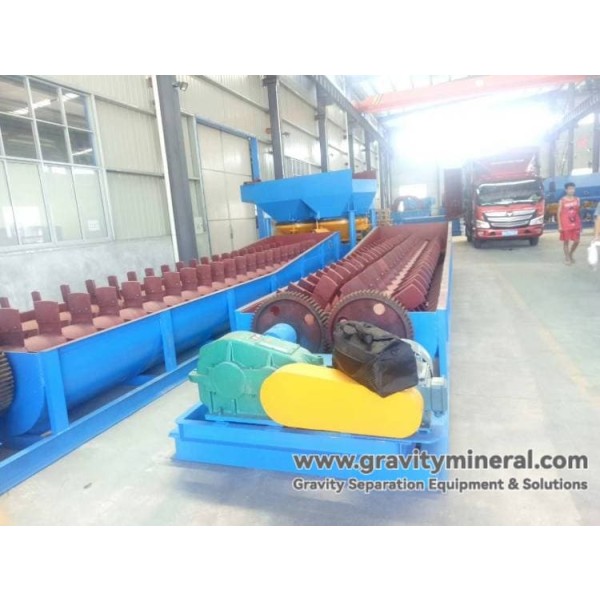
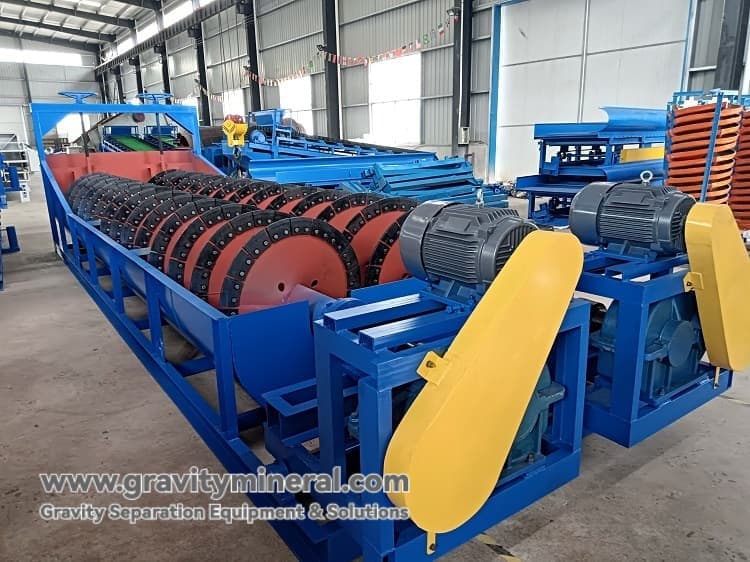
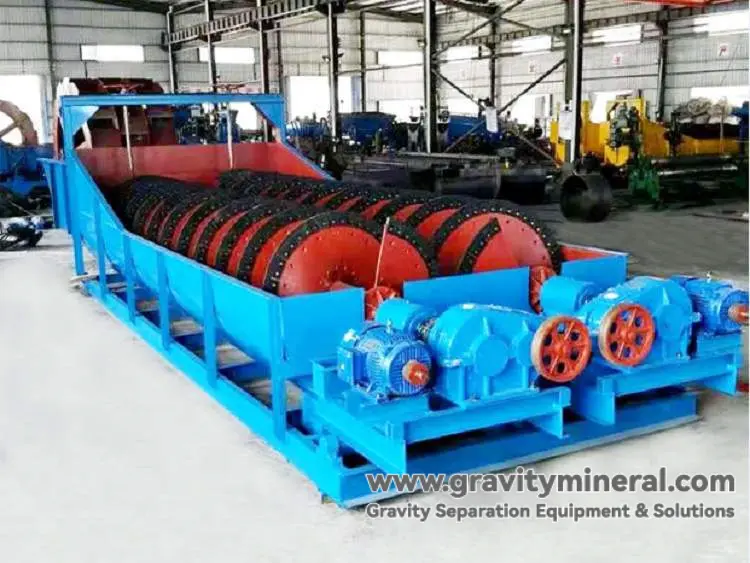
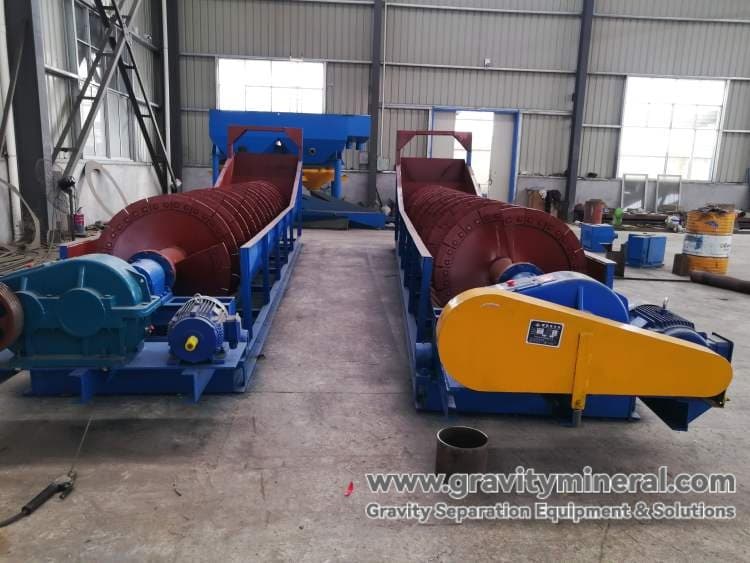
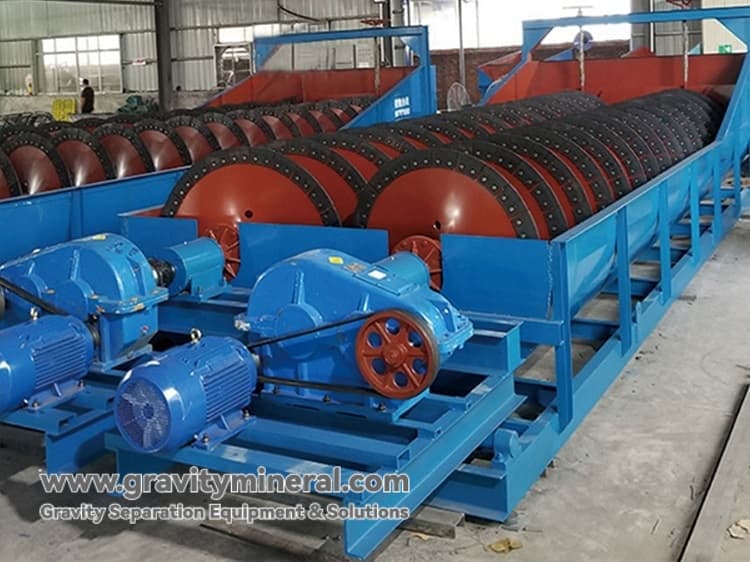
Spiral ore washer (also called a double spiral ore washer, twin-shaft spiral ore washer or spiral-type ore washer) is purpose-built to remove extremely stubborn, plastic and highly adhesive clay from low-grade ores. This heavy-duty clay washing equipment uses two counter-rotating shafts with intermeshing flights to cut and grind the clay mass, freeing valuable coarse ore and stones trapped inside and delivering clean feed to downstream crushing, grinding and gravity separation.
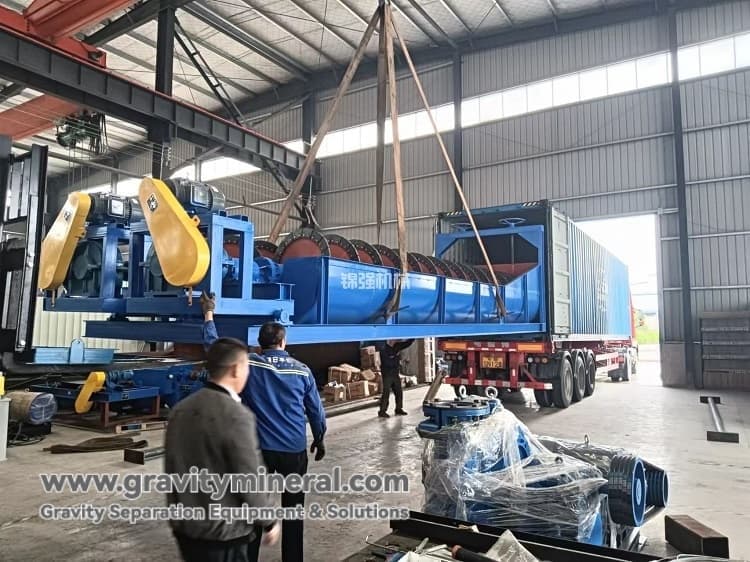
The twin-shaft spiral ore washer is a common choice for manganese ore washing and iron ore washing plants, featuring high throughput, simple installation and low operating cost. Built with a thick steel trough and a heavy-duty gearbox, it withstands the enormous torque needed to agitate rock and thick slurry. The washing flights are cast from high-wear-resistant alloy steel and bolted in place for easy on-site replacement. Washed ore can be fed directly into a fiberglass spiral chute, sawtooth jig separator or 6-S shaking table, reducing clay interference with gravity separation results.
How a Spiral Ore Washer Works
Clay-bearing run-of-mine ore and water are fed into the lower end of the inclined washing trough. A heavy motor and reducer drive two large flighted spiral shafts to counter-rotate; the flights cut into the clay layer, and friction between rocks cleans the ore thoroughly. Clean water is usually introduced near the discharge end, flowing down the trough to wash residual dirt off the rocks and carry suspended clay and light impurities away.
Clayey wastewater overflows from the lower rear overflow weir, while cleaned ore is conveyed upward by the spiral flights and discharged from the upper front end. The inclined trough design lets water flow downward carrying dissolved clay waste, while clean heavy rock is pushed toward the outlet, forming a continuous countercurrent washing process.
Technical Features
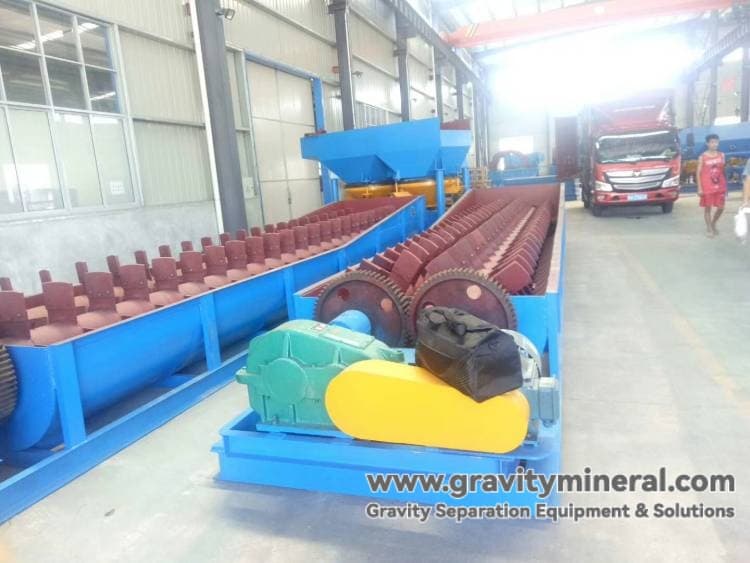
- Giant corrugated steel flights are arranged in a specific spiral pattern and intermesh when the two shafts counter-rotate, creating a strong “cutting and squeezing” action that completely breaks up hard clay lumps;
- A thick steel trough and heavy-duty gearbox withstand the enormous torque required to agitate rock and thick slurry;
- Washing flights are cast from high-wear-resistant alloy steel and bolted to the shafts, so they can be replaced on site without cutting or welding, reducing downtime;
- The inclined trough design enables countercurrent washing: water carries away dissolved clay waste while clean heavy rock is pushed to the discharge outlet;
- Long spiral body, good sealing system, simple structure, high capacity and easy maintenance;
- Low moisture and clay content in the discharged sand; washed ore can go directly to gravity separation, magnetic separation or screening and classification;
- Capacity covers 10–100 t/h, maximum feed 30–70 mm, trough inclination ≤12°, suiting pilot lines through to large concentrators.
Applications and Complete-Line Integration
A spiral ore washer is not an isolated machine but the front-end desliming and washing stage of a mineral processing line. Depending on ore type and characteristics, it can be combined with gravity, magnetic and electrostatic separation, screening and classification equipment into a complete flowsheet:
| Application |
Typical Minerals |
Matching Process / Production Line |
| Alluvial gold washing |
Placer gold, alluvial gold, riverbank gold |
Alluvial gold gravity separation plant solution |
| Alluvial tin and coastal placer |
Placer tin, tin sand, coastal heavy sand |
Alluvial tin gravity recovery solution, Coastal placer mineral processing plant solution |
| Ti-Zr placer gravity-magnetic-electric combined |
Ilmenite, zircon sand, rutile |
Ti-Zr placer gravity + magnetic/electric separation solution |
| Manganese and iron ore washing |
Manganese ore, hematite, limonite |
Chromite gravity + magnetic separation solution, ilmenite gravity + magnetic separation solution |
| Barite, tantalum-niobium, wolframite |
Barite, tantalum-niobium ore, wolframite |
Barite gravity separation plant solution, Tantalum-niobium gravity-magnetic plant solution, wolframite gravity processing solution |
| Tailings and solid waste reprocessing |
Legacy tailings, incinerator bottom ash (IBA) |
Bottom ash gravity sorting solution, Heavy placer gravity + magnetic + electrostatic solution |
| Aggregate, gravel and sand desliming |
Construction aggregate, gravel, phosphate, bauxite |
Combined with a rotary scrubber and screening equipment to form a wash-and-screen line |
In a typical spiral ore washer flowsheet, washed material can go to a jig for roughing, a spiral chute for tailings rejection, a 6-S shaking table for cleaning, or a centrifugal concentrator to recover fine gold and tin; the screening stage can use linear vibrating screens or circular vibrating screens.
2RXL Series Double Spiral Ore Washer Technical Specifications
| Model |
Spiral size (mm) |
Rotation speed (r/min) |
Max feed size (mm) |
Trough inclination (°) |
Capacity (t/h) |
Power (kW) |
Weight (t) |
| 2RXL320 |
Φ320×3200 |
28 |
≤30 |
≤12 |
10 |
4 |
0.9 |
| 2RXL400 |
Φ400×4600 |
23 |
≤30 |
≤12 |
20 |
5.5 |
1.9 |
| 2RXL540 |
Φ540×4600 |
23 |
≤30 |
≤12 |
25 |
7.5 |
3.9 |
| 2RXL750 |
Φ750×7600 |
22.7 |
≤70 |
≤12 |
50 |
11 |
7.5 |
| 2RXL800 |
Φ800×7600 |
22 |
≤70 |
≤12 |
70 |
15 |
9.5 |
| 2RXL914 |
Φ914×7600 |
21 |
≤70 |
≤12 |
100 |
22 |
12.9 |
From a Single Ore Washer to Complete-Line Integration, No Outsourcing
The desliming performance of a spiral ore washer depends on how well feed size, clay content, trough inclination and downstream gravity separator capacity are matched. GravityMineral has focused on gravity separation and ore washing systems for 20 years, with equipment produced at our own two manufacturing bases and process and mechanical engineers working in one team——the washer's spiral size, flight arrangement and trough inclination are set from process data and share the same source as the complete-line design drawings, avoiding the problem of “the washing stage and the gravity stage having mismatched capacity”.
- In-house manufacturing base: Core equipment is produced at GravityMineral's own two manufacturing bases, with full quality control from raw material purchasing through machining, assembly and no-load test running; every machine has strict inspection records before delivery.
- ISO9001 quality system: The company is ISO9001 certified, with products from an S-certified supplier and national high-tech enterprise qualifications.
- Complete-line interface matching: The ore washer's capacity is calculated together with the jig, shaking table, spiral chute and vibrating screen to reduce blockages and tailings losses.
- Global delivery experience: Products have been exported to 50+ countries, with familiarity in logistics and customs clearance across Africa, Southeast Asia, South America, the Middle East, Central Asia, South Asia and Australia; a 500+ global case library provides references for washing stage selection.
- Delivery and after-sales: Engineers attend site to guide installation and commissioning, lead single-machine and linked test runs and train customer personnel; 1-year warranty with long-term spare parts and process optimization support.
- Flexible cooperation models: Buy equipment only, request drawing design only, hire engineers for on-site commissioning only, or choose full-process EPC turnkey delivery, all to your schedule and budget.
Spiral Ore Washer FAQ
Q1: How much does a spiral ore washer cost? How is the price calculated?
Price depends on spiral size, single/twin-shaft configuration, trough specifications and motor power; the 2RXL series spans Φ320 mm to Φ914 mm. Smaller machines cost less, while large double spiral units vary more with trough and gearbox specifications. Provide your capacity and clay content for an engineer's quotation.
Q2: What is the difference between a double spiral ore washer and a rotary scrubber? How to choose?
For medium to heavy water-soluble clay, a rotary scrubber is usually enough; highly plastic, strongly cohesive and consolidated stubborn clay requires the powerful cutting and squeezing of a double spiral ore washer. With high gravel content or when desliming and elevation conveying are needed at the same time, the double spiral type is more suitable.
Q3: What capacity does a spiral ore washer handle? How to select the model?
Capacity is 10-100 t/h: 2RXL320/400 (10-20 t/h) for small-scale desliming; 2RXL540/750 (25-50 t/h) for medium concentrators; 2RXL800/914 (70-100 t/h) for large manganese and iron ore washing. Selection must match downstream gravity separator capacity.
Q4: What is the maximum feed size? Can it wash large rock?
Maximum feed is 30-70 mm by model (≤30 mm for 2RXL320/400/540, ≤70 mm for 2RXL750/800/914). A spiral ore washer is not suitable for oversized rock; it is designed to wash pre-classified or naturally small rock and gravel.
Q5: What if clay is not washed clean or lumps do not break up?
The counter-rotating corrugated steel flights intermesh to create powerful cutting and squeezing, which is the key to breaking stubborn clay lumps. If washing is incomplete, slow the feed rate, increase clean water and washing zone length, and recheck feed size and clay content.
Q6: Do the flights wear quickly? How are they replaced?
Washing flights are cast from high-wear-resistant alloy steel and bolted to the shafts, so worn flights can be replaced on site without cutting or welding, reducing downtime; spare parts are available long term.
Q7: How does washing connect to the gravity separation flowsheet?
Washed and deslimed ore can be roughing-fed to a fiberglass spiral chute for tailings rejection and then cleaned on a 6-S shaking table; final fines containing gold or tin can be handled by a centrifugal concentrator. Run a washability test first for the exact flowsheet; representative samples can be sent to us.
Q8: Does the washer use a lot of water? Can the trough inclination be adjusted?
The countercurrent washing design introduces clean water at the discharge end and drains clayey wastewater over the overflow weir, reducing wasted water while ensuring cleaning; actual consumption depends on clay content and capacity. Standard trough inclination is ≤12°, set by engineers from sample data and site conditions at the design stage.
Q9: Can it be used for sand plants and construction aggregate desliming?
Yes. A spiral ore washer is suitable for desliming sand at construction sites, sand and gravel plants, precast concrete plants and hydropower sites, as well as ore washing, classification and dewatering; it is often combined with linear vibrating screens and circular vibrating screens into a wash-and-screen flowsheet.
Q10: Can it be custom-built? How are lead time and after-sales guaranteed?
Drawing on our own manufacturing bases, materials, motor power and structure can be custom-built for severe cold, high altitude or strongly corrosive conditions. Standard equipment takes 40-60 days to manufacture, longer for custom builds, with a delivery schedule written into the contract; 1-year warranty plus long-term spare parts, technical consulting and process optimization, with on-site commissioning and training, and exports to 50+ countries.
Get a 2RXL Spiral Ore Washer Selection Plan and Quote
Tell us your ore type, feed size, clay content, target throughput (t/h), site water and power conditions, and downstream gravity/magnetic separation equipment configuration; GravityMineral engineers will prepare a spiral ore washer selection plan, a combined washing + gravity flowsheet and a transparent quotation.
You can reach us through the contact details on our website or talk directly to a sales engineer for selection advice; representative ore samples can be sent for washability testing.