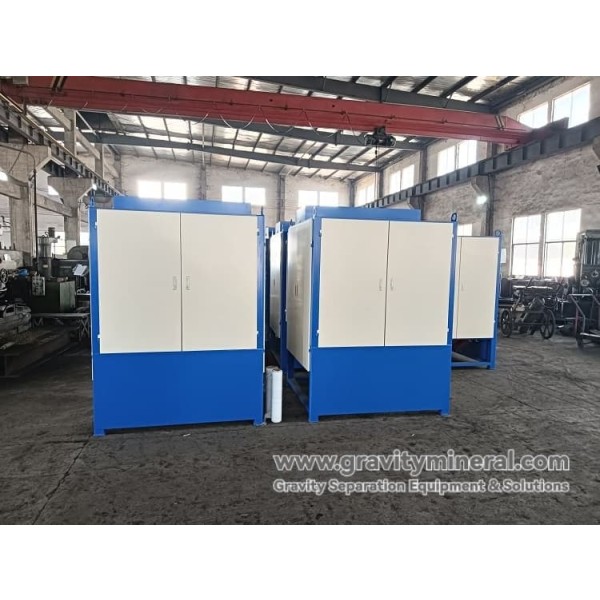
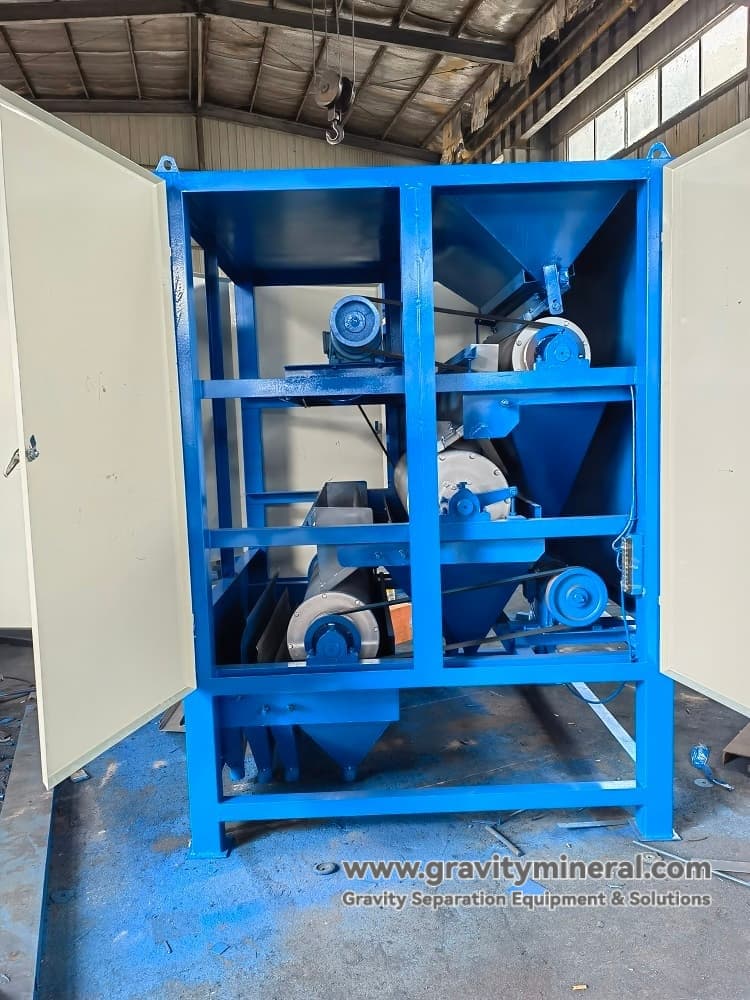
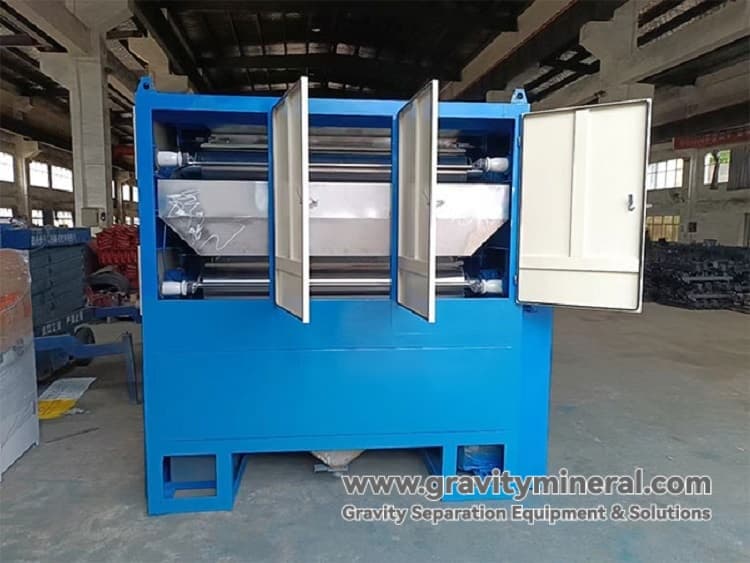
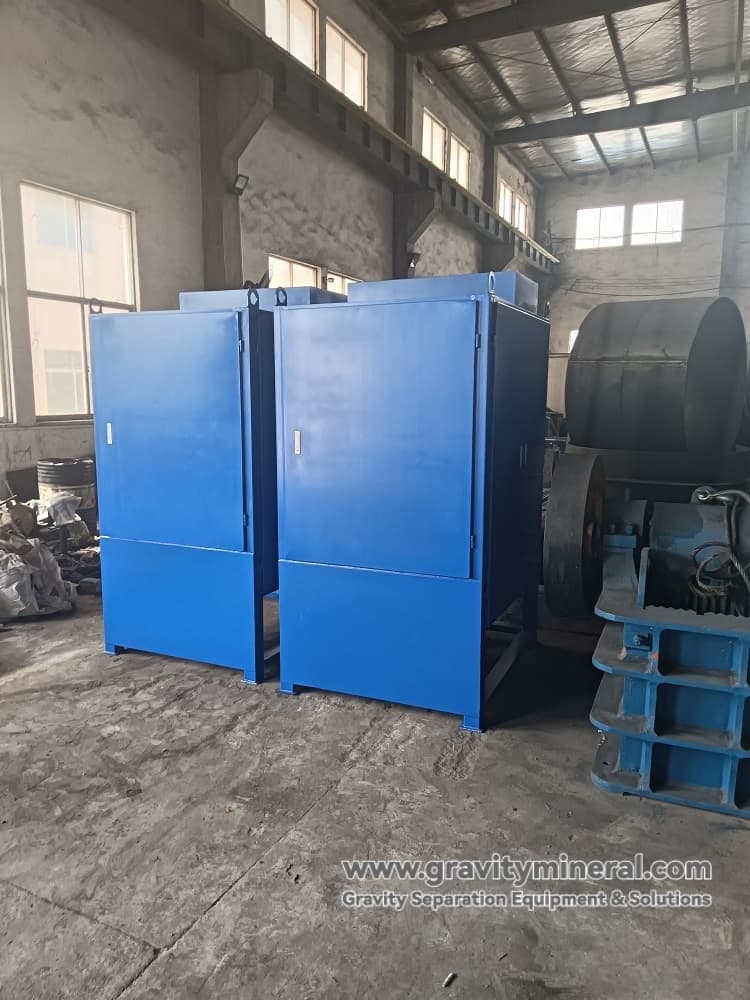
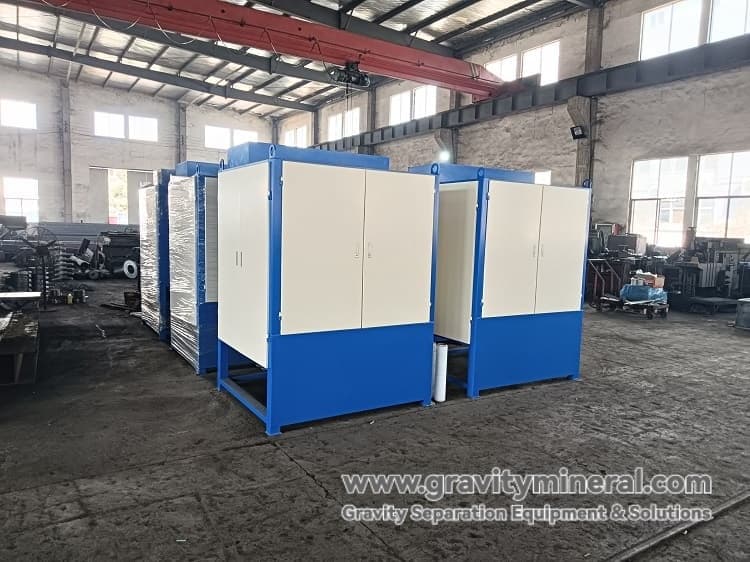
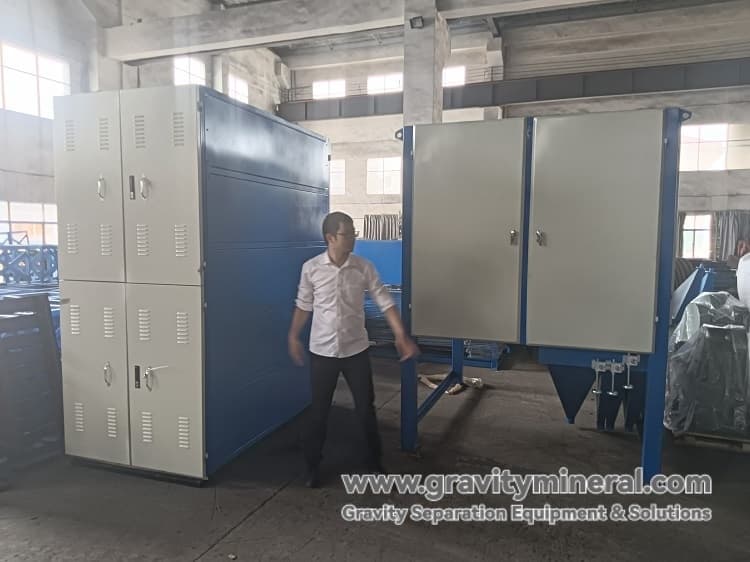
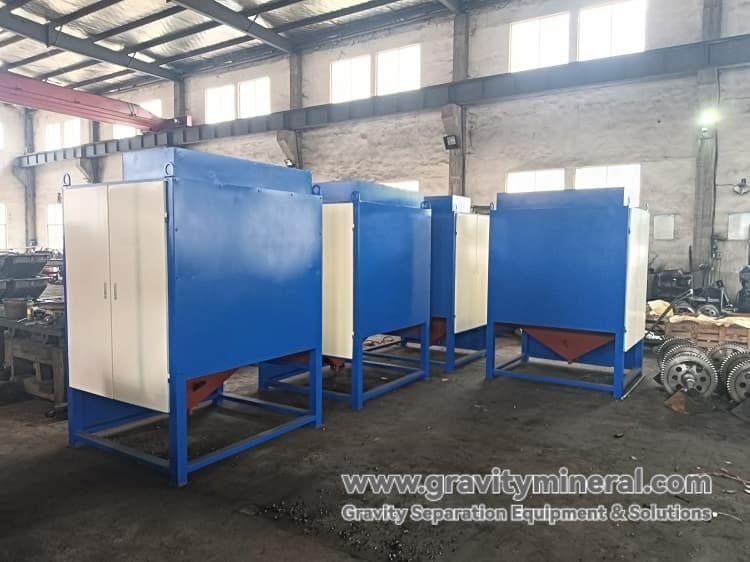
Dry multi-roller magnetic separator(commonly known in the industry as rare earth roll magnetic separator) is a high-efficiency multi-stage dry multi-roller magnetic separator. Using an advanced series of permanent magnet rollers, it forms a cascaded gradient magnetic field and is designed to separate and purify minerals of different magnetic susceptibilities.
The machine is built with ultra-strong neodymium (NdFeB) rare-earth magnets, and its surface magnetic field can reach 1.6 tesla (16,000 gauss), without the high energy consumption of electromagnetic coils. This makes the dry multi-roller magnetic separator a core dry-processing machine for upgrading heavy minerals such as ilmenite, hematite, manganese ore, chromite and monazite.
This multi-stage high-intensity dry multi-roller magnetic separator has an optimal feed size of 0.1mm to 5mm, and is especially effective at removing trace iron impurities from non-metallic minerals, ensuring high-purity glass-grade silica sand and quartz.
What Is a Dry Multi-Roller Magnetic Separator? Why Is It Essential for Mineral Purification?
The dry magnetic roller separator is a core machine in electric mineral processing that performs dry sorting based on magnetic differences, and it uses the high-gradient magnetic field formed on the surface of NdFeB permanent magnet rollers to capture and separate minerals of differing susceptibility stage by stage. Compared with wet magnetic separation, dry separation consumes no water and avoids the high power draw of electromagnetic coils, making it highly efficient for grouping magnetic minerals in heavy-mineral sands and removing iron impurities.
In heavy-mineral placer sands, gravity separation can discard large amounts of waste rock by density difference, but when it becomes necessary to further group minerals with similar magnetic properties (such as separating ilmenite, magnetite and hematite) and upgrade non-magnetic minerals such as zircon and quartz to glass-grade purity, the dry multi-roller magnetic separator is the key intermediate link between gravity and electrostatic separation.
Dry high-intensity permanent magnet separators can be widely used for ilmenite, manganese, chromite and non-metallic iron removal because the cascaded gradient magnetic field design plays a key role. Compared with traditional single-roll or low-intensity separators, a multi-roll cascade can separate minerals from strong to weak susceptibility stage by stage, greatly improving magnetic mineral recovery and final purity; it is the most widely used magnetic circuit structure in dry magnetic separation today.
Core Technology and System Advantages
- Cascaded multi-roll magnetic field: Two to five permanent magnet rollers connected in series form a gradient field (weak 0.08-0.12T, medium 0.5-0.9T, strong 1.2-1.4T), separating magnetic minerals from strong to weak susceptibility stage by stage to improve recovery and purity.
- Rare-earth permanent magnet system with no excitation energy: High-quality neodymium (NdFeB) permanent magnets (coercivity Hcj≥1114kA/m) deliver a surface field of up to 1.6 tesla (16,000 gauss), with no high power consumption from electromagnetic coils and low operating cost.
- Dry process with minimal water use: Fully dry processing needs no water or downstream slurry dewatering, suiting water-scarce regions and severe cold conditions while saving energy and protecting the environment.
- High-precision splitting device: Each roller is fitted with an adjustable mechanical splitter plate accurate to ±2mm, allowing precise cutting of mineral streams with different susceptibilities and high product purity.
- Wear-resistant roller surface: Roller surfaces are coated with high-hardness (HRC≥55) non-magnetic stainless steel to withstand continuous dry sand abrasion for a long service life.
- Matched dust collection system: A pulse-jet baghouse dust collector effectively controls airborne silica dust and particulates (efficiency ≥99%), ensuring a safe and environmentally sound working environment.
Custom engineering available: The number of cascade rollers (2 to 5) and the specific field strength of each roller can be fully customized to the mineral characteristics. Contact our engineers for a custom flowsheet and quotation.
Separation Principle of the Dry Multi-Roller Magnetic Separator: Four Stages Complete Magnetic Mineral Classification
The machine uses a cascaded multi-stage process: as ore falls stage by stage between the rollers, minerals of different susceptibilities are separated.
- Stage 1 (strongly magnetic): Completely dry ore is evenly fed onto the first roller. Because this roller has a lower field strength, it attracts and removes only strongly magnetic minerals such as magnetite; non-magnetic and weakly magnetic minerals fall with the roller stream to the next stage.
- Stage 2 (medium magnetic): The remaining material drops onto a second roller with a higher field strength, which attracts medium-magnetic minerals such as ilmenite.
- Stage 3 and beyond (weakly magnetic): Material continues to the third (and fourth/fifth) rollers. These rollers provide ultra-high field strengths (up to 14,000 gauss) to separate weakly magnetic minerals such as garnet, ilmenite or hematite.
- Non-magnetic discharge: The final product that passes all rollers without being attracted (such as zircon or pure quartz sand) falls into the end non-magnetic tailings chute.
Applications of the Dry Multi-Roller Magnetic Separator and Full-Line Integration
The dry multi-roller magnetic separator suits mineral pairs with clear magnetic contrasts and typically serves as the gravity roughing—magnetic grouping—electrostatic cleaning intermediate grouping machine in a combined flowsheet. Typical applications are listed below:
For complex intergrown or finely disseminated ores, our engineers can define the combined flowsheet and equipment interfaces from ore-sample test data, avoiding capacity mismatches between machines from different suppliers. Common matching gravity separators include the fiberglass spiral chute、6-S shaking table and jig separator; final-stage purification can be followed by the high-tension electrostatic separator and three-disc magnetic separator to complete a combined magnetic-electrostatic cleaning circuit.
Dry Multi-Roller Magnetic Separator: Technical Parameters and Specifications
| System component |
Technical feature |
| Magnetization system (roller set) |
High-quality neodymium (NdFeB) permanent magnets (coercivity Hcj≥1114kA/m). A gradient field is formed by connecting 2 to 5 rollers in series. |
| Magnetic field gradient |
Roller 1 (weak): 0.08 - 0.12 tesla (800 - 1,200 gauss)
Roller 2 (medium): 0.5 - 0.9 tesla (5,000 - 9,000 gauss)
Roller 3 (strong): 1.2-1.4 tesla (12,000-14,000 gauss) |
| Maximum surface field |
1.6 tesla (16,000 gauss) |
| Feed size |
0.1mm to 5mm (dry feed) |
| Ore feeding device |
Equipped with a vibrating feeder and a primary electromagnetic iron remover to take out scrap iron, ensuring a uniform, single-layer thin bed of ore enters the first roller. |
| Separation rollers |
Roller surfaces are coated with high-hardness (HRC≥55) non-magnetic stainless steel to withstand continuous dry sand abrasion. |
| Product separation |
An adjustable mechanical splitter (splitter plate) under each roller, accurate to ±2mm, cuts the mineral streams precisely. |
| Dust collection system |
A pulse-jet baghouse dust collector effectively controls airborne silica dust and particulates (efficiency ≥99%), ensuring a safe and environmentally sound working environment. |
Dry Multi-Roller Magnetic Separator: Operation and Safety Procedures
Startup procedure:
- Always start the pulse-jet baghouse dust collector first.
- Run empty for 5 minutes to verify belt tracking and motor stability.
- Start the vibrating feeder and gradually raise the feed rate to the rated capacity.
- Fine-tune the adjustable splitter plates under the rollers based on visual product purity.
Key safety precautions:
- Danger: Never store or carry iron tools (wrenches, hammers, steel-toed boots) within 1 meter of the magnetic rollers. Neodymium magnets are permanently active and extremely powerful.
- After shutdown, wait until the rollers have come to a complete standstill before opening the access door for maintenance.
- Regularly check the integrity of the guards and the Kevlar conveyor belt.
From a Single Dry Multi-Roller Magnetic Separator to Full-Line Integration, No Outsourcing of Responsibility
GravityMineral has focused on gravity mineral processing for 20 years, with a market share of about 35% and exports to 50+ countries and regions. The company operates two owned manufacturing bases and its own design team; core machines are produced in-house and flowsheets are designed in-house, so there is no break in the chain of responsibility. A dry multi-roller magnetic separator is rarely used in isolation - its separation performance depends on upstream gravity-concentration particle size and moisture control. Roller count, field gradient and splitter plate positions are set from process data and share the same source as the full-line design drawings, avoiding the disconnect where "equipment arrives but does not fit the flowsheet."
- Own manufacturing bases: Core machines are produced at GravityMineral's two owned manufacturing bases, with full quality control from raw material procurement through machining, assembly and no-load test runs; every machine has strict inspection records before shipment.
- ISO9001 quality system: The company is ISO9001 certified, and its products have earned S-certified supplier, national high-tech enterprise and other qualifications.
- Full-line interface matching: Jigs, shaking tables, spiral chutes, magnetic separators and electrostatic separators are capacity-matched as one system, reducing blockages and idle running and avoiding capacity mismatches between machines from different suppliers.
- Global delivery experience: Products have been exported to 50+ countries, and we are familiar with logistics and customs clearance in major markets including Africa, Southeast Asia, South America, the Middle East, Central Asia, South Asia and Australia.
- Delivery and after-sales: ISO9001 quality control throughout, engineers on site for installation and commissioning guidance, a 1-year warranty, and long-term spare parts and process optimization support.
Dry Multi-Roller Magnetic Separator FAQ
Q1: Which minerals suit a dry multi-roller magnetic separator?
It suits minerals with clear magnetic contrasts, such as ilmenite, magnetite, hematite, manganese ore, chromite, monazite and garnet and other magnetic minerals, as well as removing and purifying trace iron impurities from quartz sand, feldspar and glass sand.
Q2: What is the difference between magnetic and electrostatic separation? When should magnetic separation be used?
Magnetic separation sorts by magnetic differences, while electrostatic separation sorts by conductivity differences. When ilmenite, magnetite, hematite and other magnetic minerals need to be separated from heavy sands, or trace iron removed from non-metallic minerals such as quartz, use magnetic separation; when the remaining minerals have similar magnetic properties (such as rutile and zircon) and cannot be separated magnetically, use electrostatic separation. The dry multi-roller magnetic separator is often combined with high-tension electrostatic separator to form a combined magnetic-electrostatic cleaning circuit.
Q3: Why must the feed be dry before magnetic separation? Are there size requirements?
A dry multi-roller magnetic separator requires completely dry material: moisture causes minerals to stick together and disrupts even bed formation, degrading separation. The optimal feed size for this machine is 0.1mm to 5mm; oversized feed is insufficiently liberated and overly fine material is disturbed by dust and adhesion, so the best feed size should be determined during testing.
Q4: What is the capacity of a dry multi-roller magnetic separator? Can it run continuously?
Capacity depends on roller number and length, field gradient and feeding method; continuous feeding and continuous discharge are supported. Multi-roll cascading enables multi-stage continuous separation, and our engineers can verify specific capacity by mineral type and roller count.
Q5: Can it be integrated with existing gravity and electrostatic lines?
Yes. A dry multi-roller magnetic separator usually serves as the intermediate grouping machine in a "gravity roughing—magnetic grouping—electrostatic cleaning" combined flowsheet. Common gravity equipment includes the jig separator、6-S shaking table、fiberglass spiral chute; final-stage purification can be followed by the high-tension electrostatic separator, with full-line interfaces capacity-matched to avoid blockages and idle running.
Q6: Can the roller count and field strength of the dry multi-roller magnetic separator be customized?
Yes. The number of cascade rollers (2 to 5) and the specific field strength of each roller can be fully customized to the mineral characteristics. Contact our engineers for a custom flowsheet and quotation.
Q7: What are the main safety rules for operating a dry multi-roller magnetic separator?
Danger: Never store or carry iron tools (wrenches, hammers, steel-toed boots) within 1 meter of the magnetic rollers; neodymium magnets are permanently active and extremely powerful. After shutdown, wait until the rollers are completely stationary before opening the access door; regularly check the guards and Kevlar conveyor belt.
Q8: What routine maintenance does a dry multi-roller magnetic separator need?
Regularly check roller surface wear and splitter plate positions, verify the permanent magnet roller field, the Kevlar belt and guards, and clean the dust collector filter bags promptly. Always start the pulse-jet baghouse dust collector first.
Q9: How are delivery time and after-sales support guaranteed?
Core manufacturing of standard dry magnetic separators takes about 30-60 days, and in-house production is less affected by external supply chains; custom builds (special roller counts or fields) take longer, with a clear delivery schedule written into the contract. A 1-year warranty applies, with long-term spare parts, technical consulting and process optimization advice afterwards.
Get a Dry Multi-Roller Magnetic Separator Selection Plan and Quotation
Tell us your mineral type, feed grade, target capacity (tons per hour), feed size, dry/wet conditions, and site power and water availability, and GravityMineral engineers will prepare a dry multi-roller magnetic separator selection plan, process flowsheet and transparent quotation.
Contact us through the website or speak directly with the sales engineer for your region to get selection advice.