







How to Configure a Gold Ore Processing Production Line for High-Clay-Content Sand? Complete Equipment Solution for Washing, Screening, and Gravity Separation
The challenge in configuring a high-clay gold ore processing line has never been the gold particles themselves, but rather the clay. Phenomena such as clay that won\'t wash away, choked chutes, and fine gold lost in the overflow of centrifuges all point to the same underlying issue: inadequate liberation in the front end of the process.When a high-clay placer gold processing line is built using a standard placer gold mine design, operators often discover after purchasing the equipment that the performance metrics do not meet expectations. Attempting to modify the process at that point incurs costs far higher than those of conducting an additional round of preliminary testing.
To determine how to configure this high-clay placer gold processing line, we need to cover everything from ore washing and liberation to screening and desliming, and then to the division of labor and coordination within the gravity separation section—breaking down and clearly explaining the entire equipment solution for ore washing, screening, and gravity separation.
I. What Are the Challenges in Processing High-Clay Placer Gold Deposits?
The separation of placer gold relies on density differences; gold particles have a much higher density than gangue. Provided that the gold particles are sufficiently liberated, gravity separation is the most direct and cost-effective recovery method.The problem with high-clay gold sand ore is that gold particles are cemented and encased by clay minerals, forming “gold-in-clay” aggregates. Unless these clay aggregates are broken open, the effective density of the gold particles cannot be realized; they cannot be separated by a jig, nor can they be captured by a centrifuge—centrifugal force can only separate already liberated individual gold particles and cannot break open the clay shell.
Fluctuations in clay content are another variable. The plasticity of clay in riverbeds, terraces, and ancient river channels varies significantly, and clay content at different depths within the same mining area can jump from the teens to the twenties.The process design for a high-clay-content placer gold beneficiation line must account for these fluctuations, and the capacity of the ore washing section must be designed with a margin of safety; otherwise, performance metrics during the dry and rainy seasons could differ significantly.
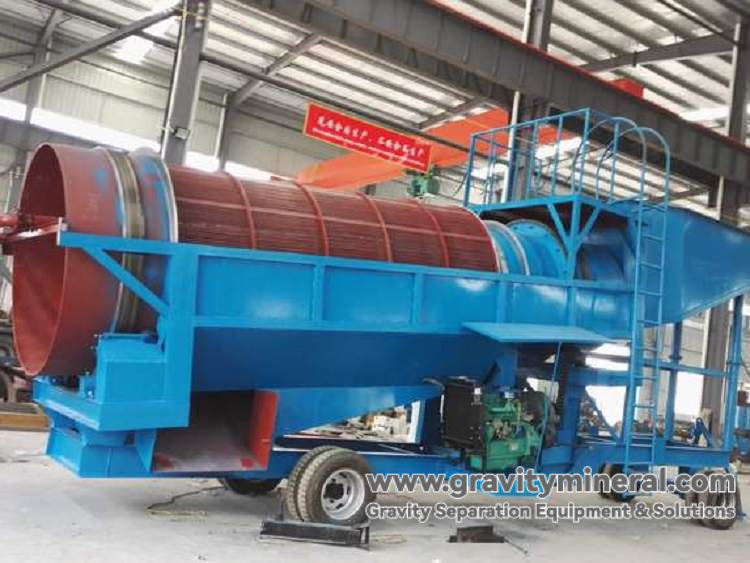
II. Ore Washing Section: The First Hurdle in the Entire Process
Ore washing is the first stage of a high-clay gold ore beneficiation production line and is also a prerequisite for ensuring the smooth operation of the subsequent gravity separation stage.
Cylindrical ore washers are currently the mainstream choice for processing high-clay ore, but ordinary trommel screens and ore washers are two entirely different things.Ordinary drum screens contain only simple water jets that rely on water flow to wash away the mud; in contrast, the inner walls of a washing machine\'s drum are equipped with spiral blades or augers. The material is lifted, dropped, and agitated within the drum, and only in combination with high-pressure water can the cohesive mud clumps be broken apart.When selecting equipment, focus on whether the drum interior has liners or agitation structures, and whether the screening section is long enough. The washing effectiveness of a short, funnel-shaped screening section is often insufficient for handling highly clay-rich ore.
Controlling the water pressure during ore washing is equally critical. If the water pressure is too low, the mud clumps cannot be broken up; if it is too high, fine-grained gold will be carried away with the overflow. A prudent approach is to set up a sampling point at the overflow outlet of the ore washer to observe the condition of the mud clumps and the gold content in the tailings water, making adjustments as you go rather than setting a fixed value based solely on experience.In the washing section of a placer gold processing line handling high-clay content, water pressure adjustment is an integral part of daily operations.
III. Screening and Desliming: Separating Grain Sizes
Screening follows the washing process. The purpose of screening placer gold is straightforward: to remove large, gold-free gravel and send the gold-bearing fine-grain fraction to the gravity separation stage. Screening high-clay ore presents a challenge—sticky material tends to clog the screen mesh.Cylindrical or drum screens have a self-cleaning effect as they rotate, making them better suited for sticky and wet conditions than vibrating screens; this is why drum screens are widely used in placer gold processing equipment.
A two-layer screen configuration is recommended. The upper layer\'s mesh size is determined by the maximum gravel particle size—typically 10 to 20 millimeters—and the oversize material is directly discharged as waste; the lower layer\'s mesh size is set between 2 and 6 millimeters, and the undersize material proceeds to gravity separation.If the intermediate particle size fraction contains gold, it can be routed through a separate coarse-grain gold recovery line using fixed or vibrating chutes. The key to the seamless integration of screening, washing, and gravity separation lies in this particle size classification; if the classification is unreasonable, even the best downstream gravity separation equipment will not receive suitable feed material.
The de-silting stage is often overlooked. After ore washing, slurry from highly clay-rich ores still contains a large amount of fine silt. If this silt is not removed in advance, it will increase the slurry\'s viscosity, disrupting the sorting bed layers in jigs or centrifuges.A hydrocyclone bank is a commonly used method; feed pressure must be stable, as any fluctuation will reduce de-silting efficiency. A common approach is to discharge the overflow directly as tailings and feed the underflow to the gravity separation stage; if the micro-fine gold entrained in the fine silt has a significant grade, it can be processed separately using a centrifuge—provided the silt volume is kept under control.
IV. Gravity Separation Stage: Jigging for Coarse Particles, Centrifugation for Fine Particles
At this core recovery stage, equipment selection depends on the particle size distribution of the gold. This decision cannot be made arbitrarily; screening and analysis tests must first be conducted to determine in which particle size fractions the gold is primarily concentrated, after which the equipment combination can be determined.
For ores dominated by coarse-grained gold, a sawtooth-wave jig is a highly efficient choice. The pulsating water flow in the jig repeatedly loosens and compacts the bed layer, allowing high-density gold particles to pass through the bed into the concentrate chamber.Compared to traditional jigging machines, the sawtooth-wave jig features an optimized water flow pulsation curve, making it more adaptable to materials with a wide particle size distribution. Jigging machines offer high throughput and stable operation, but their recovery of ultrafine gold particles is limited—a factor to keep in mind when configuring a placer gold processing line.
For ores with a high proportion of fine-grained gold, a centrifugal concentrator is the way to go. The high-speed rotation of the drum generates a centrifugal force field equivalent to dozens of times the acceleration due to gravity, flinging fine gold particles into the enrichment troughs on the inner wall of the drum.Centrifuges are sensitive to the clay content in the slurry. If upstream desliming is inadequate—resulting in high slurry viscosity and significant resistance to the settling of fine gold—the centrifuge is effectively trying to recover gold from a muddy slurry, which significantly reduces its efficiency. In a sand gold processing line with high clay content, the two critical steps of buffering and desliming preceding the centrifuge must not be omitted.
The scavenging stage uses a pulsating chute or a gold-trapping chute. The rubber plate at the bottom of the pulsating chute performs periodic pulsations to prevent bed compaction, making it more suitable for high-clay ores than a fixed chute.Gold-trapping chutes are lined with specially designed gold-trapping mats, specifically designed to capture flake gold and fine-grained gold that has escaped earlier processing stages. The concentrate from the sweep selection is returned to the roughing stage or fed directly to the concentrating stage, forming a closed circuit. In a complete solution involving washing, screening, and gravity separation, sweep selection serves as the final safety net and cannot be omitted.
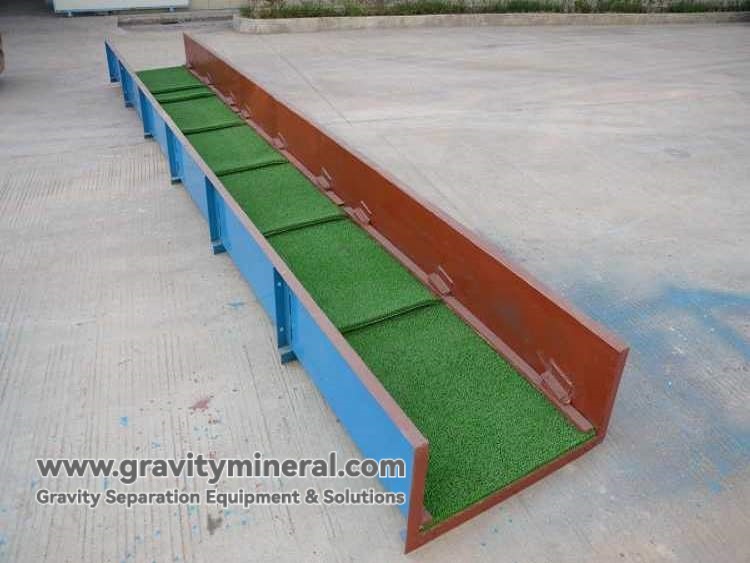
V. Concentration Stage: Shaking Table Purification and Closed-Circuit Processing
Rough concentrate is fed into shaking tables for fine selection. Shaking tables are fine-selection equipment with limited processing capacity; if the feed layer is too thick, the separation zones become unclear, and the concentrate grade drops. Operating multiple units in parallel or first using sluices for preliminary concentration before feeding into the shaking tables is more effective than overloading a single shaking table.In the fine selection stage of a high-clay-content placer gold processing line, the number of shaking tables must match the yield of the rough concentrate. If the yield is not calculated accurately, the shaking tables will either be underutilized or overloaded.
The tailings from the fine selection stage are returned to the roughing or scavenging stages, and the middlings are reprocessed, forming a closed-circuit system. The purpose of the closed-circuit system is to give gold that has not been fully separated another chance, thereby reducing losses. The closed-circuit design of the entire process is where the technical expertise in the configuration of a placer gold processing line is truly demonstrated.
VI. A Sample Configuration and Configuration Logic
The configuration below is designed for operating conditions with moderate feed particle size and a medium-to-high clay content; actual equipment selection requires adjustment based on mineral sample test data. The values provided are reference ranges; as variations between different mining areas can be significant, they should not be applied directly.
| Process Stage | Process Step Equipment | Specifications and Orientation | Quantity Reference | Key Function |
|---|---|---|---|---|
| Feeding | Vibrating Feeder | Grating Screen | 1 unit | Ensures uniform feed and removes oversized pieces |
| Ore Washing | Cylindrical ore washer | Built-in spiral blades; drum features a kneading structure | 1 unit | Breaks up clumps of clay to release trapped gold |
| Screening | Double-layer drum screen | Upper layer set according to gravel particle size; lower layer set to a few millimeters | 1 unit | Classification, removal of large gravel |
| Desliming | Hydraulic Cyclone Unit | Polyurethane lining | 1 set | Removes fine silt and stabilizes the feed for gravity separation |
| Roughing | Serrated-wave jig | Selected based on processing capacity | Determined by scale | Recovering coarse-grained gold |
| Rough Selection | Centrifugal Mineral Separator | Select based on the proportion of fine particles | Depends on scale | Recovery of Fine-Grain Gold |
| Sweep Selection | Agitated Chute | Selected based on tailings volume | Determined by scale | Processing Jigging and Centrifugal Tailings |
| Enrichment | 6-S shaking table | Matched to the yield of rough and concentrate | Depends on scale | Rough and concentrate purification |
The configuration logic can be summarized as follows: allow for capacity margin in the ore washing section to accommodate fluctuations in clay content; employ a two-stage screening configuration, with particle size classification tailored to the gravity separation equipment; place desliming at the front end to protect the centrifuges; separate coarse and fine particles, with jigging and centrifugation each handling a specific range; use sweep selection as a safety net, and operate the concentrate separation in a closed circuit.This framework for a complete ore washing, screening, and gravity separation system is suitable for most high-clay placer gold deposits; specific parameters must be determined based on the ore sample itself.
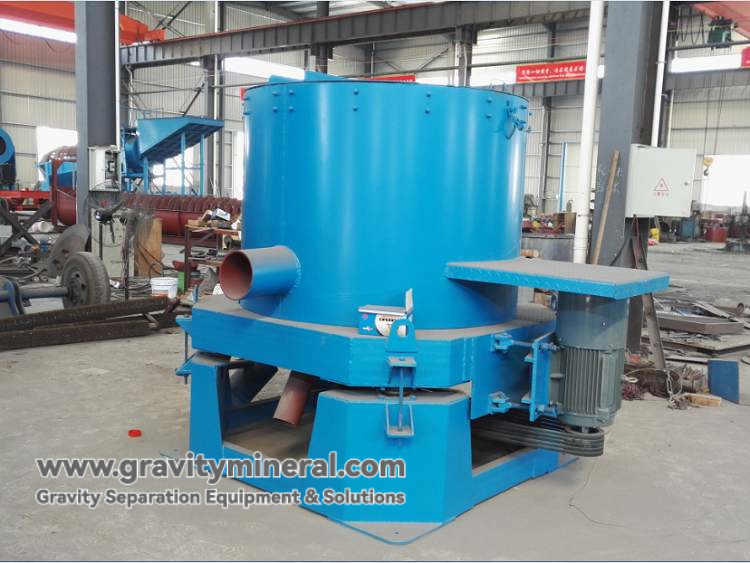
VII. Common Configuration Misconceptions
Misconception 1: Configuring the ore washing section as for ordinary placer gold deposits. If the ore washer is undersized or lacks sufficient agitation, mud clumps cannot be broken up, which affects the entire downstream process. For placer gold processing lines with high clay content, it is better to have some excess capacity in the ore washing section rather than selecting equipment based strictly on the required throughput.
Misconception 2: Failing to install a desliming unit before the centrifuge. When fine slurry enters the centrifuge, separation efficiency is compromised, and fine gold is carried away with the overflow. The placement and efficiency of the desliming equipment directly determine whether the centrifuge can function effectively.
Misconception 3: Mismatch between the number of shaking tables and the roughing yield. If the roughing concentrate yield is estimated inaccurately, the shaking tables will either run idle or become overloaded. In the scavenging stage of a placer gold processing line, the number of units should be determined based on yield balance.
Misconception 4: Blindly copying process flowcharts from neighboring mining areas. There are significant differences between mining areas in terms of clay plasticity, gold particle morphology, and gravel content.For ores rich in flake gold, the proportion of chutes and gold-trapping mats should be increased; for ores rich in coarse gold, jigs should be prioritized over centrifuges; for highly cemented ores, the washing stage may require two rounds of scrubbing. Conducting mineral processing tests before finalizing the process is far more cost-effective than modifying the system after the equipment has been purchased.
VIII. Commissioning and Operation: The Work Beyond the Equipment
Compiling an equipment list is not difficult; the real challenge lies in on-site adjustments—such as how to regulate water pipes, whether the screen mesh is clogged, and whether the feed to the centrifuge is stable. Even with the same equipment configuration, performance metrics can vary significantly depending on whether commissioning is done properly or not.For the commissioning of a high-clay-content placer gold processing line, the focus is on several key parameters: washing water pressure, screen tension, centrifuge feed concentration, and shaking table slope. Since these parameters influence one another, engineers must conduct repeated on-site trials to fine-tune them.
GravityMineral\'s approach involves engineers providing on-site installation guidance and leading the commissioning of both individual units and the entire system, with the project considered complete only when the production line is running smoothly and performance metrics are stable.The equipment is manufactured at the company\'s own production facilities, the process is designed by its in-house team, and on-site commissioning is carried out by gravity separation engineers—placing responsibility within a single team and avoiding the buck-passing that often occurs between equipment manufacturers and design firms. For projects as commissioning-sensitive as high-clay gold sand processing lines, the value of this closed-loop service is particularly evident during the commissioning phase.