







Gravity Pre-concentration Equipment and Process Solutions for Low-Grade Gold Ore
The challenges facing low-grade gold ore are quite specific: the gold particles are finely dispersed and the grade is low, so when the ore is fed directly into flotation or leaching, chemical and electricity costs spiral out of control. Gravity pre-concentration solves precisely this problem—by removing most of the gangue before the ore enters the expensive processing stages, it ensures that subsequent systems only need to process a small amount of pre-concentrated material.When evaluating gravity pre-enrichment equipment and process solutions for low-grade gold ore, the key consideration is not the number of units installed, but whether the gravity separation stage can consistently produce tailings and concentrate gold at a reasonable cost.
I. What Is the Value of Gravity Pre-Enrichment?
In a processing plant with low-grade ore, if the entire feed is sent directly to cyanidation or flotation, costs—including reagents, electricity, and labor—are difficult to reduce when averaged per metric ton.
Adding a gravity pre-concentration stage after grinding and before flotation or leaching changes the situation: jigs or spiral chutes first remove most of the gangue tailings, significantly reducing the feed volume entering subsequent processes, while the gold concentration increases severalfold.Consequently, the subsequent grinding volume, reagent consumption, and leaching tank capacity all decrease accordingly.
The core value of gravity pre-concentration lies not in “how much more gold is recovered,” but in “how much less waste rock is processed.” Every metric ton of gangue that is not ground saves on electricity, steel consumption, and reagent costs. This is the fundamental economic logic behind gravity pre-concentration equipment and process solutions for low-grade gold ore.
II. Which Low-Grade Gold Deposits Are Suitable for Gravity Pre-Enrichment
Not all low-grade gold deposits can be made viable through gravity separation. The assessment criteria primarily hinge on two factors: whether gold particles can be liberated into sufficient individual particles, and whether, after liberation, they fall within the particle size range that can be captured by gravity separation.
Ores suitable for gravity pre-enrichment:
-
Gold exists in the form of free native gold or gold-silver alloys, with particle sizes generally falling within the range where gravity separation equipment has high capture efficiency.
-
For placer gold or oxidized ore deposits with high clay content—where traditional fixed sluices are prone to caking—flexible sluice equipment such as agitating sluices and peristaltic sluices is more effective.
-
For mines with low ore grades but relatively coarse gold particles, where flotation recovery rates are unsatisfactory and reagent consumption is high, gravity separation has potential as a pre-concentration stage.
Cases requiring careful evaluation:
For ores with very fine gold mineral particles—primarily silver-gold ores or ores dominated by encapsulated gold—and complex mineralization patterns, the enrichment ratio achieved by gravity separation is often unsatisfactory.If recovery rates from shaking table or centrifuge tests on such ores are significantly low, it indicates that gold particles are difficult to capture under the shear forces of the gravity separation water flow; in such cases, the process should be shifted to whole-ore leaching or other combined processes as early as possible.Conducting gravity separation tests before selecting equipment is an essential step that cannot be skipped before implementing gravity pre-concentration equipment and process solutions for low-grade gold ores.
III. How to Configure Core Equipment: Roughing and Scavenging, with Staged Processing
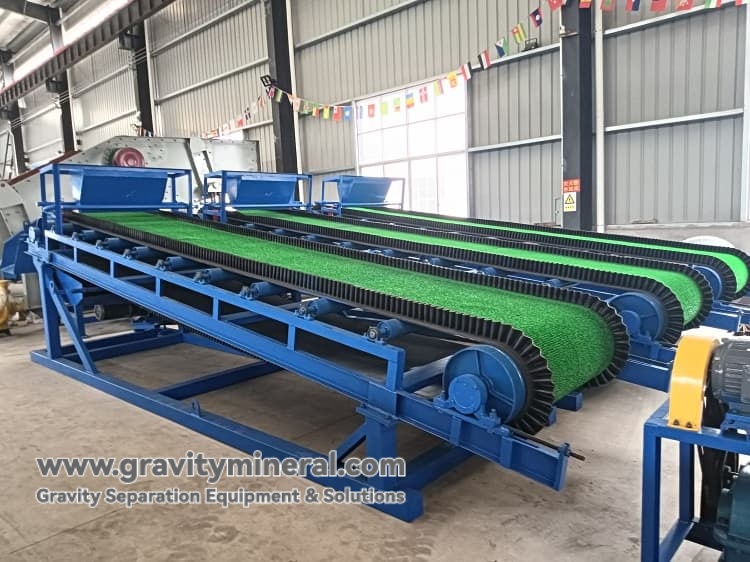
The principle for configuring gravity pre-concentration equipment for low-grade gold ores is “rough recovery and early rejection.” First, use equipment with high water consumption and stable operation to recover the bulk of the ore, then use fine-selection equipment to improve grade; there is no need to pursue high precision right from the start.
Roughing Stage: Jig or Agitated Chute
When the feed size is relatively coarse, a sawtooth-wave jig is a common choice.Taking the JT4-2 model as an example, it has a jigging area of 4 m², accepts feed sizes less than 25 mm, has a processing capacity of 8–20 t/h, and operates at 7.5 kW. Its stroke and frequency are adjustable, and bed stratification is achieved through pulsating water flow. The structure is robust, and routine maintenance requirements are minimal.
When the material has a high clay content and a large proportion of fine particles, the stratification in the jig is easily disrupted by the clay. In such cases, an agitating chute is a more suitable solution.The FGS-15 model has a processing capacity of 30–35 m³/h, accepts feed sizes less than 20 mm, and features an adjustable agitation frequency. Under agitation, the flexible rubber trough repeatedly kneads the material, breaking up the clay and sand that encase gold particles, resulting in better recovery of fine-grain gold than traditional fixed sluice boxes.
Concentration Stage: Shaking Tables or Centrifugal Separators
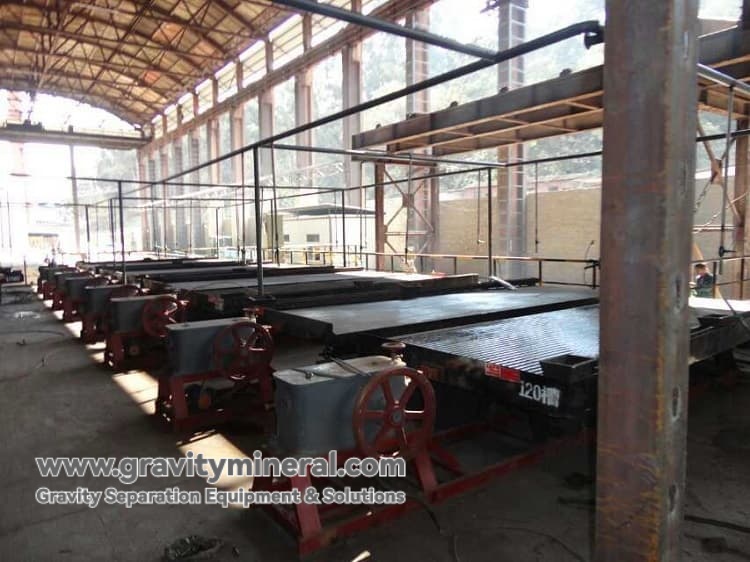
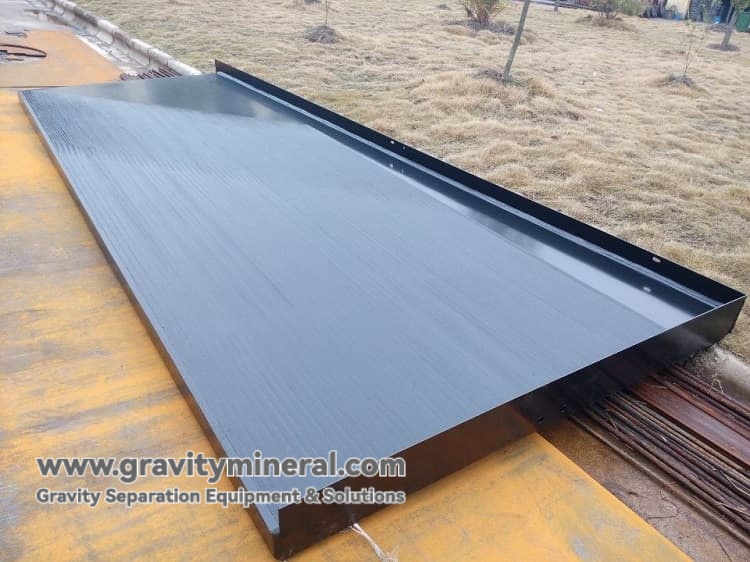
The volume of rough concentrate is not large, but the grade needs to be improved.The 6-S shaking table has a bed area of 7.6 m², a processing capacity of 1–1.2 t/h, a stroke of 16–22 mm, and a stroke rate of 220–280 r/min. With its high enrichment ratio and intuitive operation, it is suitable for processing rough concentrate.
Recovery of fine-grained gold is handled by a centrifugal concentrator. The STLB60 model has a processing capacity of 8–12 t/h, accepts feed particles smaller than 5 mm, and requires 7–10 m³/h of backwash water.Backwash water flow is a critical parameter for the centrifuge—if the flow rate is too low, the bed layer is prone to caking; if it is too high, fine-grained gold will be washed away. The optimal flow rate must be determined through ore sample testing.
Reference Configuration for Gravity Pre-concentration Equipment for Low-Grade Gold Ore
| Process Step | Equipment | Key Parameters | Function |
|---|---|---|---|
| Roughing | Sawtooth Jig JT4-2 | Jigging area: 4 m²; feed size: <25 mm; processing capacity: 8–20 t/h | Removes coarse gangue and recovers coarse gold |
| Alternative Roughing Method | Agitated Chute FGS-15 | Processing capacity: 30–35 m³/h; feed size <20 mm | Alternative to jigging in high-silt conditions |
| Final Concentration | 6-S Shaking Table | Processing area: 7.6 m², throughput: 1–1.2 t/h | Re-enrichment of rough concentrate |
| Alternative options for fine concentration | STLB60 Centrifugal Mineral Processor | Processing capacity: 8–12 t/h; feed size <5 mm | Fine-grain gold recovery |
| Dewatering | Thickener + Filter Press | Matched to concentrate output | Concentrate is sent to subsequent processes after dewatering |
IV. What Is the Flow Chart for the Gravity Pre-Enrichment Process?
-
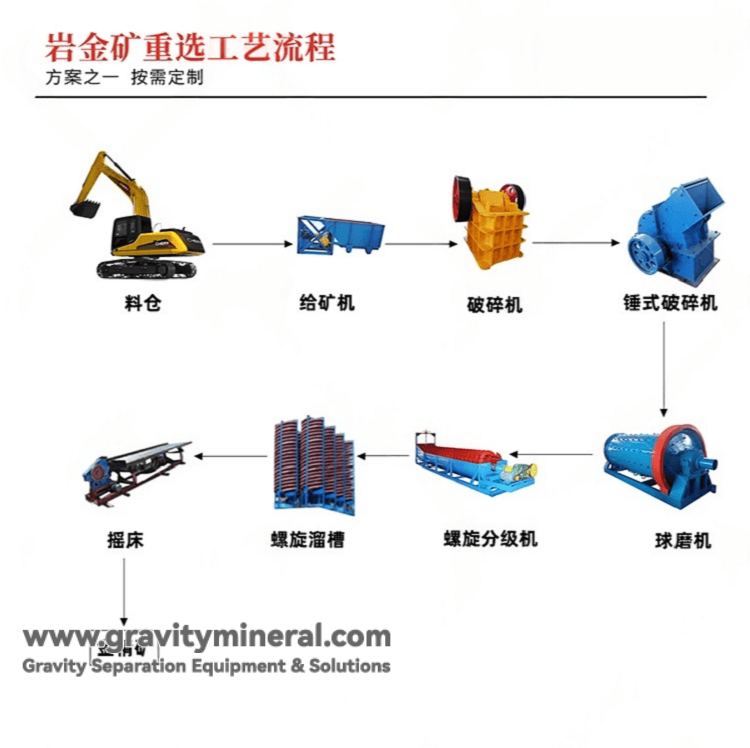
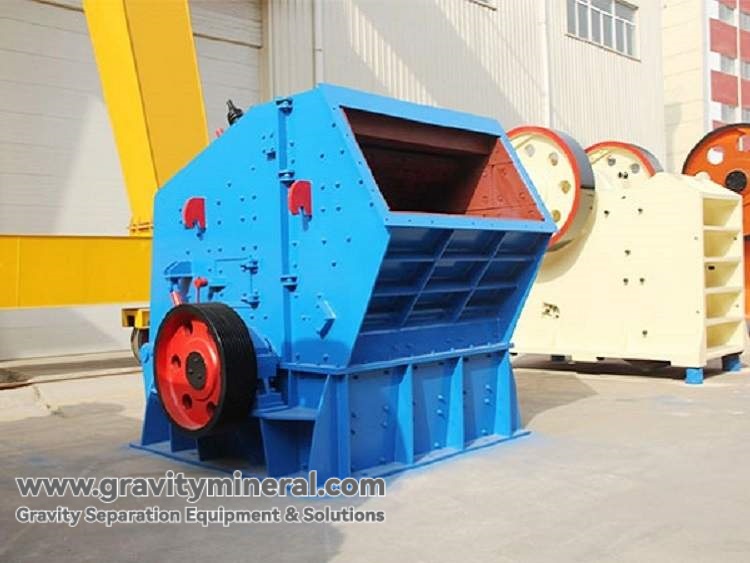
Crushing and screening. The raw ore is crushed to the particle size required by the gravity separation equipment.Jigging machines are suitable for coarser feed, while centrifuges require finer feed. If grinding is required in the subsequent process anyway, it is more cost-effective to integrate the gravity separation stage into the grinding circuit—the mill discharge first passes through gravity separation to recover coarse free gold as early as possible, thereby avoiding over-grinding that produces fine particles difficult to recover.
-
Roughing and Tailings Discharge. The slurry is fed into a jig or agitated chute. The objective of this step is to remove the majority of tailings, not to produce high-grade concentrate. The tailings grade should be controlled at a reasonable lower limit. Operators should monitor feed concentration and ensure stable water flow.
-
Concentrate Re-processing. The rough concentrate is pumped to shaking tables or centrifuges. The shaking table slope, stroke, and rinse water volume must be adjusted on-site. If the concentrate zone is too narrow, the recovery rate decreases; if it is too wide, the grade drops. A balance between grade and recovery rate must be found.
-
Tailings Water Reuse. The gravity separation process requires no chemicals; after sedimentation, the tailings water can be reused directly, offering a significant cost advantage in water-scarce regions.
The key design consideration for the gravity pre-concentration process is to ensure that the throughput of the roughing stage matches the feed rate from the upstream section, and that the throughput of the cleaning stage matches the output of the rough concentrate, while preventing material blockages and idle operation between stages.
V. Three Common Pitfalls in Operation
Fluctuations in feed rate. The separation efficiency of jigs and chutes is highly dependent on bed stability. If the flow rate of the feed pump fluctuates wildly, the bed is disturbed, and concentrate is likely to be lost into the tailings. Maintaining a steady flow is more important than repeatedly adjusting parameters.
Adjusting backwash water based on intuition. There is a reasonable range for the backwash water volume in centrifuges; if the volume is too high, fine-grain gold is washed away, and if it is too low, the bed becomes compacted. It is recommended to establish a baseline value during the testing phase and make minor adjustments on-site.
Expecting the gravity separation process to produce qualified concentrate in a single step. The grade of concentrate from low-grade ore in gravity separation is limited; its purpose is to reduce the feed load for subsequent flotation or leaching, not to directly produce gold that meets quality standards. Evaluating the gravity separation section based on the final concentrate grade is misguided.
VI. Logic for Assessing Investment and Return
The economic viability of gravity pre-concentration depends on a single ratio: whether the volume of tailings discarded can cover equipment depreciation and operating costs.
Equipment investment is directly related to ore properties, processing scale, and the number of stages configured; variations between projects are significant, so fixed figures should not be applied indiscriminately. Operating costs consist primarily of electricity consumption and labor; jigging machines have low electricity consumption per metric ton of ore, while chutes are more energy-efficient on a volumetric basis.
If pre-concentration can eliminate the majority of tailings, the processing capacity of subsequent grinding, flotation, or leaching operations will decrease accordingly, leading to proportional reductions in grinding power consumption, reagent consumption per unit, and agitation power. The savings in operating costs for these subsequent processes are the primary source of return on the pre-concentration investment.
Conversely, if the gold particles in the ore are too fine, gravity separation recovery rates are low, and gold losses in the tailings are significant, the project will not be financially viable. Whether a gravity pre-concentration equipment and process scheme for low-grade gold ore is viable is ultimately determined by mineral sample test data, not by the equipment list.
VII. Beyond the Equipment: Commissioning Determines Whether the Production Line Runs Smoothly
The structure of gravity pre-enrichment equipment is not particularly complex, but there is a significant gap between simply “installing” it and getting it to “run smoothly.”The stroke and frequency of a jig must be adjusted according to the ore particle size; the slope of a shaking table must be adjusted according to the feed concentration; and the backwash water flow of a centrifuge must be adjusted according to the degree of gold particle liberation. There is no universal manual for these parameters; they rely on an assessment of the ore\'s properties and on-site experience.
GravityMineral has specialized in gravity separation for 20 years. Core equipment—including jigs, shaking tables, spiral chutes, and centrifugal separators—is manufactured at our two in-house production bases, ensuring controllable lead times. We have the capability to implement non-standard customizations such as wear-resistant materials, anti-corrosion treatments, and motor power specifications.Gravity separation engineers provide on-site guidance for installation and lead the commissioning of both individual units and integrated systems until the production line is running smoothly and performance indicators are stable.
The company\'s products are exported to more than 50 countries and regions, with a track record of over 500 global gravity separation projects covering major ore types such as placer gold, rock gold gravity separation stages, tungsten-tin, chromite, and titanium-zirconium sand deposits. It holds a 35% market share in China\'s gravity separation equipment sector.The company has established a joint R&D center with Jiangxi University of Science and Technology, ensuring that equipment upgrades benefit from technical input from the university.
VIII. Implementation Steps for Gravity Pre-concentration Equipment and Process Solutions for Low-Grade Gold Ore
If you have ore samples on hand, you can proceed in three steps to verify the feasibility of gravity pre-enrichment:
-
Submit samples for gravity separation testing. Conduct comparative tests using shaking tables and centrifuges based on the ore\'s properties to determine concentrate yield, grade, and recovery rate, thereby assessing how much tailings can be removed via gravity separation and what level of gold loss can be controlled. Testing fees can be offset against the cost of subsequent equipment or EPC contracts.
-
Select equipment based on the test results. Use chutes for high-silt content feed; jigs for coarse-grained feed; and centrifuges for fine-grained feed. The connection between roughing and concentrating stages, as well as the processing capacity, should be clearly specified in the proposal, with equipment selection and pricing provided simultaneously.
-
On-site commissioning includes operator training. Engineers will visit the site to adjust the bed conditions, train operators, explain troubleshooting for common issues, and hand over the line once its stability is confirmed.
The value of gravity pre-concentration equipment and process solutions for low-grade gold ore is ultimately reflected in the cost reductions achieved through reduced feed volume in subsequent processes. Only when the gravity separation section operates stably can the entire line break even.