







Suppliers of Gravitational Separation Equipment for Alluvial Gold and Turnkey EPC Solutions for Processing Plants
The challenge in processing alluvial gold deposits lies not in “processing” but in “formulation.” The ore body is deposited along the mountainside, with clay content varying across different sections of the slope; gold particles range from coarse to fine and are distributed in a mixed pattern, while bedrock fragments are cemented together with clay.Even within the same mine, the ore characteristics in the upper and lower sections of the slope can differ significantly. These characteristics mean that suppliers of gravity separation equipment for slope-deposited gold cannot simply provide a list of equipment, nor can turnkey EPC solutions for processing plants be based on templates designed for bedrock gold or riverbed placer gold.Ensuring seamless integration between the various stages—washing, classification, roughing, concentrating, and finishing—and aligning the equipment with the ore\'s properties is the prerequisite for the entire line to operate smoothly. This is also the challenge that suppliers of gravity separation equipment for slope-deposited gold and EPC turnkey solution providers for processing plants must jointly address.
I. Geological Characteristics and Processing Challenges of Colluvial Gold Deposits
Alluvial gold deposits are formed when clastic material from primary gold-bearing geological bodies is weathered and transported over short distances along slopes to accumulate. They fall between residual and alluvial deposits, exhibiting both the high clay content typical of residual deposits and the partial dissociation of gold particles characteristic of alluvial deposits.
Gold particles are primarily flake-like or granular in shape, with a lower degree of erosion compared to riverbed placer gold, and a wide range of particle size distribution. Coarse gold can be recovered using jigs or sluices, while fine and ultrafine gold requires the use of enhanced gravity separation equipment such as shaking tables and centrifugal separators.Silt content is another key variable. Since slope-deposited environments lack continuous water erosion, a significant amount of fine silt and clay remains within the ore layer. When silt content is high, the ore slurry becomes viscous, screening efficiency decreases, the bed layer in the jig becomes disordered, and the stratification effect of gravity separation deteriorates.
A mixture of bedrock fragments and gravel is typical in alluvial deposits; large pieces of waste rock must be separated out during the ore washing and screening stage and must not enter the beneficiation process.Ore bodies are typically small in scale and scattered, with a limited service life. This directly influences the choice of processing plant configuration—whether fixed, modular, or mobile—which must be determined based on the distribution of mining rights. For this reason, suppliers of gravity separation equipment for alluvial gold must first review ore sample data before selecting a model, rather than directly recommending a specific machine type.
II. Ore Washing and Desliming: A Prerequisite for Placer Gold Processing
Ore washing and de-silting are not optional steps in the alluvial gold processing flow. If clay agglomerates enter gravity separation equipment without being broken up first, there are only two possible outcomes: screen mesh clogging, or gold particles being encapsulated by clay and lost with the tailings.
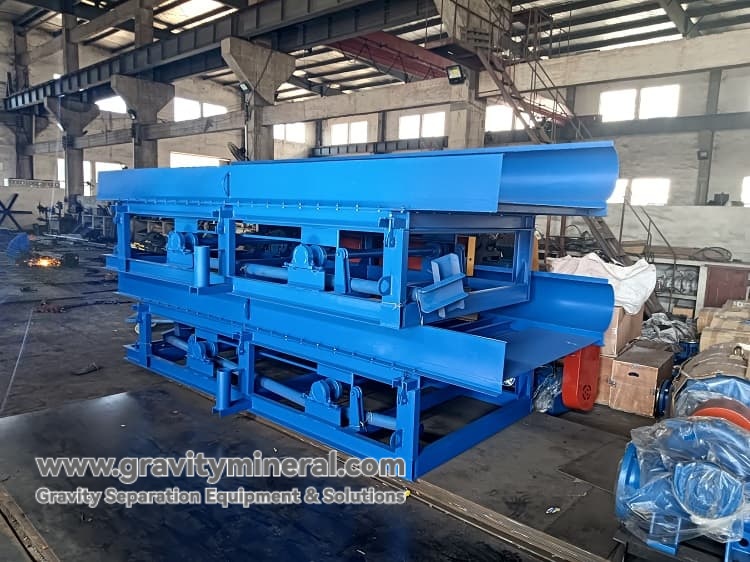
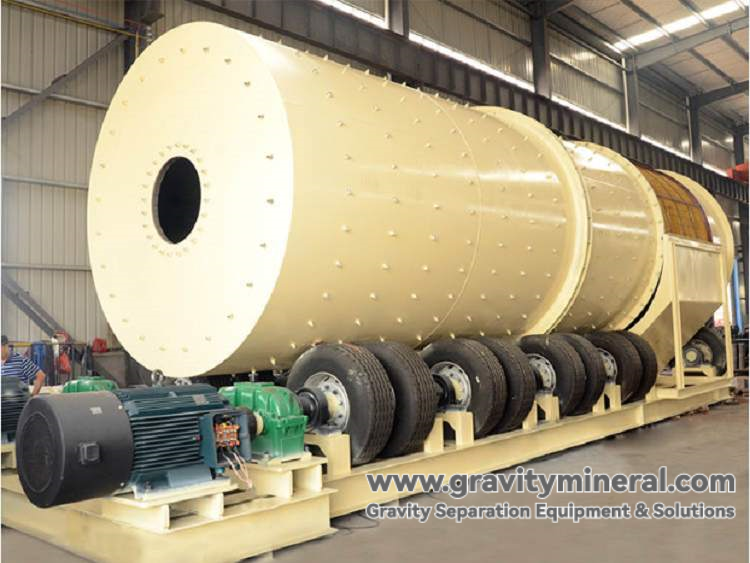
A drum washing machine is standard equipment; the rotating drum, combined with high-pressure water flushing, breaks up the clay agglomerates. For ore samples with high clay content or tightly cemented clay, it is advisable to add a scrubber to enhance desliming, as the shear force of its blades is more effective at breaking up cemented clay agglomerates than water flushing alone.Pulsating-peristaltic washing equipment combines pulsating screening with peristaltic agitation; the upper coarse screen intercepts gravel, while the lower fine screen classifies the material.while the flexible rubber plate in the middle repeatedly kneads the material on the screen under vibration, squeezing out gold particles trapped in the mud. This method is suitable for alluvial deposits that are not very large but have particularly high clay content.
Here is a key criterion: when the mud content is low, a drum washing machine is sufficient; however, if the mud content is high, omitting the scrubbing step will result in losses in the subsequent gravity separation stage that are magnified many times over.The pressure, flow rate, and duration of the washing process must be matched to the mud content; a single set of parameters cannot be applied across the entire mining section. Suppliers of gravity separation equipment for alluvial gold should determine equipment specifications and operating parameters based on the mud content data of the ore sample when configuring the washing section.
III. Gravitational Separation Section Configuration: Aggressive Roughing, Steady Cleaning, and Meticulous Finishing
After desliming, the slurry enters the gravity separation stage. The particle size characteristics of alluvial gold dictate that equipment selection cannot be a one-size-fits-all approach.
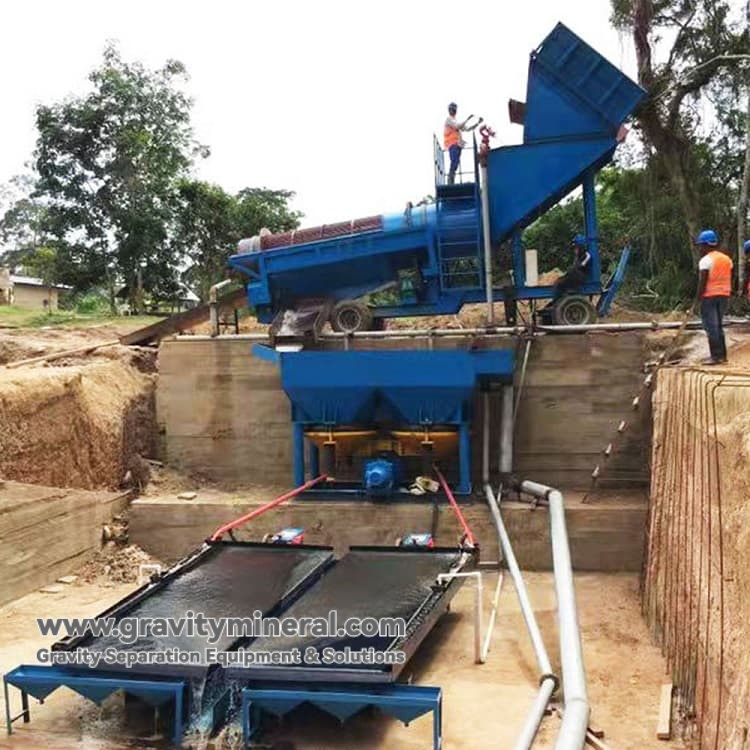
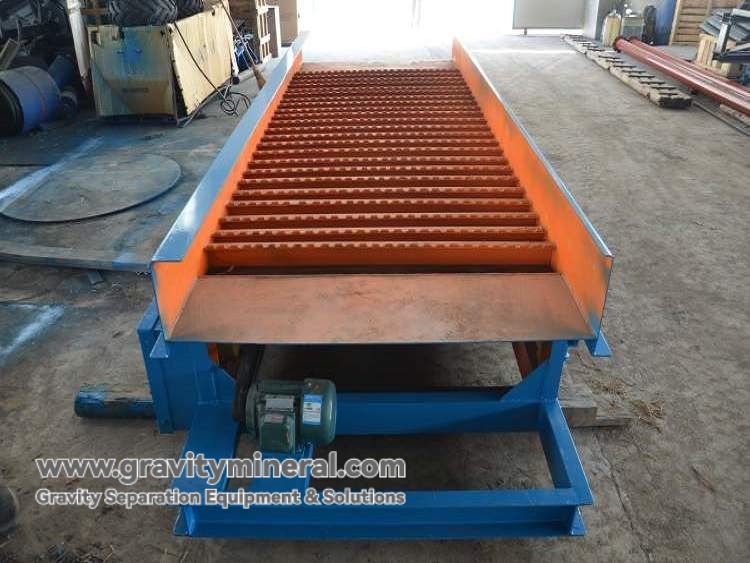
The roughing stage primarily uses sawtooth-wave jigs or spiral chutes.Jigging machines provide stable recovery of coarse-grain fractions and handle high throughputs; their sawtooth-wave pulsation curve is well-suited for materials with a wide particle size distribution. Spiral chutes feature a simple structure and require no power consumption, making them ideal for large-scale roughing and tailings rejection. They remove a significant amount of light gangue early on, thereby reducing the processing load on the scavenging stage.The core objective of roughing is to “dispose of waste as early as possible,” but tailings disposal must not be excessive; stroke length, stroke frequency, and feed concentration must be properly adjusted to prevent coarse-grained gold from being lost with the waste rock.
The fine selection stage primarily uses 6-S shaking tables, which offer high separation precision and can produce qualified gold concentrate in a single pass. Ultrafine gold particles are recovered by a centrifugal separator during the tailings sweep, which utilizes centrifugal force to enhance separation and capture fine-silt-sized gold particles that are difficult to recover using conventional gravity separation methods.The three-stage configuration—jigging for roughing, shaking tables for concentrating, and centrifugal separators for tailings recovery—corresponds to the coarse, medium, and fine particle size fractions, thereby preventing a gap where coarse particles are recovered while fine particles are entirely lost as tailings.
The number of process stages and equipment integration are determined by ore sample test data, rather than by applying a fixed template. The value of a supplier of gravity separation equipment for alluvial gold lies in translating test data into stage configurations and production capacity balancing, ensuring the entire gravity separation chain operates seamlessly.
IV. Comparison of Stationary and Mobile Solutions
Given the dispersed nature of alluvial gold deposits and the limited service life of individual ore bodies, the choice of processing plant configuration must be determined based on the distribution of mining rights. The following comparison is provided as a reference for selection; however, specific indicators vary significantly depending on ore characteristics and scale and should not be treated as absolute criteria.
| Comparison Dimensions | Fixed Modular Processing Plant (EPC Turnkey Contract) | Crawler-Mounted Mobile Gold Processing Equipment |
|---|---|---|
| Suitable Scenarios | Relatively concentrated ore bodies, reliable reserves, and long service life | Scattered ore bodies, short service life per ore body, and frequent relocation required |
| Core Equipment | Trommel screen, scrubber, jig, centrifugal concentrator, shaking table, thickener | Integrates feeding, screening, and centrifugal gravity separation into a single unit |
| Relocation Capability | Limited; disassembly, relocation, and reassembly take weeks | Strong; self-propelled on tracks or towed by a trailer, with relocation completed in a matter of hours |
| Recovery performance | Depends on the effectiveness of ore washing and the suitability of the process | Depends on ore suitability and operating parameters |
| Investment Scale | Relatively high, including civil engineering and installation | Relatively low, as civil engineering is not required |
| Requirements for the General Contractor | Must possess end-to-end capabilities in design, equipment integration, installation, and commissioning | Equipment manufacturers deliver directly, making commissioning relatively simple |
For concentrated, contiguous ore bodies with reserves sufficient for a long operating period, fixed modular processing plants are more conducive to economies of scale; for dispersed ore sites requiring frequent relocation, the flexibility of mobile equipment offers a more significant advantage.The choice of approach depends on the distribution of mining rights rather than the price of a single piece of equipment. This is also a fundamental issue that suppliers of alluvial gravity separation equipment must confirm with the project owner during the proposal phase.
V. Scope of Responsibility for Turnkey EPC Solutions in Concentrator Projects
EPC stands for Engineering, Procurement, and Construction. When applied to alluvial gold projects, its significance differs from that in large-scale bedrock gold mines.In large-scale bedrock gold mines, EPC projects focus on mill specifications, leaching tank volumes, and automation levels; in turn-key EPC solutions for alluvial gold processing plants, the focus is on the ability to adapt to small, scattered, muddy, and fine-grained ore.
Ore test processing is the first step. Screening and analysis, clay content determination, gold particle size distribution analysis, and gravity separation recovery tests must be conducted at sampling points covering different slope sections and depths; if ore samples lack representativeness, the process design will lack a solid foundation.Once the process design is finalized, the EPC contractor is responsible for equipment selection and manufacturing, with process parameters derived from test data rather than pre-set templates. During the construction and commissioning phases, the EPC contractor is accountable for the final production targets; when recovery rates fall short of standards, responsibility is clearly assigned, preventing finger-pointing among design, equipment, and installation parties.
The boundaries of responsibility must be clearly defined in the contract: the EPC contractor is responsible for equipment manufacturing, process design, installation guidance, and commissioning training; civil construction and general installation labor are organized locally by the project owner, with the EPC contractor\'s engineers on-site to provide technical guidance. This division of labor ensures engineering quality while controlling labor and travel costs.The installation of gravity separation equipment is relatively standardized, and local workers can competently perform tasks such as positioning, leveling, and piping connections after receiving guidance. Whether a turnkey EPC solution for a concentrator can be successfully implemented depends largely on whether this boundary of responsibility is clearly defined.
VI. Reference Construction and Delivery Timelines
The construction timeline for a alluvial gold processing plant varies depending on scale, degree of customization, and logistics conditions. The following are reference phases for a typical turnkey project; specific timelines are subject to actual project approval.
| Phase | Core Tasks | Estimated Duration |
|---|---|---|
| Requirements Discussion | Understand ore type, production capacity, and site conditions; arrange for sample shipment | Several days to one week |
| Process Determination, Equipment Selection, and Quotation | Engineers determine the process flow and provide an equipment selection proposal and quote | One to two weeks |
| Contract Signing and Payment | Clarify scope of responsibility and payment milestones | A few days |
| Design of drawings | Process flow diagrams, equipment lists, layout drawings, and civil engineering requirements drawings | One to two weeks |
| Equipment Manufacturing | Production scheduling, machining, assembly, test runs, and factory acceptance testing | Several dozen days |
| Shipping and Logistics | Booking, container loading, ocean freight, inland transportation | Varies depending on destination distance |
| Installation, Commissioning, and Training | Equipment installation, piping connections, integrated commissioning, and personnel training | Varies based on project scale and site conditions |
For projects involving the purchase of standard equipment with in-house installation, the timeline is significantly shorter than that of a full-process turnkey project. Advance planning and allowing sufficient buffer time for coordination are essential to ensuring on-time commissioning. For projects adopting a plant-selection EPC turnkey solution, equipment manufacturing, design, and logistics coordination can proceed concurrently, thereby shortening the overall timeline.
VII. Common Technical Issues
How to address excessively high mud content and incomplete ore washing?
Viscous slurry causing the jig machine\'s bed layer to fail to flip and reducing screening efficiency is a common issue in the slope-accumulation gold processing line. Solutions include increasing the capacity of the ore washing section or using multiple units in series, adjusting the water pressure and flow rate for ore washing, and selecting anti-clogging screen meshes.For ore sections with significant fluctuations in clay content, the washing section design should allow for adjustment margins; it should not be configured based on the minimum clay content.
How should severe loss of fine-grain gold be addressed?
The loss of fine-grain gold is often caused by inadequate classification or the absence of tailings recovery equipment.Gravity separation is sensitive to particle size distribution; mixing coarse and fine particles yields poor results. The solution is to incorporate a classification stage into the process: coarse particles feed the jig, fine particles feed the spiral chute or shaking table, and ultrafine particles are processed by a centrifugal separator to reduce the tailings grade.
Can the process adapt to significant fluctuations in ore properties?
The clay content and particle size distribution of alluvial gold vary across different mining sections. Process design must account for the range of these fluctuations and the operational tolerance for errors. Adjustable stroke and frequency on the jig, adjustable slope on the shaking table, and the ability to swap spiral chutes with different pitch specifications are all built-in adjustment mechanisms.When fluctuations exceed the acceptable range, operating parameters or specific process steps must be adjusted. The adaptability limits should be evaluated during the testing phase through comparative testing of different ore samples and clearly communicated to the operating team during training.
VIII. Criteria for Selecting Suppliers of Gravity Separation Equipment for Alluvial Ore
When selecting a supplier for alluvial gold gravity separation equipment, the focus should not be on the quoted price for a single unit, but rather on the supplier\'s end-to-end capabilities—from ore sample testing and process design to equipment manufacturing and on-site commissioning. The most common failure in alluvial gold projects occurs when equipment is available but the process is poorly configured or on-site commissioning is unsuccessful.If a supplier can handle both process design and equipment manufacturing, mechanical engineers will have a clear understanding of upstream feed rates and downstream separation requirements during equipment fabrication. Having a single team responsible for ensuring interface compatibility and capacity alignment across all stages—crushing, ore washing, gravity separation, and dewatering—can prevent system incompatibilities caused by piecemeal solutions from multiple suppliers.
The delivery capability of a supplier of gravity separation equipment for alluvial gold projects is ultimately reflected in the stability of production metrics and the clarity of the chain of responsibility. Only when these three elements—in-house design, manufacturing at the supplier\'s own facility, and on-site commissioning by engineers—are integrated can a turnkey EPC solution for a processing plant be effectively implemented.If you need to evaluate process direction and equipment configuration based on specific ore sample data, please submit information on ore properties and site conditions so that our engineers can provide a tailored solution.