







Solution for the Cyanidation Process in Gravity Concentration of Residual Ore
I. What Is the Problem?
It depends on the situation: First, determine whether your processing plant is also stuck in a situation where “coarse particles can be recovered, but fine particles cannot be retained.”
Why can\'t the recovery rate be improved, and why can\'t the tailings grade be reduced? A typical characteristic of residual placer gold deposits is this: in the gravity separation stage, coarse-grained gold is recovered reasonably well, but the gold grade in the tailings remains consistently high; meanwhile, the cyanidation stage fails to leach the gold completely—both ends fall just short of the mark.
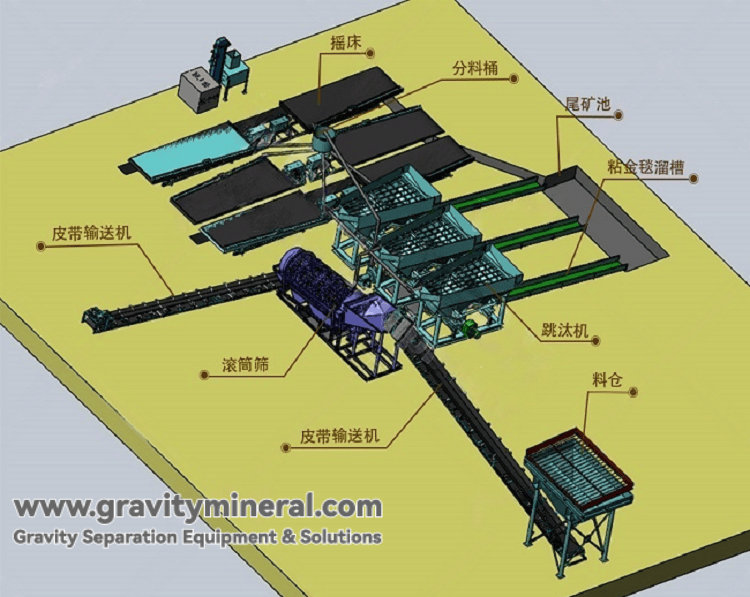
Residual gold consists of sand gold left behind in situ after the weathering of the host rock; it contains gold particles ranging from coarse to fine and has an exceptionally high clay content. Unlike riverine sand gold, which has undergone long-distance transport and sorting, residual gold has a more mixed grain size distribution and contains significantly more clay.If ordinary placer gold processing procedures are directly applied to this type of deposit, coarse gold can barely be recovered, while fine gold ends up in the tailings. For the overall process design, one can first refer to the “washing—screening—gravity separation” framework used in placer gold gravity separation production lines, then add a cyanidation step as a backup based on the characteristics of residual gold.
II. Why Does This Problem Occur?
It depends on the specific circumstances: the root cause often lies not in the equipment, but in a lack of thorough understanding of the ore\'s characteristics.
Reason 1: Inadequate ore washing and desliming. Residual gold is heavily clay-laden, with gold particles encased in clay clumps. If a drum washer fails to thoroughly remove the clay, the subsequent chutes and jigs will merely process the slurry, preventing the gold from settling. This is the most common—and most easily overlooked—root cause for residual gold.
Reason 2: Particle size segregation is inadequate.Residual gold contains a mix of coarse and fine particles. If a single set of equipment only covers one particle size range, the gold at the other end is lost. Coarse gold that should be recovered early isn\'t captured, fine gold that should be collected at the bottom isn\'t retained, and there\'s no buffer in between. As a result, fine gold circulates within the system, ultimately leading to tailings with excessively high gold grades.
Reason 3: Unstable cyanide feed. When gravity separation tailings enter the cyanide leaching process, the feed concentration fluctuates between too high and too low, and the leaching time is insufficient, so fine-grain gold is not leached out at all. Many plants assume they haven\'t added enough reagent, when in fact the problem lies in unstable feed and inadequate leaching time.
Quick Reference Table: Problems—Causes—Solutions
| Problem Symptoms | Root Cause | Countermeasures |
|---|---|---|
| Excessively high gold grade in tailings | Incomplete de-silting during ore washing | Enhance de-silting; pre-screen gravel using a drum screen |
| Loss of fine-grained gold | Particle size classification not kept up with | Implement coarse-fine separation and add fine-particle recovery equipment |
| Cyanide foam is not clean | Unstable feed concentration and insufficient processing time | Buffer and adjust slurry to stabilize feed |
The root cause of the problem isn\'t where you\'re looking—if residual gold losses are high, you should usually start by checking the desliming and classification stages first, rather than immediately suspecting the reagents.
III. What Is the Solution?
It depends on the situation: The key is to “recover coarse particles early via gravity separation and use cyanidation to capture fine particles,” integrating residual gold gravity separation with cyanidation into a complete process line.
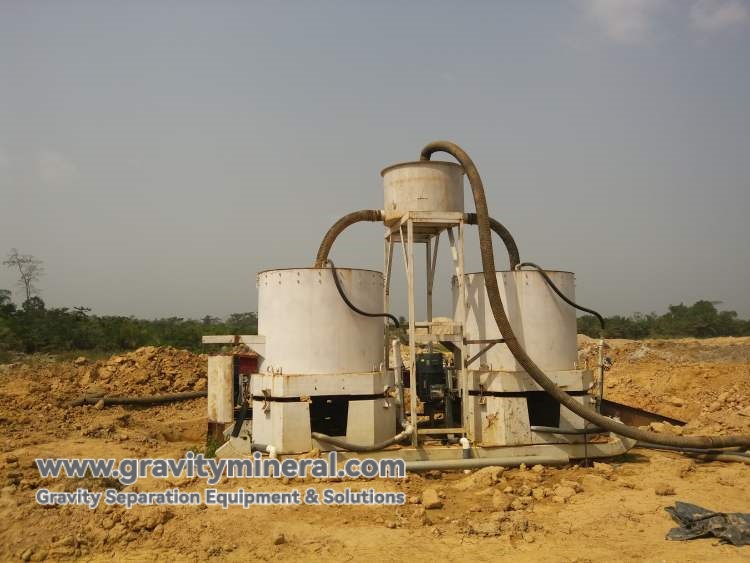
First, clarify the gravity separation stage. The main approach is to intercept the gold by particle size: coarse-grained free gold is sent to a sawtooth jig (which uses pulsating water flow to stratify by density) for early recovery to prevent overgrinding;medium- and fine-sized particles are sent to a 6-S shaking table for concentration; fine and ultrafine particles are then recovered by a centrifugal separator. Each section of equipment is responsible only for the particle size range it specializes in; if the sequence is reversed, fine-particle gold will be lost.
Next comes the cyanidation stage. Fine-grain and entrapped gold in the gravity separation tailings must be recovered through cyanidation. A buffer slurry adjustment stage is added before the feed enters the cyanidation process to stabilize the concentration; only by carefully controlling the sodium cyanide concentration and leaching time can fine-grain gold be effectively extracted.
There must be a buffer between the two stages; they cannot be directly connected. The particle size and concentration of the gravity separation tailings fluctuate significantly; if fed directly into the cyanidation stage, leaching efficiency would be entirely a matter of chance.The key to gravity separation followed by cyanidation for residual gold lies in linking these two processes—“gravity separation for coarse recovery and cyanidation for fine recovery”—through a stable feed stream.
Changing your approach is better than changing equipment—the success of residual gold processing largely depends on de-silting, stage separation, and seamless feed coordination, rather than simply piling on equipment.
IV. How to Implement the Plan
It depends on the situation: From pilot testing to full-scale production, make sure to follow these steps clearly before proceeding.
- Step 1: Determine the particle size distribution. Take representative ore samples and perform sieve analysis to determine the proportions of coarse-grained gold, fine-grained gold, and encapsulated gold. This serves as the basis for selecting equipment and defining processing stages.
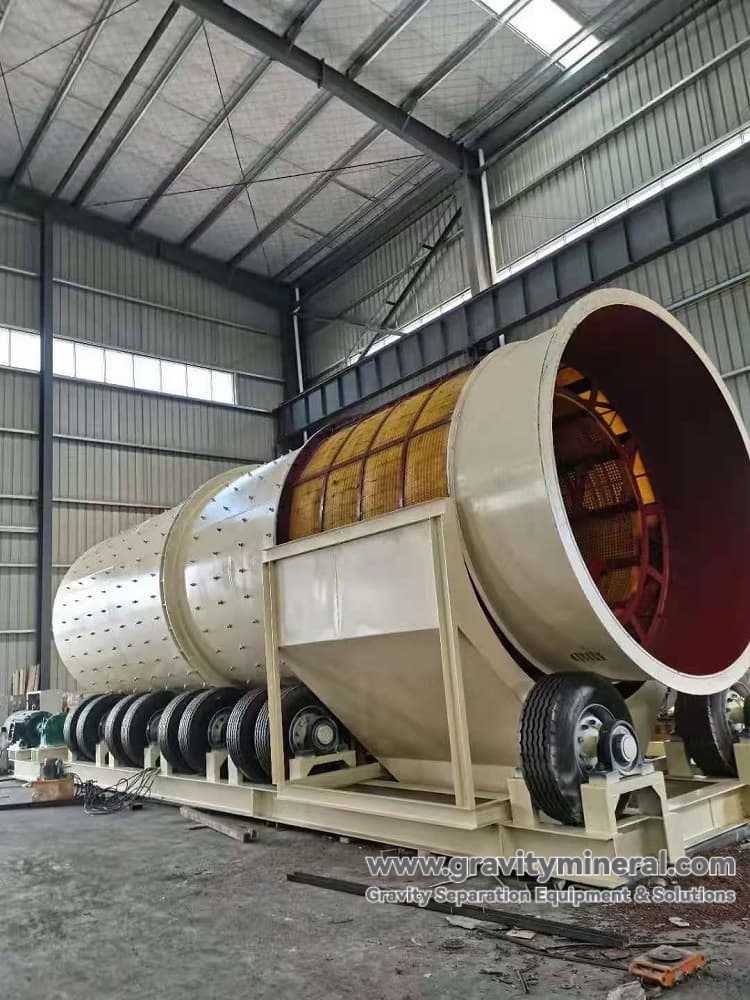
- Step 2: Intensify desliming. For residual gold with high mud content, the desliming process in the front end must be thorough. Use trommel screens to separate gravel and cylindrical ore washers to break up mud clumps; if desliming is inadequate, the subsequent gravity separation process will be entirely in vain.
- Step 3: Stage-by-stage gravity separation. If coarse particles predominate, move the jigging stage upstream and use coarser grinding; if fine particles predominate, focus on shaking tables and centrifuges, supplemented by agitated chutes in the fine-particle stage for auxiliary retention.
- Step 4: Follow up with cyanidation as a backup. Before the gravity separation tailings enter the cyanidation process, add a buffer to adjust the slurry consistency, stabilizing the feed concentration and leaching time. For the micro- and fine-grain fraction—which is most prone to being missed—use a suspended vibrating mat machine for a final sweep to recover additional material; this will significantly reduce the burden on the cyanidation process.
- Step 5: Conduct pilot tests before scaling up production. First, run tests to verify recovery efficiency; only scale up the production line once the data is stable—do not invest in large-scale equipment right from the start.
V. How Effective Is It?
It depends on the situation: After implementing size-based segregation and adding a cyanidation backup process, the results depend on the properties of the ore.
For residual gold consisting mainly of coarse particles with good single-particle liberation, segmented processing can increase the overall recovery rate by 6–9 percentage points (depending on the specific properties of the ore);For ores dominated by fine particles and encapsulated gold, combined with scavenging using centrifuges and blanket machines, along with cyanidation to fill gaps, the recovery rate also improves significantly, and the gold grade in the tailings decreases accordingly.
Actual results also depend on three factors: whether desliming is thorough enough, whether the stage configuration is correct, and whether the cyanide feed is stable. When the equipment is properly matched to the particle size and both the gravity separation and cyanidation stages run smoothly, the tailings grade will naturally be reduced.
Do not skimp on dewatering. With large amounts of residual gold and voluminous tailings, using a high-efficiency thickener in conjunction with filter presses for dry discharge ensures that both concentrate transportation and tailings disposal are effectively managed. Only when these processes are streamlined can the overall profitability of the gravity separation plus cyanidation process for residual gold be sustained.
Consulting and Cooperation
It depends on the specific situation: Send us your ore data, and we\'ll first conduct a particle size and desliming analysis before discussing solutions and equipment configurations.
Determining the optimal gravity separation and cyanidation process for residual gold depends crucially on the compatibility between the ore and the process flow. If you have such residual gold deposits awaiting development, or if your existing production line produces tailings with relatively high grades, please provide us with data on grade, particle size distribution, clay content, and target processing capacity.Based on this information, we will analyze process compatibility and equipment selection. If necessary, we will request samples to conduct beneficiation tests and use the resulting data to determine the optimal gravity separation and cyanidation solution. Only with a well-designed process can we reliably ensure high recovery rates and effective cost control in subsequent operations.