







How to Choose a Gravitational Separation Method for Free Gold? A Detailed Explanation of Equipment and Processes for Efficient Free Gold Recovery
When it comes to gravity separation of free gold, many mine owners start by asking, “Which machine should I buy?” This line of questioning is misguided from the outset.Gravity separation is a chain of processes: the size distribution of gold particles, the fineness of grinding, the choice of equipment for coarse and sweep separation, and how to finalize the concentrate. If any link in this chain is missing, even the best single machine won\'t meet the performance targets. Below, we\'ll break down the process according to the actual sequence of equipment selection to clearly explain the equipment and processes involved in free gold gravity separation.
I. Start with Screening and Analysis: The starting point for free gold gravity separation is “where is the gold?”
When you receive the ore, the first step is not to select equipment, but to conduct sieve analysis and mineral analysis to determine in which particle size fractions the free gold is concentrated, the degree of individual particle liberation, and the clay content.
Coarse-grained free gold (roughly +0.074 mm) can be recovered using conventional gravity separation equipment such as jigs and shaking tables, which offer high throughput and low operating costs.For fine and ultrafine free gold (-0.074 mm), the separation efficiency of shaking tables drops significantly, requiring supplementary equipment that enhances the gravitational field, such as centrifugal separators. In sand deposits with high clay content, if the ore is not adequately washed and de-silted beforehand, even the most powerful gravity separation process will be ineffective.
II. Grinding Fineness: Balancing “Liberation” and “Avoiding Over-grinding”
For the gravity separation of free gold in rock gold ores, grinding is an indispensable preliminary step. If grinding is insufficient, the gold remains trapped in the gangue and cannot be recovered by gravity separation; if over-ground, coarse gold particles are ground into ultrafine particles, making recovery by centrifuges more difficult, and the resulting slurry can interfere with subsequent separation.
The appropriate approach is to conduct grinding fineness tests to identify the range where gold is sufficiently liberated as individual particles without excessive overgrinding.Gravity separation emphasizes “recovering gold as early as possible.” By placing a jig or centrifuge upstream in the grinding circuit, already liberated coarse gold can be extracted early, reducing the circulation of gold particles within the mill and minimizing sludging. For brittle ores, a rod mill may be considered, as overgrinding is relatively more controllable.
III. Equipment Configuration: Jig, Centrifuge, and Shaking Table Each Handle a Specific Stage
The core of equipment configuration for free gold gravity separation lies in “stage-by-stage matching,” not in selecting a single, all-purpose machine with the highest capacity.
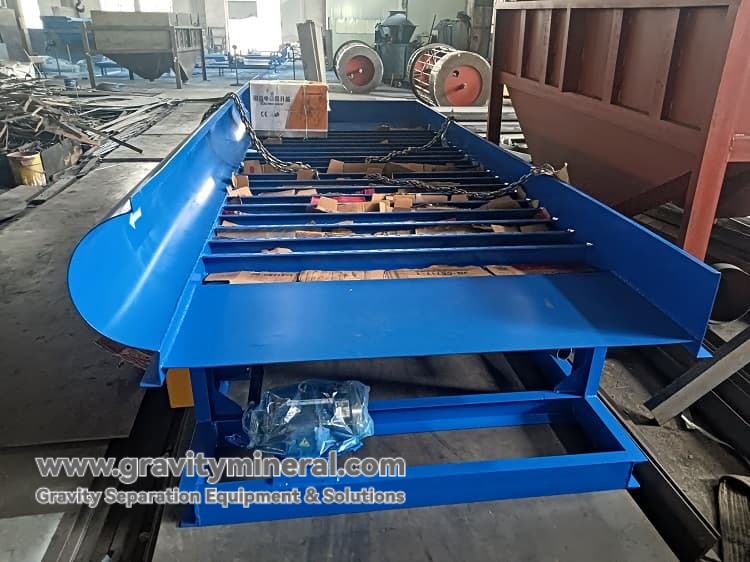
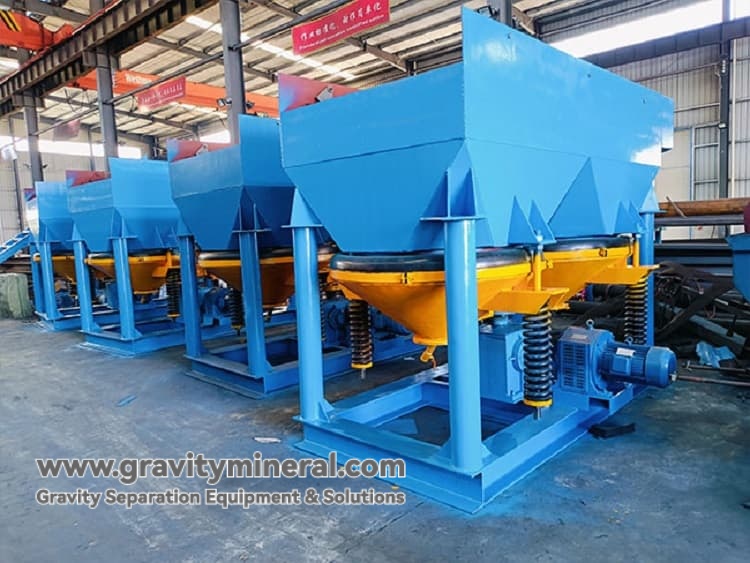
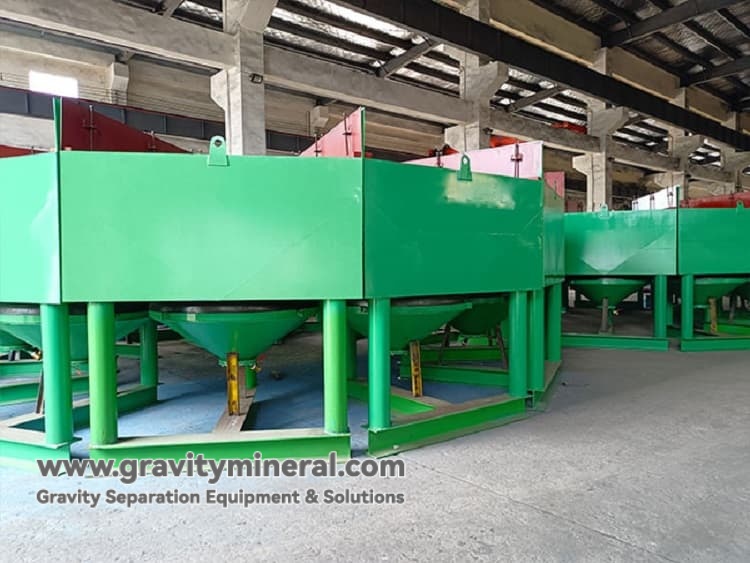
Coarse-grain stage: After crushing and screening, feed the material to a sawtooth-wave jig for roughing. This equipment handles high throughput and adapts well to a wide particle size range, first recovering the coarser gold particles that have been individually liberated. The jig tailings are then sent to the grinding circuit; reversing this sequence is not recommended.
Fine-Grain Stage: A centrifugal separator is integrated into the grinding circuit.Install one centrifuge at the ball mill discharge end to recover coarse-grained gold, and another at the classification overflow to recover fine-grained gold and agglomerates; this two-stage interception provides greater stability than a single-point configuration. Feed concentration and backwash water pressure are the two key parameters for optimal centrifuge performance and must be monitored closely during each shift.
Enrichment Stage: Feed the centrifuge concentrate to the shaking table for enrichment to thoroughly remove gangue and produce qualified gold concentrate. The shaking table processes only concentrate, not raw ore directly—this approach avoids many unnecessary detours.
IV. Tailings Screening: This is where the lower limit for free gold recovery lies
Gold is typically still present in gravity separation tailings; the key is determining the quantity and whether recovery is economically viable.
Centrifuge tailings can be fed into a blanket machine, a vibrating chute, or a second-stage centrifuge for scavenging. This process is low-cost and simple to operate, and it is effective at capturing some ultrafine free gold. Tailings sampling must be conducted regularly; gold grade data determines whether the scavenging stage should be retained, adjusted, or eliminated.
V. Integrated Process: Leave an Interface at the End of Free Gold Gravity Separation
Single-stage gravity separation has its limits. Gold trapped in fine-grained particles or within gold-bearing sulfides cannot be recovered by gravity separation alone and requires flotation or leaching as a backup.
A common approach for gold-bearing rock ores is to perform coarse-grain early recovery via gravity separation first, then feed the gravity tailings to flotation to recover gold from sulfide ores, or to cyanide leaching to recover fine-grain gold. For zircon-ilmenite ores, gravity concentration is followed by magnetic and electrostatic separation for fine-grain separation.Reserving interfaces at the end of the process during design is far less costly than making modifications after construction is complete.
VI. Several Common Equipment Selection Issues
Yes. It\'s common to replace individual units during the retrofitting of older plants or to start small-scale operations with a single-unit configuration. However, before commissioning a single unit, you must confirm that the feed particle size and throughput are compatible with the equipment; otherwise, the interfaces won\'t align.
Not recommended. The selection of gravity separation equipment relies heavily on three parameters: density difference, particle size distribution, and clay content. Without representative ore sample data, equipment selection is essentially a guess. Sending samples for feasibility testing first, then determining the process and equipment, carries significantly less risk.
Allow for adjustment during the design phase: jig stroke and frequency should be adjustable, shaking table inclination should be adjustable, and spiral chutes should be available in models with interchangeable pitch. When fluctuations exceed the acceptable range, respond by adjusting operating parameters or making minor local process adjustments; these limits must be clearly established during the testing phase.
It depends on the ore properties. For ores with a significant density difference and coarser grain sizes, gravity separation has lower costs and less environmental pressure; for fine-grained and complex mixed ores, flotation offers higher separation precision. In most cases, the two processes complement each other—gravity separation handles roughing and tailings disposal, while flotation handles concentration and acts as a safety net. Calculate the overall costs based on test data.
VII. Pitfalls to Avoid: Three Common Stumbling Blocks
If the concentration is too high, the bed becomes compacted, preventing gold particles from entering the concentration trough; if too low, throughput cannot be maximized. Install a concentration monitor and record readings by shift.
Insufficient pressure causes the concentrate bed to compact, resulting in artificially high grades and reduced recovery rates; excessive pressure washes away gold particles. Install a pressure gauge and assign specific personnel to monitor it.
Given the high grade of gold concentrate, losses during stockpiling are often overlooked. Construct covered concentrate storage ponds and maintain clear records of incoming and outgoing shipments.
VIII. Quick Checklist
- Sieve analysis and mineral analysis have been conducted to identify the grain size range where gold particles are concentrated
- Grinding fineness has been determined through testing; flotation specifications have not been blindly adopted
- The jig is positioned before grinding or at the coarse end of the grinding circuit
- Centrifuges are arranged in at least two stages, with records of feed concentration and backwash water pressure
- Shaking tables are used only to process concentrate, not raw ore directly
- Tailings are processed using scavenging equipment, and tailings grades are sampled periodically
- □ The disposition of gravity separation tailings is clearly defined: flotation, leaching, or re-processing
- Concentrate stockpiles are covered and maintained in a ledger
IX. Implementation of Equipment and Processes
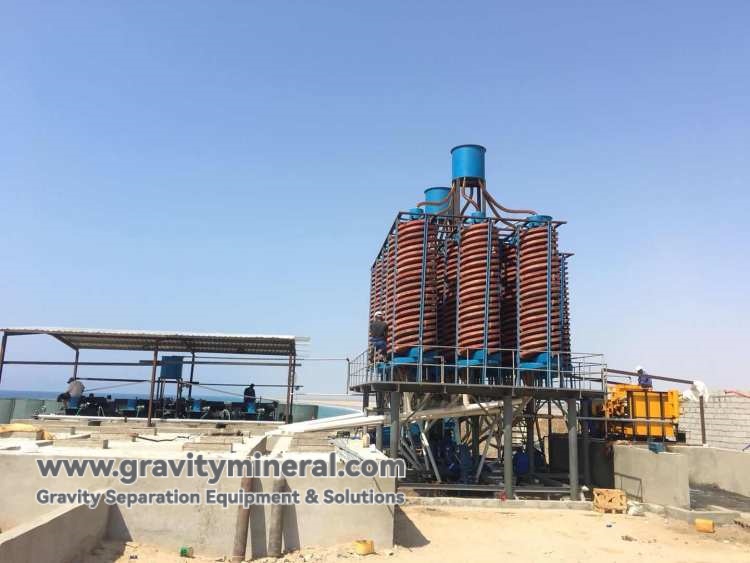
There is no universal template for the parameters of free gold gravity separation. Since ore particle size distribution, gold particle morphology, and clay content vary, the equipment configuration and operating parameters must be adjusted accordingly.The stroke and frequency of a jig are determined based on screening data; the slope of a shaking table is adjusted according to feed particle size; and the backwash water pressure of a centrifuge is set based on feed concentration. If these details are not properly aligned, individual machines will not perform to their full potential.
GravityMineral has specialized in the manufacturing of gravity separation equipment and process design for twenty years. Core equipment—including jigs, shaking tables, spiral chutes, and centrifugal separators—is produced at our in-house manufacturing facilities. Process design and equipment manufacturing are seamlessly integrated within the same team, minimizing interface mismatches.Our engineers can travel to your site to provide on-site guidance for installation and commissioning until the production line is operating stably. For projects currently selecting equipment for free gold gravity separation or seeking to get the equipment and process configured correctly the first time, please submit information on ore samples and feed conditions to receive tailored equipment configuration recommendations.