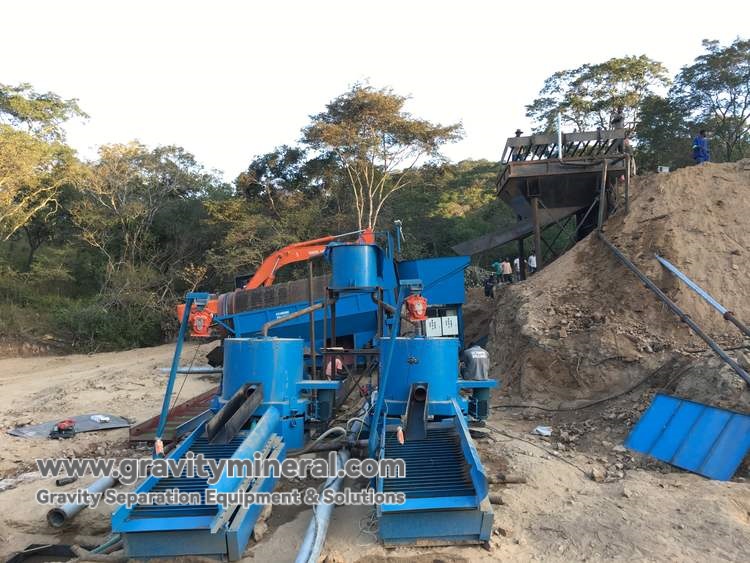
Is your placer gold gravity separation process inefficient? This gravity separation solution boosts recovery rates by 30%.
- The low efficiency of gravity separation for placer gold is not usually due to the jig or centrifuge itself, but rather to inadequate desliming in the front end and improper grain size matching.
- For high-silt-content placer gold deposits, the intensity of the washing and scrubbing process directly determines whether gold particles will be “visible” in subsequent gravity separation.
- Coarse-grained gold is best recovered using a jig, fine-grained gold using a centrifuge, and flake gold using a mat-type sluice box; a three-stage gold recovery process is more reliable than relying on a single piece of equipment.
- Parameters aren\'t set once and forgotten forever; bed condition and feed concentration should be included in daily inspections.
The principle behind placer gold processing is simple: gold is heavier than gangue; with water and gravity, the heavy particles remain while the light ones are washed away.But in the field, even with the same setup of jig and sluice box, some processing plants can still find gold flakes by sifting through their tailings, while others suffer from painfully low gold recovery efficiency, with recovery rates consistently hovering at rock-bottom levels. The gap often lies not in the equipment\'s nameplate specifications, but in the processes preceding the heavy media separation stage.
In many placer gold projects, the equipment list is by no means meager—centrifuges, jigs, and shaking tables are all present—yet performance metrics simply won\'t improve. The owner\'s first instinct is to replace the equipment; after a series of replacements, money has been spent, but the problem remains unsolved. The root cause of low placer gold gravity separation efficiency often lies in the misjudgment of sticky gangue during the pretreatment stage.Jig separation relies on density differences; once gold particles are coated in a mud shell, their effective density becomes nearly indistinguishable from that of the waste rock, rendering the separation conditions invalid from the start.
The core logic of a practical gold sand recovery solution can be summed up in one sentence: First, expose the gold particles cleanly; then, capture them by particle size. If these two steps are executed properly, a 30% increase in gold recovery rate is supported by engineering evidence—not just theoretical calculations.
I. The First Hurdle in Low Placer Gold Recovery Efficiency: Inadequate Desliming
The greatest challenge with gold particles in placer deposits is not their fineness, but rather “gold encased in mud.” In areas with strongly lateritic placer deposits, clay does not disperse when exposed to water; the more it is agitated, the stickier it becomes. Gold particles are trapped within mud clumps, which cannot be stopped by the bars of a sluice box nor separated by centrifugal force.If the tailings water is as murky as rice water, it\'s safe to assume the gold has been lost in the mud.
The core of pretreatment is not screening, but scrubbing and liberation. The cylindrical ore washing and screening machine is responsible for breaking up agglomerated mud clumps and screening out large pieces of waste rock, but relying solely on the water spray inside the cylinder is often insufficient for dealing with kaolinite-type sticky soils.This process should be followed by a spiral washing machine, where the spiral blades repeatedly shear and tumble the slurry to strip away the clay film adhering to the surface of the gold particles. If this step is carried out thoroughly, the gold particles entering the gravity separation process will be “bare,” making subsequent sorting meaningful.
For sand deposits with low clay content, pretreatment can be simplified; a multi-layer vibrating screen can be used to remove coarse particles. However, if a mineral sample feels slippery when rubbed by hand or the water remains cloudy rather than clear after stirring, the scrubbing and de-silting process is essential.The method for determining this is straightforward: take a mineral sample, add water, and stir; let it stand for two minutes. If the water remains cloudy, thorough washing is required. Low efficiency in sand gold gravity separation is often not due to issues in the separation stage, but rather because this crucial step has been neglected.
II. The Core of the Placer Gold Gravity Separation Plan: Segmented, Sequential Processing by Grain Size
Placer gold does not consist of a single grain size. Within the same ore batch, there are coarse-grained gold particles, fine sand-sized flake gold, and ultrafine gold particles visible only under a microscope. Using a jig to capture ultrafine particles is ineffective; using a centrifuge to process coarse-grained feed with high clay content is prone to clogging.A sound gold recovery plan involves dividing the process by grain size, with separate stages for coarse, medium, and fine particles.
| Separation Stages | Core Equipment | Objectives | Key Control Points |
|---|---|---|---|
| Coarse-Grain Retention | Sawtooth Jig | Recovery of coarse-grain gold and free-standing sulfide ores | Stable bed lift, uniform underflow |
| Medium- and Fine-Grain Separation | Agitated Chute | Processes jig tailings to recover flake gold and medium-to-fine-grained particles | Agitation cycle adjusts according to feed particle size to prevent caking |
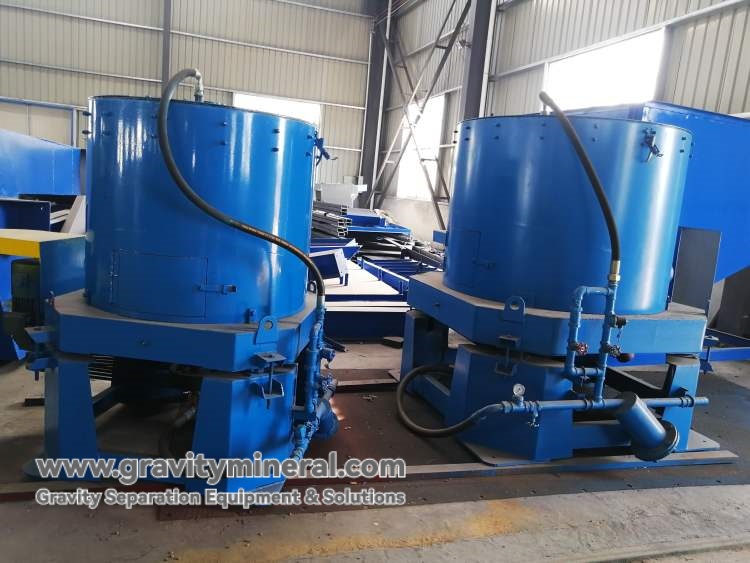
| Fine-Grain Recovery | Centrifugal Mineral Separator | Processes fine-grained free gold | Stable feed concentration; feed is de-slimed before processing |
| Concentrate purification | 6-S Shaking Table | Selection of heavy sand to produce high-grade gold concentrate | Transverse water flow matched to stroke length, resulting in clear zone separation |
The jig is positioned as the first stage, featuring high throughput and a wide feed size range; coarse gold and intergrown particles settle to the bottom in the pulsating water flow, while tailings overflow into the agitating chute.The pulsation curve of the sawtooth-wave jig is more optimal than that of traditional jigs, making it more adaptable to materials with a wide particle size range.The agitating chute incorporates an additional “breathing” motion compared to a flat chute, preventing the bed layer from compacting into a dead zone; flake gold and fine-grained gold are trapped between the felt or slats.The centrifuge is placed at the end of the process to address any oversize, specifically targeting the fine, free-particle gold that was missed in the first two stages. The feed to the centrifuge must have a low clay content; when the slurry viscosity is high, fine gold faces significant resistance to settling and cannot adhere to the drum wall, preventing the centrifugal force from being fully utilized.
The shaking table serves as the final stage, not as the primary roughing equipment. Due to its low processing capacity, feeding the shaking table the full feed rate causes the bed surface to become a uniform, muddied mass, making it impossible to maintain both concentrate grade and recovery rate.A high enrichment ratio is the shaking table\'s strength; its proper role is in fine selection—purifying the coarse concentrate produced by the sluice boxes and jigs. This staged, relay-style sand gold gravity separation scheme is more stable than relying on a single piece of equipment to handle the entire load, and it forms the technical foundation for a 30% increase in sand gold recovery rate.
III. Equipment Configuration Logic: Interface Compatibility Is More Important Than Individual Unit Parameters
There is another often-overlooked reason for low efficiency in placer gold processing: mismatched interfaces between equipment. If the throughput of the jig does not match that of the chute, the intermediate stage will either experience material blockages or run idle; if the discharge particle size from the washing section does not match the jig\'s feed requirements, the bed condition will remain unadjustable no matter how it is fine-tuned.No matter how impressive the specifications of individual units may be, if they conflict when integrated, the overall line performance will still fail to improve.
| Key Points | Key Points for Equipment Configuration | Interconnection Requirements with Upstream and Downstream Processes |
|---|---|---|
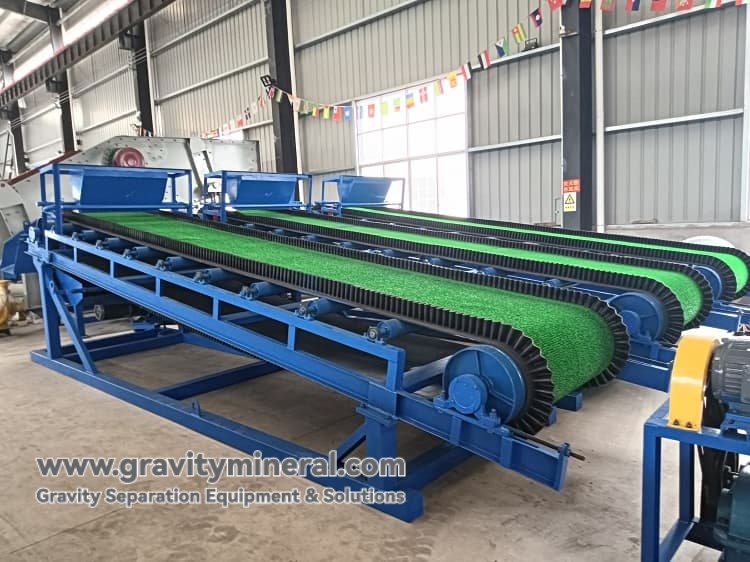
| Feeding | Trough-type feeders are suitable for sticky, wet ore | Ensure uniform feeding to prevent sudden fluctuations in feed rate from disrupting the bed layer |
| Ore Washing and Screening | Combination of a cylindrical ore washer and a spiral ore washer | Undersize particle size matches the maximum feed size for gravity separation equipment |
| Rough Selection | Sawtooth-wave jig | Tailings overflow particle size compatible with chute recovery range |
| Sweep Selection | Agitated Chute | Aligning concentrate yield with shaking table processing capacity |
| Recovery | Centrifugal concentrator | Desliming prior to feeding; maintain concentration within a stable range |
| Enrichment | 6-S shaking table | Match the feed grade to the bed\'s zone separation capacity |
Equipment selection should be based on ore sample data, not the nominal processing capacity listed in equipment catalogs. Without a clear understanding of these three parameters—silt content, gold particle size distribution, and feed rate—any equipment selection is arbitrary.Gravity separation is extremely sensitive to particle size matching; mixing coarse and fine particles often results in poor performance across the board. To successfully implement a placer gold gravity separation plan, aligning the production capacities of equipment and ensuring smooth particle size transitions between units requires more attention than simply selecting individual machines.
IV. Parameter Management: Ensuring Daily Efficiency in Placer Gold Gravity Separation
On the day of equipment commissioning, the parameters are set, and the metrics look promising. But after running for a while, the metrics drop. The first reaction is often to blame equipment wear, but in reality, it is more often due to changes in feed conditions that have not been reflected in the parameters. A portion of the inefficiency in placer gold gravity separation is lost in these gaps in daily management.
For jigging machines, observe the bed layer. During normal operation, the bed layer should rise uniformly, with a clear suction action during the descent phase.If the bed layer remains rigid and motionless, check the stroke or bottom water level; if the bed layer churns too violently, the stroke or bottom water level is likely too high; if slurry accumulates on the bed surface without moving, check the feed rate. These assessments do not require instruments—simply standing beside the equipment and observing the bed layer\'s condition provides a general idea.
For centrifuges, observe the concentrate yield and tailings. If the concentrate yield suddenly decreases, check the rotational speed first; if fine-grain gold is visible in the tailings, check the feed concentration and desliming efficiency.For agitating chutes, adjust the agitation interval according to the feed particle size distribution. When the proportion of fine particles is high, shorten the cycle to keep the bed layer loose, allowing fine gold to sink downward.
During shift handoffs, do not simply report that “equipment is normal”; clearly communicate the current feed characteristics, bed condition, and bottom water valve opening. Parameter management is a critical factor in ensuring the long-term stability of performance indicators in a placer gold gravity separation process, and it is also key to maintaining recovery rates after they have been increased by 30%.