







How to Choose Gravitational Separation Equipment for Alluvial Gold Mines? Practical Solutions for High Recovery Rates and Low Operating Costs
Choosing the right gravity separation equipment for alluvial gold mining essentially involves striking a balance between “what can be recovered” and “what you can afford to spend.” A recovery rate that\'s just a few percentage points lower could mean half a month of work at the site goes to waste; if the equipment selection is off, electricity and labor costs can eat up a significant portion of the profits.Many placer gold processing lines appear fully equipped—with chutes, jigs, and shaking tables all in place—yet the gold grade in the tailings remains unacceptably high. The problem often lies in misalignment: the equipment isn\'t organized by particle size, and the process isn\'t designed according to the ore\'s characteristics.Below, we\'ll break down the logic behind selecting heavy-media separation equipment for placer gold mines—along with the cost analysis—based on the ore\'s characteristics.
- The gold in placer gold is already free-standing and does not require grinding; gravity separation is the naturally suitable processing route, and the scenarios where flotation is appropriate are very limited.
- No single piece of equipment can handle all particle sizes. Coarse-grained gold is processed using jigging machines or sluices; fine-grained gold is processed using centrifugal separators; and concentrate recovery relies on shaking tables. Classification and sorting are the key to ensuring high recovery rates.
- Jigging machines are a relatively stable choice for the roughing stage, offering high throughput and a wide feed size range; however, recovery of fine-grained gold requires supplementary centrifugal separators or chute scavenging in the downstream process.
- Chutes are low-cost but have limited net recovery rates in fixed configurations; vibrating chutes structurally address the issue of material caking, resulting in significantly improved net recovery performance.
- The operating costs of a gravity separation line consist primarily of electricity, labor, and wear parts; chemical costs are zero. The cost per metric ton of ore is generally low, though specific figures vary significantly depending on scale, ore characteristics, and region.
Assessing Ore Characteristics: Why Alluvial Gold Is Best Processed by Gravity Separation
The biggest difference between placer gold and vein gold lies in the degree of liberation. After being transported, eroded, and deposited by rivers, the gold particles have long since separated from the gangue, with particle sizes ranging from a few millimeters to tens of micrometers, but primarily in a free state. This means there is no need for a ball mill, a chemical agitation tank, or a flotation machine.The process—washing, screening, and density separation—follows a clear main workflow.
While flotation is technically feasible for placer gold, it is generally not economically viable. A flotation line requires a grinding mill, flotation cells, a dosing system, and thickening and filtration equipment; both the capital investment and the processing cost per metric ton of ore are significantly higher than those of gravity separation.The grade of placer gold is typically low, and profit margins are limited; when reagent costs and electricity expenses are factored in, it is difficult to break even. Unless the ore contains an extremely high proportion of fine-grained gold—and the gold is encapsulated by sulfides requiring liberation—gravity separation is the preferred method. This is also the fundamental premise for selecting gravity separation equipment for placer gold mines.
Equipment Division of Labor: Configure by Particle Size to Avoid Relying on a Single Machine to Handle Everything
Although there are not many types of gravity separation equipment for placer gold mines, each type has a different range of applicability. If the wrong equipment is selected, it is not that the equipment itself is unsuitable, but rather that it is being used in the wrong processing stage.
Jigging machines perform consistently in the roughing stage. They accommodate a wide range of feed particle sizes, handle high throughput, discharge material continuously, and are relatively easy to operate. The pulsation curve of a sawtooth-wave jigging machine creates a rapid upward water flow and a slow downward flow, giving gold particles ample time to settle to the bottom of the bed.However, jigging machines have limited capacity to capture ultrafine gold particles, and the loss of fine gold in tailings is a common occurrence, requiring the installation of scavenging equipment downstream.
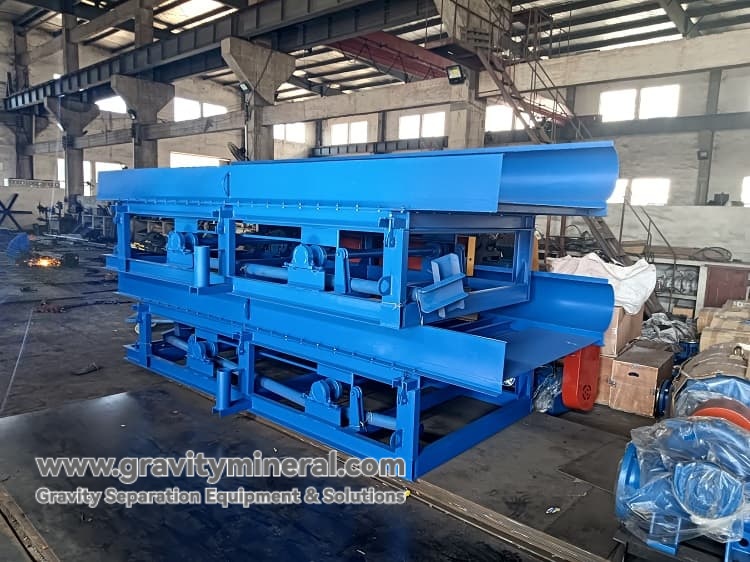
Agitated sluices deserve special mention. They are an improvement over fixed sluices, featuring a rubber bottom plate that is agitated up and down by an eccentric mechanism, thereby alleviating the caking problem associated with fixed sluices.Once slurry caking occurs in a fixed chute, gold particles struggle to settle, limiting the efficiency of the cleaning process; the vibrating chute maintains a loose bed layer through continuous vibration, significantly improving cleaning performance. It features low energy consumption, with drive motor power typically within a few kilowatts, making it suitable as a supplement to the roughing or scavenging stages.
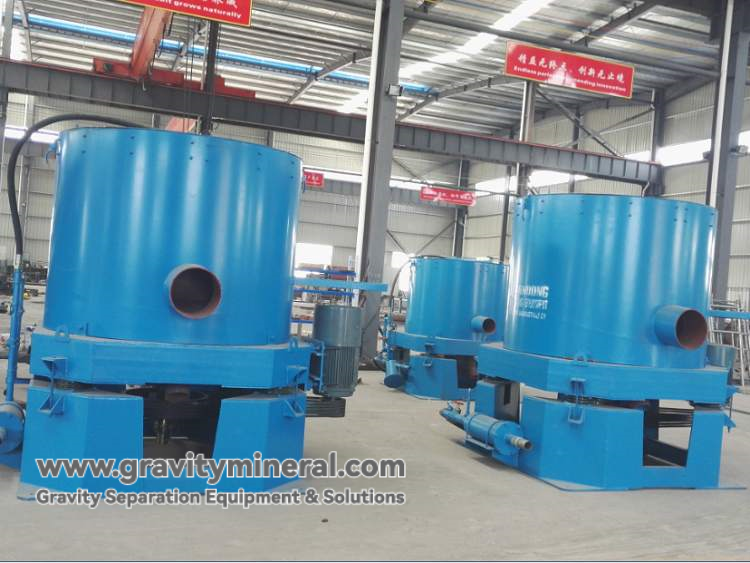
Centrifugal separators play a crucial role in the recovery of fine-grain gold. Water-jacketed centrifuges generate an enhanced gravitational field during high-speed rotation, amplifying the settling velocity of fine gold particles, while backwash water continuously flushes the ore bed through the water jacket to prevent caking.Fine-grain recovery performs well under laboratory conditions; however, on-site performance may fluctuate due to feed concentration, particle size distribution, and operating parameters. Nevertheless, as a fine-grain scavenging device, it offers a competitive enrichment ratio. With a relatively low processing capacity, it is best suited for placement at the end of the processing flow.
Shaking tables are designed for fine selection. They offer a high enrichment ratio and can directly produce high-grade concentrate; however, due to their low throughput and large footprint, they are not suitable for processing raw ore.The rough concentrate produced during roughing is often mixed with heavy minerals such as magnetite, ilmenite, and zircon. The shaking table relies on asymmetric reciprocating motion and a thin layer of water flow to separate minerals by density, resulting in a significant improvement in concentrate grade.Shaking tables serve as the final purification equipment in a placer gold processing line, but upstream equipment must be in place to perform roughing and enrichment.
Spiral chutes have limited application in gold panning operations. They require no electricity, have a high processing capacity, and are low-cost; however, their separation precision is limited. They are suitable for the preliminary enrichment of low-grade material, though their recovery efficiency for fine particles is generally poor. When raw ore has a high clay content or contains very fine gold particles, spiral chutes are typically not the first choice.
| Equipment | Core Positioning | Applicable Particle Size Range | Key Features | Selection Considerations |
|---|---|---|---|---|
| Jig | Mainstay for Rough Concentration | Wide particle size range, primarily coarse and medium-sized particles | High throughput, continuous discharge, and stable recovery performance | Fine-grained tailings require subsequent scavenging |
| Agitated Chute | Roughing/Sweep Selection | Medium- and fine-grain | Pulsating action prevents caking, improves cleaning efficiency, and reduces energy consumption | Significant advantages when clay content is high |
| Centrifugal Mineral Separator | Fine-Grain Sweeping | Ultrafine particles | Enhanced gravitational field, high enrichment ratio | Low throughput; suitable for final processing |
| Shaking Table | Selection and Purification | Fine-grained | High enrichment ratio, with a significant increase in concentrate grade | Does not process raw ore; only accepts coarse concentrate |
| Spiral Chute | Roughing/Pre-concentration | Medium- and fine-grained | Zero energy consumption, high throughput | Limited accuracy; high loss of fine particles |
Process Flow: Grading and Sorting—Letting Each Piece of Equipment Do What It Does Best
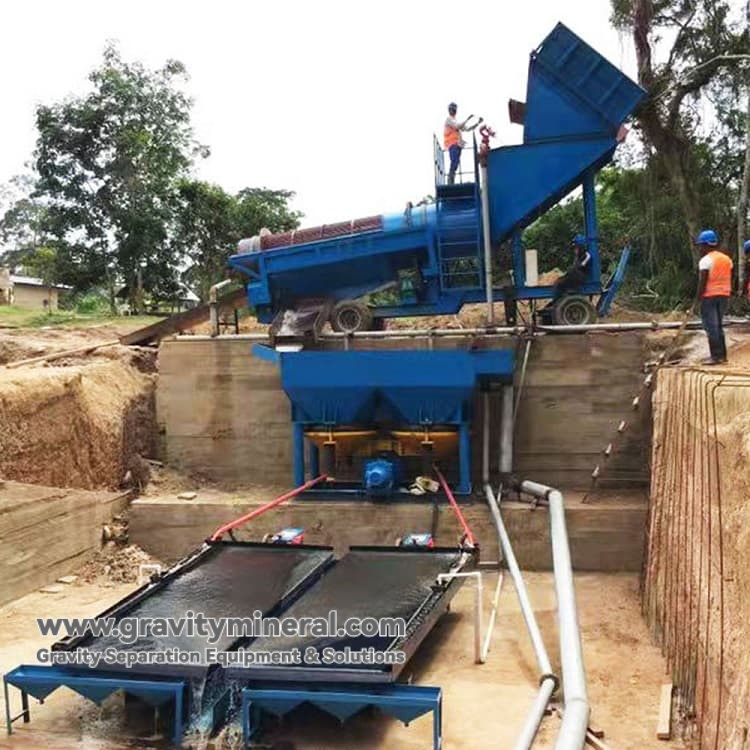
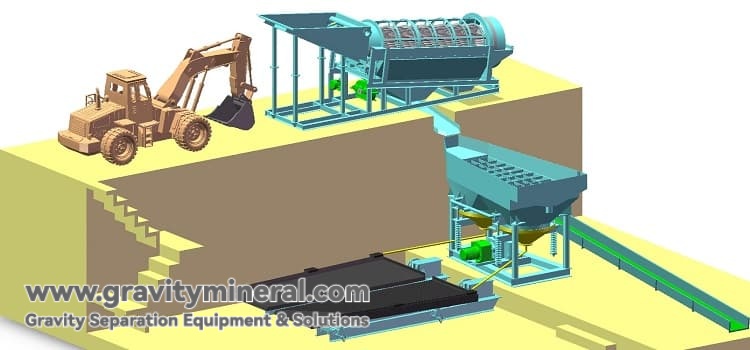
The ore first enters the washing stage. In placer gold deposits with high clay content, gold particles are coated in clay; incomplete washing will directly affect subsequent separation. A trommel washer or vibrating washing screen breaks up the clay while simultaneously screening out large pieces of waste rock, creating suitable feed conditions for subsequent gravity separation.
The screened material is divided into two or more streams based on particle size. The coarse fraction enters a jig or agitated chute for rapid tailings removal, yielding a coarse concentrate. The fine fraction enters a centrifugal separator to recover fine gold lost in the jig tailings.The tailings from the centrifugal concentrator then undergo final scavenging through a flat chute or a gold-trapping chute to retain ultrafine gold particles.
The coarse concentrate is combined and fed into shaking tables. Although the feed rate to the shaking tables is relatively low, the concentrate grade increases rapidly. Depending on the nature of the associated minerals, a decision is made whether to use magnetic separation or electrostatic separation to further purify the shaking table concentrate.
The overall recovery rate of this process is influenced by ore characteristics, particle size distribution, and operational proficiency; it varies significantly across different projects and cannot be summarized by a single figure. Reasonable expectations should be based on beneficiation tests and comparisons with similar cases.When selecting gravity separation equipment for placer gold mines, the ultimate consideration comes down to this process: whether the placement of each piece of equipment, its feed conditions, and its production capacity are appropriately matched.
Operating Costs: The advantage of gravity separation lies not in purchasing equipment, but in using it
Equipment investment is a one-time expense, while operating costs are ongoing.
Power consumption in a gravity separation line is concentrated in the drive motors for pumps, jigs, and centrifugal separators. The installed power of shaking tables and their associated pumps is limited, and chute-type equipment consumes virtually no electricity. Chemical costs are zero.In terms of labor, the number of on-site personnel is small, and the training period is short. Maintenance primarily focuses on chute linings, the wear-resistant layers of shaking table surfaces, and pump wear parts.
Operating costs per metric ton of ore are influenced by processing scale, electricity rates, labor costs, and the clay content of the ore, resulting in significant variations between projects.Overall, the operating cost structure of a gravity separation line is simple and highly controllable, with no additional expenses associated with reagent procurement or complex process management. Compared to the flotation route, gravity separation offers a distinct cost advantage in placer gold scenarios; the additional investment in flotation typically centers on grinding, reagents, and process management—all of which are unnecessary for placer gold processing.
Common Technical Issues
Support Beyond the Equipment: Design and Commissioning Equally Impact Recovery Rates
Selecting gravity separation equipment for placer gold mines involves more than just choosing machines. Details such as how many shaking tables are connected downstream of a jig, how to control the feed concentration for centrifugal separators, and what slope to set for the chutes—these details determine whether the equipment can operate in coordination.When equipment from different manufacturers is pieced together, interfaces and production capacities may not align, and it becomes difficult to assign responsibility when performance falls short of standards.
When selecting heavy media separation equipment for placer gold mines, the key factor ultimately comes down to the ore itself. Three key parameters—particle size distribution, clay content, and gold particle morphology—determine the equipment configuration and process flow. Submitting data from representative ore samples to our engineers, combined with comparisons against our database of over 500 global case studies, provides a more reliable basis for equipment selection than relying solely on sample catalogs.For further information on the configuration of placer gold gravity separation equipment and process flows, please submit your ore data to receive a customized solution.