







How to Choose Equipment for Reclaiming and Re-processing Tailings? High-Efficiency Recovery Solutions to Help You Boost Profits
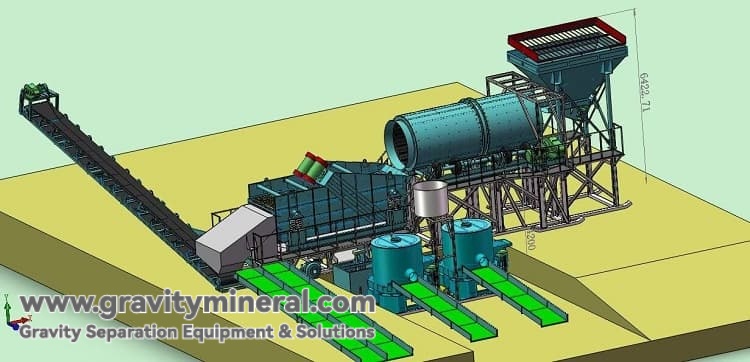
When selecting equipment for the washing and gravity separation of residual gold, the key lies not in the specifications of any single piece of equipment, but in whether the equipment used in the five stages—washing, screening, roughing, scavenging, and concentrating—can work together effectively.The following discussion explores five key areas—manifestations and causes of recovery loss in residual gold gravity separation, equipment configuration, implementation steps, and performance limits—to provide a reference framework for selecting equipment for residual gold washing and gravity separation.
I. Typical Manifestations of Recovery Rate Loss in Residual Gold Re-selection
Abnormal recovery rates at residual gold processing plants are typically indicated by several identifiable on-site signs. If the material on the screen remains clumped together when squeezed in the hand and released, it indicates insufficient fragmentation capacity in the ore washing section.After several hours of operation, chutes and grids become caked, with the heavy sand layer compacted, preventing light minerals from escaping through the openings. Fine-grained gold is carried into the tailings along with the surface water flow. The tailings water appears visibly turbid to the naked eye, and fine sand settles at the bottom after standing, indicating that ultrafine gold particles have not been effectively captured.
There is another situation that is easily overlooked: while coarse-grain gold recovery is acceptable and visible gold is present in the concentrate, the tailings grade remains consistently high. The problem often lies not with the roughing equipment itself, but with the lack of a dedicated recovery pathway for fine-grain material.In residual ore, coarse-grained and fine-grained gold coexist. A single chute or jig cannot simultaneously meet the settling conditions for both grain sizes; while coarse grains are retained, fine grains escape. This is precisely the direct reason why gravity separation equipment for residual gold ore processing must be configured in stages.
II. Root Cause: Mismatched Configuration of the Ore Washing and Classification Stages
The root cause of unsatisfactory re-selection results for residual gold can mostly be traced back to two stages.
Functional deficiencies or insufficient intensity in the ore washing stage. The clay in residual ore is not merely an excess of mud but possesses cementing properties.During the weathering process, clay minerals and quartz fragments form mud clumps that may encapsulate gold particles. If a trommel washer is not equipped with a water spray system capable of generating sufficient pressure, or if a scrubber is not added downstream, these mud clumps cannot be sufficiently broken up.When the slurry enters the gravity separation equipment with excessive viscosity, it disrupts density stratification and slows down the settling rate of heavy minerals. The ore washing stage is the first critical step in the residual gold processing and gravity separation system; if this stage fails, even the most sophisticated downstream equipment will yield poor results.
The feed size has not been classified. Residual gold particles range continuously from several millimeters to a few tenths of a millimeter. Coarse gold particles require a stable bed layer and sufficient settling time, while fine gold particles require an enhanced centrifugal field. Feeding both into the same unit inevitably results in operating parameters that compromise one aspect at the expense of the other.If the jig stroke is increased, recovery of fine particles deteriorates; if it is decreased, the bed for coarse particles becomes too loose. The purpose of screening and classification is to break down material with a wide particle size distribution into narrower particle size ranges suitable for processing by different equipment—a step that is most often overlooked in the design of residual gold re-selection schemes.
III. Stage-by-Stage Configuration Plan for Residual Gold Washing and Re-selection Equipment
Ore Washing and Desliming Section: Trommel washer with high-pressure water spraying, supplemented by a scrubber if necessary
For residual ore with high clay content, the drum washer is the standard configuration. The rotating drum, combined with built-in high-pressure water jets, breaks up agglomerated clay clumps and thoroughly washes away clay adhering to the surface of the gravel.Trommel washers are effective for difficult-to-wash materials, provided that the water pressure and flow rate are matched to the processing capacity; insufficient water pressure renders the washing section ineffective.
For ore sections where the clay content approaches the upper limit, or where clay minerals are predominantly montmorillonite—which swells significantly when exposed to water—a scrubber should be added after the drum washer.In a scrubber, high-concentration slurry removes the clay film from the surface of gold particles through friction between the materials; this method is more effective than simply increasing the washing time. Whether to install a scrubber depends on the rate at which mud clumps disintegrate during ore sample soaking tests; it cannot be determined solely based on experience.
Screening and Classification Section: A double-deck vibrating screen with mesh sizes determined by the gold particle size distribution
The washed ore enters a double-deck vibrating screen. The upper screen mesh size is set based on the size of the waste rock, typically 10 to 30 millimeters; large gravel particles on the upper deck are directly discarded, reducing the load on subsequent processing stages.The lower screen mesh size is a critical parameter that must be determined based on the results of the ore sample screening analysis; the common range is 2 to 6 millimeters. The oversize and undersize fractions are directed to different roughing equipment, enabling separate processing of coarse and fine particles. If the screen mesh size is set incorrectly, adjustments to the parameters of subsequent residual gold re-selection equipment will lack a reference point.
Coarse-Grain Pre-concentration Section: Combination of Jig and Agitated Chute
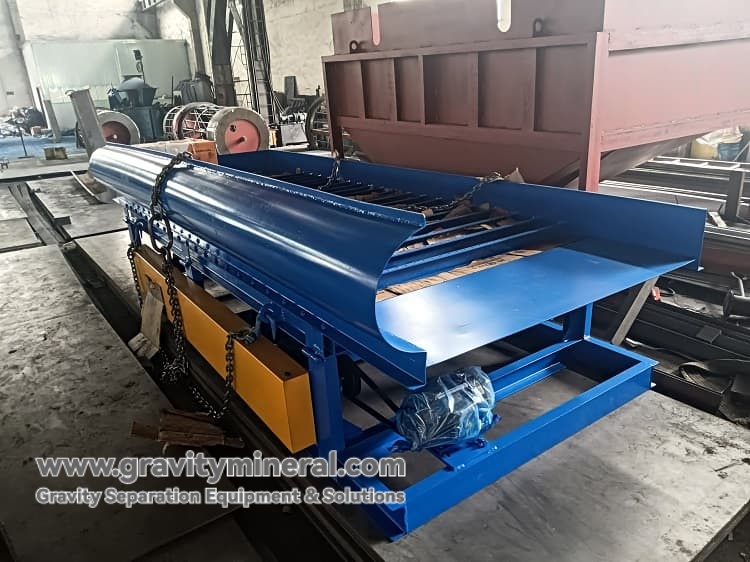
The oversize coarse-grain material from the screen enters the jig. The pulsation curve of a sawtooth-wave jig is well-suited for wide-grained materials; it allows for a loose bed with controllable rhythms, making it suitable for processing coarser-grained gold.The matching of stroke length and frequency must be adjusted based on the actual bed conditions, with the goal of achieving a distinct concentrate zone and no visible gold in the tailings.
The jig tailings enter the agitating chute for scavenging. The core improvements of the agitating chute lie in its rubber bottom plate and eccentric agitation mechanism; the up-and-down reciprocating motion of the bottom plate keeps the sediment layer consistently loose, resolving the inherent problem of bed compaction found in fixed chutes.For medium- and fine-grained gold in residual ore that the jig failed to fully recover, the agitating chute provides a second stage of interception. The combination of the agitating chute and the jig is a reliable configuration for the coarse-grain section of re-selection equipment used in the processing of residual gold ore.
Fine-Grain Scavenging Stage: Centrifugal Separator for Micro-Fine Particles
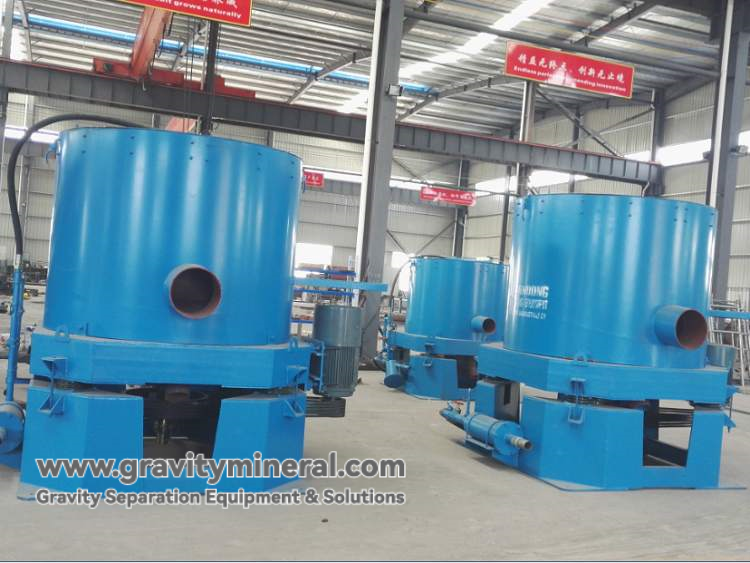
The undersize fine-grain material and the ultrafine-grain fraction from the agitated chute tailings are fed into the centrifugal separator. The centrifugal separator utilizes the centrifugal force field generated by the high-speed rotation of the drum to fling ultrafine-grain gold particles against the drum wall for enrichment. The coordination of rotational speed and backwash water flow is a key operational consideration:If the rotational speed is too low, fine particles cannot be retained; if it is too high, the concentrate grade decreases. Before feeding the ore, ensure thorough desliming, as residual clay in the slurry can coat gold particles, weakening the direct effect of centrifugal force on them. The centrifugal ore separator is an indispensable component of the fine-grain stage in residual gold re-selection schemes.
Concentrate Purification Stage: Shaking Table Enrichment
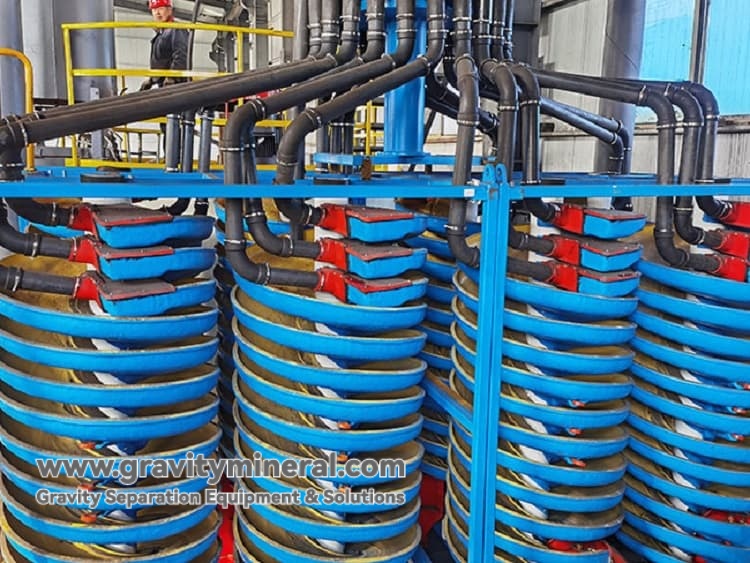
The coarse concentrates produced by the jig, agitated chute, and centrifugal separator are combined and fed into the shaking table for fine selection.The 6-S shaking table utilizes the asymmetrical reciprocating motion of the bed surface in conjunction with lateral flushing water to cause heavy minerals to segregate into fan-shaped zones based on density. The boundaries between the concentrate, middlings, and tailings zones are clearly defined, facilitating collection by operators.The upper limit of feed particle size for shaking tables is typically quite fine; coarse concentrate must first undergo grinding or screening to achieve the appropriate particle size before being fed into the process. Shaking table concentration determines the final concentrate grade and serves as the final stage in the residual gold beneficiation equipment chain.
IV. Key Steps for Implementing the Plan
Step 1: Screen and analyze ore samples first. Before selecting equipment, screen and analyze representative ore samples to determine the yield and gold grade distribution across each particle size fraction. The specific particle size fraction where gold particles are concentrated and the fraction with the highest loss directly determine the initial settings for screen mesh size, jig stroke, and centrifuge speed.Equipment selection for residual gold washing and re-selection without particle size data lacks a solid basis.
Step 2: Separate commissioning of the ore washing section. After installing the ore washing equipment, do not proceed with gravity separation immediately. Instead, run the system independently to adjust the water spray pressure and drum speed until the oversize material can break apart after being compacted, and the undersize slurry contains no noticeable clumps of mud. If the ore washing section is connected to the subsequent process before being properly adjusted, the commissioning parameters for the gravity separation equipment will lose their reference baseline.
Step 3: Coordinated operation of the roughing and scavenging stages. First, adjust the jig to achieve a loose bed layer and a stable concentrate zone, then connect it to the agitated chute. Coordinate the agitation frequency of the agitated chute with the feed concentration, and observe whether any visible gold particles remain in the tailings.Connect the centrifugal separator after the roughing stage has stabilized. Gradually adjust the backwash water pressure from low to high, finding the balance where concentrate discharge is smooth and no significant gold loss is observed in the tailings.
Step 4: Parameter Finalization and Shift Handover. Once equipment in each section is operating stably, compile the screen mesh size, jig stroke and frequency, agitation frequency, centrifuge speed and backwash pressure, as well as the shaking table incline and rinse water volume into an operating sheet.Since the properties of residual ore fluctuate, the operating cards provide baseline parameters; shift personnel make fine adjustments based on these parameters in response to changes in the feed material. The finalization of parameters marks the transition of the residual gold re-concentration process from commissioning to stable operation.
V. Expected Results and Applicability Limits
The combined gravity separation process—involving ore washing, desliming, and classification—for treating residual gold ore yields significantly improved recovery rates compared to single-chute or single-jig operations when ore properties fall within a reasonable range.The extent of improvement depends on the clay content of the raw ore, the particle size distribution of gold, and the precision of operation; variations exist between different ore sections, making it difficult to generalize with a single numerical value. The reduction in tailings grade is similarly limited by the natural distribution of gold within the ore itself.The value of re-mineralization equipment for residual gold lies in recovering as much of the recoverable grain size fraction as possible, rather than promising an absolute recovery rate that is detached from the actual ore conditions.
The applicable limits must be clearly defined. For ore bodies with excessively high clay content—beyond the crushing and dispersing capacity of the ore washing equipment—or where the vast majority of gold particles are distributed in an extremely fine-grained disseminated type, the recovery efficiency of a simple gravity separation process reaches a ceiling. For such ores, consideration should be given to submitting the tailings to flotation or leaching processes for deep recovery after gravity roughing and tailings disposal.The selection of gravity separation equipment for residual gold ore is essentially a matter of finding the right balance between thorough cleaning and clear separation based on the ore\'s clay content and particle size distribution. Conducting screening and analysis first, then determining the process flow, offers greater control than purchasing equipment and then testing it on the ore.
Appendix: Key Self-Check Points for Selecting Residual Gold Washing and Gravity Separation Equipment
- If mud clumps remain intact when the oversize material is squeezed, this indicates that the washing section requires additional high-pressure water spraying or the installation of a scrubber
- If chutes or agitated chutes become compacted after only a few hours of use, check the fine silt content in the feed; implement pre-de-silting or adjust the washing parameters
- If fine sand settles and exhibits a visible luster after the tailings water is allowed to stand, this indicates a lack of fine-grain recovery; a centrifugal separator must be added
- If only coarse-grained gold is present in the concentrate and the tailings grade is abnormally high, this indicates that screening and classification are inadequate; parameters for coarse and fine particle separation must be reset
- Recovery rates fluctuate significantly across different mining areas, indicating substantial variations in clay content and particle size among different ore sections; the adjustment range of the residual gold re-concentration equipment must cover this fluctuation range
Ultimately, selecting the appropriate equipment for the re-selection of residual gold involves an accurate assessment of the ore\'s properties combined with a reasonable segmentation of equipment functions. The ore washing stage addresses the issue of clay; the screening stage addresses particle size; the roughing and scavenging stages address recovery; and the concentrating stage addresses grade.Only when each of these four issues has a corresponding equipment solution can the residual gold re-concentration plan be considered complete.