







How to Choose a Gravitational Separation Method for Exogenous Gold? An Analysis of High-Efficiency Recovery and Gravitational Separation Solutions for Exogenous Gold
When selecting a gravity separation process for exogenous gold, the answer lies not in the equipment quotation but in the ore itself. Even with the same gravity separation process, some operations achieve ideal results, while others fail to meet both concentrate grade and recovery rate targets. The difference often stems from the interplay between three factors: grinding fineness, equipment selection, and process placement.The core of a gravimetric separation plan for exogenic gold is to thoroughly understand the liberation limits of gold particles and then integrate the separation equipment into the correct stage of the process.
Core Logic: Three Main Pillars of Exogenous Gold Gravity Separation Solutions
The distinction between exogenous gold and primary gold-in-vein is that exogenous gold has already been liberated from the gangue or is embedded along the edges of sulfides and within fissures; its particle size is typically coarser than that of gold-in-vein.Gravity separation relies on density differences—gold has a density of approximately 19.3, while common gangue minerals range from 2.5 to 3.5, resulting in a density difference of more than six times. As long as the gold particles have been fully liberated and their particle size falls within the recoverable range for gravity separation, gravity separation can effectively capture them.
The challenge with exogenic gold lies in its particle size distribution, which often straddles the range between coarse, free-standing gold and fine, intergrown gold.Some particles can be recovered using a jig, some require a centrifuge to enhance the gravitational field, and others may have already been ground into fine slime. Therefore, determining the optimal gravity separation strategy for exogenic gold essentially involves balancing three variables: grinding fineness determines the degree of liberation, equipment selection determines the lower recovery limit, and the position in the process determines whether over-grinding and loss occur.
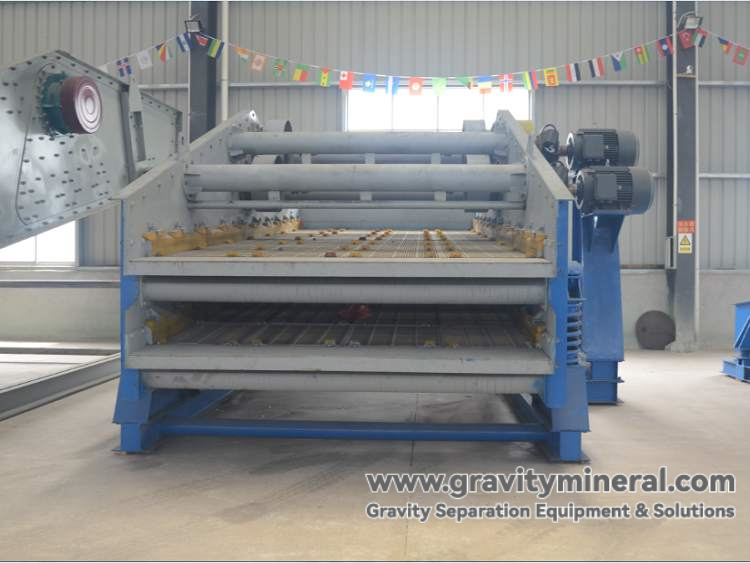
Mineralogical analysis is the first step in developing a gravity separation plan for exogenous gold
What to do: Perform sieve analysis on representative ore samples, focusing on the distribution of gold across various particle size fractions, particularly the gold content in the +0.074 mm fraction. Combined with microscopic identification or MLA analysis, determine whether exogenous gold exists as free particles, aggregates, or inclusions, as well as the types of associated minerals.
Why It Matters: Equipment selection for exogenic gold gravity separation schemes relies heavily on three parameters: density difference, particle size distribution, and clay content. Selecting equipment without mineralogical data results in an insufficient basis for decision-making. Ore with a high degree of single-particle liberation has a higher maximum recovery rate; ore with a high proportion of agglomerates requires provisions for integration with other processing stages.
Common Mistakes: Skipping mineralogical analysis and proceeding directly to equipment quotes. Without a clear understanding of the ore\'s properties, the equipment will struggle to perform at its designed capacity once it arrives on-site.
Grinding fineness determines whether exogenic gold can be recovered through gravity separation
Operational Guidelines: The grinding fineness for exogenic gold gravity separation is typically controlled within the range of 65% to 75% of particles smaller than -0.074 mm.This range may be appropriately relaxed when gold particles are coarsely disseminated, or moderately increased when exogenous gold is tightly associated with sulfides. The principle is “liberation without sludging,” to avoid over-grinding that produces secondary sludge encapsulating gold particles.
Why It Matters: Gravity separation relies on the sedimentation response of gold particles in a fluid. If the particle size is too fine, slime interferes with the sedimentation process, and the separation efficiency of the centrifugal separator also decreases. Industry experience shows that gravity separation is extremely sensitive to particle size distribution; mixing coarse and fine particles significantly reduces separation efficiency, and the stability of the classification process directly affects gravity separation performance.
Common Mistake: Blindly adopting the grinding fineness used in flotation. Flotation emphasizes surface freshness, while gravity separation emphasizes particle integrity; the two approaches cannot be interchanged.
The selection of roughing equipment must match the size range of exogenic gold particles
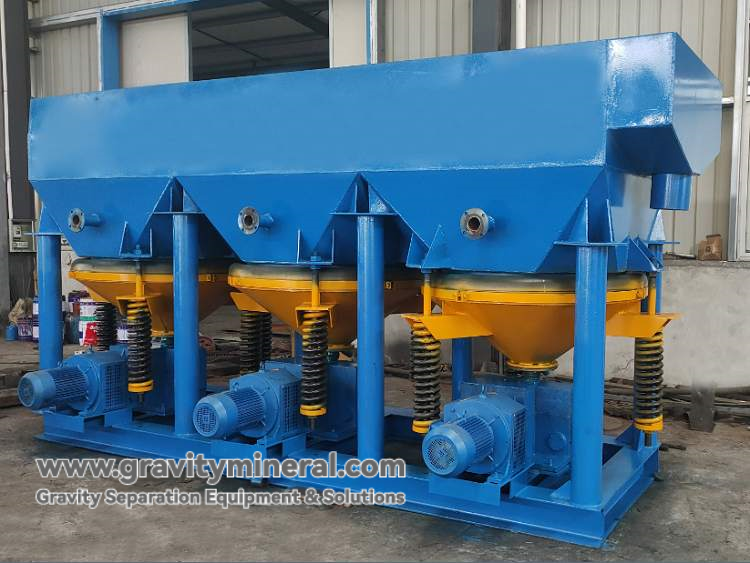
Equipment Configuration Approach: When the size range of exogenic gold falls between 0.01 mm and 0.5 mm, a centrifugal concentrator is suitable as the core equipment for roughing, with the gravity multiple typically set between 60 and 90 G and the feed concentration controlled within a reasonable range.When gold particles are relatively coarse and the proportion of particles greater than 0.5 mm is high, a jig can be installed at the front end for coarse-grain scavenging, with the jig concentrate then fed into a centrifuge or shaking table for fine selection.
Why It Matters: Jigging machines have a high throughput for coarse-grained material but limited recovery capacity for the -0.074 mm size fraction, where exogenous gold is commonly found.Centrifugal concentrators enhance the recovery of fine-grained heavy minerals by intensifying the gravitational field. Shaking tables are designed for fine concentration and have limited throughput; it is not economical to process feed material across all particle sizes directly with them.
Common Misconception: Using shaking tables for roughing. While shaking tables excel at recovering fine particles, their throughput and feed size range make them unsuitable as the primary roughing equipment.
The process location determines whether exogenous gold is recovered or lost
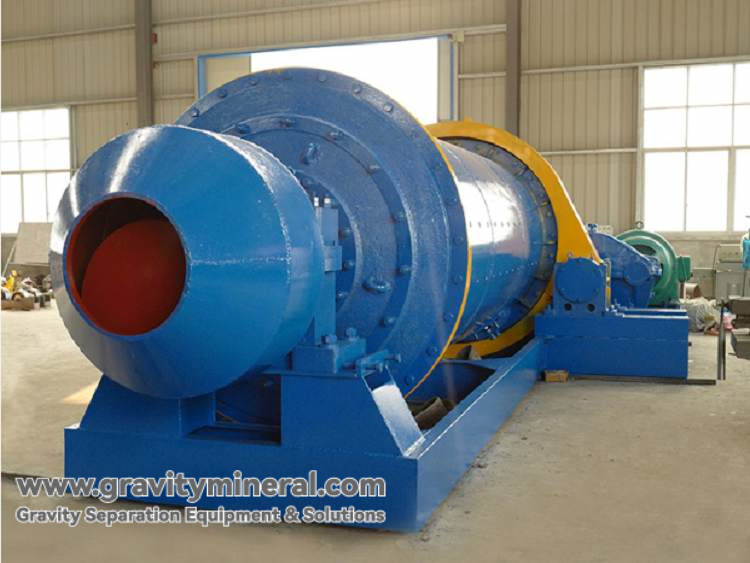
Process Design: Embed gravity separation equipment between the mill discharge and the classification equipment to form a closed-circuit process: “grinding—gravity separation—classification—return sand regrinding—gravity separation.”The mill discharge first undergoes gravity separation to recover already liberated gold particles; the gravity tailings proceed to the classification stage; the coarse concentrate is sent to the shaking table for fine selection; and the middlings from the shaking table are returned to the mill for regrinding.
Why It Matters: If exogenous gold continues to circulate in the grinding circuit after liberation, there is a risk of overgrinding; once reduced to ultrafine particles, it may fall outside the recoverable size range for gravity separation.By placing gravity separation immediately after the mill outlet, gold particles are captured as soon as they are liberated, reducing losses due to overgrinding. This aligns with the processing principle of “more crushing, less grinding; recover as early as possible.”
Common Misconceptions: Placing gravity separation after flotation to treat tailings. At this stage, gold particles may have been affected by reagents or overground, resulting in reduced gravity separation efficiency.
Tailings treatment is the final step in the exogenic gold gravity separation process
Processing Approach: The gravity concentration concentrate proceeds to the scavenging or smelting stage, while the subsequent process for gravity concentration tailings is determined based on the form in which gold is present. When gold in the tailings consists primarily of fine particles encapsulated in sulfides, the tailings are fed into flotation; when they consist primarily of oxidized ore or fine-grained free gold, they are fed into a leaching process.
Why It Matters: The concentrate grades from exogenic gold gravity separation are merely process indicators; the tailings grade reflects the actual recovery level. Gravity separation struggles to recover intergrown and ultrafine particles, and a single gravity separation process has an upper limit on recovery. Combining gravity roughing and tailings disposal with flotation or leaching as a backup is a common approach to improve overall recovery rates.
Common Issues: Gravitational separation tailings are not sampled or analyzed but are directly discharged into the tailings pond, making it impossible to assess recovery losses and leaving no basis for process optimization.
Equipment Interface Coordination and Capacity Balancing
Configuration Principles: The throughput of the jig must align with that of the subsequent shaking table, and the jig concentrate output should remain within the shaking table\'s capacity; the return rate of the shaking table\'s middlings must match the mill\'s processing capacity. Capacity balancing across the crushing, screening, ore washing, gravity separation, and dewatering stages should be calculated during the equipment selection phase.
Why It Matters: A gravity separation line constitutes a complete chain of “crushing—screening—ore washing—gravity separation—dewatering.” Mismatched capacity at any link can cause material blockages or idle operation. When equipment from different sources is pieced together, conflicts in interface dimensions and capacity are common, making it difficult to determine responsibility when system performance falls short of standards.
Common Issues: Crushing, gravity separation, and dewatering equipment are procured separately, lacking unified technical handover; this leads to interface mismatches on-site and the need for rework.
Common Misconceptions in Exogenous Gold Gravity Separation Solutions
Quick Checklist for Gravitational Separation of Exogenic Gold
- Has the screening of the raw ore been completed? Is the distribution of gold in the +0.074 mm size fraction clear?
- Has the degree of individual liberation of exogenic gold been confirmed by microscopic examination?
- Is the grinding fineness controlled within the range that ensures liberation without muddiness?
- Have comparative tests been conducted on the centrifuge gravity multiple and the fluidization water volume?
- Is the gravity separation equipment integrated into the grinding and classification circuit rather than at the end of the process?
- Have samples of gravity separation tailings been collected and analyzed, and is the gold grade in the tailings known?
- Are the processing capacities of the jig and shaking table aligned, and do their interfaces match?
- Are the concentrate enrichment equipment and its destination clearly defined?
The selection of a gravity separation process for exogenic gold ultimately boils down to the compatibility of ore properties, equipment parameters, and process flow structure. While the equipment is fixed, the ore characteristics vary; the value of a process design lies in thoroughly understanding these variable factors before determining the equipment configuration and process stages.By first completing mineralogical analysis and screening tests before discussing equipment selection, the reliability of the re-selection plan for exogenous gold will be significantly higher.