







Suppliers of Gravity Gold Recovery Equipment: From Individual Machine Selection to Complete Production Line Solutions
I. Industry Background: Why Gravity Separation Has Returned to the Forefront
For a considerable period in the past, cyanide leaching was regarded as the universal solution for processing rock gold. The process is short, delivers stable performance metrics, and is highly adaptable to a wide range of ore properties. However, with rising environmental requirements, fluctuating chemical costs, and the gradual depletion of easily processable ores, the industry has begun to re-evaluate the value of the “gravity separation first, leaching later” approach.
The advantages of gravity separation are no mystery: it requires no chemical additives, energy consumption is relatively controllable, and it is effective for recovering coarse-grained free gold. Its limitations are equally clear: it is ineffective for recovering fine-grained, encapsulated gold and is highly dependent on the degree of ore liberation. Understanding this is more important than memorizing any set of technical indicators.
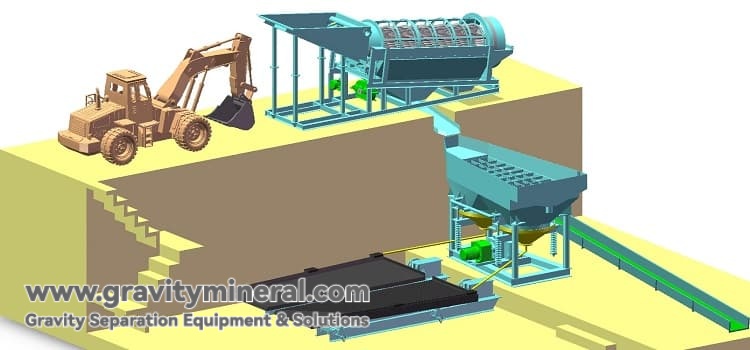
The changes in the placer gold sector are even more immediate. After years of mining in riverbeds, terraces, and ancient river channels, the remaining ore bodies have higher clay content and finer gold grains, making the early practice of simply “flushing through a sluice box” unsustainable.A staged process design—including ore washing, screening, roughing, and concentrating—has once again become the standard configuration for placer gold processing lines.
II. Technical Logic: Density Difference Determines the Lower Limit; Degree of Disintegration Determines the Upper Limit
The density of gold is approximately 19.3 g/cm³, while that of common gangue minerals such as quartz is about 2.65 g/cm³—a difference of several times. This density difference constitutes the entire physical basis for the viability of gravity separation.
In a flowing medium, particles with higher density settle faster, while those with lower density are carried away by the water flow.Jigging machines utilize vertical pulsating water flow to separate particles into layers; shaking tables rely on bed vibration and lateral water flow to segregate particles; spiral chutes use the combined effects of centrifugal force and gravity to discharge tailings; and centrifugal separators recover fine particles through an enhanced centrifugal field. These four types of equipment correspond to four distinct particle size ranges and are not interchangeable.
However, the density difference only determines “whether separation is possible”; what truly determines “how thoroughly the separation is” is the degree of individual liberation.If gold remains encapsulated within pyrite or gangue, the overall density of the intergrown particles is diluted, inevitably reducing the efficiency of gravity separation. Therefore, grinding fineness, classification efficiency, and the setting of the early cut-off point often have a greater impact on the final result than the specific equipment model.
This is also why suppliers of gravity gold recovery equipment—from individual units to complete turnkey solutions—must first conduct ore sample tests. Without data on particle size distribution and ore inclusion characteristics, any equipment selection lacks a solid basis.
III. Process Flow: Scenario-Based Design by Ore Type
Gold deposits in different occurrence states exhibit significant differences in process flow structures. Suppliers of gravity gold recovery equipment—offering comprehensive solutions ranging from individual units to complete processing lines—typically design processes based on four distinct scenarios: bedrock gold, placer gold, tailings reprocessing, and polymetallic ores. Analyzing these scenarios separately provides a much clearer understanding.
| Ore Type Scenarios | Typical Process Flow Structure | Design Focus |
|---|---|---|
| Rock Gold (Vein Gold) | Crushing, grinding and classification, early-recovery jigging, centrifugal and shaking table concentration, tailings flotation or leaching | Location of the early recovery point, grinding fineness, prevention of overgrinding and sludging |
| Placer Gold | Ore washing, screening, jigging or chute roughing, shaking table concentration, centrifugal scavenging | Thoroughness of ore washing, mud content treatment, water balance |
| Tailings reprocessing | Sampling and analysis, slurry adjustment, centrifugal or chute concentration, shaking table concentration | Material representativeness, degree of liberation, economic cut-off |
| Polymetallic ores | Gravity pre-concentration, magnetic separation for grouping, electrostatic separation or flotation for purification | Integrated process sequence, inter-stage coordination |
The key to processing vein gold lies in “early recovery”; for specific configurations, please refer to the vein gold gravity separation production line solution.Install a jig at the classification and return point of the ball mill circuit to intercept the already liberated coarse gold particles early on, preventing them from re-entering the mill and being ground further. Although this location may seem unremarkable, it directly affects the load on the subsequent leaching stage.
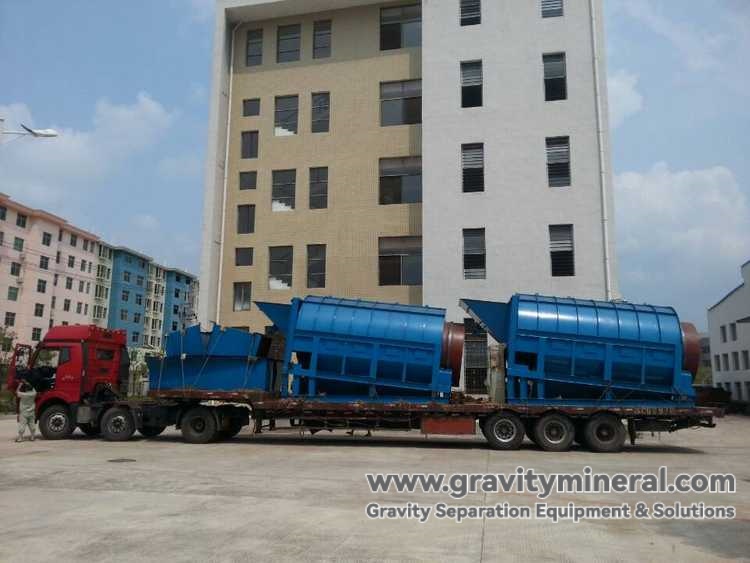
The key to a placer gold processing line lies in “thorough washing,” and this is also the focus of the placer gold gravity separation production line solution. If material with high clay content is not adequately washed, gold particles become coated with a clay film, and the gravity separation equipment ends up processing clumps of clay rather than minerals. Investing in a cylindrical washing machine and a trommel screen is often more worthwhile than investing in fine separation equipment.
For tailings reprocessing, the boundaries must first be clearly defined. Historical tailings vary greatly in grade, particle size, and liberation state; whether they are worth reprocessing must be determined through sampling tests and cannot be inferred based on experience alone.
IV. Equipment Configuration: The Division of Labor Among Four Core Equipment Categories
The core equipment of a gravity separation line is not complicated; the challenge lies in ensuring each piece performs its specific function at the correct particle size range.
| Equipment | Primary Function | Applicable Particle Size Range | Typical Location |
|---|---|---|---|
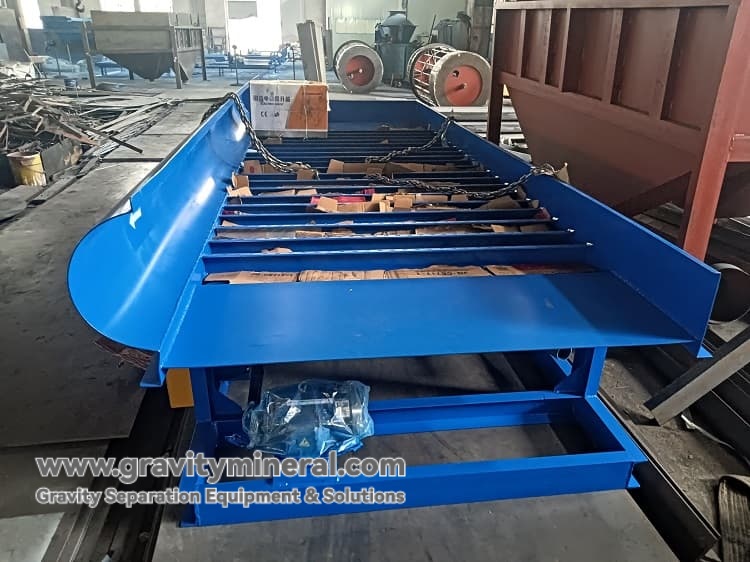
| Sawtooth Jig | Rough selection of coarse-grained heavy minerals; high throughput | Coarse Fraction | Under-screen material from grinding circuits or ore washing plants |
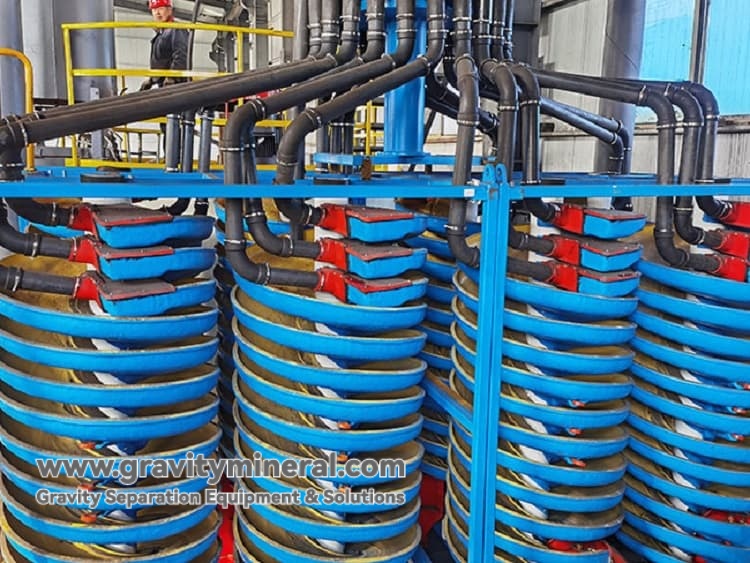
| Fiberglass-reinforced plastic spiral chute | High-capacity roughing and tailings rejection, no power consumption | Medium- and Fine-Grain Fraction | Roughing stage |
| 6-S shaking table | Concentrate enrichment with high separation accuracy | Fine-grain fraction | Enrichment Section |
| Centrifugal Mineral Separator | Recovery of ultrafine heavy minerals | Fine slime grade | Sweep or Fine Slime Stage |
Sawtooth-wave jigs are suitable for processing already liberated coarse-grained material and are often placed in the grinding circuit to perform early recovery. Fiberglass spiral chutes have a simple structure and require no power, making them suitable for large-scale tailings rejection in the roughing stage; however, their processing capacity depends on adequate classification.The 6-S shaking table is the mainstay of the concentrate recovery stage; the finer the feed particle size, the lower the unit processing capacity—a factor that is often underestimated during configuration. When plant space is limited, multi-tier shaking tables can be considered to increase processing capacity per unit area.Centrifugal separators are responsible for recovering ultrafine particles that are difficult to process using conventional gravity separation; backwash pressure and feed concentration are the two key variables in operation.
There is no such thing as “good” or “bad” equipment; it is simply a matter of whether it is properly matched to the application. It is not uncommon in retrofit projects for a single piece of equipment that operates well on its own to experience a sharp drop in performance when integrated into a process with a mixed particle size distribution.
V. Standalone Unit or Complete Line: The Deciding Factor Lies in Interfaces
When discussing suppliers of gravity gold recovery equipment—from individual units to turnkey solutions—the choice between a single unit and a complete line is often the first point of contention. For retrofitting existing plants, it is usually sufficient to replace a single shaking table or add a centrifuge, which can be met by supplying a single unit; if further increases in output per unit area are sought, multi-deck shaking tables can be used instead.For new processing plants, comprehensive capacity expansions, or process redesigns, a complete line solution is more suitable. The difference between the two lies not in price, but in interfaces and responsibility.
| Comparison Criteria | Single-Unit Supply | Complete Line Solutions |
|---|---|---|
| Interface Compatibility | Requires independent verification of upstream and downstream production capacity | Unified Calculation of Particle Size and Throughput Alignment |
| Assignment of Responsibility | Difficult to define when multiple parties are involved | Process and equipment managed by a single party |
| Design and Drawings | May require separate commissioning | Process flows, layouts, and civil engineering requirements are provided simultaneously |
| Delivery Schedule | Each vendor manages its own production schedule | Unified production scheduling and shipping |
| Applicable Scenarios | Single-point replacement, spare parts replenishment | New production lines, capacity expansion and retrofits, process reengineering |
There is only one key consideration: Does the project require a single piece of equipment, or a stable, fully operational process? If the feed rate and particle size distribution from upstream, as well as the dewatering capacity downstream, remain unchanged, replacing a single unit is the rational choice; if any of these factors changes, adopting a line-wide perspective is the more prudent approach.
VI. Information Required Before Selecting Equipment
Gravity separation schemes are sensitive to input conditions; the more complete the preliminary data, the smaller the deviation in the proposed solution. Typically, the following details must be clarified:
- Ore type and major associated minerals, to determine whether magnetic separation, electrostatic separation, or flotation is required
- Raw ore grade and gold particle size distribution, to determine the liberation target and early recovery point
- Target processing capacity, measured in hours or days; distinguish between design values and operating values
- Clay content and moisture content, which directly affect the configuration of the ore washing section; where necessary, de-sliming equipment such as spiral washers must be provided
- Site conditions, including plant buildings, power supply, water supply, and transportation
- Investment range and expected commissioning timeline, used to determine equipment specifications and implementation schedule
Among the above factors, particle size distribution and clay content are most easily overlooked, yet they have the greatest impact on process design. Providing only grade and throughput typically yields only general recommendations and makes it difficult to develop a feasible configuration plan.
VII. Scope of Delivery and Service Content
Delivering a complete line does not mean handling everything. A reasonable division of labor is as follows: the equipment supplier is responsible for process design, equipment manufacturing, installation guidance, and commissioning and training; while the project owner organizes civil construction and general installation labor locally. This model ensures technical standards are met while avoiding the costs associated with dispatching large numbers of personnel across borders.
Specific services typically cover the following stages: ore sample testing and feasibility analysis; process design; equipment selection and drawings; manufacturing and turnkey supply of core equipment; on-site installation guidance; commissioning of individual units and integrated systems; operation and maintenance training; quality assurance during the warranty period; and long-term spare parts supply.
It is important to emphasize that successful commissioning and meeting performance standards should be considered the marker of project completion. The arrival of equipment is merely the midpoint; the project is truly complete only when the production line is running smoothly, performance indicators are stable, and the operations team is capable of independent operation. The value of a gravity gold recovery equipment supplier—from individual units to turnkey solutions—is precisely reflected in this often-overlooked transition phase.
VIII. Frequently Asked Questions
Q: Is it feasible to purchase only a single piece of equipment?
A: Yes. In the retrofitting of existing plants, replacing shaking tables, adding centrifuges, or supplementing with hydraulic radial jigs are all common requirements. However, it is necessary to confirm that the new equipment matches the feed particle size, concentration, and throughput of the existing process.
Q: Can you guarantee a recovery rate?
Recovery rates are influenced by multiple factors, including density differences, grain size distribution, and mineral associations, and vary significantly between different ore bodies. The rigorous approach is to determine a reasonable process for the specific ore conditions through mineral processing tests and then evaluate performance metrics based on that, rather than providing fixed values that are detached from the ore\'s actual characteristics.
Q: Can gravity separation completely replace flotation or leaching?
For most rock gold projects, no. Gravity separation is better suited as a means of pre-concentration and coarse-grain gold recovery; fine-grain, embedded gold still requires flotation or leaching for final recovery. The sequence of combined processes must be determined based on liberation characteristics.
Q: If the performance of the existing process is unsatisfactory, is it necessary to rebuild it?
Not necessarily. It is recommended to first conduct a process diagnosis to determine whether the problem lies in ore washing, classification, equipment parameters, or the interface between process stages. A significant number of projects can be improved through localized modifications without the need for a complete overhaul.
IX. About Us
GravityMineral has long specialized in the field of gravity mineral processing, with services covering ore sample testing, process design, equipment manufacturing, installation guidance, and commissioning training.Our core equipment is manufactured at our in-house production facilities under the ISO 9001 quality management system. Our products are exported to numerous countries and regions, and our project experience spans rock gold, placer gold, tungsten-tin, chromite, titanium-zirconium sand, barite, and tailings reprocessing, among others.
In terms of cooperation models, we offer three options: individual equipment supply, phased services, and turnkey line delivery. For special operating conditions—such as extreme cold, high altitudes, and highly corrosive environments—we provide customized solutions tailored to specific material requirements, motor power, and structural design.
As a supplier of gravity gold recovery equipment—offering comprehensive solutions ranging from individual units to complete production lines—our focus is not on the length of the equipment list, but on ensuring that every particle size is properly processed and that the process remains adjustable even after production begins.For further information, please submit details regarding ore properties, processing capacity, and site conditions; we will then provide tailored process recommendations and configuration proposals based on this information.