







What does a complete set of gravity gold separation equipment include? Integrated solutions for gravity separation, concentration, and fine separation
Key Conclusions
-
The configuration logic for a complete set of gravity gold separation equipment is based on a multi-stage process: roughing and waste rejection, concentration and grade improvement, and scavenging to produce concentrate. Each of the three stages performs a specific function, and the coordination between stages is more critical to the final performance metrics than the selection of individual machines.
-
Centrifugal gold separators are responsible for recovering fine-grained gold; the feed particle size is typically controlled below 2 mm, and the grinding fineness must match the degree of liberation. Feed concentration and backwash water parameters are critical to operation.
-
Gold shaking tables handle the final stage of concentration. They process small feed volumes with high enrichment ratios; feed must undergo pre-classification to separate coarse and fine particles before feeding to achieve optimal performance.
-
The thickening and dewatering stages determine whether the water circulation can be closed-loop and whether the filter cake moisture content meets standards; they are hidden variables affecting the operating costs of a gravity gold recovery production line.
-
The basis for determining how to configure a complete set of gravity gold separation equipment lies in the grain size distribution of the gold and the clay content; whether coarse grains or fine grains dominate dictates two distinct gravity separation configurations.
The challenge in configuring equipment for a gravity gold recovery production line often lies not in the individual units themselves, but in matching particle size, concentration, and throughput between processing stages. If the roughing stage processes material that is too fine, the concentrating stage handles material that is too coarse, and the intermediate thickening stage is bypassed, the entire line will fail to produce stable results—no matter how impressive the performance metrics of individual units may be.The following section outlines the composition and configuration logic of a complete gravity gold separation system, organized into three operational stages: roughing, concentration, and scavenging.
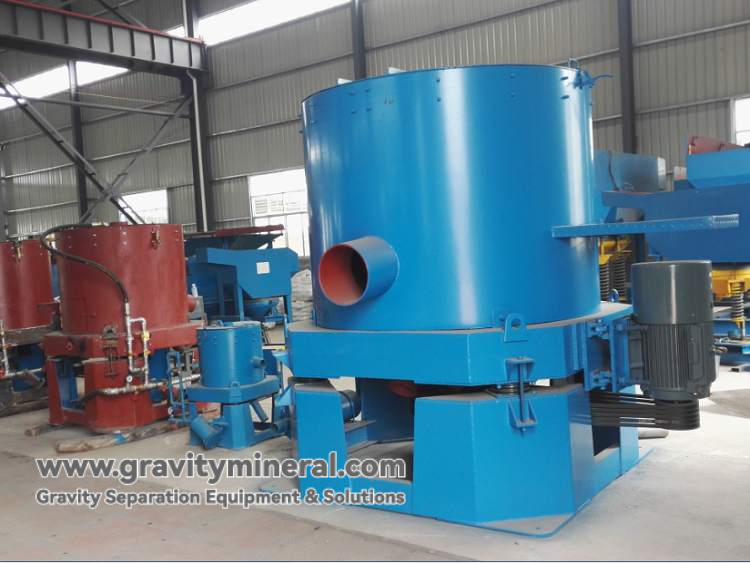
I. Roughing Stage Equipment: The Division of Labor Between Centrifugal Gold Separators, Chutes, and Jigs
The task of the roughing stage is to remove gangue as early as possible to reduce the processing load on subsequent stages. Given the limited grade of gold ore and the fixed costs of grinding, removing a portion of the waste rock during the coarse-grain stage will lower the energy consumption and reagent usage of the entire line. The selection of equipment for the roughing stage depends on the grain size of the gold and the clay content of the raw ore.
The centrifugal gold separator is the primary equipment for recovering fine-grain gold. Taking the STLB-type water-jacketed centrifuge as an example, it utilizes a centrifugal force field to enhance gravity separation, achieving better recovery of fine-grain free gold than traditional sluices.The upper limit of feed particle size is generally controlled between 2 and 6 mm. In actual operation, the proportion of particles finer than -0.074 mm must match the degree of liberation of free gold. Feed concentration, backwash water pressure, and drum rotation speed are the three core operating parameters.Processing capacity ranges from a few tenths of a metric ton to over 100 metric tons per hour. When selecting equipment, the number of units should be determined based on the raw ore throughput and the expected waste rejection rate to prevent individual units from operating at overload.
Vibrating sluices are suitable for placer gold deposits or coarse-grained ore. The bottom plate performs a vibrating motion, alleviating the problem of bed compaction found in fixed sluices. They consume no power, and the installation angle is generally set at 8–12 degrees, which is particularly advantageous for recovering the +0.1 mm size fraction.Loss of fine-grained gold is relatively high; the coarse concentrate produced by the chute must undergo further processing in the next stage and should not be used as the final product.
Jigging machines still have a place in the processing of placer gold and ore with coarse-grained gold distribution. Pulsating water flow causes the bed to alternately loosen and compact, allowing high-specific-gravity gold particles to pass through the gaps and settle to the bottom. Water consumption is relatively high, and the lower limit for fine-grain recovery is lower than that of centrifugal gold separators.
The guiding principle for the roughing stage is as follows: the centrifugal gold separator ensures the recovery of fine and ultrafine particles, while the chute or jig handles the throughput and retains coarse particles. When coarse and fine/ultrafine gold particles coexist in the ore, using a chute at the front to remove coarse particles and a centrifuge at the back to recover fine particles is more reliable than relying on a single piece of equipment.
II. Concentration Stage Equipment: Integration of Thickening Machines and Filter Presses
The concentrate yield from the roughing stage is modest, and the concentration is often low. The concentrate from the centrifugal gold separator is discharged with wash water, and the slurry concentration may be only a few percentage points; feeding this concentration directly into a shaking table results in suboptimal separation efficiency and water flow control.
A high-efficiency thickener is responsible for increasing the concentration at this stage. The coarse concentrate slurry enters the thickener, where the underflow concentration is raised to 30%–50%, and the overflow is returned to the roughing stage for recirculation.Small- and medium-sized processing plants can select the NXZ-8 or a center-drive thickener of similar specifications. Underrun discharge should be maintained continuously and stably; concentration fluctuations caused by intermittent discharge will directly affect shaking table operations.
Concentration on the tailings side is also essential. If gold-processing tailings are fed directly into a filter press, processing capacity is limited, and filter cloth lifespan is reduced.A deep-cone thickener raises the tailings concentration to over 50%; the underflow is then fed into a high-pressure chamber filter press, where the filter cake moisture content can be controlled, and the filtrate is reused together with the thickener overflow.Only when this stage is properly configured can a closed-loop circulation of process water be achieved, thereby reducing the amount of fresh water required for makeup.
From an operating cost perspective, while the investment in the thickening section accounts for a limited portion of the total line cost, its impact on the number of filter presses, filter cloth consumption, and water recycling costs extends throughout the entire production cycle. Ensuring that the processing capacity of the thickening section matches that of the filter presses is an aspect of the complete gravity gold separation equipment configuration that is often underestimated.
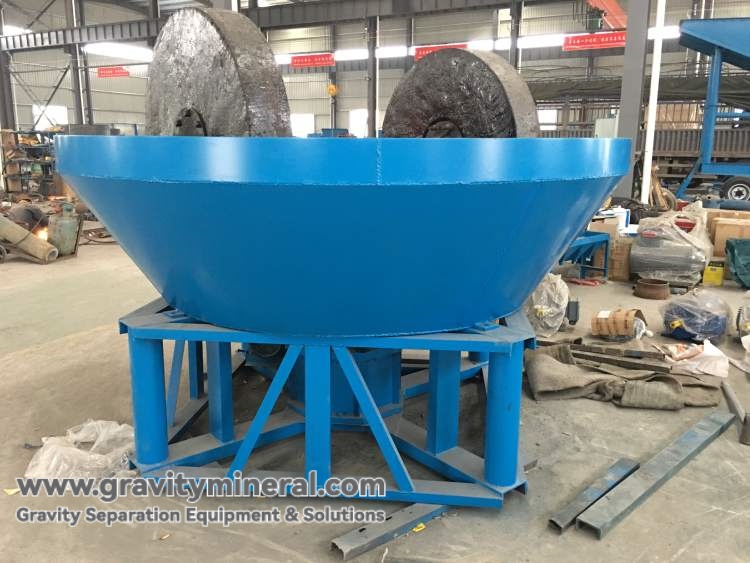
III. Concentration Section Equipment: Gold Shaking Tables and Feed Preparation
The objective of the fine selection stage is to produce gold concentrate suitable for sale or smelting, with the enrichment ratio serving as the core indicator.
Gold shaking tables are the key equipment in the concentration stage. 6-S shaking tables and similar fiberglass-reinforced plastic (FRP) table-top shaking tables have limited processing capacity for rough concentrate per unit, but they achieve high enrichment ratios.The differential reciprocating motion of the bed surface, combined with transverse water flow, causes gold particles to concentrate toward the concentrate end along the longitudinal troughs, while light minerals are carried away by the transverse water flow. Stroke length, stroke frequency, and bed surface slope are all adjustable to accommodate different ore characteristics.
Two conditions must be met before feeding ore to the shaking table: stable concentration and prior classification.When the particle size range of the rough concentrate is wide, the movement behavior of coarse and fine particles on the bed surface differs significantly, causing interference between the separation zones. Pre-classification using a hydraulic classifier or small-diameter hydrocyclone, with coarse and fine particles fed separately, is necessary to achieve the full separation efficiency of the gold shaking table.
The treatment of middlings from the shaking table requires separate consideration. Shaking table separation produces three product zones: concentrate, middlings, and tailings. Since the middlings grade falls within an intermediate range, direct disposal as tailings results in significant losses, while returning them to the roughing stage increases the circulation volume. A more reasonable approach is to return the middlings to a centrifugal gold separator or to regrind them separately before returning them to the scavenging stage.Test data from some mines indicate that a synergistic process involving centrifugal pre-discharge, washing of rough and concentrate, and centrifugal fine concentration results in lower gold losses than a single-stage gravity separation process.
When the rough concentrate contains sulfide ore or requires further grade improvement, a washing stage or manual sluice can be added after the shaking table as a supplement; however, the primary enrichment is still performed by the gold shaking table.
IV. Complete Configuration Table for Gravity Gold Recovery Equipment
The table below lists core and auxiliary equipment by processing stage; specific models and quantities must be determined based on ore properties, grain size distribution, and site conditions.
| Processing Stage | Core Equipment | Supporting Equipment | Applicable Scenarios | Key Control Parameters |
|---|---|---|---|---|
| Rough Concentration (Fine Grains) | Centrifugal Gold Separator | Slurry distribution box, feed pump | Fine-grained disseminated gold deposits, tailings reprocessing | Feed particle size, feed concentration, backwash water pressure |
| Roughing (sand ore/coarse particles) | Agitated chute | Vibrating screen, feed chute | Placer gold, coarse-grained disseminated ore | Installation angle, agitation frequency |
| Concentration (Concentrate) | Center-driven thickener | Underflow pump, flocculant dosing system | Centrifuge and chute Concentration of coarse and concentrate | Underrun Concentration, Overflow Turbidity |
| Concentration (Tailings) | Deep-cone thickener | Flocculant preparation system | Tailings Dewatering and Dry Discharge | Undersize concentration |
| Concentration | Gold Shaking Table | Hydraulic classifiers, small-diameter hydrocyclones | Rough and concentrate upgrading | Feed Concentration, Pre-classification Particle Size |
| Dewatering | High-pressure chamber filter press | Feed pump, air compressor | Dewatering of Thickener Undersize | Filter cake moisture content |
| Water Recirculation | Return water tank, return water pump | Piping system | Full-Process Recirculation | Overflow and Filtrate Reuse Rate |
The number of units in a complete gravity gold recovery plant should be configured based on the principle of processing capacity balance: the processing capacity of the roughing stage should be slightly higher than the design capacity; the underflow discharge capacity of the thickening stage should match the feed rate of the scavenging stage; and the filter press capacity should match the underflow output from the thickener.Excess or insufficient capacity in any stage will manifest as material blockages or idle operation during operation.
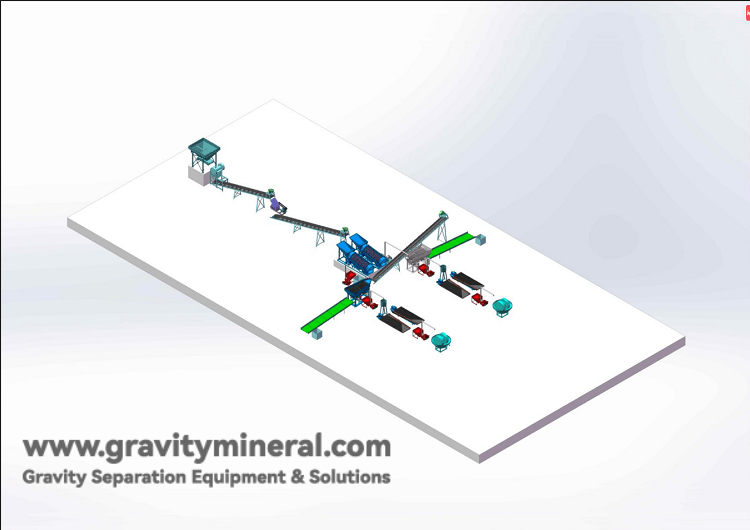
V. Differences in Gravity Separation Processes for Alluvial and Bedrock Gold Deposits
There are significant differences in the configuration of gravity gold separation equipment between alluvial and bedrock gold deposits; process designs cannot be applied interchangeably.
For placer gold deposits, ore washing and screening serve as the preliminary stages. Since the clay content in the raw ore fluctuates significantly, a drum washer or cylindrical screen is used to separate out large gravel; the undersize slurry then enters a jig or spiral chute for roughing, followed by fine concentrate being sent to a shaking table for concentration, while the fine-grained fraction is recovered by a centrifugal gold separator.The thoroughness of the ore washing process directly determines the recovery efficiency of the subsequent gravity separation stage. A complete set of gravity gold separation equipment for placer gold deposits is highly modular; small-scale operations can start with a single jig and shaking table, with interfaces reserved for gradual expansion as production increases.
For rock gold ore, crushing and grinding serve as the preliminary stages. A jaw crusher performs coarse crushing, a cone crusher handles medium and fine crushing, and a ball mill operates in a closed circuit with a spiral classifier. The sand fraction from the classifier enters a jig or centrifugal gold separator for early recovery, while the tailings are sent to the flotation or leaching stage as appropriate.The core objective of the gravity separation section in rock gold mines is “early recovery.” Gravity separation equipment is integrated into the grinding circuit to minimize overgrinding and the formation of fine slime from already liberated gold particles.Rod mills are used in applications involving brittle minerals such as tungsten and tin to prevent over-grinding, whereas in rock gold ore processing, grinding particle size is primarily controlled through classification efficiency.
A common feature of both ore types is that the fine selection stage concludes with a gold-separating shaking table, and the concentration stage requires both a thickener and a filter press. The differences lie in the equipment configuration of the roughing stage and the pre-processing stage; these are the aspects of the complete gravity gold separation system that most require adjustment based on the specific ore type.
VI. Common Configuration Issues
Should a chute be installed upstream of the centrifugal gold separator? This depends on the proportion of coarse-grained gold in the ore. For placer gold or ores with coarse-grained gold distribution, a pre-installed chute can reduce the load on the centrifuge; when gold is primarily present in fine grains, the chute\'s effectiveness is limited, and feeding the ore directly into the centrifuge after screening is a simpler approach.
How can insufficient processing capacity of gold shaking tables be addressed? By connecting multiple units in parallel. Shaking tables are fine-selection equipment, and their limited processing capacity per unit is a design characteristic. Relying on a single large-capacity shaking table to handle the entire output makes it difficult to control water flow and bed conditions, resulting in a decline in concentrate grade that outweighs any increase in processing capacity.
Can tailings be discharged dry without concentration? While technically feasible, this approach increases the number of filter presses required, leads to frequent filter cloth replacement, reduces water recovery rates, and raises operating costs. The investment in a thickener can be gradually recouped through savings on filter press operating expenses and filter cloth consumption.
Does the concentrate need to be dried? For gravity-concentrated gold, natural drainage followed by bagging typically meets transportation requirements. Sun-drying or low-temperature drying should only be considered when transportation distances are long or when pricing imposes strict restrictions on moisture content.
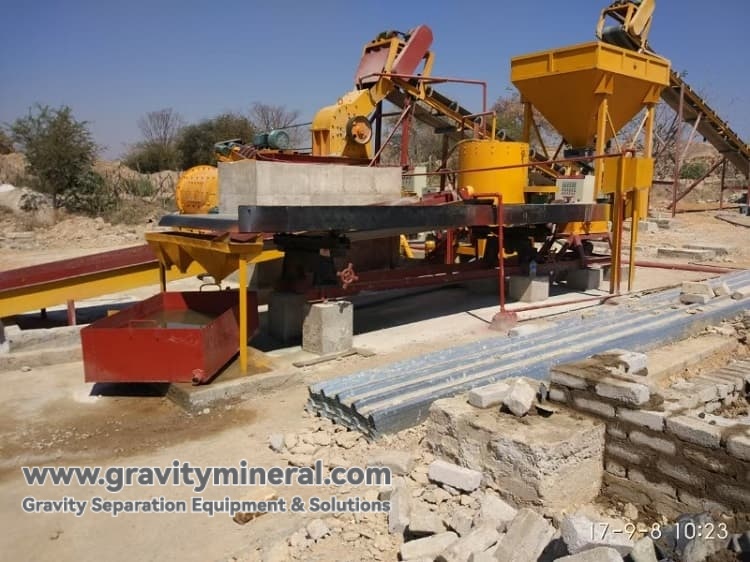
The configuration of a complete gravity gold recovery system centers on the coordination of three processing stages: the roughing stage reduces throughput, the thickening stage controls water content, and the concentrating stage increases grade. Matching particle size, concentration, and throughput between stages is more important than the brand and specifications of individual pieces of equipment.
Equipment selection should be based on ore test data. The recovery rates of centrifugal gold separators and the enrichment efficiency of shaking tables are both influenced by the particle size distribution and degree of muddiness of the ore sample; parameter comparisons that do not account for ore characteristics have limited reference value.It is recommended to complete particle size analysis and recoverability tests before process design. Based on these results, determine the models, quantities, and interface parameters for the complete set of gravity gold separation equipment, ensuring that the gravity separation, concentration, and fine selection stages form a complete closed-loop system.