







What Types of Ore Are Suitable for Gold Re-concentration Equipment? Fine-Grain Gold Recovery Processing Solutions
Determining which ores are suitable for heavy-medium separation equipment is an unavoidable issue in mine investment and processing plant upgrades. While the equipment may be readily available, if the performance metrics do not meet expectations, the root cause often lies not in the machinery itself, but in whether the ore properties align with the processing route.This article focuses on the range of ores suitable for gold gravity separation equipment and ore processing solutions for fine-grain gold recovery. It clearly explains the decision-making logic, equipment selection, and common pitfalls, serving as a reference for processing plant managers and technical personnel.
I. What Types of Ore Are Suitable for Gold Gravity Separation Equipment: Start by Examining Three Basic Parameters
To determine which ores are suitable for gold gravity separation equipment, one cannot simply ask, “Is it a gold ore?” but must instead consider three fundamental parameters of the ore: gold particle size, degree of liberation, and distribution pattern.
Gold particle size determines the type of equipment. Coarse-grained gold can be effectively processed using jigs and shaking tables; fine-grained and ultrafine gold, however, require equipment that enhances the gravitational field, such as centrifugal separators.The degree of liberation determines whether gravity separation can be used as a standalone process; ores with good single-particle liberation achieve high separation efficiency, while ores with a high proportion of intergrown particles require grinding or combined processing methods. The distribution pattern determines the position of gravity separation within the processing flow; for ores where gold is encapsulated by sulfides, gravity separation is more suitable as a pre-concentration step rather than a final separation method.
Once these three points are clearly understood, half the answer to the question of which ores are suitable for gravity separation is already evident. The remainder can be confirmed through beneficiation tests using representative ore samples.
II. Types of Gold Ore Suitable for Gravity Separation
Placer gold deposits. Placer gold found in riverbeds, terraces, and ancient river channels features highly liberated gold particles and significant fluctuations in clay content.This type of ore is the most typical application for gold gravity separation equipment. After ore washing and screening, it undergoes roughing in a jig or spiral chute, followed by scavenging in a shaking table and a centrifugal separator. The process is relatively simple, and operating costs are low.
Oxidized rock gold ores. Gold is present in the oxidation zone; the gangue is highly weathered, and the gold particles are well liberated from the gangue. For this type of ore, using gravity separation for roughing—to discard tailings and recover coarse-grained gold early—yields relatively stable results.
Quartz vein-type gold deposits. Gold is primarily present in a free state, with uneven grain size distribution. Incorporating a jig into the grinding circuit to achieve “early recovery” can reduce losses caused by overgrinding and slime formation; the gravity concentrate is then further refined using shaking tables.
Gold-bearing tailings and tailings from legacy processing plants. Historical tailings often contain residual, unrecovered gold; while the particle size tends to be fine, the degree of liberation is relatively good. A common approach for the resource recovery of tailings involves re-processing them using a centrifugal separator followed by a shaking table.
For the above categories of ore, gravity separation equipment can serve as the primary means of separation. However, for sulfide-encased gold and ultrafine disseminated ores, gravity separation is better suited as a pre-concentration step, used in conjunction with flotation or leaching processes.
III. What Makes Fine-Grained Gold Recovery Challenging
Ultimately, the challenge in recovering fine-grained gold boils down to the fact that it “won\'t settle.” The finer the particles, the slower the settling velocity. Conventional shaking tables have a limited lower size limit for processing, and finer gold particles are easily washed into the tailings due to water flow turbulence.
Another challenge is slurrification. Excessively fine grinding or high clay content increases the slurry\'s viscosity, hindering the settling of gold particles; even the best equipment struggles to perform effectively under these conditions. The third challenge is encapsulation. When gold particles are encapsulated by sulfides such as pyrite, they cannot be separated—no matter how great the density difference—and must first be liberated.
These three factors determine that mineral processing schemes for fine-grain gold recovery cannot simply replicate those used for coarse-grain gold; they require targeted design in terms of equipment selection and process configuration.
IV. Process Concept for Fine-Grain Gold Recovery
A comprehensive fine-grain gold recovery process is typically structured around “staged processing and coordinated use of multiple pieces of equipment.”
Ore washing and desliming stage. A cylindrical or spiral ore washer is used to remove slime, creating suitable feed conditions for subsequent gravity separation. If desliming is incomplete, all subsequent efforts will be in vain.
Coarse-Grain Early Recovery Stage. A jig is used to process the coarse-grain fraction, recovering free gold early in the grinding circuit to reduce over-grinding. The jig concentrate is then fed to a shaking table for fine selection.
Fine-Grain Enhanced Recovery Section. A centrifugal concentrator processes the ultrafine grain fraction, utilizing an enhanced centrifugal field to improve the capture efficiency of fine-grain gold. This is a critical step in the fine-grain gold recovery process.
Re-processing of middlings. Middlings from the shaking tables are re-ground and returned to the gravity separation process to further liberate gold particles from the intergrown ore, thereby improving the overall recovery rate.
Tailings recovery stage. Depending on the ore characteristics, fine-grain gold in gravity separation tailings can be further recovered using flotation or leaching processes, forming a closed-loop system combining gravity separation with other processes.
It should be noted that the model selection, number of stages, and processing capacity for each stage must be determined based on ore sample test data; as conditions vary significantly between mines, a one-size-fits-all approach is not recommended.
V. Key Considerations for Selecting Gold Gravity Separation Equipment
Determining which ores are suitable for gold gravity separation equipment involves several specific considerations.
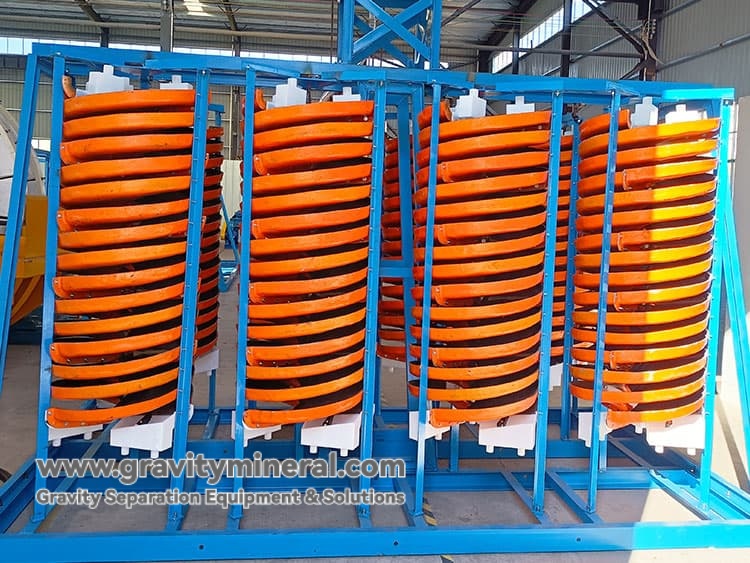
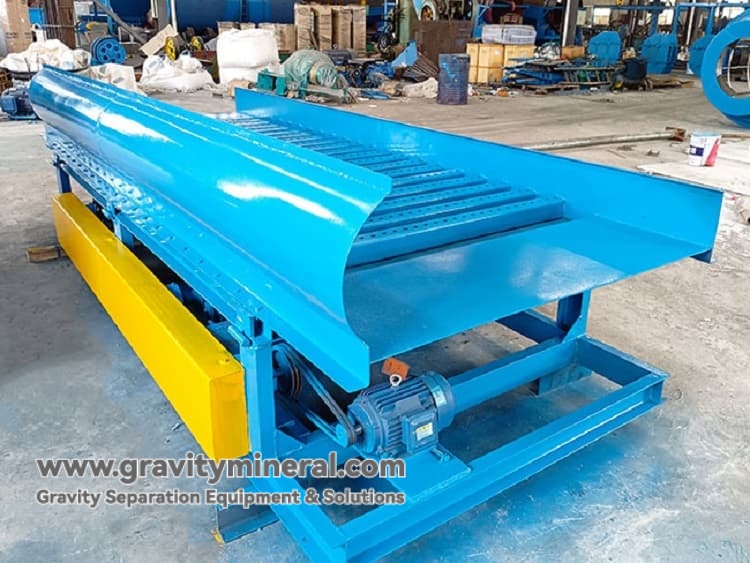
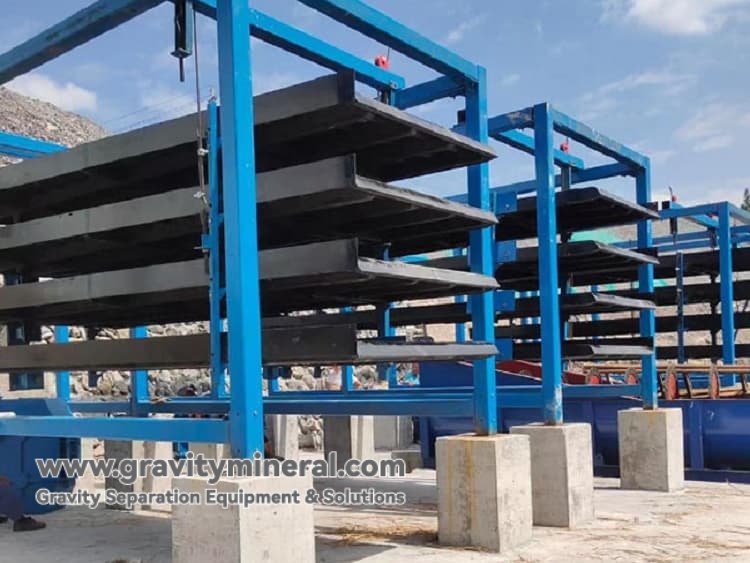
Jigging machines are suitable for the roughing stage, which handles coarse-grained material at high throughput; sawtooth-wave jigging machines are particularly well-suited for materials with a wide particle size distribution. Shaking tables are suitable for fine-grained concentration, offering high sorting precision and the ability to produce qualified concentrate in a single pass.Spiral chutes feature a simple structure and require no power consumption; they are suitable for roughing and tailings disposal in applications with high throughput and low grade. Centrifugal separators are designed for the recovery of ultrafine heavy minerals and serve as a supplementary and reinforcing measure in fine-grain gold recovery schemes.
When selecting equipment, it is also essential to consider how well the equipment integrates with the processing flow. The interfaces between the crushing, screening, gravity separation, and dewatering stages must be properly matched, and production capacities must be aligned. Ideally, a single team should be responsible for this to avoid interface conflicts and capacity mismatches caused by piecing together equipment from different manufacturers. A disconnect between equipment manufacturing and process design is a hidden cause of many processing plants failing to meet their performance targets.
VI. Common Misconceptions
Misconception 1: Gravity separation does not use chemicals, so it has no costs. While the advantages of gravity separation include environmental friendliness and relatively low operating costs, equipment wear, water consumption, maintenance, and labor costs must all be factored into the overall budget; it cannot simply be equated with “zero cost.”
Misconception 2: Applying the specifications of coarse-grain equipment to fine-grain ore. Shaking tables perform well for coarse-grain sand ore, but when switched to fine-grain slime, recovery efficiency may be significantly lower even with the same parameters. Fine-grain ore requires fine-grain equipment.
Misconception 3: Building a plant without conducting tests. The selection of gravity separation equipment relies heavily on three parameters: density difference, particle size distribution, and clay content. Installing equipment without data from representative ore samples carries significant risk. It is a more prudent approach to conduct mineral processing tests first, then determine the process flow and equipment.
VII. Service Support for Gold Gravity Separation Equipment and Fine-Grain Gold Recovery Solutions
Ultimately, the suitability of gold gravity separation equipment for a given ore depends on the ore\'s properties and is realized through engineering expertise. From mineral analysis, beneficiation testing, and process design to equipment manufacturing, on-site installation guidance, and commissioning training, the entire process is managed by a single team with clearly defined responsibilities, thereby minimizing issues arising from misalignment between equipment and process.
For fine-grain gold recovery processing solutions, we recommend first sending representative ore samples for feasibility testing. Once data on liberation size and separation indices are obtained, the equipment configuration and number of process stages can be determined.For mines requiring plant retrofits or new processing facilities, please provide clear details on the ore type, processing capacity, feed particle size, and site conditions. Our engineers will then use case studies of similar ore types to provide preliminary equipment selection recommendations.
The answer to which ores are suitable for gold gravity separation equipment is not found in brochures, but in ore sample data and process design. Only by thoroughly understanding the ore\'s properties and properly matching the equipment with the process can the gravity separation route effectively fulfill its role in fine-grain gold recovery.