







Guide to Selecting Gold Mine Shaking Tables: High-Efficiency Gravity Separation Equipment to Boost Gold Recovery, Improve Quality, and Increase Efficiency
In a mining plant, the equipment most prone to the problem of “looking fine on the surface but actually losing money” is often the shaking table. The table surface is moving, and the ore bands are separated, yet the concentrate grade always falls just short, while fine-grained gold continues to slip away unnoticed in the tailings.Shaking tables are the most precise type of gravity separation equipment and also the most sensitive to proper configuration—feed particle size, number of troughs on the bed surface, stroke and frequency, slope, and water flow. If any one of these parameters is off, gold recovery will be compromised.
This guide to selecting shaking tables for gold mines breaks down the selection process into five steps, clearly explaining what to look for and where mistakes are commonly made. The value of high-efficiency gravity separation equipment lies not in the impressive specifications of a single unit, but in its placement at the correct position in the process flow and in parameters tailored to the characteristics of the ore.
I. First, Confirm the Shaking Table\'s Position in the Process
The first common mistake in selection is treating the shaking table as a “one-size-fits-all” machine. Feeding raw ore slurry directly into the shaking table will result in an insufficient throughput. A single shaking table has limited processing capacity; its role in the gravity separation process is as a final concentrator, not as an initial roughing unit.
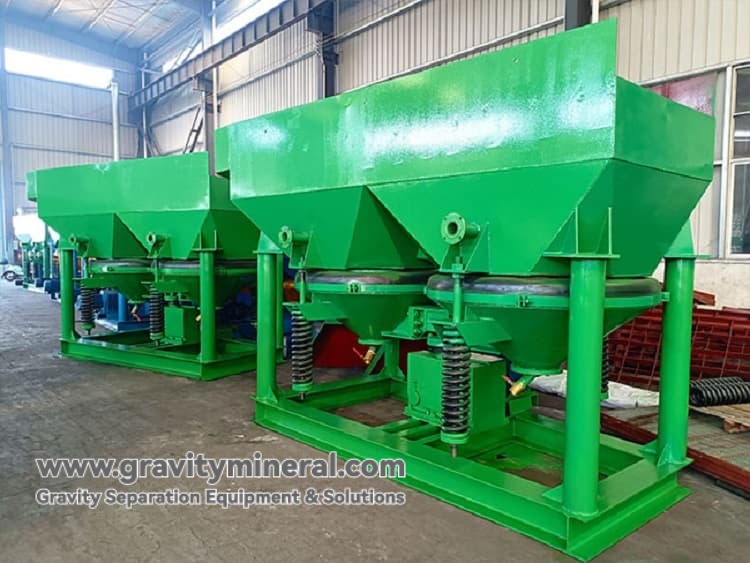
A reasonable division of labor is as follows: jigs or spiral chutes handle roughing and tailings rejection, centrifugal separators recover fine-grained gold, and the resulting rough concentrate is then sent to the shaking table for purification. For placer gold deposits, the common process is “chute roughing—shaking table concentration”; for lode gold deposits, it is “early recovery via jigging in the grinding circuit—shaking table concentration.”Before selecting a gold ore shaking table, first confirm whether there is equipment in the front end to complete rough selection and tailings rejection. If the front end is missing, simply increasing the number of shaking tables will not solve the problem; the bottleneck in gold recovery does not lie with the shaking tables themselves.
II. The Number of Grooves on the Bed Surface Must Match the Feed Particle Size
The grooves on the shaking table surface are designed according to particle size: coarse particles require wide, sparsely spaced grooves, while fine particles require narrow, densely spaced grooves. This is a fundamental principle of equipment selection.
Coarse sand should be processed on a coarse-sand bed surface, fine sand on a fine-sand bed surface, and slime requires a bed surface with closely spaced grooves.The consequences of mismatching are immediate: if coarse particles enter a bed with densely spaced grooves, the ore layer cannot loosen up, causing light and heavy minerals to mix together, which significantly increases metal loss in the tailings; if fine silt enters a bed with sparsely spaced grooves, lateral water flow washes away the fine gold particles directly into the tailings, and no clear separation zones can even be seen on the bed surface.
When selecting a gold shaking table, the feed particle size screening report should serve as the basis for determining the bed configuration; one must not rely on empirical estimates or settle for a bed configuration that is merely “good enough.” The prerequisite for high-efficiency gravity separation equipment is proper matching between the equipment and the ore; if the number of troughs is mismatched, no amount of fine-tuning of subsequent parameters can compensate for this.
III. Stroke and Stroke Frequency: Large for Coarse Grains, Small for Fine Grains
Stroke refers to the distance the bed surface advances in a single cycle, while stroke frequency refers to the number of reciprocating cycles per minute. The basic rule is: use a long stroke and low stroke frequency for coarse grains and thick ore layers; use a short stroke and high stroke frequency for fine grains and thin ore layers.
For the coarse sand fraction, use a larger stroke and lower stroke frequency; for the fine sand fraction, use a smaller stroke and higher stroke frequency; and for the silt fraction, use an even smaller stroke and the highest stroke frequency. When making adjustments, change only one parameter at a time: first observe the separation zones, then decide on the next step. Adjusting both parameters simultaneously makes it difficult to pinpoint the cause of any issues that arise.
The most common deviation encountered in the field is an excessively large stroke. Operators often mistakenly believe that a bed surface that pushes strongly and a fast-moving ore stream indicate high efficiency; however, fine-grained gold cannot withstand the agitation caused by a large stroke. The particles tumble chaotically, the separation zone becomes unstable, and gold particles are lost with the tailings.Selecting a gold shaking table involves more than just choosing an equipment model; it also means selecting a set of reproducible parameter ranges. Stroke and frequency must be tied to the feed particle size.
IV. Slope and Flushing Water Must Be Adjusted in Tandem
The transverse slope determines the lateral movement speed of ore particles on the bed surface. For coarse sand separation, the slope should be steeper; for fine sand, it should be shallower; and for the silt section, even shallower. If the slope is too steep, the concentrate zone shifts downstream, the tailings zone widens, and gold particles are washed away before they can settle;if the slope is too shallow, the material layer becomes congested; the concentrate zone widens but becomes mixed with middlings, preventing the grade from increasing.
Flushing water should be applied at the boundary between the concentrate zone and the middlings zone to flush the middlings back toward the tailings side, ensuring the concentrate zone remains clean. Applying it to the concentrate zone will wash away the concentrate, while applying it to the tailings zone will fail to flush out the middlings. The adjustment sequence is to first set the slope, observe the zone separation, and only adjust the water flow if the zone separation is incorrect.
The feed concentration must also be kept stable. If the concentration is too high, viscosity increases, slowing particle settling and causing the separation zone to shift downward; if the concentration is too low, the water flow becomes turbulent, blurring the separation zone. If the preliminary classification is not done properly and coarse and fine particles enter the shaking table mixed together, it will be difficult to achieve stability no matter which parameters are adjusted later.The efficiency of high-efficiency gravity separation equipment depends to a large extent on whether these interrelated conditions are taken seriously.
V. Pre-startup inspections determine the day\'s performance metrics
Shaking tables are equipment that undergoes vigorous reciprocating motion; loose bolts or worn-out corrugated bars will directly affect the separation zone. If the corrugated bars are worn flat or loose, the eddy currents that cause light minerals to float and heavy minerals to sink will weaken, resulting in reduced separation efficiency.
Before each startup, perform a full inspection: check whether the bed\'s corrugated bars are loose or worn; verify that the oil level in the gearbox is normal and that the oil has not emulsified; ensure that the anchor bolts and connecting bolts are tight; and confirm that the belt tension is appropriate. Run the machine empty for one minute, listening for unusual sounds and observing whether the bed operates smoothly.
Do not resort to spraying water to compensate for belt slippage. Spraying water actually reduces the stroke, preventing the bed from pushing heavy minerals; gold particles remain on the bed, and the tailings grade actually increases. The correct solution is to adjust the motor base or replace the belt. Even if the correct gold shaking table model is selected, gold recovery cannot be maintained if daily inspections are neglected.
VI. Key Questions to Clarify Before Selection
- Is the feed particle size distribution clear? The selection of gravity separation equipment relies heavily on three parameters: density difference, particle size distribution, and clay content. Without representative ore sample data, the selection process lacks a solid basis. If possible, conduct mineral processing tests first to derive the process flow and equipment configuration based on the data.
- Is the upstream process properly integrated? Whether there is roughing and tailings disposal equipment before the shaking table, as well as any classification operations, directly determines whether the shaking table can operate stably.
- Is there room for parameter adjustment? Since ore properties can fluctuate, stroke length, stroke frequency, and slope should allow for adjustment, and the operating team must be clear on the adjustment limits.
- Do the equipment and process follow the same logic? If the interfaces between crushing, screening, gravity separation, and dewatering are mismatched, it becomes easy to shift blame when the system fails to meet performance standards. The gravity separation process is particularly sensitive to particle size continuity; a piecemeal, ad-hoc setup can easily result in coarse particles being recovered while fine particles are lost in the tailings.
- Should equipment be procured individually or as a complete line? For retrofitting existing plants, it may be sufficient to replace a single shaking table; for new production lines, equipment must be configured according to the number of process stages. Both approaches are viable, but the key is to ensure that interfaces and production capacity are aligned.
VII. Turn Equipment Selection into an Actionable Checklist
- After screening and analyzing the feed particle size, determine the number of bed channels by particle size class
- Confirm that a jig, spiral chute, or centrifuge is installed upstream of the shaking table to handle roughing
- Set baseline values for stroke and frequency by particle size; adjust only one parameter at a time
- Conduct linked commissioning of slope, rinse water, and feed concentration, and document the results
- Include future inspections of crossbars, bolts, oil levels, and belts in the pre-startup SOP
- When representative ore samples are available, conduct recoverability tests first, then determine the process flow and equipment list
The core of this gold ore shaking table selection guide is to shift the focus from “picking a single piece of equipment” to “configuring a set of parameters and processes that ensure stable operation.”High-efficiency gravity separation equipment helps improve gold recovery, quality, and efficiency—provided that the equipment is properly positioned, the number of troughs is correct, the parameters are set correctly, and inspections are thorough. If even one of these four conditions is missing, recovery rates will decline without you even realizing it.
If you need assistance selecting a shaking table based on specific ore properties, please provide the feed particle size, processing capacity, and target concentrate grade, and our engineers will offer preliminary recommendations for equipment configuration.