







How to Determine a Test Concentration Plan for Gravity-Recoverable Gold? Gold Mining Equipment Manufacturers Provide EPC Production Lines
Industry Background: Why Trial Protocols Must Be Developed First
BackgroundWith gold prices remaining high, ores that previously did not meet the criteria have once again become viable for consideration. Gravity-recoverable gold refers to the portion of native gold that can be recovered early through gravity separation—these ores tend to have coarser grain sizes and a high proportion of free gold, making them ideal candidates for the “recover early, recover as much as possible” approach.
However, it is precisely with this type of ore that one must not rush to purchase equipment right away. For the same ore, recovery efficiency can vary significantly depending on the grinding particle size and the point at which gravity separation is applied. Conducting mineral processing tests first—using comparative data from gravity separation and leaching to fine-tune the process—before discussing production lines is essential to avoiding detours.
In mining areas such as the Zhaoyuan Gold Mine in Shandong and the Qianxinan Gold Mine in Guizhou—where coarse-grained free gold predominates—most operations have followed the “test first, then scale up” approach.
Technical Principle: Recover as Early as Possible; Prevent Overgrinding
PrincipleThe technical backbone of this approach is the gold gravity separation process—utilizing density differences among mineral particles to create layers, thereby intercepting coarse-grained free gold early in the grinding circuit. The core principle can be summed up in one phrase: “Recover as early as possible.”
and the primary cause of sludging (where fine particles are overground into mineral sludge that is difficult to recover). When coarse-grained gold is ground too finely too early in the grinding circuit, recovery becomes both difficult and costly.
By integrating gravity separation equipment into the grinding circuit, the already liberated gold is recovered first, thereby reducing the grinding load and saving on reagents.
Critical Path: Test to determine the process; EPC implementation follows.
Simply put, the key to this solution is to “test it out” before “building it”—process parameters are determined through testing, and the EPC contractor implements the design.
Process Flow: Defining Each Stage One by One
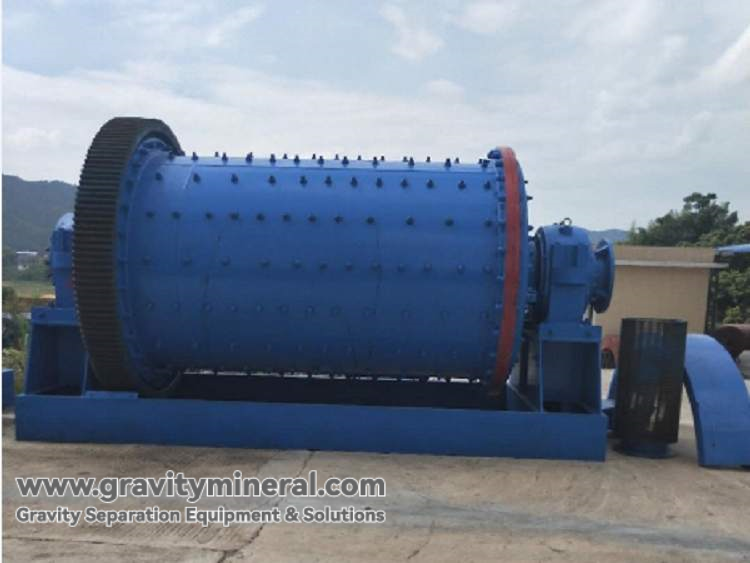
ProcessThe complete process can be broken down into five stages, with each stage addressing a specific issue.
Crushing
The raw ore enters the jaw crusher for primary crushing, reducing it to a size suitable for processing by the mill.
Gravity Separation – Early Recovery
The classified sand is fed into a sawtooth jig for roughing and then re-concentration to produce gold concentrate.
Bottom-feed recovery
Gravity separation tailings are sent to flotation or cyanide leaching to recover fine-grain gold.
Dewatering
Thickener paired with a filter press; concentrate is transported, and tailings are dry-discharged.
From “density-based stratification” to “flotation enrichment,” and then to “sodium cyanide dissolution recovery,” each stage targets a specific recovery window, ensuring comprehensive recovery at every level and leaving no fine-grained gold behind.
Scheme Comparison: Pilot Testing vs. Direct Production Line Implementation
ComparisonWhen the two approaches are compared side by side, the differences are clear.
| Comparison Criteria | Direct Implementation on the Production Line | Pilot Testing + EPC |
|---|---|---|
| Process Basis | Experience, practice | Mineral sample test data |
| Recovery Risk | Relatively high; there is a risk of failing to recover the expected amount of gold | Controllable; the process is well-founded |
| Pre-production Investment | Investment involves installing equipment | Conduct trials first; investment is controllable |
| Chain of Responsibility | Multiple equipment suppliers; interfaces managed independently | A single EPC contractor coordinates everything, ensuring a seamless chain of responsibility |
| Retrofit Costs | Rework after commissioning is costly | Well-defined processes minimize rework |
It\'s not that going straight to production is necessarily wrong, but conducting trials first is generally a safer approach until the properties of the ore are fully understood. The value of EPC (a turnkey solution covering design, procurement, manufacturing, installation, and commissioning) lies in applying this “safety” to the entire production line.
Equipment Configuration and Technical Specifications
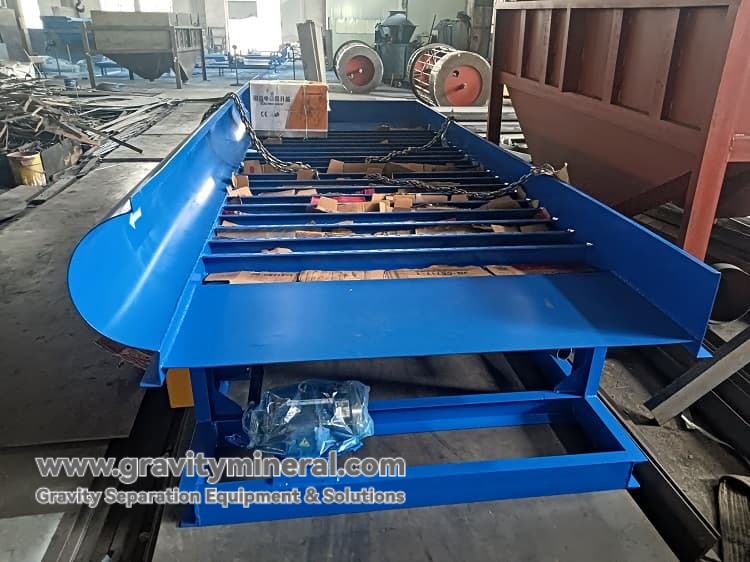
EquipmentThe list of main equipment and key technical points can be summarized in a single table.
| Process Steps | Common Equipment | Technical Specifications |
|---|---|---|
| Crushing | Jaw Crusher | Primary crushing; controls feed particle size |
| Grinding | Ball Mill, Spiral Classifier | Closed-circuit grinding, aligning particle size and production capacity |
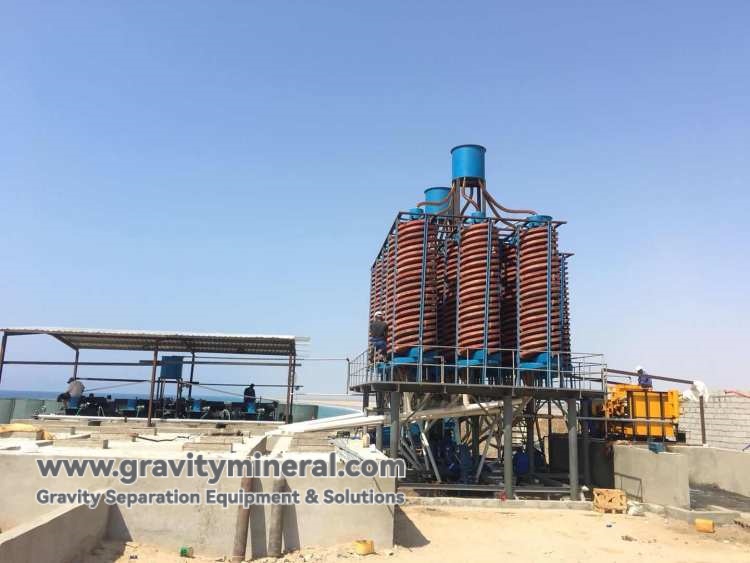
| Gravity Separation | Sawtooth jig, 6-S shaking table, centrifugal separator | Early recovery where possible; coarse and fine fractionation |
| Fine-grain stage | Agitated Chute (Fine-Grain Gold Recovery Chute) | Sweep selection to supplement fine-grain free gold |
| Dewatering | High-efficiency thickener, filter press | Concentrate Transportation, Dry Tailings Discharge |
Here\'s a point that\'s often overlooked: the separation point in gravity separation is critical. The higher the proportion of coarse-grained gold, the earlier the separation point should be set; the specific location should be determined by test data, not by experience.
Practical Implementation: How to Coordinate EPC
ImplementationFrom communication to production start-up, there are roughly five steps.
Sample Testing
Send representative ore samples to the equipment manufacturer for mineral processing tests; the results serve as the basis for process design and equipment selection. This step is typically free of charge.
Proposal and Quote
Based on the test results, we finalize the process flow and provide a list of selected equipment along with a transparent quote—all in a single document that clearly outlines “the process flow, the equipment configuration, and the total cost.”
Design Drawings
Process flow, equipment configuration, site layout, civil engineering requirements, and technical briefing are all provided in a single set of documents.
Manufacturing and Shipping
Production scheduling at our own facility, factory acceptance testing, and logistics coordination to ensure the equipment arrives safely at the destination port.
Installation, Commissioning, and Training
Engineers are on-site to supervise installation, conduct integrated commissioning tests with materials provided, and train operators. You may organize local civil construction and general installation workers, while the supplier dispatches engineers to oversee technical compliance.
EPC does not mean that civil engineering and labor are automatically included. The equipment manufacturer is fully responsible for design, manufacturing, installation guidance, commissioning, and training, while civil engineering and general labor are organized locally—ensuring quality while saving on labor costs.
Frequently Asked Questions
FAQQuestion 1: Is it okay to purchase equipment without receiving a sample first?
This carries significant risk. Without a clear understanding of the ore\'s properties and a well-defined processing flow, even the best equipment may fail to recover the expected amount of gold. The cost of testing is far less than the expense of rework after production begins.
Question 2: Is gravity separation the best first step for all gold deposits?
Not necessarily. If the ore consists primarily of fine-grained gold-bearing material with very little free gold, the benefits of a gravity separation stage will be limited, and the focus of the process should shift to leaching. To determine suitability, testing should be conducted first.
Question 3: Does an EPC contract cover everything?
We recommend maintaining some flexibility: take full responsibility for equipment manufacturing, process design, installation guidance, commissioning, and training, while organizing civil engineering and general installation labor locally—this can save a significant amount on labor costs.
Conclusion and Recommendations
ConclusionThe trial should clearly define “how much to charge and how to charge it.”
EPC takes full responsibility for “how to build, how to install, and how to commission” all at once.
Only when both ends are aligned can the production line run smoothly.
For gravity-based gold recovery processing schemes, the process is determined through testing and implemented via EPC.
If you have this type of ore or wish to add a gravity separation stage to an existing production line, simply send us the grade, particle size, gold occurrence state, and processing capacity. For projects where the process can be determined directly, we\'ll proceed to equipment selection and pricing; for those requiring validation, please send samples for testing.
We handle both process design and equipment manufacturing, ensuring a seamless chain of responsibility.