







Is it difficult to process high-clay gold ore? How can gravity separation processes efficiently recover gold resources?
I. Industry Background: The Challenges of Processing High-Clay Gold Ore—Where Do the Difficulties Lie?
The difficulty in processing high-clay gold ore essentially stems from the problem of “gold trapped in clay.” When clay minerals come into contact with water, they swell and turn into mud, trapping gold particles inside mud clumps. The water flow in a jig cannot break through the cemented mud shell, nor can the centrifugal force of a centrifuge tear through this protective layer.As a result, the gold is carried away with the clay clumps, leading to persistently high tailings grades and low concentrate grades, and the efficiency of the gravity separation process is bottlenecked at the ore washing stage.
The unique aspect of this problem is that it does not depend on equipment precision, but rather on the thoroughness of liberation. If the clay structure is not broken up during the ore washing stage, even the most sophisticated downstream gravity separation equipment will be ineffective. Ultimately, the difficulty in processing high-clay gold ore lies in the very first step of process design—how to remove the clay and expose the gold.
From the perspective of ore properties, high-clay gold ores share several notable characteristics. Gold particles tend to be relatively coarse; fine-grained gold is more easily carried away and dispersed by clay during weathering, leaving behind mostly coarse-grained gold or aggregates cemented by clay—which actually presents favorable conditions for gravity separation.The clay minerals are primarily kaolinite, illite, and montmorillonite; montmorillonite exhibits the strongest swelling when exposed to water and presents the greatest challenge during ore washing. Clay content fluctuates significantly—ore properties during the rainy season and dry season can differ drastically—so the process must allow for operational flexibility.
GravityMineral has specialized in gravity separation for two decades and has accumulated extensive experience in processing ore with high clay and silt content. We have a wealth of historical data to draw upon—from ore washing and scrubbing intensity to the configuration of gravity separation stages.
II. Technical Principles: The Logic Behind High-Efficiency Gold Recovery in Gravity Separation Processes
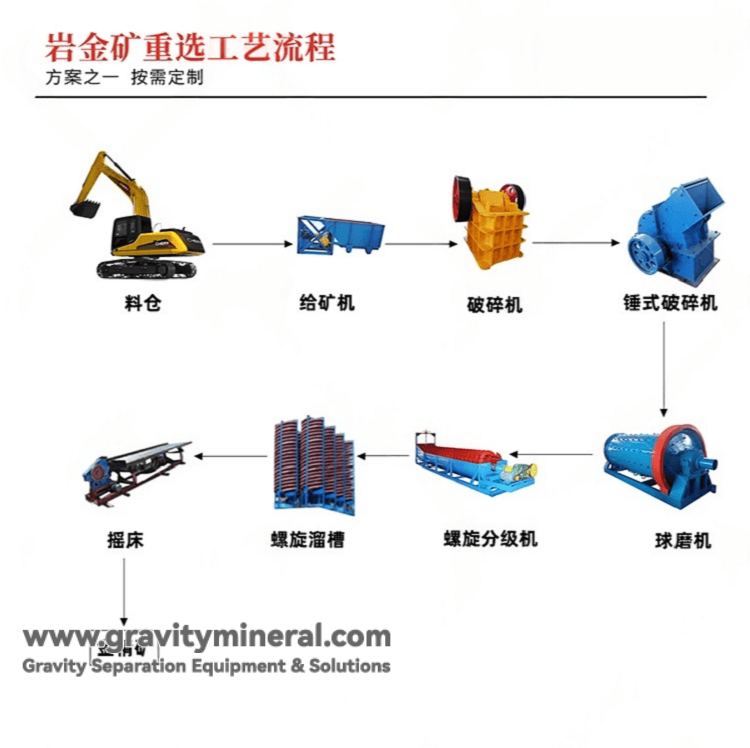
The core logic behind the gravity separation process for efficiently recovering gold resources lies in utilizing the density difference between gold and gangue minerals to achieve separation in a water flow or centrifugal field. Gold has a density of approximately 19.3 g/cm³, which is significantly higher than that of common gangue minerals; this distinct density difference is a prerequisite for the feasibility of gravity separation.
However, the challenge with gold ores containing high clay content is that this density difference is “masked” by a clay coating.When gold particles are coated with clay, their overall density is reduced, causing them to settle more like mud clumps than individual gold particles, making them unrecognizable to gravity separation equipment. Therefore, the prerequisite for the gravity separation process to efficiently recover gold resources is first to break open the clay coating and expose the gold particles—this is the purpose of ore washing and scrubbing.
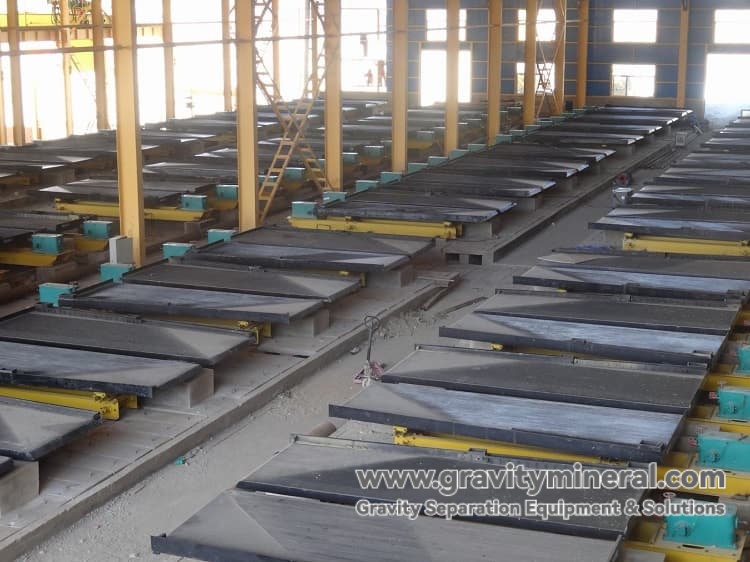
After washing, the material is sorted by particle size and fed into different gravity separation equipment. The coarse fraction is processed using a jig, where pulsating water flow loosens the bed layer, causing heavy minerals to sink and light minerals to float; the fine fraction is processed using a centrifugal separator, where centrifugal force enhances the settling of fine heavy minerals;refining is performed using shaking tables, where the differential motion of the bed surface, combined with transverse water flow, further enhances the grade of the already-enriched coarse concentrate. Each of these three stages performs its specific function, forming the core framework of the gravity separation process for the efficient recovery of gold ore resources.
It is important to emphasize that the high efficiency of the gravity separation process in recovering gold resources does not mean a single piece of equipment can handle everything. Jigging machines struggle with particles finer than 0.037 mm; centrifuges are susceptible to slime; and shaking tables have a low throughput. The proper particle size transition between equipment and the de-sliming process determine whether the entire line can operate smoothly.
III. Process Flow: Segmented Configuration from Ore Washing to Concentration
The gravity separation process for high-clay gold ore can be organized in the following sequence: “ore washing and scrubbing—screening and classification—coarse-grain jigging—fine-grain centrifugation—concentrate shaking table.”
- Step 1: Ore washing and scrubbing. The raw ore enters a trommel washer or spiral washer, where it is washed with water to break up clay agglomerations. The intensity of the scrubbing depends on the drum rotation speed, the configuration of the internal agitation plates, and the flushing water pressure; if these three parameters are not properly coordinated, the clay shells will not break apart.
- Step 2: Screening and Classification. The scrubbed material passes through a trommel screen or circular vibrating screen, separating it into three fractions: coarse particles, fine particles, and overflow. The coarse particles feed into the jig, the fine particles into the centrifuge, and the fine slurry in the overflow is processed separately.
- Step 3: Coarse-grain jigging. The coarse-grain fraction from the screen enters a sawtooth-wave jig to recover free gold particles larger than 0.2 mm. The stroke is appropriately increased to ensure the bed remains loose and prevent mud from caking.
- Step 4: Fine-Grain Centrifugation. The undersize fines, after having the -10 μm clay removed by a hydrocyclone, enter a centrifugal concentrator to recover ultrafine gold. The feed concentration is kept relatively low, and the backwash water pressure is set slightly higher to flush away the sticky clay.
- Step 5: Concentrate shaking table. The coarse concentrates from the jig and centrifuge are combined and fed into a 6-S shaking table for fine selection, raising the grade to meet the requirements for subsequent processing.
- Step 6: Treatment of Fine-Grain Overflow. The -1 mm fine particles in the ore washing overflow contain dissociated fine-grain gold and cannot be sent directly to the tailings. A centrifuge or blanket chute can be used to perform a preliminary separation, enriching the heavy minerals first; if conditions permit, the material can be fed into the grinding and leaching system.
IV. Comparison of Process Schemes: Selection of Gravity Separation Routes Under Different Ore Conditions
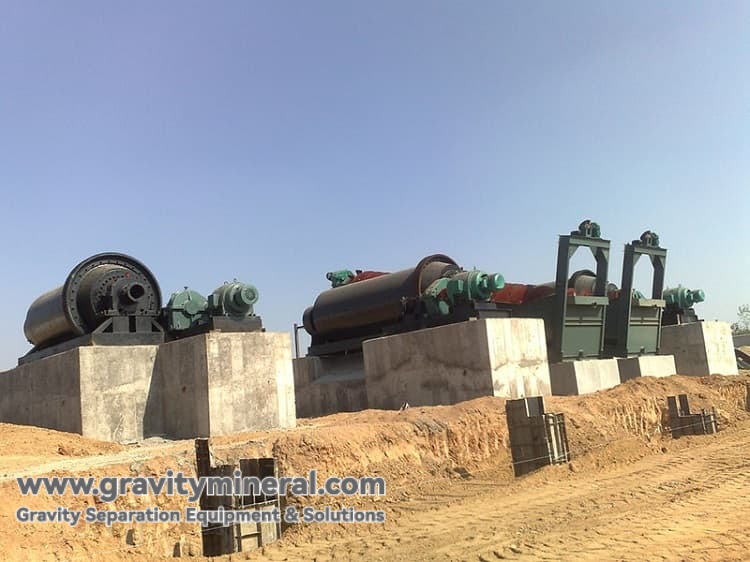
Processing schemes for high-clay gold ores vary significantly, depending on the distribution characteristics of gold particles, clay type, and silt content. The table below provides a general comparison based on common operating conditions; specific configurations should be determined based on mineral sample test data.
| Scheme | Applicable Conditions | Main Equipment | Advantages and Disadvantages |
|---|---|---|---|
| Single-Stage Gravity Separation | Coarser gold particles, good single-particle liberation, moderate clay content | Mineral Washer + Jig + Shaking Table | Low cost, no chemicals required; limited recovery of fine particles |
| Gravity Separation + Centrifugal Screening | Primarily coarse gold with some fine gold | Ore washer + jig + centrifuge + shaking table | Improved recovery of fine-grain gold; slightly more complex process |
| Gravity Separation Followed by Leaching | High proportion of coarse free gold | Gravity separation stage + tailings leaching | Early recovery of coarse particles to prevent overgrinding; reduced leaching load |
| Leaching followed by gravity separation | Fine-grained disseminated gold with complex associations | Leaching stage + shaking table/centrifuge for scavenging | Suitable for complex ores; gravity separation serves as a supplementary finishing process |
| Combined gravity separation and flotation | Sulfide ores, fine-grained encapsulated gold | Gravity separation stage + flotation machine | Coarse-grain gravity separation for early recovery; fine-grain flotation as a backup |
The choice of processing route depends primarily on the particle size distribution of the gold. If the proportion of coarse free gold is high, placing gravity separation at the front end is more cost-effective, as coarse gold dissolves slowly in the leaching system and is prone to deposition losses.If fine-grained embedded gold predominates, a “leaching-first, gravity-second” or combined gravity-flotation process is more suitable. For ores with highly expansive clay, the washing section should be extended, and a margin should be allowed for scrubbing intensity.
V. Equipment Configuration: Key Considerations for Core Gravity Separation Equipment and Supporting Systems
The gravity separation process efficiently recovers gold resources; the key to equipment configuration lies in particle size coordination and capacity matching. The key points for configuring core equipment and supporting processes are as follows.
| Process Stage | Equipment | Configuration Key Points |
|---|---|---|
| Ore Washing | Trommel Washer/Spiral Washer | The length-to-diameter ratio of the drum must be sufficient; the angle of the cutting blades should be adjusted according to the plasticity of the clay; the flushing water pressure is adjustable |
| Screening | Trommel Screen / Circular Vibrating Screen | Screen aperture size is determined by the feed particle size for gravity separation; the section length ensures complete screening |
| Desliming | Hydrocyclone/Desliming Hopper | Essential prior to the centrifuge to remove -10 μm silt and stabilize the feed to the centrifuge |
| Rough Selection | Sawtooth-wave jig | Adjustable stroke and frequency; ensures sufficient bed looseness to prevent sludge caking |
| Sweep Selection | Centrifugal Mineral Separator | Independent and adjustable backwash system; controls feed concentration when it is low |
| Enrichment | 6-S Shaking Table | Adjustable lateral slope; water flow rate adjusted according to slime volume |
| Dewatering | Thickener/Filter Press | Concentrate has low moisture content for easy transportation; dry tailings discharge complies with regulations |
When selecting equipment, high-clay ores place one level higher demands on the ore washing machine and desliming stages than conventional rock gold ores.The drum diameter-to-length ratio of drum washers must be sufficient; screw washers are suitable for ore with exceptionally high clay content, and the screw blades must be treated for wear resistance; it is critical that the backwash water system of centrifuges be independently adjustable, as different particle sizes require different backwash water pressures, and fixed systems can be cumbersome to operate.
VI. Common Technical Issues: Practical Questions Regarding Gravity Separation of High-Clay Gold Ore
VII. Conclusions and Recommendations
Washing gold ore with high clay content is challenging; the key to overcoming this lies in the washing and scrubbing stages, not in the gravity separation equipment itself. Only once the clay coating is broken can jigs, centrifuges, and shaking tables be effectively utilized. The prerequisite for an efficient gravity separation process to recover gold resources is a rational process segmentation, smooth particle size transitions, and thorough desliming.
The properties of clay and the distribution of gold particles vary greatly from mine to mine; there is no single set of parameters that works for all cases. It is far more reliable to design a process flow after clearly organizing data on particle size distribution, clay mineral types, and gold particle distribution characteristics than to simply copy a template.The challenge of processing high-clay gold ores is not insurmountable; the path to efficiently recovering gold resources through gravity separation is clear. The key lies in fine-tuning the details and conducting proper commissioning.