6-S Shaking Table | High-Efficiency Gravity Separation and Fine Mineral Concentrator
6-S shaking table (also called 6S shaking table or fiberglass mineral shaking table) is one of the world's most widely used and efficient gravity concentration machines. With an exceptional enrichment ratio often exceeding 100 times, this mineral separation equipment upgrades low-grade ore and cleans rough concentrate without any harmful chemicals such as cyanide or mercury, making it the ultimate solution.
As a top-tier gold shaking table, its specialized design efficiently recovers fine and ultrafine heavy minerals, excelling at separating placer gold, rock gold, tungsten, tin, tantalum, niobium and other rare metals. The machine handles ores across a wide particle-size range, performing roughing (2–0.5 mm), washing (0.5–0.074 mm) and scavenging (−0.074 mm) precisely. In mineral processing flowsheets it serves as the core cleaning unit in the alluvial gold gravity separation plant solution and the wolframite gravity processing solution.
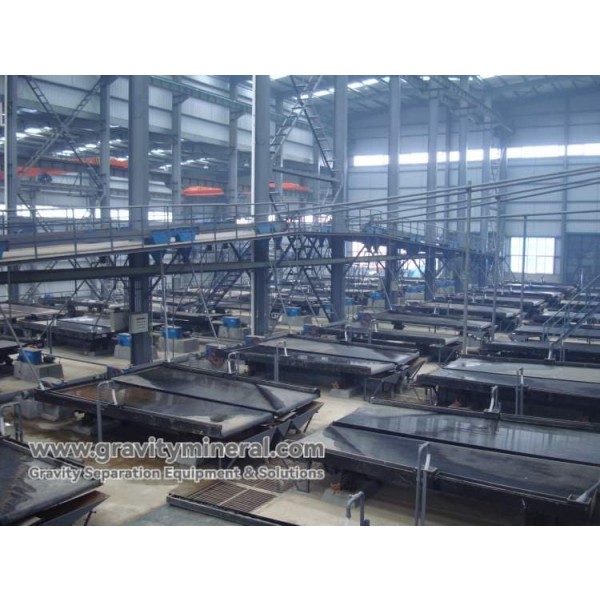
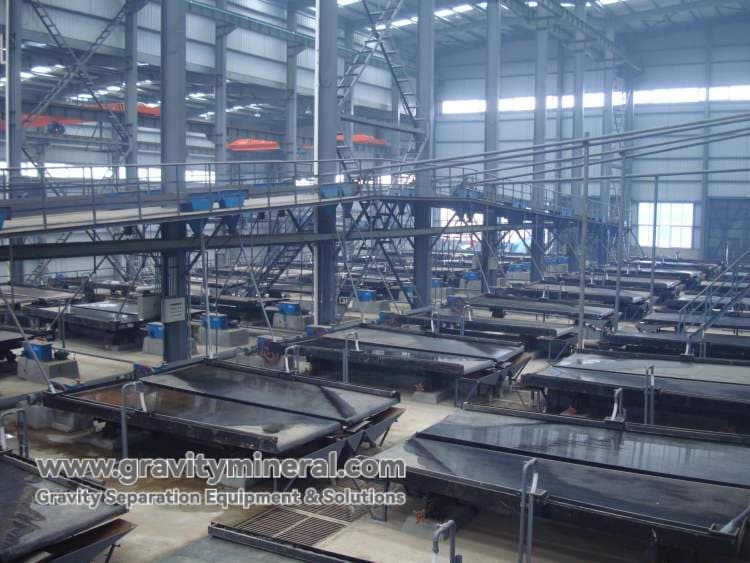
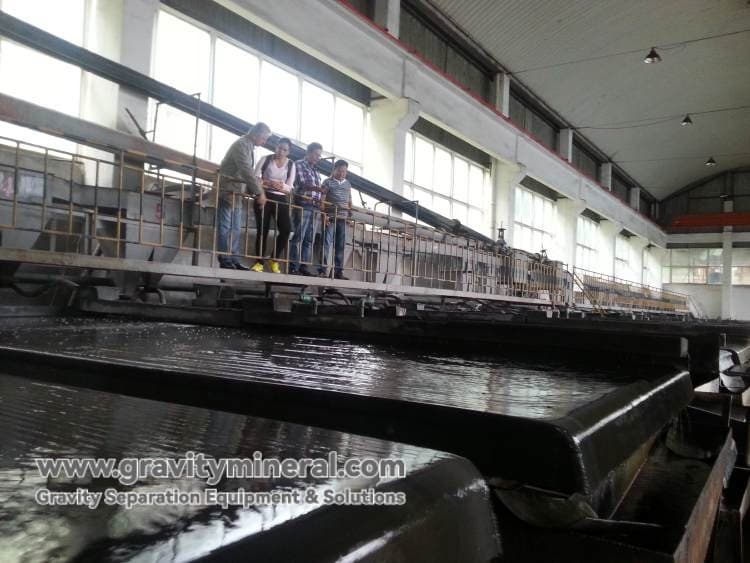
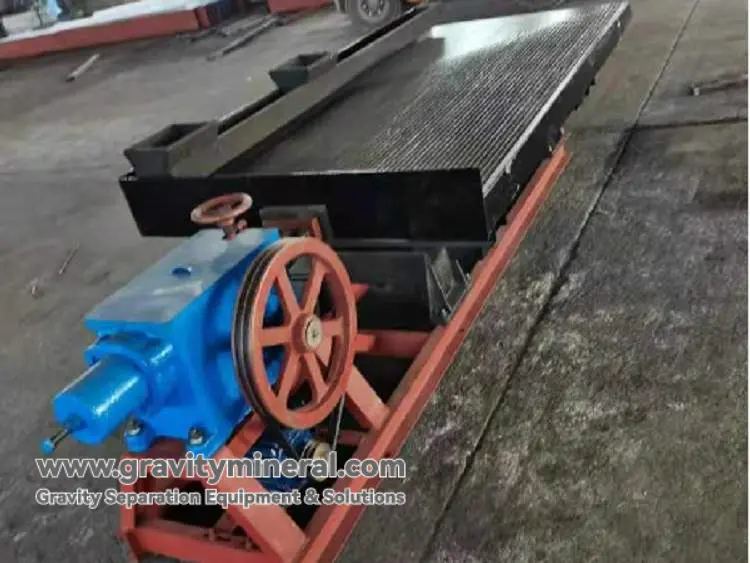
Using an advanced fiberglass-reinforced plastic (FRP) deck, this gravity separator clearly reveals the banding of concentrate, middlings and tailings, making operation and adjustment intuitive for miners.
How the 6-S Shaking Table Works
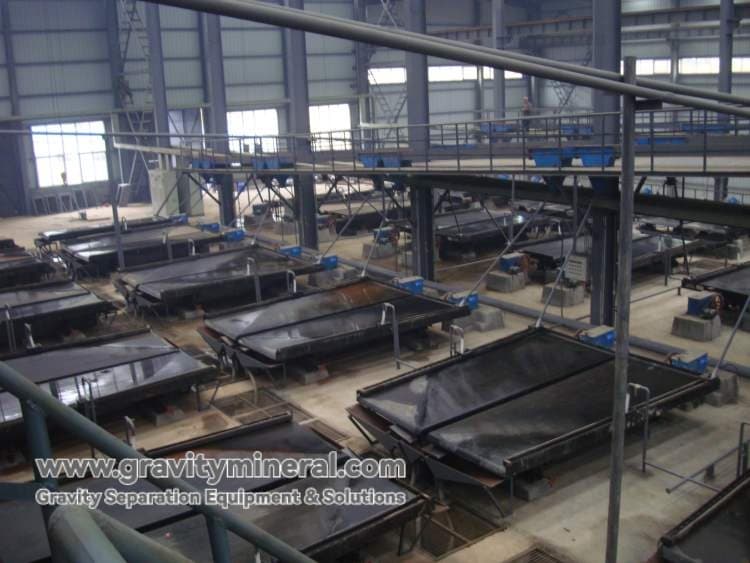
The entire separation process of the 6-S shaking table takes place on a sloping deck fitted with riffles. The mineral particle group is fed from the feed box at the upper corner of the deck, while wash water is supplied laterally by the water box. Under the combined action of gravity, the impact of cross flow, and the inertial and frictional forces created by the deck's asymmetric reciprocating motion, particles stratify by specific gravity and size, moving longitudinally along the deck and transversely down its slope.
- Asymmetric reciprocating motion: the drive head generates an asymmetric motion——the deck advances slowly then rebounds quickly. This inertial force drives heavy particles forward along the riffles.
- Gravity stratification: in the deck grooves (riffles), heavy minerals such as gold or tin settle to the bottom, while light minerals such as quartz sand are pushed to the top of the material bed.
- Cross-water washing: a thin film of wash water flows transversely across the sloping deck, carrying surface light minerals over the riffles and down into the tailings launder.
- Fan-shaped discharge: particles of differing specific gravity and size slowly flow in a fan from side A to side B along their own paths, discharging from different zones at the concentrate end and the tailings side, and finally splitting into concentrate, middlings and tailings.
Core Advantages of the 6-S Shaking Table
- High separation accuracy and enrichment ratio: minerals form a clearly visible fan-shaped distribution on the deck. High-grade concentrate bands separate sharply from middlings and light tailings, allowing precise cut-point setting and a high enrichment ratio.
- Durable FRP deck: traditional wooden decks have been replaced by advanced fiberglass-reinforced plastic (FRP) coated with corundum. This material offers high wear resistance, water resistance and corrosion resistance, resists deformation and rot, and has a long service life.
- Flexible adjustment: stroke length and transverse tilt angle can be adjusted instantly during operation, letting operators adapt quickly to changes in ore grade or feed rate. Springs are housed inside the box for a compact structure.
- Eco-friendly, no chemicals: operating purely on specific gravity and water flow, it delivers a 100% environmentally friendly, zero-chemical-addition solution for gold and heavy metal recovery.
- Easy installation and operation: the machine is easy to install, simple to operate and convenient to attend; the stroke is easy to adjust, and the deck stays balanced while the transverse slope and stroke are changed.
Applicable Minerals and Whole-Line Integration
The 6-S shaking table is widely used to separate tungsten, tin, tantalum, niobium, iron, manganese, chromium, titanium, bismuth, lead, gold and other non-ferrous and precious metal ores, and is also used in coal processing. It suits roughing, cleaning and scavenging duties across coarse sand (2–0.5 mm), fine sand (0.5–0.074 mm) and slime (−0.074 mm) size fractions. When treating tungsten and tin ores, the effective recovery size range is 2–0.022 mm.
| Application |
Typical minerals |
Supporting process / line |
| Precious metal cleaning |
Placer gold, rock gold (free gold), platinum, silver |
Alluvial gold gravity separation plant solution, Rock gold gravity separation plant solution |
| Heavy mineral sand separation |
Zircon, rutile, ilmenite, monazite |
Titanium-zircon placer gravity + magnetic/electric solution, Heavy mineral sand gravity + magnetic + electric solution |
| Non-ferrous and rare metals |
Tungsten (wolframite/ferberite), tin (cassiterite), tantalum, niobium, lead |
Wolframite gravity processing solution, Tantalum-niobium beneficiation plant solution |
| Ferrous metals and coal |
Fine iron ore, manganese ore, chromite, coal |
Chromite gravity + magnetic separation solution, Ilmenite gravity + magnetic separation solution |
In the process flow, the 6-S shaking table commonly serves as the cleaning unit, with a sawtooth-wave jig separator upstream for roughing and tailings rejection, or a fiberglass spiral chute for fine particles. A cone classifier or hydrocyclone is recommended ahead of feeding to remove ultrafine slime; a high-frequency vibrating screen can be used to dewater fine tailings.
6-S Shaking Table Technical Specifications
Note on deck types: we offer three specific deck designs to match your ore size: a coarse sand deck (for 2–0.5 mm), a fine sand deck (for 0.5–0.074 mm) and a slime deck (for −0.074 mm).
| Model |
Deck type |
Separation area (m²) |
Max feed size (mm) |
Capacity (t/h) |
Feed density (%) |
Stroke (mm) |
Stroke frequency (r/min) |
Motor power (kW) |
| 6-S 7.6 |
Coarse sand deck |
7.6 |
2 |
1.1-1.2 |
20-30 |
16-22 |
220 |
1.1 |
| Fine sand deck |
7.6 |
0.5 |
0.5-1 |
18-25 |
11-16 |
250 |
1.1 |
| Slime deck |
7.6 |
0.074 |
0.3-0.5 |
15-20 |
8-16 |
280 |
1.1 |
| 6-S 4.08 (medium) |
4.08 |
Sand -2 / slime -0.1 |
0.4-1.5 |
10-30 |
6-30 |
210-320 |
1.1 |
| 6-S 1.95 (small) |
1.95 |
Sand -2 / slime -0.074 |
0.3-0.8 |
10-30 |
12-28 |
250-450 |
1.1 |
| 6-S 0.5 (laboratory) |
0.5 |
Sand -2 / slime -0.074 |
0.05-0.2 |
- |
9-17 |
280-460 |
0.55 |
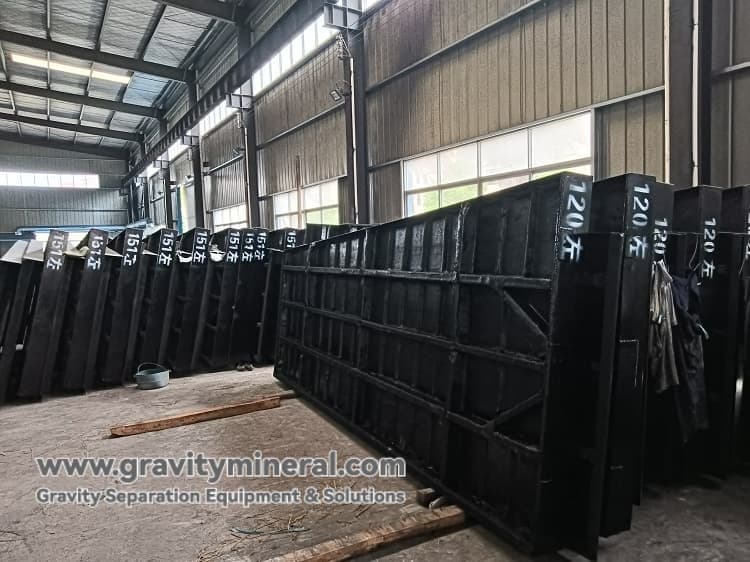
Important ordering note: depending on your plant layout, the 6-S shaking table can be configured as a left-hand or right-hand model. To identify it: stand at the drive head looking toward the concentrate end; if the feed box is on the right, it is a right-hand table. Riffle cross-sections can be rectangular, sawtooth-wave or triangular.
From a Single Shaking Table to Complete Gravity Lines — Responsibility Not Outsourced
The separation performance of the 6-S shaking table depends on matching stroke, stroke frequency, transverse slope and feed particle size. GravityMineral has specialized in gravity separation and gravity equipment manufacturing for 20 years; equipment is produced in our own two manufacturing bases, with process and mechanical engineers working in one team——the deck area, riffle profile and stroke configuration of each 6-S shaking table are set from process data and share the same source as the whole-line design drawings, avoiding the disconnect of “cleaning equipment and roughing equipment with mismatched capacity.”
- Own manufacturing bases: core equipment is produced in GravityMineral's own two manufacturing bases, with full quality control from raw material procurement through machining, assembly and no-load test running; every machine has strict inspection records before leaving the factory.
- ISO9001 quality system: the company is ISO9001 certified, with qualifications including S-certified supplier and National High-Tech Enterprise.
- Whole-line interface matching: the 6-S shaking table, sawtooth-wave jig separator, fiberglass spiral chute and cone classifier are capacity-matched as one system, reducing blockages and tailings losses.
- Global delivery experience: products have been exported to 50+ countries, with familiarity in logistics and customs clearance across Africa, Southeast Asia, South America, the Middle East, Central Asia, South Asia and Australia; a 500+ global case library supports 6-S shaking table selection.
- Delivery and after-sales: engineers supervise installation and commissioning on site, leading single-machine and integrated test runs and training customer personnel; 1-year warranty with long-term spare parts and process optimization support.
- Flexible cooperation models: buy equipment only, commission drawing design only, hire engineers for on-site commissioning only, or go full-process EPC turnkey — on your schedule and budget.
6-S Shaking Table FAQ
Q1: How much does a 6-S shaking table cost? How is the price calculated?
Price depends on deck area, deck type and order quantity; the 6-S series offers 7.6 m², 4.08 m², 1.95 m² and 0.5 m² (laboratory) options. Small machines cost less and large ones more; provide your ore type and capacity for an engineer's quotation.
Q2: What is the difference between a shaking table, a jig and a spiral chute? Which to choose?
For coarse heavy minerals (2–30 mm, such as nugget placer gold) choose a jig separator; for fine/ultrafine particles (<2 mm) roughing choose a spiral chute; the 6-S shaking table delivers the highest accuracy and enrichment ratio, suited to cleaning. A common combination is "jig/chute roughing + shaking table cleaning".
Q3: How many tons per hour can a 6-S shaking table process? How to select the model?
The 7.6 m² model handles about 0.3-1.2 t/h (varying by coarse sand/fine sand/slime), the 4.08 m² about 0.4-1.5 t/h, the 1.95 m² about 0.3-0.8 t/h, and the 0.5 m² about 0.05-0.2 t/h. Choose a small deck for pilot or small-scale work, and the 7.6 m² for plant cleaning.
Q4: How to choose coarse sand, fine sand or slime decks? How fine can they separate?
Coarse sand deck (2–0.5 mm), fine sand deck (0.5–0.074 mm) and slime deck (−0.074 mm, with shallower riffles that capture heavy particles down to 0.022 mm). For tungsten and tin the effective recovery range is 2–0.022 mm; select the deck by the ore's size distribution.
Q5: What feed size and pulp density does the 6-S shaking table require? Is classification needed?
Feed should be ground to typically below 2 mm and strictly classified, with a pulp density around 10%-30% (by deck type). A cone classifier or hydrocyclone is strongly recommended upstream to remove ultrafine slime so particles reaching the deck are relatively uniform, ensuring recovery.
Q6: How high is the enrichment ratio? Are chemical reagents used?
The enrichment ratio often exceeds 100 times, upgrading low-grade ore and cleaning rough concentrate. It operates purely on specific gravity and water flow, 100% environmentally friendly with zero chemical addition, using no cyanide or mercury, ideal for gold and heavy metal recovery.
Q7: Which is better, a fiberglass (FRP) deck or a wooden deck?
Traditional wooden decks have been replaced by fiberglass (FRP) with a corundum coating, offering high wear resistance, water and corrosion resistance, and resistance to deformation and rot, with a long life. The deck clearly shows concentrate/middlings/tailings bands, making cut points easy to set.
Q8: Can the stroke and transverse slope be adjusted? How?
Yes. Stroke length and transverse tilt angle can be adjusted instantly during operation, adapting quickly to changes in ore grade or feed rate; springs are housed inside the box for a compact structure, and the deck stays balanced while slope and stroke are adjusted.
Q9: How to choose a left-hand or right-hand shaking table?
It depends on plant layout and access aisles. Stand at the drive head looking toward the concentrate end; if the feed box is on the right, it is a right-hand table. Confirm the drawing with the engineer before ordering so on-site piping is not affected.
Q10: What minerals suit the 6-S shaking table? Can it be custom-built? What is the lead time?
It treats tungsten, tin, tantalum-niobium, iron, manganese, chromium, titanium, bismuth, lead, gold and silver, and other non-ferrous and precious metals, plus coal, as in the alluvial gold gravity separation plant solution. Decks and riffle cross-sections (rectangular/sawtooth/triangular) can be customized by ore type; standard machines take 30-60 days to manufacture, with a 1-year warranty, on-site commissioning and training, and exports to 50+ countries.
Get a 6-S Shaking Table Selection Plan and Quotation
Tell us your ore type, feed particle size, target capacity (t/h), pulp density, plant space and left/right-hand installation requirement; GravityMineral engineers will prepare a 6-S shaking table selection plan, a gravity separation flowsheet and a transparent quotation.
You can reach us through the contact details on our website, or contact a sales engineer directly for selection advice; representative ore samples can be sent for separation tests.