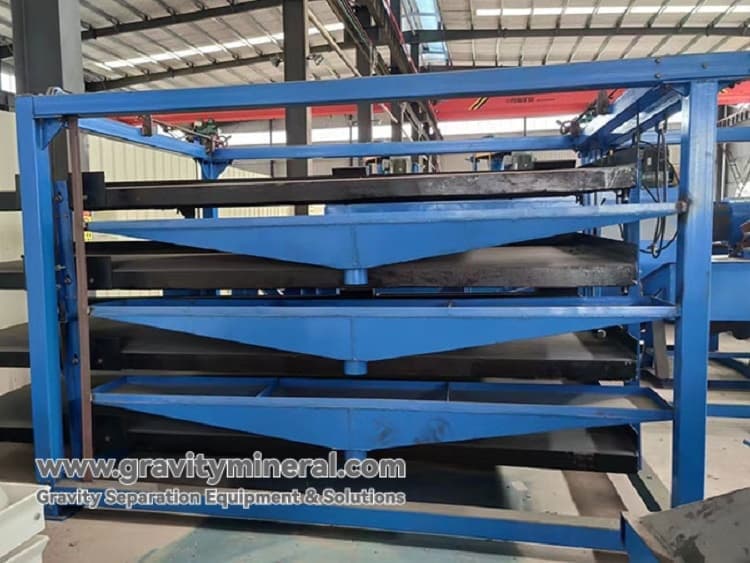
Multi-Deck Shaking Tables (3LYG / 4LYG Series) | Suspended Gravity Separation Equipment
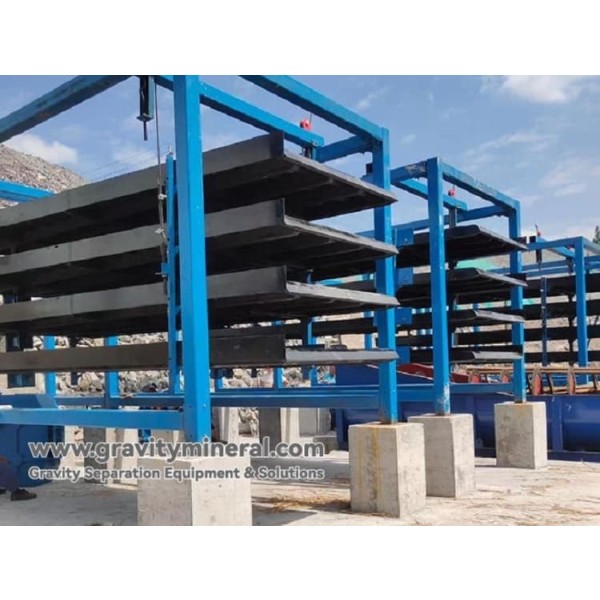
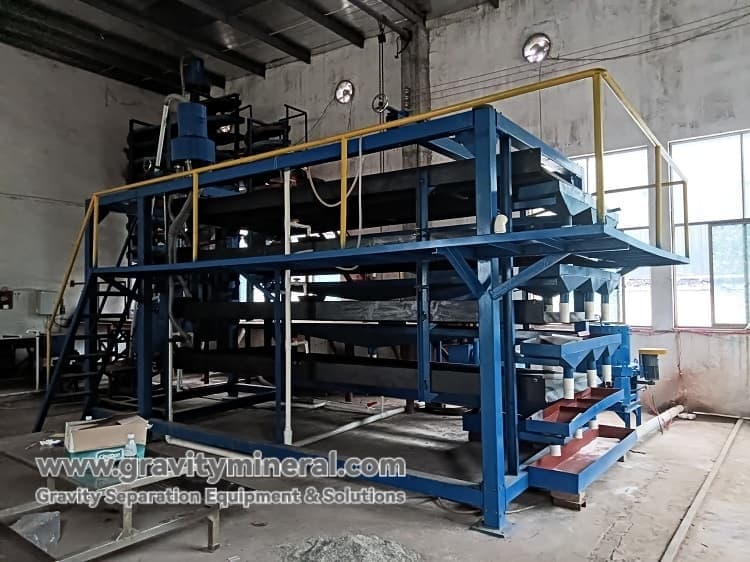
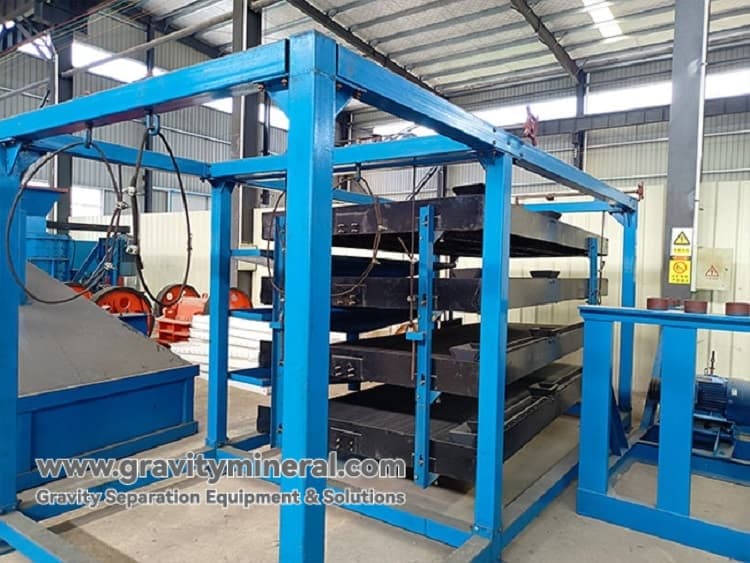
Multi-deck shaking tables (also known as multi-layer shaking tables, suspended vibrating tables, or multi-deck gravity separators) are innovative gravity separation machines designed to solve the most challenging space constraints in mineral processing plants. By vertically stacking multiple fiberglass decks (typically two to four layers), the machine delivers three to five times the throughput per unit floor area of a conventional single-deck shaking table.
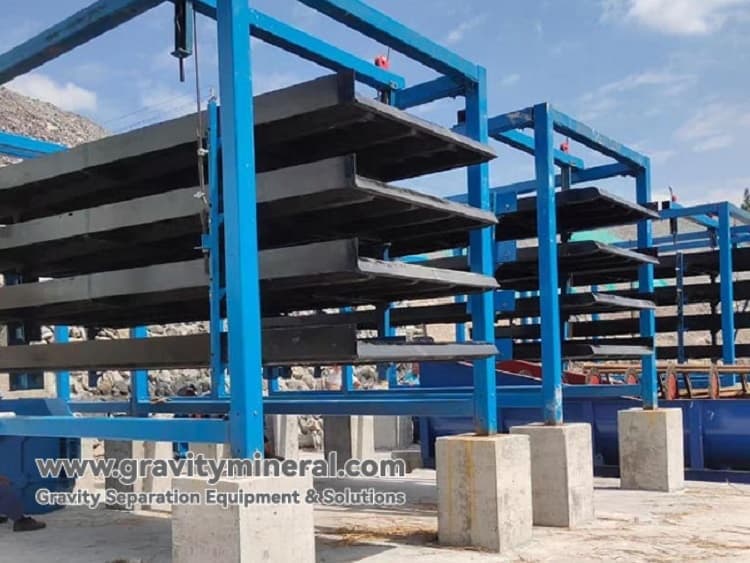
In addition to saving space, the suspended shaking table is equipped with a revolutionary self-balancing inertial mechanism. Unlike older 6-S shaking tables that rely on massive, expensive poured-concrete foundations to absorb vibration, this suspended design completely eliminates vertical jolting. The unit can be bolted directly to a light steel frame or installed on the upper floor of a multi-level processing plant. In mineral processing flowsheets, it is often used as a cleaning unit in wolframite gravity separation solutions and alluvial tin gravity recovery solutions.
This double-deck vibrating table (and its three-deck and four-deck variants) handles fine particles from 2 mm down to 0.022 mm and performs exceptionally well in the roughing, cleaning, and scavenging of tungsten, tin, tantalum, niobium, gold, and other heavy metals.
How a Multi-Deck Shaking Table Works
A Shicheng multi-deck shaking table consists of eight parts: the deck, motor, slope adjuster, deck board, ore trough, water trough, riffles, and air inlet pipe. The deck's continuous longitudinal motion is driven by a crank-and-connecting-rod mechanism: the motor turns the large drive pulley through a chain drive, rotating the crankshaft, and the rocker arm moves up and down. When the rocker arm moves downward, the toggle plate pushes the rear support and reciprocating rod backward, compressing the springs; because the deck is connected to the reciprocating rod through the linkage seat, the deck also moves backward. When the rocker arm rises, the spring force pushes the deck forward. Under the combined action of the cross water flow and the deck's asymmetric reciprocating motion, the slurry stratifies by specific gravity and particle size and is finally discharged from the concentrate end and the tailings end respectively.
Core Advantages of the Multi-Deck Shaking Table
- 300% greater space utilization: The vertical multi-deck structure triples plant capacity without expanding the building, sharply reducing capital expenditure on workshop construction. Deck boards are mounted in layers on the same frame, making them easy to install and remove and increasing output per unit floor area.
- No concrete foundation required: The inertial deck uses a steel-cable suspension system to self-balance the reciprocating force, with no vertical exciting force and therefore no vertical vibration. It can be installed quickly and flexibly on a light steel structure or mounted on a fixed support frame.
- 40% energy saving: The heavy deck runs suspended rather than dragging on slide rails, greatly reducing frictional resistance. A small-power motor is sufficient to drive it, delivering significant energy savings.
- Variable frequency drive (VFD): A variable-frequency speed controller lets the operator precisely adjust the stroke frequency (270–360 r/min) for different feed conditions and ore types. Changing the counterweight blocks alters the shaking table stroke.
- Highly wear-resistant deck: The fiberglass deck board with wear-resistant riffles resists abrasion, water, cracking, and corrosion, with minimal deformation, little maintenance, and a long service life.
Industrial Applications and Whole-Line Integration
Multi-deck shaking tables are widely used to separate tungsten, tin, tantalum, niobium, iron, manganese, chrome, titanium, bismuth, lead, gold, and other rare and precious metal ores, and can also serve the coal industry. They suit roughing, cleaning, and scavenging duties and different particle sizes: coarse sand (2-0.5 mm), fine sand (0.5-0.074 mm), and slime (-0.074 mm). For tungsten, tin, and other iron-bearing sands, the effective recovery range of a shaking table is 2-0.022 mm.
In a typical process flow, the multi-deck shaking table serves as a cleaning unit: upstream it can be paired with a sawtooth-wave jig separator for roughing and tailings rejection, or a fiberglass spiral chute for fine particles. For clay-rich feed, washing and desliming can use a spiral log washer or a rotary scrubber; dewatering of fine tailings can use a high-frequency vibrating screen.
3LYG / 4LYG Series Multi-Deck Shaking Table Technical Specifications
Below are the standard specifications for the three-deck (3LYG) and four-deck (4LYG) models. As with standard screening decks, coarse sand, fine sand, or slime deck surfaces can be configured. Riffle cross-sections are available in rectangular, sawtooth, or triangular profiles.
| Parameter |
3LYG-Coarse sand |
3LYG-Fine sand |
3LYG-Slime |
4LYG-Coarse sand |
4LYG-Fine sand |
4LYG-Slime |
| Deck concentration area (m²) |
7.6 × 3 |
7.6 × 3 |
7.6 × 3 |
7.6 × 4 |
7.6 × 4 |
7.6 × 4 |
| Max. feed size (mm) |
2 |
0.5 |
0.074 |
2 |
0.5 |
0.074 |
| Capacity (t/h) |
4-5 |
2-3 |
1.5-2.5 |
5-6.5 |
3-5 |
2-3.5 |
| Feed density (%) |
20-30 |
18-25 |
15-20 |
20-30 |
18-25 |
15-20 |
| Stroke (mm) |
8, 10, 12, 15, 18, 20, 22 (optional) |
| Stroke frequency (r/min) |
270—360 (variable-frequency control) |
| Water consumption (t/h) |
0.7-1 |
0.4-0.7 |
0.4-0.7 |
0.7-1 |
0.4-0.7 |
0.4-0.7 |
| Motor power (kW) |
1.5 |
| Overall dimensions (mm) |
6330 × 2450 × 2660 |
From a Single Shaking Table to Complete Gravity Separation Lines, With No Outsourced Responsibility
The separation performance of a multi-deck shaking table depends on how well the stroke, stroke frequency, cross slope, and feed size are matched. GravityMineral has specialized in gravity separation and gravity concentration equipment for 20 years, with equipment built at two owned manufacturing bases and process and mechanical engineers working in one team——the deck area, number of layers, and stroke configuration of a multi-deck shaking table are set from process data and share the same source as the whole-line design drawings, avoiding the problem of “a cleaning unit whose capacity is mismatched with the roughing unit”.
- Own manufacturing bases: Core equipment is produced at two GravityMineral-owned manufacturing bases, with full quality control from raw material procurement through machining, assembly, and no-load test running. Every unit has strict inspection records before it leaves the factory.
- ISO9001 quality system: The company is ISO9001 certified, and its products hold S-certified supplier, national high-tech enterprise, and other qualifications.
- Whole-line interface matching: The throughput of the multi-deck shaking table is calculated together with the sawtooth-wave jig separator, fiberglass spiral chute, and high-frequency vibrating screen, reducing blockages and tailings losses.
- Global delivery experience: Products have been exported to more than 50 countries, with familiar logistics and customs clearance procedures across Africa, Southeast Asia, South America, the Middle East, Central Asia, South Asia, and Australia; a library of more than 500 global cases provides references for shaking table selection.
- Delivery and after-sales: Engineers provide on-site guidance for installation and commissioning, leading single-machine and interlocked test runs and training customer personnel; one-year warranty, with long-term spare parts and process optimization support.
- Flexible cooperation models: Buy equipment only, commission drawing design only, hire engineers for on-site commissioning only, or choose full-process EPC turnkey, all arranged around your schedule and budget.
Multi-Deck Shaking Table FAQ
Q1: How much does a multi-deck shaking table cost? How is the price calculated?
Price depends mainly on the number of layers (three or four), deck concentration area, and deck type; the 3LYG and 4LYG differ in price because of the layer count. Compared with multiple single-deck shaking tables that require large concrete foundations, a multi-deck shaking table saves workshop and foundation investment. We recommend providing the ore type and capacity for an engineer's quotation.
Q2: What is the difference between a multi-deck shaking table and a 6-S shaking table? Which should you choose?
The traditional 6-S shaking table is mostly single-deck, requires a massive concrete foundation, and occupies a large area; the multi-deck shaking table uses a suspended self-balancing structure, requires no concrete foundation, stacks three to four decks vertically, delivers three to five times the capacity per unit area, and is more energy efficient. Where space is tight or capacity is high, choose a multi-deck shaking table.
Q3: Does a multi-deck shaking table need a concrete foundation? Can it be installed upstairs or on a steel frame?
No. The inertial deck uses a steel-cable suspension system to self-balance the reciprocating force, with no vertical exciting force, so it can be bolted directly to a light steel frame or the upper floor of a multi-level plant. It also suits mobile or skid-mounted washing plants, saving substantial foundation and civil works costs.
Q4: How many tons per hour can a multi-deck shaking table handle? How do you select the model?
The 3LYG handles about 1.5-5 t/h and the 4LYG about 2-6.5 t/h, depending on the coarse sand, fine sand, or slime deck. Model selection considers ore type, feed size, feed density, and target capacity: three decks save space, four decks deliver higher capacity.
Q5: How fine can a multi-deck shaking table separate? Are there feed size requirements?
It handles coarse sand (2-0.5 mm), fine sand (0.5-0.074 mm), and slime (-0.074 mm); for tungsten, tin, and similar ores, the effective recovery range is 2-0.022 mm. Select the deck type according to your ore's own particle size distribution.
Q6: How do you choose between coarse sand, fine sand, and slime decks?
Choose by feed size: coarse sand deck (2-0.5 mm, high capacity, water consumption 0.7-1 t/h), fine sand deck (0.5-0.074 mm), and slime deck (-0.074 mm, feed density 15-20%). Riffle cross-sections can be rectangular, sawtooth, or triangular, with the feed density adjusted accordingly.
Q7: How does a multi-deck shaking table distribute slurry to each layer? Is the distribution even?
A top-mounted special slurry distributor is used: the feed pipe first delivers slurry into the distributor, which then splits it evenly through independent pipes to each deck, ensuring every layer runs at its best capacity with even distribution and no flow bias.
Q8: Can the stroke and stroke frequency be adjusted? How?
Yes. Stroke frequency is adjustable from 270 to 360 r/min through variable-frequency control, and the stroke can be set to 8/10/12/15/18/20/22 mm; changing the counterweight blocks alters the stroke, adapting to different feed conditions and ore types for optimal stratification and recovery.
Q9: What are the water and power consumption of a multi-deck shaking table? Is it energy efficient?
Water consumption is about 0.4-1 t/h depending on the deck type, and motor power is only 1.5 kW. The heavy deck runs suspended rather than dragging on slide rails, so friction is low and energy consumption can be reduced by 40%; a small motor can drive the multi-layer deck.
Q10: Which minerals suit a multi-deck shaking table? Can it be custom-built? What is the lead time?
It suits tungsten, tin, tantalum-niobium, iron, manganese, chrome, titanium, bismuth, lead, gold, and silver, as well as other rare and precious metals, and is also used for fine coal and barite; see the wolframite gravity separation solution. Decks and the number of layers can be custom-built for the ore; standard equipment has a 30-60 day manufacturing cycle and a one-year warranty, with long-term spare parts and process support and engineers on site for commissioning and training.
Get a 3LYG / 4LYG Multi-Deck Shaking Table Selection Plan and Quotation
Tell us your ore type, feed size, target capacity (tons per hour), feed density, workshop space, and floor load-bearing conditions. GravityMineral engineers will provide a multi-deck shaking table selection plan, a gravity separation flowsheet route, and a transparent quotation.
You can reach us through the contact details on our website, or contact the sales engineer directly for selection advice; representative ore samples can also be sent for mineral processing tests.