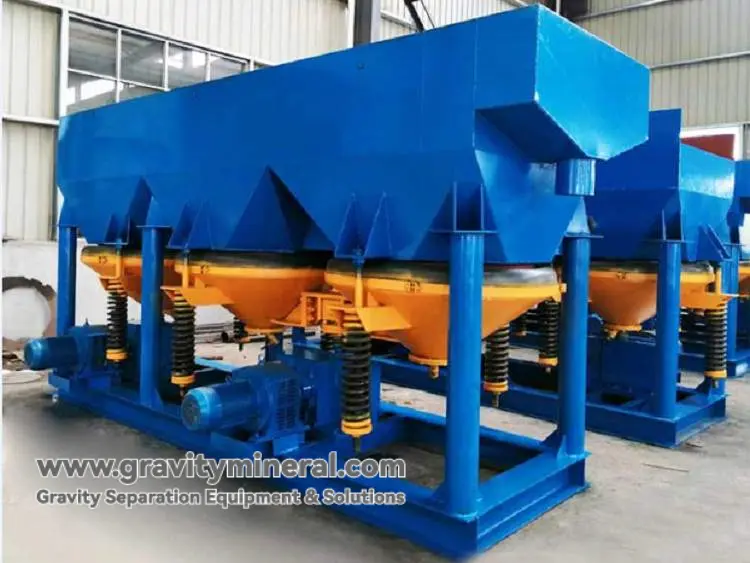
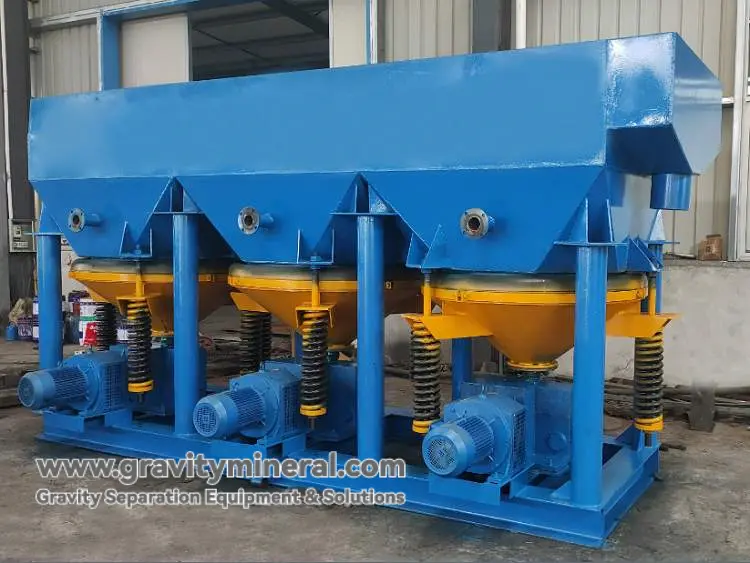
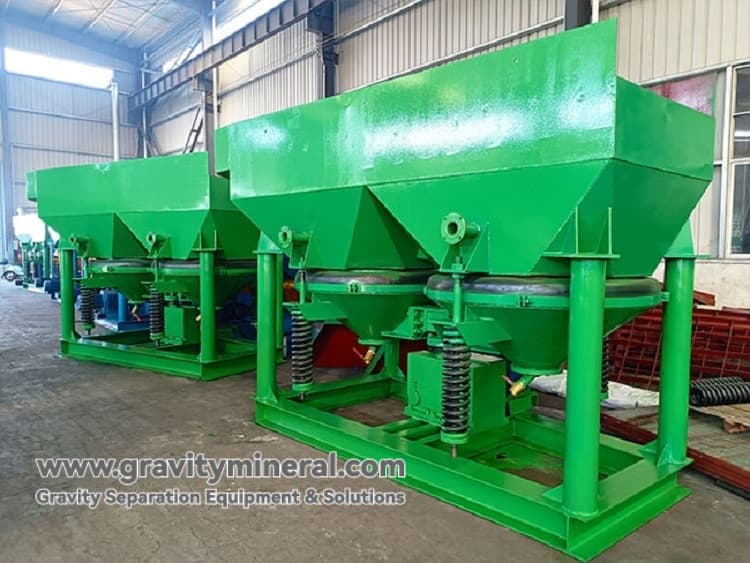
Sawtooth-Wave Jig (JT Series) | High-Efficiency Coarse Heavy Mineral Recovery
The sawtooth-wave jig (also called mineral jig separator and gravity jig) is a core gravity separation machine designed for the efficient recovery of coarse heavy minerals. Unlike shaking tables and centrifugal concentrators that excel at capturing fine powder, this sawtooth-wave jig has a unique advantage: it recovers heavy mineral lumps and particles up to 30 mm in particle size.
This machine uses advanced sawtooth-wave jigging technology. Compared with a conventional sine-wave jig, the sawtooth pulsation creates a “fast rise, slow fall” water dynamic that effectively loosens the bed and greatly shortens heavy mineral settling time, significantly improving the recovery of alluvial gold, diamond, tin, tungsten, barite and manganese ore. In mineral processing flowsheets it is widely used as the core roughing unit in the alluvial gold gravity separation plant solution and the alluvial tin gravity recovery solution.
Driven by an electromagnetic speed-regulating motor, this gravity jig is an energy-saving workhorse——it can cut water consumption by up to 40% while maximizing metallurgical performance.
How the Sawtooth-Wave Jig Works
Jigging separates particles of different specific gravity in a pulsating fluidized bed. Conventional jigs are mostly driven by an eccentric shaft, producing a sine-wave pulsation in which the upward and downward water speeds and durations are nearly equal, which is unfavorable for bed loosening and gravity stratification. The sawtooth-wave jig, based on bed stratification theory, changes the pulsation curve into a sawtooth shape so the upward water flow is faster than the downward flow (short rise, long fall). This increases bed looseness, reduces suction effect, and lets heavy mineral grains settle fully.
- Feeding: raw ore is fed onto the screen inside the jig chamber.
- Pulsation (sawtooth wave): the diaphragm mechanism drives water pulsating upward through the screen. The “fast rise” stage lifts the entire material bed vigorously, loosening and separating the particles.
- Stratification: during the “slow fall” stage of the water cycle, particles settle back onto the screen. Heavy minerals such as gold or barite settle faster than light rock such as quartz, so they quickly sink to the bottom of the bed.
- Discharge: heavy minerals pass through the screen (or are discharged from the bottom of the bed), while light tailings are washed over the top overflow weir. A combined “over-screen and under-screen” discharge mode effectively reduces the need for under-screen make-up water.
Why Choose Our Sawtooth-Wave Jig?
- Outstanding recovery: the sawtooth pulsation curve improves every recovery index over conventional jigs. Field data show tin (Sn) recovery up 3.01%, tungsten (W) up 5.5%, lead (Pb) up 1.63% and zinc (Zn) up 2.04%.
- Significant water saving: the “over-screen and under-screen” discharge mode and unique pulsation cycle cut under-screen make-up water demand, saving 30%-40% water versus conventional equipment.
- Intelligent control: stroke length and stroke frequency are both continuously adjustable (stepless speed regulation); the electromagnetic speed-regulating motor adapts easily to different ore types and feed conditions.
- Small footprint: the efficient chamber design delivers huge throughput while occupying up to one-third less floor area than older models.
- Easy installation and maintenance: compact structure, simple installation, low barriers to operation and routine maintenance, suitable for concentrators and gold dredges of every scale.
Suitable Minerals and Complete Line Integration
The sawtooth-wave jig is the undisputed leader in coarse mineral recovery, widely used for precious metals, diamonds and gemstones, heavy non-metallic minerals, and ferrous and non-ferrous metals:
| Application |
Typical minerals |
Supporting process / production line |
| Placer and alluvial gold roughing |
Placer gold, alluvial gold, gold nuggets |
Alluvial gold gravity separation plant solution |
| Placer and primary tin ore |
Cassiterite, placer tin, lode tin |
Alluvial tin gravity recovery solution, Primary tin ore gravity concentration solution |
| Diamonds and gemstones |
Rough diamond, sapphire, ruby |
Gemstone placer gravity separation solution, Diamond beneficiation solution |
| Heavy non-metallic minerals |
Barite, fluorite |
Barite gravity separation plant solution |
| Ferrous and non-ferrous metals |
Manganese ore, iron ore, tungsten ore, lead-zinc ore |
Chromite gravity + magnetic separation solution, Wolframite gravity processing solution |
In the flowsheet, the sawtooth-wave jig usually serves as the roughing unit at the front end. After washing and desliming it can be paired with a rotary scrubber wash plant or spiral log washer; rougher concentrate then goes to a 6-S shaking table for cleaning, while the fine fraction can be recovered with a fiberglass spiral chute or centrifugal concentrator; a linear vibrating screen can be added for screening.
JT Series Sawtooth-Wave Jig Technical Specifications
We offer multiple sizes, from the compact JT0.57-1 for small operations or cleaning duties to the giant JT5-2 for high-volume rough processing.
| Model |
Jigging area (m²) |
Max feed size (mm) |
Capacity (t/h) |
Stroke length (mm) |
Stroke frequency (r/min) |
Motor power (kW) |
| JT0.57-1 |
0.57 |
<6 |
1.5-3 |
8.5-12 |
80-180 |
1.5 |
| JT1-1 |
1.04 |
<10 |
2.5-5 |
10-17 |
80-180 |
2.2 |
| JT2-2 |
2.28 |
<10 |
5-10 |
12-21 |
80-180 |
3 |
| JT3-1 |
3.0 |
<10 |
7.5-15 |
12-30 |
50-125 |
5.5 |
| JT4-2 |
4.0 |
<25 |
8-20 |
25-57 |
50-125 |
7.5 |
| JT4-2S |
4.0 |
<25 |
8-20 |
25-57 |
50-125 |
4×2 |
| JT5-2 |
4.86 |
<10 |
12-25 |
12-30 |
50-125 |
7.5 |
From a Single Sawtooth-Wave Jig to Complete Gravity Lines - Full Responsibility, No Outsourcing
Sawtooth-wave jig recovery depends on the match between stroke, stroke frequency, screen size and feed size. GravityMineral has focused on gravity separation and gravity equipment manufacturing for 20 years, with equipment made in our two own manufacturing bases and process and mechanical engineers working in one team——jigging area, stroke length and motor power are set from process data and share the same source as the complete-line design drawings, avoiding the problem of “roughing and cleaning capacity falling out of step”.
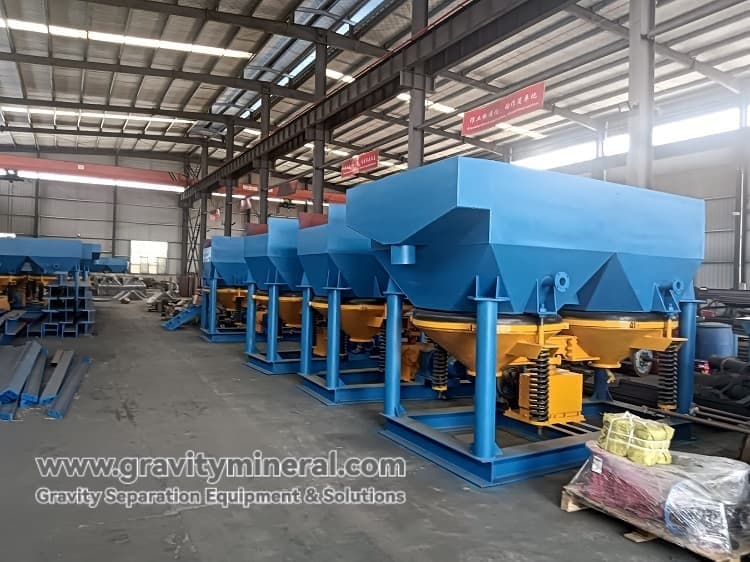
- Own manufacturing bases: core equipment is produced in GravityMineral's two own bases, with full quality control from raw material purchase through machining, assembly and no-load trial running; every unit is strictly inspected before shipment.
- ISO9001 quality system: the company is ISO9001 certified, and products hold S-certified supplier, national high-tech enterprise and other qualifications.
- Complete-line interface matching: the sawtooth-wave jig is capacity-matched with the 6-S shaking table, spiral chute and centrifugal concentrator to reduce blockages and tailings loss.
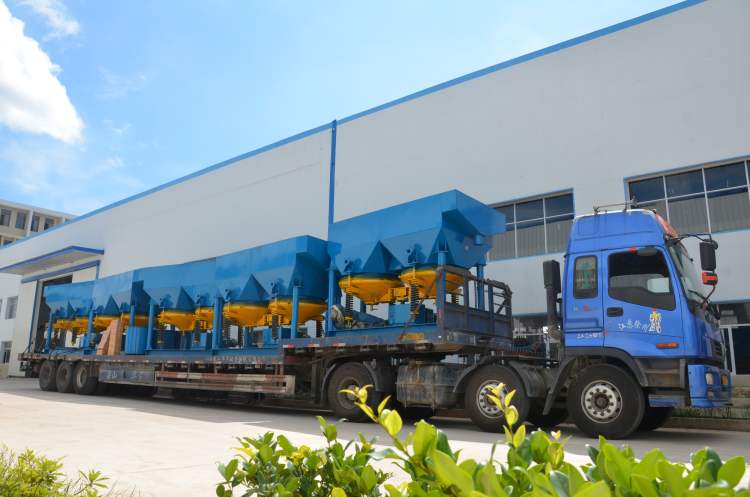
- Global delivery experience: products have been exported to more than 50 countries; we know the logistics and customs procedures of major markets in Africa, Southeast Asia, South America, the Middle East, Central Asia, South Asia and Australia, and a 500+ global case library supports jig selection.
- Delivery and after-sales: engineers supervise installation and commissioning on site, lead single-unit and linked trial runs and train customer personnel; a one-year warranty and long-term spare parts and process optimization support are provided.
- Flexible cooperation models: buy equipment only, commission drawing design only, hire engineers for on-site commissioning only, or choose full-process EPC turnkey - all arranged to your pace and budget.
Sawtooth-Wave Jig FAQ
Q1: How much does a sawtooth-wave jig cost? How is the price calculated?
Price depends on jigging area, capacity and motor power; the JT series spans from JT0.57-1 (0.57 m²) to JT5-2 (4.86 m²). Small machines cost less and large twin-chamber machines more; provide ore type, feed size and capacity for an engineer's quote.
Q2: What is the difference between a jig and a shaking table? When should a jig be used?
At the front of the flowsheet use a jig separator to recover coarse heavy minerals directly (up to 30 mm), avoiding overgrinding of coarse gold; later use the 6-S shaking table to recover ultrafine gold particles and gold fines missed by jigging. Use the jig for roughing and the table for cleaning.
Q3: How does a sawtooth-wave jig differ from a conventional sine-wave jig?
Conventional jigs use a sine-wave pulsation with equal rise and fall times, which hinders bed loosening; the sawtooth-wave jig rises fast and falls slowly, giving a looser bed and easier settling of heavy grains. Measured results show tin recovery up 3.01% and tungsten up 5.5%, with 30%-40% water savings and one-third less floor space.
Q4: How many tons per hour can a sawtooth-wave jig process? How do I select a model?
Capacity is about 1.5-25 t/h (JT0.57-1 around 1.5-3 t/h up to JT5-2 around 12-25 t/h). Select by ore type, feed size, gravity difference and capacity: small machines for small or cleaning duties, JT4-2/JT5-2 for high-volume roughing.
Q5: What is the maximum feed size of a jig? How coarse can it treat?
Maximum feed size reaches 30 mm (e.g. JT4-2); the machine is designed for coarse heavy mineral recovery over a wide 0-30 mm range. For ultrafine material, pair it with a shaking table or centrifugal concentrator.
Q6: What is the jig "ragging bed"? What is used as ragging?
To assist separation, an artificial bed is laid on the jig screen, commonly steel shot, hematite or large high-density rock. During pulsation the heavy ragging creates suitable gaps for heavy gold/minerals to sink while blocking light sand. Ragging is selected by mineral specific gravity.
Q7: Are the jig stroke length and frequency adjustable? How?
Yes. Stroke length and frequency are both steplessly adjustable (e.g. JT0.57-1 stroke 8.5-12 mm, frequency 80-180 r/min), driven by an electromagnetic speed-regulating motor, so settings can be tuned for different ores and feed conditions for optimal stratification and recovery.
Q8: Does a jig use a lot of water? How can water be saved?
The "over-screen and under-screen" discharge mode and unique pulsation cycle reduce under-screen make-up water demand, saving 30%-40% water versus conventional equipment and sharply lowering consumption while maintaining recovery.
Q9: Which minerals suit a jig? Can it treat placer gold, diamonds and tin?
It treats placer/alluvial gold, placer and primary tin, diamond and sapphire/ruby, barite, fluorite, manganese ore, iron ore, wolframite and lead-zinc. It is the core roughing unit in the alluvial gold gravity separation plant solution and the alluvial tin gravity recovery solution.
Q10: Can it be custom-built? How are delivery and after-sales guaranteed?
Non-standard customization is available for jigging area, screen and structure by ore type and capacity. Standard machines take about 30-60 days to manufacture, custom units longer, with a clear delivery schedule in the contract; a one-year warranty is followed by long-term spare parts, technical consultation and process optimization, with on-site commissioning and training and exports to 50+ countries.
Get a JT Series Sawtooth-Wave Jig Selection Plan and Quote
Tell us your ore type, feed size, target capacity (t/h), specific gravity difference and site utilities; GravityMineral engineers will prepare a sawtooth-wave jig selection plan, gravity flowsheet and transparent quotation.
You can reach us through the contact details on this site, or talk directly with a sales engineer for selection advice; representative samples can be sent for beneficiation testing.