







Gold Tailings Reclamation Cyanidation Plant—High-Efficiency Gold Recovery Equipment and Process Solutions
The tailings grade has long remained stuck above 0.3 g/t, the recovery rate is five to eight percentage points lower than the design value, and the specific consumption of sodium cyanide has been rising month by month. This is the most typical operating condition for a cyanide plant processing gold tailings from gravity separation, and it is also a direct indication of a mismatch between the gold recovery equipment and the process.
The problem does not lie with the cyanidation tanks themselves. In most cases, the gold escapes through the gaps between the gravity separation and cyanidation processes.
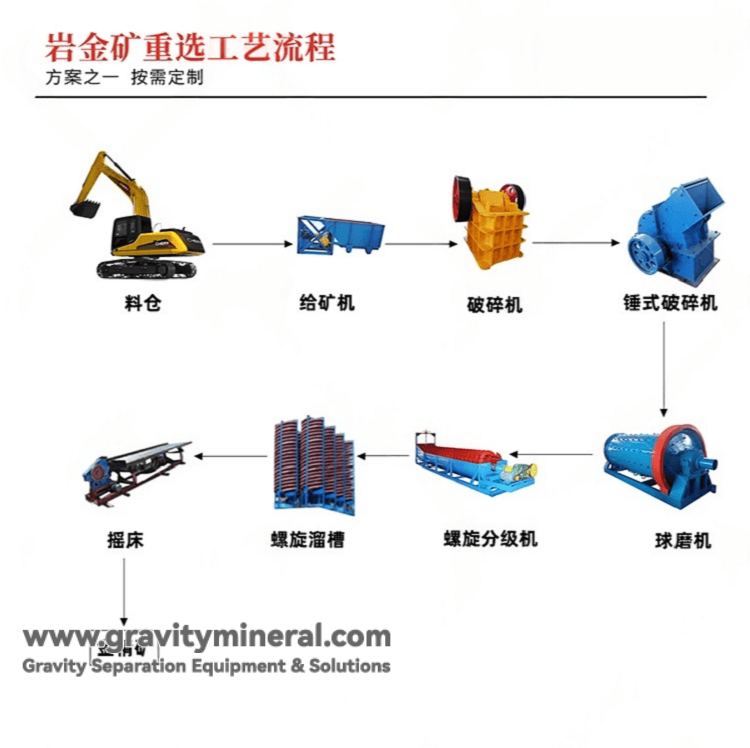
I. The Problem: Typical Operational Deviations in Gravitational Separation Gold Tailings Cyanidation Plants
The design logic of a cyanide leaching plant for gold tailings from gravity separation is clear: gravity separation recovers coarse, free gold, while the tailings are sent to the cyanide leaching process to extract fine and entrapped gold. Theoretically, the total gold recovery rate should fall within a reasonable range. In actual operation, deviations are concentrated in three areas.
Tailings gold grade remains persistently high. At plants with a daily processing capacity of approximately 200 metric tons, the gold grade in the tailings discharge remains stable at 0.30 to 0.40 g/t, a significant deviation from the design value. This indicates that a substantial proportion of the gold entering the cyanidation system has not been fully leached and is being discharged with the tailings.
Chemical consumption is out of step with recovery performance. Sodium cyanide consumption per metric ton of ore has gradually risen from the lower end of the normal range, yet the tailings grade has not decreased in tandem with the increased chemical dosage. The fact that increased dosing does not improve efficiency indicates that the chemicals are not acting on the target gold minerals.
Fluctuations in indicators exceed reasonable limits. Even with the same ore source and the same shift schedule, variations in tailings grade among different work crews can reach 0.05 g/t or more. After ruling out operational factors, there are structural issues with the stability of the process itself.
The phenomena described above are common in cyanidation plants processing gold tailings from gravity separation. If all three conditions are present simultaneously, it can generally be concluded that there is a disconnect between the physical state of the cyanide feed and the chemical conditions.
II. Causes: Three Overlooked Process Discontinuities
The grinding fineness does not match the leaching requirements. The goal of grinding in the gravity separation section is to liberate gold to a particle size visible to the naked eye or recoverable by gravity separation equipment, whereas cyanide leaching requires a degree of liberation that allows the reagents to make contact with the ore. There is a significant gap between the two.Studies on flotation tailings from hard-to-leach gold ores indicate that some gold is present in the form of encapsulated or lattice-bound gold within sulfide minerals such as arsenopyrite and pyrite. During cyanide leaching, this gold cannot come into contact with the leaching solution, which is one of the primary causes of excessive gold loss.Such intergrown gold is also present in gravity separation tailings; if particle size control is not performed prior to cyanidation, this portion of the gold will merely “tag along” in the leaching tank.
The effective residence time in the leaching tank is insufficient. When the pulp concentration is too high, the settling rate of the ore particles accelerates, leading to localized short-circuiting within the agitation tank. The discrepancy between the designed residence time and the actual effective reaction time becomes particularly pronounced when the concentration exceeds 40%.Data from leaching experiments on regrind tailings from gold concentrates can serve as a reference: after circulating grinding reduced the median particle size from 139.5 μm to 2.50 μm, leaching efficiency improved significantly. Finer particle size not only enhances liberation but also alters the rheological properties of the pulp; both factors jointly influence leaching efficiency.
Gold-bearing sulfides compete for cyanide in the cyanidation stage.Gravity separation tailings often contain sulfides such as pyrite and arsenopyrite, in which gold is associated with or encapsulated within these minerals. Under cyanidation conditions, sulfides react preferentially with cyanide and oxygen, consuming large amounts of reagents while hindering the effective leaching of gold.Test data from the flotation tailings of a certain polymetallic ore indicate that after pre-desulfurization, the gold grade in the tailings decreased from 0.18 g/t to 0.10 g/t, clearly demonstrating the interference caused by sulfur.This logic also applies to cyanidation plants processing gold tailings from gravity separation: if sulfur is not removed prior to cyanidation, both reagent efficiency and gold recovery rates are compromised.
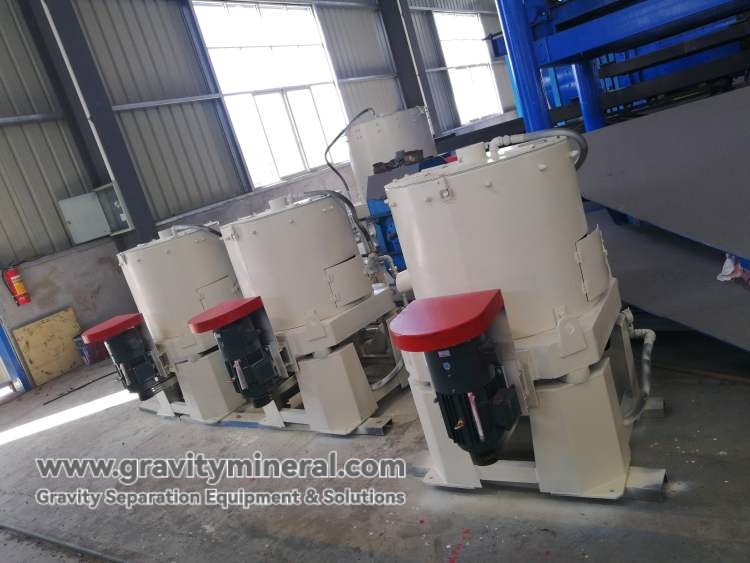
III. Solution: Combined Configuration of Equipment and Processes
Adjusting the approach takes precedence over replacing equipment. Adding a stage for particle size and composition control between gravity separation and cyanidation is more effective than simply replacing the leaching tanks with larger ones or increasing the dosage of reagents. The core of this solution consists of three parts.
Re-grinding Equipment: Grinding the cyanidation feed to a fineness accessible to the reagents
The goal of regrinding is not to achieve extreme fineness, but to reduce the proportion of coarse particles in the cyanidation feed to a reasonable range. In engineering practice, controlling the proportion of the +0.074 mm particle size fraction in the cyanidation feed to below 15% is a feasible adjustment for most gravity separation gold tailings.In terms of equipment selection, tower mills or high-efficiency fine grinders are preferable to traditional ball mills because their fine grinding efficiency and the concentration of the particle size distribution per unit of energy consumption are better suited for this stage of the process. For plants with smaller processing capacities, a localized regrinding solution integrated in series with the existing grinding circuit can also be considered to avoid duplicate investment.
Flotation Pretreatment: Separating Gold-Bearing Sulfides from the Cyanidation Feed
If the sulfide content in the gravity separation tailings is within a detectable range (visually observable pyrite or abnormally high sulfur grades in laboratory analysis), adding a flotation process prior to cyanidation is a viable option.The flotation process produces a sulfur concentrate, with gold-bearing sulfides entering the concentrate product, which can be processed separately or sold externally; the flotation tailings are fed into the cyanidation process, resulting in a significant reduction in reagent consumption.In a flotation column test on a cyanide tailings sample, a “one rough, one clean” process was used to produce a concentrate with a gold grade of 20.13 g/t and a recovery rate of 86.58%, while the tailings grade was reduced to 0.41 g/t.Although the test subject was cyanide tailings, the mineralogical logic is consistent with the pretreatment of gold-bearing sulfides in gravity separation tailings: first remove the components that compete for reagents, then leach the remainder.
Cyanidation Parameter Adjustments: Synchronized with Feed Changes
Once regrinding and flotation are completed, the parameters of the cyanidation stage must be adjusted accordingly. It is recommended to control the pulp concentration within the range of 35% to 40%, balancing tank capacity utilization and sedimentation control.Sodium cyanide concentration should be maintained between 0.05% and 0.08%, with pH stabilized between 10.5 and 11. Aeration uniformity must be checked tank by tank; insufficient dissolved oxygen will directly reduce the rate of gold dissolution.These parameters are not complex in themselves; the key lies in coordinating them with changes in feed particle size and composition, rather than continuing to follow pre-retrofit operating practices.
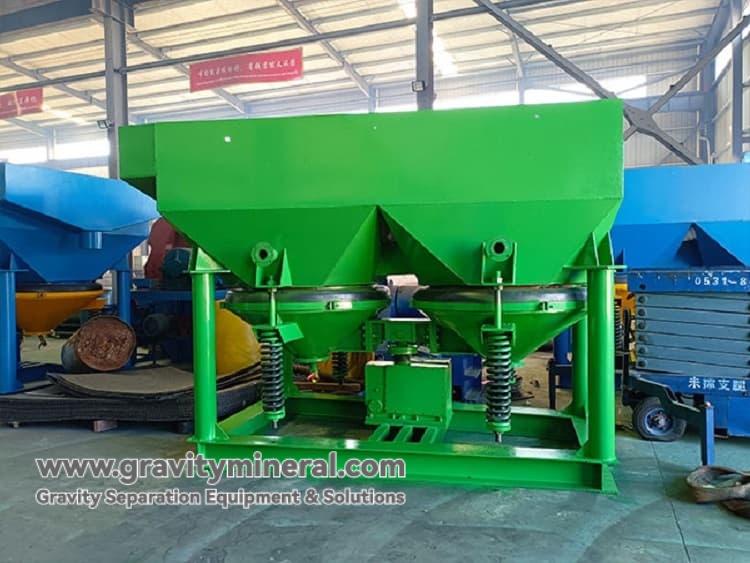
IV. Implementation Path: Phased Implementation from Diagnosis to Stabilization
Phase I: Process Diagnosis and Sampling Analysis. Samples are collected from three locations—gravity separation tailings, cyanidation feed, and cyanidation tailings—and subjected to sieve analysis (for the three particle size fractions: +0.074 mm, +0.045 mm, and -0.045 mm) and grade testing.The objective is to answer two questions: from which particle size fraction is gold primarily lost, and to what extent do sulfides contribute to reagent consumption? Without this data set, any subsequent equipment selection lacks a solid basis.
Phase Two: Small-Batch Regrinding Validation. Take representative samples of the gravity separation tailings and perform regrinding on a laboratory or pilot scale. The target fineness can initially be set so that 80% to 85% of the material is within the -0.045 mm size fraction; measure the residue grade after leaching.Once data from the comparison samples (unre-ground) are available, the economic viability of re-grinding can be assessed. At the same time, observe whether the grinding process leads to increased slime formation or abnormal reagent adsorption.
Phase Three: Flotation Feasibility Assessment and Process Integration. If laboratory analysis indicates an excessively high sulfur grade, conduct open-circuit flotation tests using cyanide feed to determine the reagent regime and concentrate recovery rate. When selecting flotation equipment, consider the space available for integration with the existing process; prioritize models with a small footprint and high operational flexibility.
Phase 4: Parameter Stabilization and Shift Handover.Upon completion of the retrofit, incorporate the adjusted pulp concentration, reagent concentration, and pH control range into the operating procedures, and add observation items for tailings color and foam condition to the shift handover records. It takes two to three weeks of operational data to confirm that indicators have stabilized; judgments should not be based on data from a single shift or a single day.
Step-by-Step Implementation Schedule
| Phase | Estimated Timeline | Key Actions | Basis for Assessment |
|---|---|---|---|
| Diagnostic Sampling | Week 1 | Three-point sampling, screening, and laboratory analysis | Grain Size–Grade Distribution, Sulfur Grade |
| Regrinding Verification | Weeks 2–3 | Small-batch regrinding + comparative leaching | Differences in tailings grade, grinding energy consumption |
| Flotation evaluation | Weeks 3–4 | Open-circuit flotation test | Sulfide concentrate yield, gold distribution |
| Parameter Optimization | Weeks 5–8 | Adjustment of operating parameters, training | Stability of indicators over three consecutive weeks |
V. Effectiveness Evaluation: Reasonable Expectation Range
Results vary depending on ore characteristics; the following ranges serve as reasonable expectations for cyanidation plants processing gold tailings from gravity separation.
Tailings Grade. Provided that the regrinding fineness is adequate and sulfide interference is controlled, reducing the tailings gold grade from the 0.30–0.40 g/t range to 0.15–0.25 g/t is an achievable target for most mines.For ores that are difficult to leach or contain a high proportion of encapsulated gold, the improvement may be more limited; for easily leachable ores, the reduction may be greater.Test data from the flotation tailings of a hard-to-leach gold mine in Gansu Province can serve as a reference: after classification, re-grinding the coarse fraction and performing activated flotation, followed by combined cyanidation, the total gold recovery rate increased by approximately 9 percentage points, and the gold grade in the tailings was reduced to below 0.3×10⁻⁶.
Chemical consumption per unit. After flotation pretreatment removes some gold-bearing sulfides, a reduction in sodium cyanide consumption per unit is a highly predictable improvement. The extent of the reduction depends on the sulfur content of the ore and the flotation removal rate, typically ranging between 20% and 30%.
Recovery Rate. The extent to which the recovery rate can be improved at a cyanidation plant processing gold tailings from a gravity separation process is constrained by the properties of the ore and losses in the gravity separation stage. Without altering the gravity separation stage, optimizing only the cyanidation feed conditions can reasonably increase the recovery rate by approximately 4 to 8 percentage points.Achieving results beyond this range requires a concurrent assessment of the separation efficiency in the gravity separation stage.
Applicability Limits. When the gold grade in tailings is below 0.15 g/t, the energy consumption and steel ball consumption associated with regrinding may offset the value of the recovered gold, necessitating a reassessment of economic viability. For ore sources with extremely low sulfide content, the necessity of flotation pretreatment decreases, and the focus should shift to particle size and leaching time.Finer is not necessarily better when it comes to regrinding fineness; overgrinding leading to slurry formation can worsen the leaching environment, and the upper limit of fineness must be determined through testing.