







How Do Flour Gold Recovery Systems Improve Screening Efficiency? Professional Solutions Help Businesses Reduce Costs and Boost Efficiency
I. Industry Background: Why Is the Efficiency of Flour Gold Gravity Separation So Low?
The particle size of gold in flour is typically below 74 micrometers, with some flake-like gold particles only a few micrometers thick.Typical characteristics of this material during gravity separation include low mass and low terminal settling velocity; even a slightly faster water flow in conventional chutes causes the gold to be carried away with the tailings. During shaking table separation, the gold content in the middlings is relatively high, and the concentrate enrichment ratio remains low.
The root causes of these issues can be summarized in three aspects. First, the separation medium is mismatched. Traditional chutes rely on continuous unidirectional water flow, causing fine gold particles to be washed away before they have fully settled. Second, interference from clay content.Fine-grained gold ores are often associated with clay; when a clay film coats the gold particles, their density advantage is weakened, and separation selectivity decreases. Third, an insufficient number of process stages. The absence of a pre-concentration step between roughing and concentrating causes fine gold particles to circulate repeatedly within the system, ultimately ending up in the tailings.
This is also the most common pitfall when selecting gravity separation equipment for fine-grain gold: focusing solely on the parameters of individual units without considering the particle size coordination and capacity matching of the entire line. Gravity separation is extremely sensitive to particle size matching; mixing coarse and fine particles yields poor results, and if equipment parameters are not properly adjusted according to the ore characteristics, performance targets will naturally not be met.
II. Technical Principles: Pulsating Water Flow and Dynamic Bed Layer Are the Keys to Efficiency
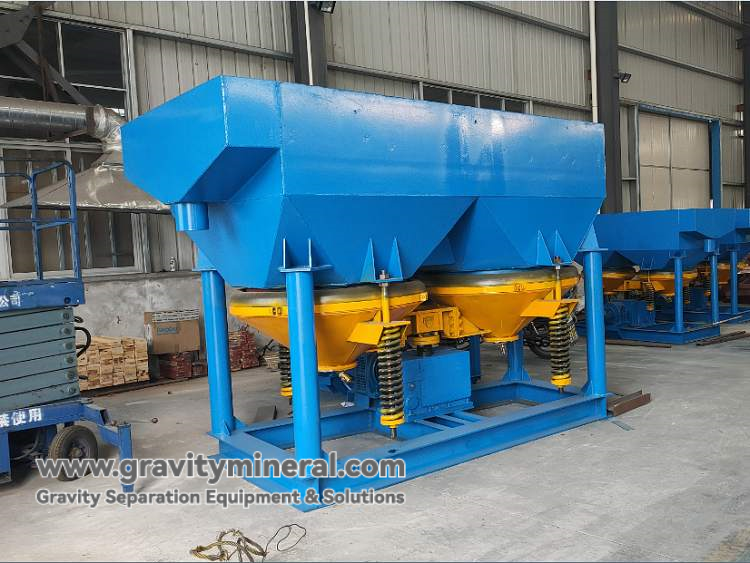
The key to improving screening efficiency in fine-grain gold recovery equipment lies in ensuring the bed layer can “loosen up and settle properly.” Pulsating water flow equipment, typified by sawtooth-wave jigs, uses an eccentric mechanism to drive a piston in reciprocating motion, generating a periodic water flow with a strong upward current and a slow downward current.During this pulsation, the slurry undergoes three stages: loosening, stratification, and settling. Gold particles have a density of approximately 19.3 g/cm³, while common gangue densities range from 2.5 to 3.5 g/cm³; this density difference is an objective reality. As long as sufficient settling time and appropriate loosening are provided, gold particles have the opportunity to reach the bottom layer.
There are several key points regarding parameter control.The downward flow velocity must not be too fast; otherwise, gold particles that have already settled will be resuspended. The stroke and stroke frequency must be adjusted according to the material particle size. When processing materials consisting mainly of fine gold, the stroke should be appropriately reduced and the stroke frequency moderately increased, while the bed expansion rate should be controlled within a range where the material is just loose enough to prevent excessive churning.It is recommended to maintain the feed concentration between 30% and 50%; if the concentration is too low, the bed cannot be compacted, and if too high, the material will accumulate on the screen surface, preventing the pulsating water flow from penetrating it.
Clay content is another variable. Clay coating weakens the sorting advantage provided by density differences. Equipment such as agitating chutes repeatedly kneads the material through the flexible deformation of the chute body,first breaking down the clay coating and then allowing gold particles to settle in the channels. This approach offers greater control than simply increasing the rinse water volume—as excessive water flow can cause fine gold particles to be carried away with the water. How to improve screening efficiency in fine gold gravity separation equipment largely depends on whether these dynamic parameters can be adjusted in real time according to the ore characteristics.
III. Equipment Configuration: Divide Tasks by Processing Stage; Do Not Rely on a Single Machine to Handle Everything
There is no “one-size-fits-all” single machine for flour gold beneficiation. The roughing stage prioritizes throughput and waste rejection rate, while the concentrating stage prioritizes enrichment ratio and fine-grain recovery; equipment configuration must be tailored to each stage.
| Equipment Type | Applicable Stage | Key Parameter Focus | Key Configuration Points for Fine-Grain Gold Scenarios |
|---|---|---|---|
| Sawtooth Jig | Rough Selection/Pre-Enrichment | Stroke and frequency adjusted according to particle size | Excellent clog resistance; capable of continuous operation even with high clay content, providing a stable feed to the fine selection stage |
| Agitated Chute | Roughing/Sweeping | Amplitude and agitation frequency are coordinated | The kneading action helps break up mud coatings; energy consumption is low, but the concentrate requires further processing to improve grade |
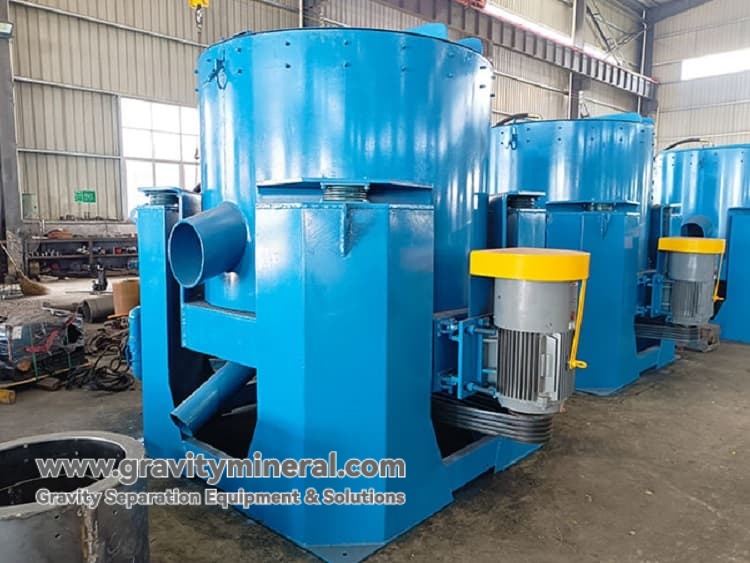
| Centrifugal concentrator | Concentration/Fine-Grain Pre-Enrichment | Backwash pressure matched to feed concentration | The centrifugal force field enhances the settling of fine particles, making it suitable as a supplementary process for fine-grain gold recovery |
| 6-S shaking table | Concentration | Stroke length and frequency adjusted according to particle size | High enrichment ratio but relatively low throughput; the issue of fine gold loss in the middlings must be resolved through pre-enrichment in the upstream process |
In terms of configuration logic, it is recommended to adopt a combination of “jig or agitated chute for roughing and rejection—centrifugal concentrator for fine-grain recovery—shaking table for fine selection to produce concentrate.” Gravity separation serves as a pre-concentration method, first discarding a large amount of gangue, then allowing the subsequent fine selection stage or combined process to handle the reduced-volume material.For rock-gold-type “flour gold” materials, the gravity separation tailings can be fed into flotation or leaching processes, forming a combined flow sheet characterized by “early recovery via gravity separation + fine-grain capture.” The selection of “flour gold” gravity separation equipment should not focus on which single unit has the highest performance indicators, but rather on whether the interfaces of the entire line are properly aligned and whether production capacity is balanced.
IV. Process Flow: Step-by-Step Description
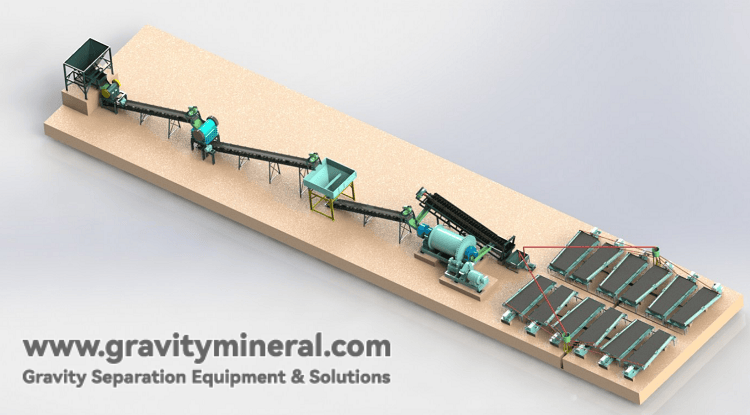
Taking rock-type “flour gold” material as an example, a typical gravity separation-led process can be broken down into the following steps.
- Crushing and Grinding. The ore is coarsely crushed by a jaw crusher and then medium- and fine-crushed by a cone crusher before entering a closed-circuit system consisting of a ball mill and a spiral classifier. Following the principle of “more crushing, less grinding,” the grinding particle size is controlled to minimize over-grinding and slime formation.
- Early Recovery via Gravity Separation. The sand fraction from the classifier enters a sawtooth-wave jig for roughing; the rough concentrate is then sent to a 6-S shaking table for fine selection, producing gold concentrate. Gravity separation equipment is integrated into the grinding circuit to achieve “early recovery whenever possible,” thereby preventing already liberated gold particles from being repeatedly ground into finer sizes.
- Supplementary recovery of fine particles. The microfine fraction from the classifier overflow and gravity separation tailings is fed into a centrifugal separator for recovery, reducing the loss of fine-grained gold in the tailings.
- Integrated Process Back-up. Depending on the ore characteristics, gravity separation tailings are fed into flotation or leaching processes to recover fine-grain gold and gold from associated sulfide ores, forming a complete recovery chain.
- Dewatering and Tailings Treatment. Concentrates are dewatered using thickeners and filter presses before being shipped off-site, while tailings are either dry-stacked in accordance with environmental regulations or evaluated for reprocessing.
The core of this process is not simply stacking equipment, but ensuring that each stage performs what it does best: the roughing stage handles volume reduction, the concentrating stage improves grade, and the combined process serves as a safety net.
V. Return on Investment: Look at the Big Picture, Not Just Equipment Quotes
When conducting an economic evaluation of a fine-grain gold re-concentration project, it is recommended to consider three variables together: equipment investment, the loss of fine-grain gold in tailings, and the chemical and energy consumption of subsequent processes.
Equipment investment is a one-time expense, while tailings loss occurs daily. Gravity pre-concentration first removes gangue, thereby reducing the amount of ore entering flotation or leaching, which in turn lowers the consumption of collectors and modifiers as well as grinding energy consumption.For processing plants that originally had low performance metrics due to poor recovery of fine-grain gold, adding a single-stage centrifugal concentrator or optimizing jig parameters is often more economical than building an entirely new process line.
It should be noted that the extent of recovery rate improvement and the payback period vary from mine to mine, depending on the grade of the ore, the distribution characteristics of gold particles, the clay content, and the condition of the existing process; therefore, it is not appropriate to apply uniform figures. A practical approach is to first conduct mineral processing tests to verify the feasibility of the process using representative ore samples, and then calculate the investment and return based on actual data.When considering how to improve the screening efficiency of flour gold gravity separation equipment, the discussion ultimately boils down to two specific questions: “What performance metrics can be achieved with this ore?” and “How much will this processing line cost?”
VI. Common Technical Issues
What should be done if the feed concentration fluctuates significantly? It is recommended to control the feed concentration for a jig between 30% and 50%; use a concentration flask to measure it frequently on-site. When the concentration is too high, reduce the feed rate and appropriately increase the water addition to maintain the bed expansion rate; when the concentration is too low, reduce the water addition to prevent the bed from being washed away.
What should be adjusted first when fine-grain gold is being lost in the tailings? Prioritize checking the flushing rate. An excessively high flushing rate causes the downflow velocity to be too fast, causing already settled fine gold to be resuspended. Try lowering the flushing rate and appropriately reducing the makeup water supply, then observe changes in the tailings. If significant loss persists after adjustment, evaluate the possibility of adding a scavenging stage to the centrifugal separator.
How should a sudden increase in mud content be handled? Do not force the process to run. High-silt feed entering the jig reduces the permeability of the bed layer, diminishing the effectiveness of the pulsating water flow. Temporary measures include increasing make-up water and reducing feed rate; the fundamental solution is to install a spiral washer or vibrating screen before gravity separation to remove silt, thereby creating suitable feed conditions for the fine gold gravity separation equipment.
Can the process adapt to significant fluctuations in ore properties? Adjustment flexibility should be built into the design phase: the jig\'s stroke and frequency should be adjustable, the shaking table\'s incline should be adjustable, and spiral chutes with different pitch specifications should be available for replacement. When fluctuations exceed a certain range, comparative tests using different ore samples must be conducted to assess the adaptability limits, and these parameters must be clearly communicated to the on-site team during operational training.
VII. About Us
For fine-grained “flour gold” materials, we can configure a combined solution of jigging machines, agitating chutes, centrifugal separators, and shaking tables based on ore sample data, and design tailored processes for scenarios involving high clay content, fine particle sizes, and fluctuating ore properties.If you are evaluating how heavy-medium separation equipment for fine-grained “flour gold” can improve screening efficiency, please provide us with the ore type, original ore grade, processing capacity, feed particle size, and clay content. We will first assess the feasibility and propose a preliminary solution before deciding whether to proceed with testing and equipment configuration.
If you would like to learn more about our heavy-medium separation equipment configurations for fine-grain gold, please submit your requirements.