







How do you choose a complete gravity separation production line for processing alluvial placer gold deposits?
I. The Decision at Hand
It depends on the situation: For a complete gravity separation production line for alluvial placer gold deposits, the question is usually not “which piece of equipment to buy,” but rather “which production line configuration to choose.”
To put it simply: there is no “best” solution—only the solution that best suits your specific deposit. Alluvial placer gold deposits are characterized by high variability in clay content, uneven gold particle sizes, and sometimes scattered ore locations—factors that determine significant differences in production line configurations.
Your deposit might consist of riverine alluvial material with high clay content requiring powerful ore washing, or it might be terrace material with abundant gravel and relatively coarse gold grains. Choosing the wrong production line structure isn\'t just a matter of spending a little extra money—it means daily operations won\'t run smoothly.This article lays out and compares three common approaches to help you make the right choice. As a general guideline, you can first refer to the “washing—screening—gravity separation” framework used in standard gold panning production line designs.
II. Option A: Standard Fixed Gravity Separation Line
Let\'s look at the specifics: Option A is suitable for alluvial placer gold deposits with a fixed mining site, stable throughput, and moderate silt content.
Option A is the most typical setup: it begins with ore washing and screening, uses sluices and jigs as the main gravity separation units, and concludes with a shaking table for concentrate recovery. It is a classic structure that is “adequate, proven, and cost-effective.”
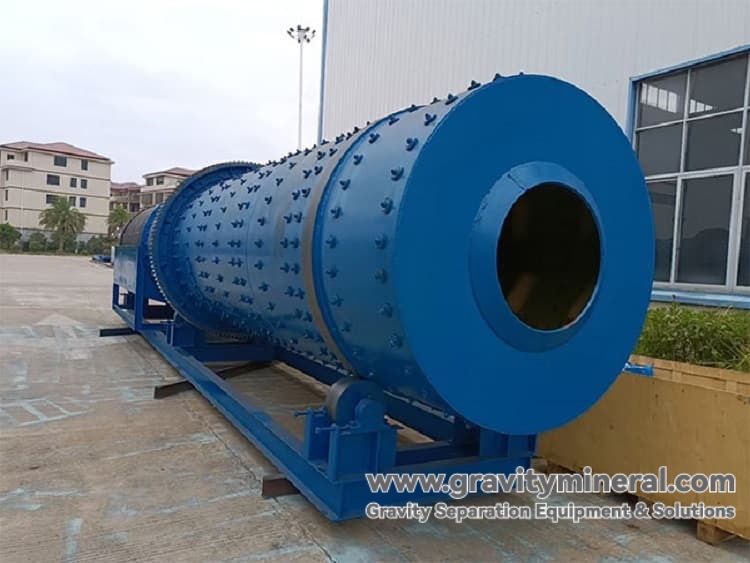
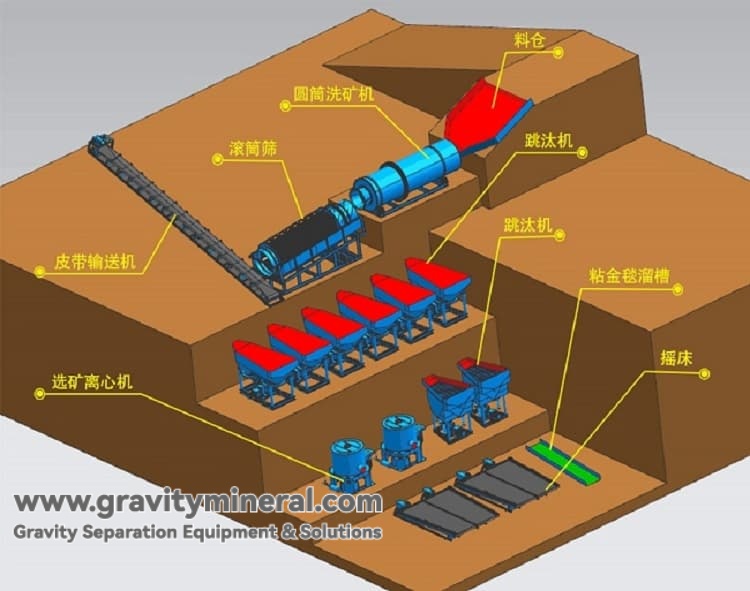
The workflow is straightforward. The raw ore first passes through a cylindrical ore washer to remove clay and break up clay clumps; the undersize material enters the sluice box for coarse screening, capturing coarser gold particles first; the tailings from the sluice box then enter the jig for further enrichment of medium-sized gold particles; finally, the coarse concentrate is sent to the shaking table for fine selection, yielding the gold concentrate.
The advantages include a mature design, simple operation, relatively low investment, and quick training for on-site workers. The disadvantage is limited recovery of fine-grained gold—chutes and jigs are best suited for coarse and medium-sized particles, while fine particles are easily lost with the tailings; when clay content fluctuates significantly, incomplete ore washing can hinder the entire production line.The investment range typically falls within the budget of small- to medium-scale operations, depending on the processing capacity and equipment configuration.
III. Option B: Enhanced Gravity Separation Line
Depending on the situation: Option B is suitable for alluvial placer gold deposits with a significant proportion of fine-grained gold and higher recovery requirements.
Option B adds a fine-grain recovery stage to Option A. The core process remains ore washing—screening—gravity separation, but the gravity separation section is further subdivided: coarse grains are recovered early via chutes or jigs; medium and fine grains are processed by a 6-S shaking table for selective concentration; and fine and ultrafine grains are then recovered by a centrifugal concentrator.
The advantage of this approach is that it implements “coarse-fine separation” at the equipment level, preventing fine-grain gold from flowing directly into the tailings.The drawbacks include more equipment, higher capital investment, and stricter operational and maintenance requirements, as personnel are needed to monitor feed concentration and zone separation. For alluvial material with relatively fine gold particles and high clay content, the overall recovery rate of Scheme B is generally more stable than that of Scheme A.
The key to this scheme lies not in the number of pieces of equipment, but in balancing the processing capacity across each stage. Since shaking tables have a low throughput capacity, the feed rate must be reduced to improve grade; forcing large feed volumes will immediately result in the bed surface becoming overloaded and the inability to separate the grades.
IV. Option C: Modular and Mobile Gravity Separation Line
Depending on the situation: Scheme C is suitable for alluvial placer gold deposits with scattered mining sites, where relocation is required, or where operations are implemented in phases.
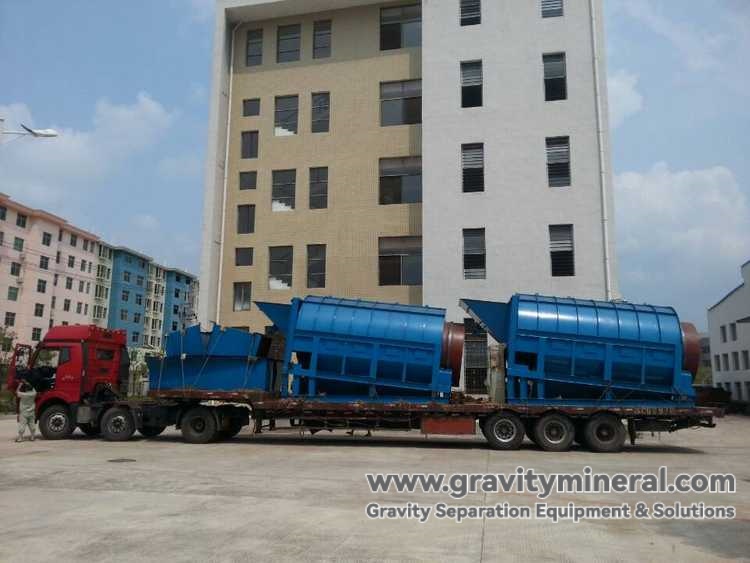
Alluvial placer gold deposits often have limited reserves at a single site, requiring a move to a new location once the deposit is exhausted. Solution C designs the core processes—ore washing, screening, and gravity separation—as modular or mobile structures, facilitating disassembly, assembly, and relocation; mobile screening equipment such as trommel screens is often used as the primary front-end processing unit.
The advantages include flexibility, the ability to phase in initial investments, and suitability for multi-site operations; the disadvantage is that the large-scale processing capacity at a single site is inferior to that of a fixed line, and efficiency will be compromised if the modules are not tightly integrated. For alluvial gold deposits with limited reserves and scattered locations, this “portable” production line is often a more practical choice than a large fixed line.
V. Multi-Dimensional Comparison
Let\'s examine the scenarios: Placing the three solutions in a single table makes the differences immediately apparent.
| Comparison Dimensions | Option A: Standard Fixed-Type | Option B: Enhanced | Option C: Modular/Mobile |
|---|---|---|---|
| Investment | Relatively low | Relatively high, with more equipment | Moderate; can be implemented in phases |
| Operating Costs | Low | Moderate; maintenance and electricity consumption are slightly higher | Moderate; additional expenses for relocation |
| Processing Capacity | Stable, suitable for a fixed scale | Stable, suitable for medium to large processing volumes | Flexible, but individual units are relatively small |
| Recovery Rate | Good for coarse and medium-sized particles; weaker for fine particles | Balances coarse and fine particles, with more stable overall performance | Depends on module configuration |
| Maintenance Difficulty | Low; simple structure | Relatively high, with many steps | Moderate; frequent disassembly and reassembly |
| Ore adaptability | Moderate clay content, relatively uniform particle size | High proportion of fine particles; significant variation in clay content | Scattered ore deposits, limited reserves |
For the fine-grain recovery stage, Scheme B often includes an additional spiral chute for pre-enrichment of medium- and fine-grained material, which reduces the feed rate to the shaking table and allows for more controlled separation. None of the three schemes is inherently superior; the choice depends entirely on “which one suits your ore.”
VI. How to Choose: Clear Recommendations for Three Scenarios
Consider each scenario individually: Matching the scheme to the specific properties and scale of your ore is more effective than repeatedly comparing prices.
Scenario 1: Moderate clay content, relatively coarse gold particles, and fixed ore locations. Choose Option A. The system is well-established and requires minimal maintenance; it effectively recovers coarse gold, so there\'s no need to spend extra on a fine-grain stage that won\'t be utilized.
Scenario 2: High proportion of fine-grain gold, strict recovery rate requirements, and substantial processing volume. Choose Option B. The additional investment ensures full recovery of the fine-grain fraction, offering better long-term value. Add a suspended vibrating mat machine for final screening to recover the gold most prone to being missed.
Scenario 3: Dispersed mining sites, limited reserves, and a desire for phased investment. Choose Option C. The ability to relocate and implement the system in stages is a more practical approach than gritting your teeth and building a single large, fixed-line operation.
Regardless of which option you choose, do not skimp on dewatering. Alluvial sand contains large amounts of gold and generates a lot of tailings; using a high-efficiency thickener in conjunction with a filter press for dry discharge ensures both transportation and environmental compliance. Selecting the right equipment isn\'t about choosing the cheapest option, but about choosing the one you\'ll least regret—calculate the operating costs first, then discuss the investment price.
VII. Consultation and Cooperation
It depends on the situation: Provide us with your ore data, and we\'ll conduct a matching analysis before discussing solutions and quotes.
When selecting a complete gravity separation production line for alluvial sand gold deposits, the key lies in matching the ore characteristics to the project scale. If you have such a deposit ready for development, please provide us with data on grade, particle size distribution, clay content, deposit distribution, and target processing capacity.Based on this information, we\'ll perform process matching and equipment selection analysis. If necessary, we\'ll request samples to conduct mineral processing tests and determine the solution based on the data. Only when the process is properly matched to the ore can subsequent recovery rates and cost control be reliably supported.