







How do you conduct a gold ore gravity separation test? First, determine how much gold can be recovered by gravity separation.
Key Findings at a Glance
- The first step in gold ore gravity separation testing is not selecting equipment, but rather measuring the GRG (Gravity Recoverable Gold). This indicator determines whether the gravity separation process is worthwhile and, if so, to what extent.
- GRG tests typically use a laboratory centrifugal concentrator to perform three-stage grinding and three-stage separation, simulating the recoverability of gold during its gradual liberation process.
- GRG values vary significantly across different mining areas; the root cause often lies not in the equipment, but in the state of gold occurrence and the liberation size.
- Laboratory GRG values do not equate to actual recovery rates at processing plants; there is a reduction factor between the two. When conducting economic evaluations, this reduction factor must be factored in.
Industry Background: Why Gravity-Recoverable Gold Is Indispensable in Gold Ore Gravity Separation Tests
Gold gravity separation is a relatively low-cost route within mineral processing that faces relatively little environmental pressure.As long as the gold in the ore possesses sufficient density contrast and the necessary liberation conditions, gravity separation is often the first option that should be evaluated. However, the problem lies in the fact that many projects proceed to equipment selection before the process route has been validated, ultimately resulting in unsatisfactory recovery rates and excessively high tailings grades.
The crux of the problem usually lies not with the equipment itself, but with the failure to address a fundamental question during the testing phase: How much of the gold in this ore can be recovered by gravity methods under existing grinding conditions?
This is the core value of GRG (Gravity Recoverable Gold) determination in gold ore gravity separation tests. It is not a vague recovery rate figure, but rather a segmented presentation of gold\'s liberation and recovery behavior at different grinding fineness levels, providing a basis for subsequent process design.In other words, when conducting gold ore gravity separation tests, the first step should be the determination of gravity recoverable gold.
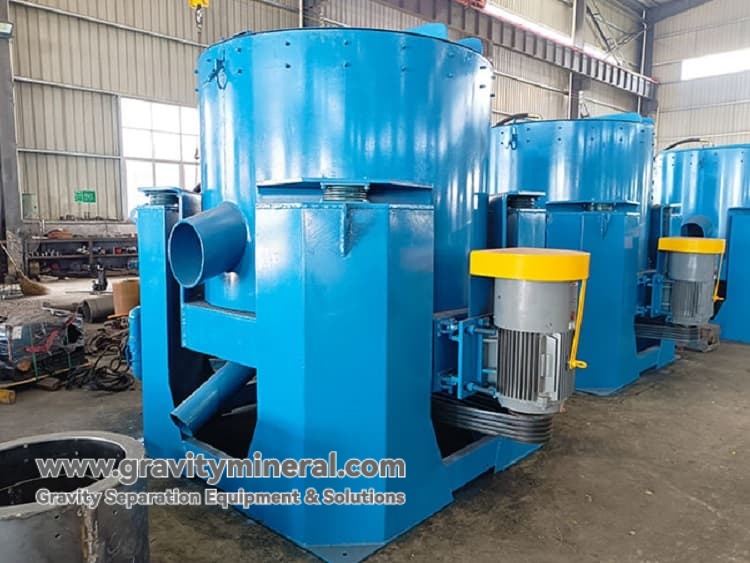
Technical Principle: Why GRG Represents Gravity-Recoverable Gold
The concept of GRG was proposed by McGill University in Canada. Its logic is to simulate the actual conditions of multi-stage grinding and multi-stage recovery in a processing plant. The standard procedure typically involves three stages: in the first stage, the ore is ground to a relatively coarse fineness and separated using a laboratory centrifugal concentrator; the tailings are then reground to a finer size and re-separated; in the third stage, the ore is ground to an even finer size before separation.The concentrate and tailings from each stage are analyzed separately, the recovery rates for each stage are calculated, and these are summed to obtain the GRG value.
The true value of this test lies not in the total figure, but in the recovery rates for each stage.
If the recovery rate is already substantial under the coarse grinding conditions of the first stage, it indicates that gold is liberated early and that coarse, free gold accounts for a high proportion. In this case, gravity separation equipment should be installed as early as possible in the grinding circuit to achieve early recovery.If the recovery rate is primarily driven by the second and third stages, this indicates that the gold is relatively fine and requires finer grinding for liberation; however, the finer the grinding, the lower the collection efficiency of centrifugal equipment for ultrafine particles tends to be, so the process design must be adjusted accordingly.If the combined GRG for all three stages remains low, it indicates that most of the gold is present in fine-grained embedded or encapsulated forms; in this case, gravity separation is better suited as a pre-concentration or auxiliary method rather than the primary recovery method.
Therefore, the core output of gold ore gravity separation tests is a set of gravity-recoverable gold (GRG) data that can guide the direction of the process, rather than an isolated recovery rate conclusion.
Test Procedure: Specific Steps for Gold Ore Gravity Separation Tests
The standard procedure for gold ore gravity separation tests is not complicated, but it requires a high degree of attention to operational details. The steps are outlined below.
Sample Preparation
A representative ore sample is taken, typically in the range of several dozen kilograms. A sample that is too small lacks representativeness, while one that is too large is difficult for laboratory equipment to process. When sampling, consideration should be given to different parts of the ore body and different ore types.
First Stage of Grinding and Separation
After crushing, grind the ore to the target fineness, adjust the slurry concentration to an appropriate range, and feed it into the laboratory centrifugal concentrator.Operating parameters—including relative centrifugal force, backwash pressure, and feed rate—must be set according to the properties of the ore. The concentrate obtained from the separation process is processed using a gold pan to separate the heavy mineral concentrate from the pan tailings; the gold grade of each is then analyzed separately.
Second Stage of Grinding and Beneficiation
The tailings from the first stage of gravity separation are re-ground to a finer particle size, and the centrifugal separation and panning steps are repeated.
Third Stage of Grinding and Separation
The tailings from the second stage are further ground to a finer particle size and then processed; samples of the final tailings are retained for analysis.
Data Compilation
Sum the metal content of the concentrate from the three washing stages and divide it by the total metal content of the original sample to obtain the GRG recovery rate. At the same time, list the grade of each stage\'s concentrate alongside its recovery rate to create a complete stage-by-stage data table.
Key Details: The washing stage must not be omitted. Centrifugal concentrates often contain gangue minerals with higher specific gravity; direct analysis would result in an artificially inflated grade. The tailings from the washing stage must also be analyzed to ensure metal balance. The reliability of data from gold ore gravity separation tests depends largely on whether these details are properly addressed.
Data Interpretation: How to Interpret Gravity-Recoverable Gold Results
GRG results can vary significantly across different mining areas. In quartz vein-type gold deposits with a high proportion of coarse, free-standing gold, satisfactory GRG indicators can be achieved under coarse grinding conditions; whereas in ores with finer gold distribution and a high proportion of sulfide-encased gold, GRG values tend to be lower and rely more heavily on the contribution of the fine grinding stage.
When interpreting GRG data, it is recommended to focus on three key points:
First-stage recovery rate
This determines whether effective recovery can be achieved during the coarse grinding stage and directly impacts grinding costs and process layout.
Total GRG Value
This represents the theoretical upper limit of the gravity separation process under the given ore conditions and serves as the basis for determining whether gravity separation can function as the primary process.
Concentrate Grade by Stage
These grades affect the difficulty of subsequent enrichment and washing processes and also influence the sales or reprocessing options for the gravity separation concentrate.
It should be emphasized that GRG values are results obtained under specific test conditions; differences may arise depending on the testing institution and parameter settings. Therefore, gold ore gravity separation test reports should fully present the test conditions and stage-by-stage data to facilitate cross-comparisons and process simulation.
From Testing to the Processing Plant: The Issue of Gold Recovery Rate Reduction
There is one fact that is easily overlooked: laboratory GRG test results are obtained under optimized conditions, where feed rate, backwash pressure, and operational rhythm are all carefully controlled. During actual plant operations, fluctuations in feed volume, changes in water quality, equipment wear, and variations in operational proficiency can all affect actual recovery performance.
Comparative studies of multiple processing plants abroad indicate that actual gravity recovery rates are typically lower than laboratory GRG predictions, with a certain degree of reduction between the two. The extent of this reduction varies depending on ore properties, process configuration, and operational management levels, and cannot be generalized.
This does not mean that GRG tests are meaningless. On the contrary, it is precisely because of this reduction factor that GRG data must be applied conservatively. When conducting economic evaluations, it is advisable to factor in a reduction margin based on the GRG values and use conservative estimates to calculate payback periods and operating costs.If the gravity separation process remains economically viable under conservative estimates, the project is more likely to proceed; if it barely breaks even based on the original GRG values, a cautious evaluation is warranted. The value of gold ore gravity separation tests lies precisely in grounding such judgments in data rather than making decisions based solely on experience.
Equipment Configuration: Selection Based on Gravity-Recoverable Gold Data
Once the GRG data is available, the approach to equipment configuration becomes much clearer. The following configuration guidelines, based on GRG characteristics, are provided for reference.
| GRG Characteristics | Gravity Re-grinding Equipment Configuration Approach | Notes |
|---|---|---|
| High recovery rate in the first stage | Incorporate a jig or centrifugal separator into the grinding circuit to capture the ore as early as possible | Gold dissociation occurs early; early recovery can reduce the grinding load |
| The second and third stages are the primary contributors | Install a centrifugal separator at the classification overflow to enhance fine-particle recovery | Gold tends to be fine-grained, requiring supplemental recovery in the fine grinding stage |
| Overall GRG is moderate | Gravity separation involves roughing, scavenging, and tailing; tailings are fed to flotation or leaching | Gravity separation reduces the load on subsequent processes |
| Significant sulfide encapsulation | Desulfurization prior to gravity separation, or regrinding and reprocessing of gravity separation concentrate | Encased gold requires prior opening of the inclusions |
Jigging is suitable for the roughing stage, which handles coarse particle sizes and high throughput; centrifugal separators are designed for fine particle sizes and are often used as a supplementary step at the end of the process; shaking tables offer high separation precision but have limited throughput and are primarily used for fine selection.The configuration of equipment in series should be based on GRG stage-by-stage data—equipment should be prioritized in the stage that contributes the most.
It is also important to note that there is a significant difference in throughput capacity between laboratory equipment and plant-scale equipment. During scale-up, parameters such as centrifugal force, backwash pressure, and feed concentration must be readjusted; laboratory values cannot be directly applied. In this phase, collaboration between equipment and process teams with on-site commissioning experience is often more effective than relying solely on test reports.
Common Technical Issues
What is the appropriate grinding fineness?
The recovery rates by stage from the GRG test serve as a reference in themselves. If the recovery rate in the coarse grinding stage is already high, it indicates that adequate liberation can be achieved through coarse grinding alone, and excessive grinding is unnecessary; if the recovery rate is primarily improved by the fine grinding stage, then the costs of grinding must be weighed against the benefits of increased recovery. This is precisely the significance of the stage-by-stage data in gold ore gravity separation test reports.
How should one choose between a centrifugal concentrator and a shaking table?
Centrifugal separators excel at processing fine particles and have a high throughput, making them suitable for integration into the grinding circuit; shaking tables offer high separation precision and are suitable for concentrate enrichment or applications with lower throughput. In actual processes, the two are often used in combination, with centrifugal separators handling roughing and shaking tables handling enrichment.
What kind of organization should be selected to conduct GRG tests?
Focus on two key points: whether the facility has a laboratory-scale centrifugal mineral separator, and whether it performs washing separation and analyzes the washed tailings. Reports that only perform centrifugal separation—without washing—and directly analyze the concentrate have limited data value. Complete data on stage-by-stage recovery rates and metal balance are the fundamental basis for evaluating the quality of a gold ore gravity separation test report.
Conclusions and Recommendations
When conducting gold ore gravity separation tests, the sequence must not be reversed. First, determine the gravity-recoverable gold content; then, proceed with equipment selection and process configuration. This is the fundamental logic for reducing investment risk.
Upon receiving the GRG report, focus on three key elements: the recovery rate of the first stage, the total GRG value, and the grade of the concentrate in each stage. Calculate economic viability using conservatively adjusted figures. Equipment configuration should be based on the stage-by-stage data: early recovery in the coarse-grain stage, supplementary recovery in the fine-grain stage, and reliance on combined processes to capture entrapped gold.
The separation efficiency of the core gravity separation equipment determines the lower limit of recovery, while the coordination of supporting processes—such as feeding, crushing, washing, and dewatering—determines whether the entire line can operate stably. It is recommended to involve a team with expertise in equipment manufacturing and process design during the testing phase to ensure that gravity-recoverable gold data can be seamlessly translated into a practical process plan.
If you would like to further discuss test plans and process configurations for gold ore gravity separation, please provide information such as the grade of the ore, the grain size distribution of the gold, and the current grinding fineness. This will allow us to conduct a targeted analysis in conjunction with the gravity-recoverable gold data.