







How should a complete gravity gold ore processing production line be configured?
[30-Second Read]
-
The configuration of a complete gravity gold beneficiation plant essentially involves arranging equipment according to the particle size distribution of the gold grains, rather than simply stringing together several gravity separation units.
-
Grinding fineness is a key prerequisite for the gravity separation process of rock gold; if the gold is not liberated, the separation efficiency of subsequent gravity separation equipment will be limited.
-
Alluvial gold and bedrock gold require two distinct gravity gold processing production lines: alluvial gold processing primarily involves washing, screening, and gravity separation, while bedrock gold processing primarily involves crushing, grinding, and gravity separation.
-
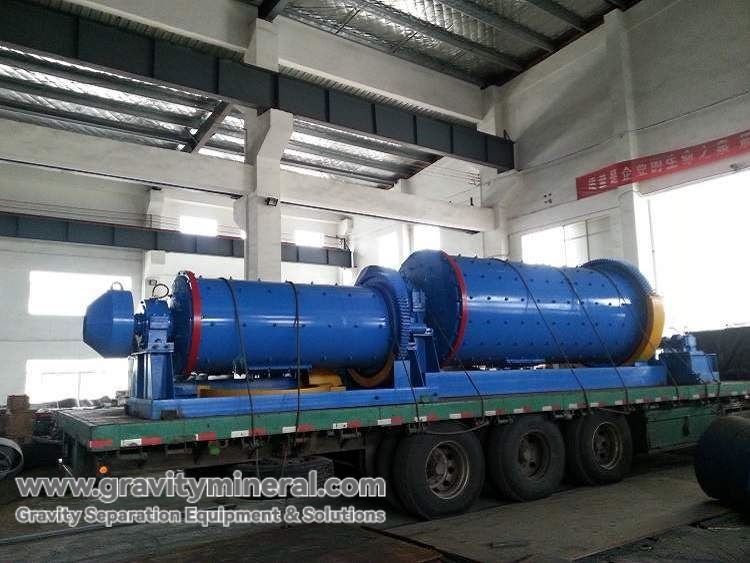
A common configuration for a medium-scale rock gold gravity separation line includes a jaw crusher, cone crusher, ball mill, classifier, jig, spiral chute, centrifugal separator, and shaking table.
-
The recovery efficiency of a complete gravity gold processing production line depends on the synergy among equipment placement, particle size distribution, and operating parameters.
I. When configuring a complete gravity gold ore processing line, the first question to answer is: In which particle size range is the gold primarily found?
When configuring a complete gravity gold beneficiation production line, one cannot avoid a preliminary question: in which particle size range is the target gold mineral primarily distributed? Without answering this question, there is no basis for selecting the subsequent gravity gold beneficiation equipment.
Native gold has a specific gravity of approximately 17.5 to 18.0, while gangue minerals typically range from 2.5 to 2.7; a specific gravity difference of more than six times forms the basis of the gravity separation process. However, this specific gravity difference can only translate into effective separation results when combined with appropriate particle size distribution.Jigging machines have limited recovery capacity for fine-grained gold particles smaller than 0.1 mm; processing ultrafine material with a jig results in a significant drop in separation efficiency. Centrifugal separators are not well-suited for coarse-grained gold larger than 2 mm, as coarse particles struggle to stratify effectively within the drum.
Therefore, the first step in a complete gravity gold processing production line is to obtain screening data from representative ore samples to determine the distribution proportions of gold in particle size fractions such as +0.2 mm, -0.074 mm, and -0.037 mm. This data essentially determines the selection of the main equipment for the gravity gold processing system.The clay content and the distribution of gold must also be confirmed simultaneously: when clay content is high, the ore washing and de-sliming stages cannot be omitted; when gold is encapsulated within sulfides, gravity separation is suitable for pre-concentration, followed by flotation or leaching processes.
Skipping the screening and analysis phase to directly determine the equipment list often results in rework costs during the commissioning stage. The quality of the configuration for a complete gravity gold processing production line begins to diverge based on this data.
II. Alluvial Gold vs. Bedrock Gold: Process Differences Between the Two Gravity Gold Processing Lines
Placer gold and bedrock gold correspond to two gravity gold processing production lines with distinct process logics; mixing equipment lists for the two is a common configuration error.
The gravity separation process for placer gold follows the sequence of ore washing, screening, and gravity separation. Under natural conditions, gold particles are already largely free-standing, eliminating the need for crushing or grinding. The core tasks are to break up clay agglomerates, screen out large gravel, and feed the gold-bearing fine sand into the gravity separation equipment.Trommel washers and trommel screens form the basic configuration of gravity gold separation equipment for placer gold. The thoroughness of the washing process directly affects the separation efficiency of subsequent jigs and spiral chutes—when gold particles are coated with clay, the separation efficiency of gravity separation equipment drops significantly.
The gravity separation process for rock gold ores follows the sequence of crushing, grinding, and gravity separation.Since gold is embedded in quartz veins or sulfides, liberation is a prerequisite for gravity separation. Coarse crushing by a jaw crusher, medium crushing by a cone crusher, and fine grinding by a ball mill to the target liberation particle size constitute the main front-end section of the gravity separation equipment for rock gold.The grinding stage accounts for a relatively high proportion of energy consumption in the entire production line; however, both insufficient liberation and overgrinding must be avoided: insufficient liberation prevents coarse-grained gold from entering the gravity separation stage, while overgrinding increases the risk of fine-grained gold being lost during subsequent separation.For brittle gold-bearing minerals, rod mills should be prioritized in the grinding stage to minimize overgrinding.
The distinction between these two production lines determines that the equipment configuration and investment structure of a complete gravity gold beneficiation plant are entirely different. Determining the ore type before configuration is a fundamental prerequisite for selecting the appropriate gravity gold beneficiation equipment.
Grain Size Segmentation of the Three and Four Categories of Core Gravity Gold Concentration Equipment
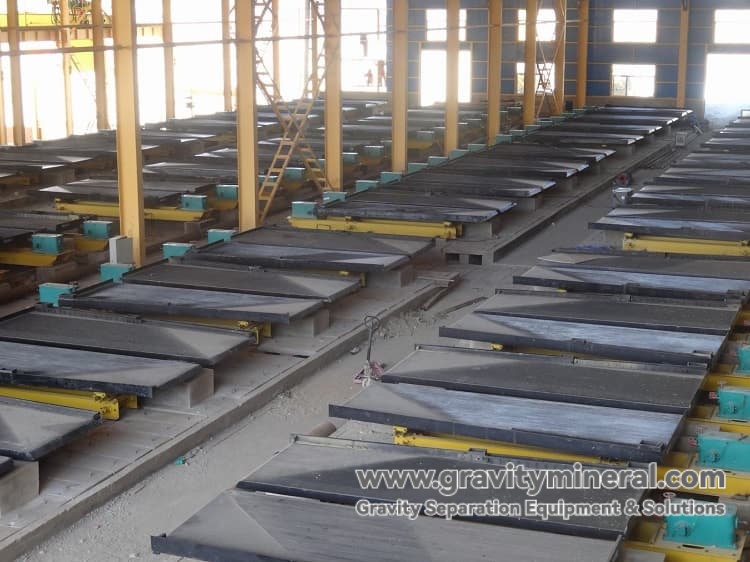
In a complete gravity gold processing production line, jigs, spiral chutes, centrifugal separators, and shaking tables are not substitutes for one another but rather operate in sequential stages according to particle size. The roles of these four types of gravity gold processing equipment are as follows.
| Equipment | Primary Applicable Particle Size Range | Process Role | Key Considerations for Selection |
|---|---|---|---|
| Sawtooth Jig | Approx. 0.5 to 25 mm | Early recovery and roughing in the grinding circuit | Limited recovery capacity for fine-grain gold |
| Fiberglass-reinforced plastic spiral chute | Approx. 0.03 to 4 mm | Intermediate roughing, tailings rejection, and scavenging | The bed surface is prone to clogging when the mud content is high |
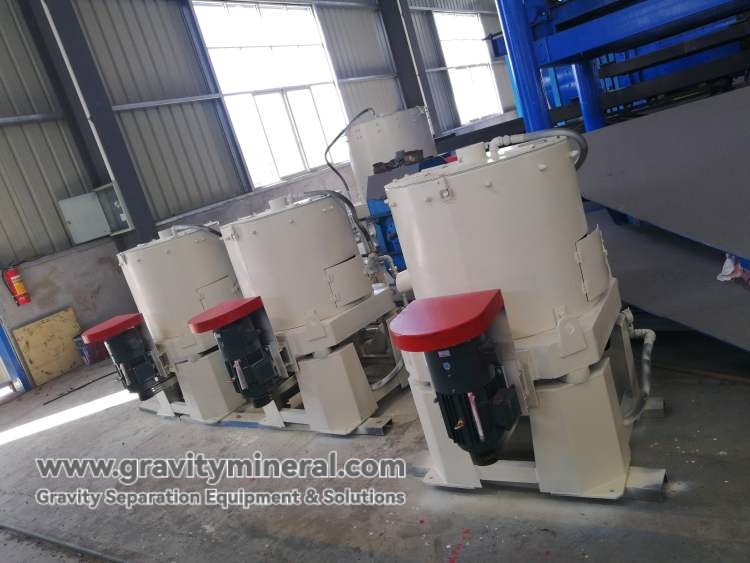
| Centrifugal concentrator | Approx. 0.01 to 0.2 mm | Recovery of fine-grained gold | Coarse material is prone to clogging |
| 6-S shaking table | Approx. 0.019 to 3 mm | Final Concentration | The sorting belt is prone to disruption when the feed particle size range is too wide |
The jig performs the roughing function. In a placer gold production line, the jig is positioned at the mill discharge or at the return point of the classifier to recover liberated coarse-grained gold early on, thereby reducing recovery losses caused by this gold entering subsequent processes.Spiral chutes consume no power and have a high throughput, making them suitable for scavenging operations and for processing jig tailings; however, their precision is limited, so they are not suitable as final concentration equipment.Centrifugal separators target ultrafine free gold particles, serving as a vital supplement for particle sizes that jigging machines and spiral chutes cannot effectively cover; their concentrates typically still require further processing in a shaking table. Shaking tables have low throughput but high separation precision, performing the final concentration function for the entire line; coarse concentrates produced by upstream equipment are fed into the shaking table to further enhance grade.
The division of labor among these four types of gravity gold separation equipment can be summarized as follows: jigging machines recover coarse particles, spiral chutes sweep and separate medium-sized particles, centrifugal separators capture fine particles, and shaking tables complete the final concentration. If any one of these stages is missing, gold recovery for the corresponding particle size range will be compromised.The key to configuring a complete gravity gold ore processing line lies in ensuring seamless particle-size coordination among these four types of equipment.
IV. Complete Process Configuration for a Medium-Scale Rock Gold Gravity Concentration Line
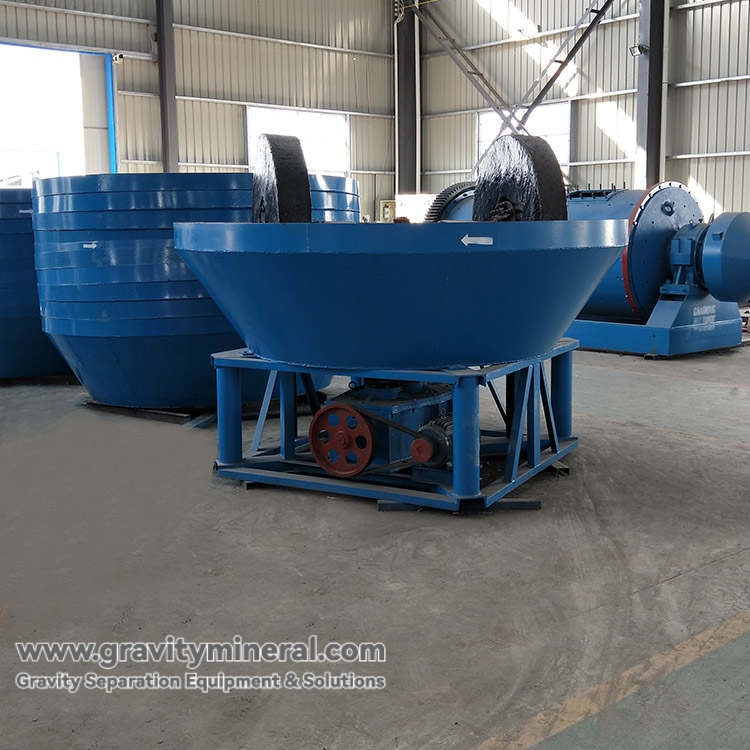
Taking a 50- to 150-metric-ton-per-hour rock gold gravity separation line as an example, the typical process configuration for a complete gravity gold ore processing production line is as follows. It is explained segment by segment according to the material flow and can be directly replicated for use.
Feeding
The raw ore is uniformly fed into the jaw crusher via a vibrating feeder. The feeder ensures a stable feed rate and preliminarily screens out fine particles to prevent the crusher from clogging.
Primary Crushing
The jaw crusher coarsely crushes the raw ore to a size of 150 to 200 millimeters, providing feed material of the appropriate particle size for subsequent secondary crushing.
Secondary Crushing and Closed-Circuit Screening
The primary crushed product is fed into a cone crusher for secondary crushing to 20 to 40 millimeters. The secondary crushed product is then graded using a circular vibrating screen: the undersize material that meets the required particle size is fed into the ball mill, while the oversize material is returned to the cone crusher, forming a closed-circuit crushing process that ensures a stable feed size for the ball mill.
Grinding and Classification
The qualified particle size enters the ball mill for fine grinding. The ball mill operates in a closed-circuit configuration with the spiral classifier: the classifier\'s underflow is returned to the ball mill for regrinding, while the classifier\'s underflow and overflow are directed to different gravity separation stages, respectively, providing feed material of the appropriate particle size for gravity separation.
Early Recovery of Coarse Gold
The underflow from the classifier enters a sawtooth-wave jig, which recovers liberated coarse-grain gold early in the grinding circuit, thereby reducing overgrinding and loss caused by coarse-grain gold entering subsequent stages. The coarse concentrate from the jig is fed to a 6-S shaking table for fine selection.
Medium- and Fine-Grain Sweeping
The overflow from the classifier enters a fiberglass-reinforced plastic spiral chute, which performs the functions of rough selection, tailings rejection, and scavenging for medium- and fine-grain material. Depending on particle size, the coarse concentrate from the spiral chute is fed to a shaking table or a centrifugal concentrator for further processing.
Recovery of Micro- and Fine-Grain Gold
The fine-grain material from the spiral chute enters the centrifugal concentrator to recover ultrafine free gold that is difficult to capture using the jig and spiral chute. The concentrate from the centrifugal concentrator is then sent to the 6-S shaking table for further processing.
Enrichment and Product
The rough concentrate from the jig and the concentrate from the centrifugal concentrator are combined and fed into the 6-S shaking table for final concentration. The shaking table produces the final gold concentrate, which is sent for smelting or subsequent gold extraction processes.
Tailings Treatment
Tailings from the spiral chutes, centrifugal separators, and shaking tables are combined and fed into the tailings treatment system. When the ore has a high sulfide content or contains encapsulated gold, the gravity separation tailings can be fed into a flotation or carbon-in-leach (CIL) process, forming a combined flow sheet where gravity separation provides early recovery and flotation or leaching serves as a backup.
This production line configuration has three key stages
- Jig Location:When positioned at the mill discharge, the slurry concentration is higher and the proportion of coarse particles is greater, which facilitates the early capture of coarse gold and reduces over-grinding; when positioned at the classifier overflow, the feed particle size tends to be finer, and jigging efficiency may decrease. For ores with a high proportion of coarse gold, the jig should be moved forward appropriately.
- Feed concentration for the centrifugal separator: If the concentration is too high, the bed becomes compacted, making it difficult for fine-grained gold to enter the annular groove; if the concentration is too low, processing capacity decreases. The feed concentration is typically controlled within the range of 30% to 50%, with specific values determined based on the equipment model and ore properties.
- Feed particle size for shaking tables: Shaking tables have limited adaptability to wide particle size distributions; when coarse and fine particles are mixed, the separation zone is prone to disruption. A classification or thickening stage should be installed upstream of the shaking table to narrow the feed particle size distribution.
V. Common Issues in the Configuration of Complete Gravity Gold Processing Equipment Production Lines
Insufficient grinding fineness
This is the most common issue in the configuration of rock gold gravity separation lines. When gold is not sufficiently liberated, the gravity separation equipment is effectively processing gangue. The grinding fineness should be determined based on the gold\'s embedment size: for ore with coarser gold embedment, grinding to a size where 55% to 65% falls within the -200 mesh range may meet liberation requirements;for ore with finer gold grains, this should be increased to 75% or even higher. The increased energy consumption from grinding is typically offset by improved recovery rates.
Lack of Treatment for Clay Content
Clay agglomerates in placer gold and secondary slime generated from the grinding of bedrock gold can cause bed plugging in jig tables, bed clogging in spiral chutes, and blurred separation zones on shaking tables once they enter the gravity separation equipment.A mineral washing unit should be installed at the front end of a placer gold production line; when the volume of mineral slurry is excessive in a rock gold production line, a desliming process should be considered, or a centrifugal concentrator with good adaptability to clay-bearing ore should be selected to handle the recovery of the fine-grain fraction.
Mismatched Equipment Capacity
When there is a significant disparity in processing capacity between the jig and the shaking table, and there is no intermediate buffering or classification stage, material blockages or equipment idling are likely to occur. This is also a common issue when equipment is procured separately and pieced together—individual units may operate normally, but the entire line fails to function smoothly when integrated.The integration of equipment and the balancing of production capacity across a complete gravity gold processing line must be considered holistically during the process design phase.
VI. Configuration Sequence and Implementation Recommendations
It is recommended to proceed with the configuration of a complete gravity gold ore processing line in the following order.
- Complete the screening and analysis of ore samples to determine the distribution of gold across various particle sizes, the clay content, and the ore\'s disseminated state. This data serves as the starting point for selecting gravity gold separation equipment.
- Determine the processing capacity. Different scales correspond to different equipment combinations and investment structures. Small-scale lines can use a basic combination of jaw crushers, ball mills, spiral chutes, and shaking tables;medium-scale lines require a combined process involving cone crushers, closed-circuit screening, jigs, centrifugal separators, and shaking tables; larger-scale operations involve multi-stage crushing, multiple mills, and combined gravity separation configurations. The composition of a complete gravity gold ore processing line varies significantly depending on scale.
- A team with expertise in gravity separation processes should prepare the process design and equipment list based on screening and analysis data. Process design and equipment selection should be guided by a consistent technical logic, avoiding the reversed sequence of first setting a price and then piecing together a process.