







How should a complete production line be configured for a combined gold ore gravity separation and leaching plant?
[30-Second Summary]
- In a combined gravity separation and leaching plant for gold ore, the core principle is "gravity separation for early recovery of coarse particles, and leaching to capture the remaining fine particles," with each process operating independently.
- By integrating gravity separation into the grinding circuit, early recovery of coarse particles is achieved, which not only prevents over-grinding and slime formation but also saves on leaching reagents.
- The entire line is configured in four stages: crushing and grinding, early recovery via gravity separation, final recovery via leaching, and dewatering; interfaces must be aligned during the design phase.
- This combined configuration is best suited for rock-type gold ores with a high proportion of coarse-grained free gold and a mixture of coarse and fine particles.
Why do some processing plants using only gravity separation hit a bottleneck with the same ore, while this combined solution immediately stabilizes performance indicators? Ultimately, it comes down to the separation of coarse and fine gold particles—a single process cannot effectively handle both ends of the spectrum. A combined gold processing plant using gravity separation and leaching solves precisely this long-standing problem of “prioritizing one aspect at the expense of another.”
I. What Is This Solution?
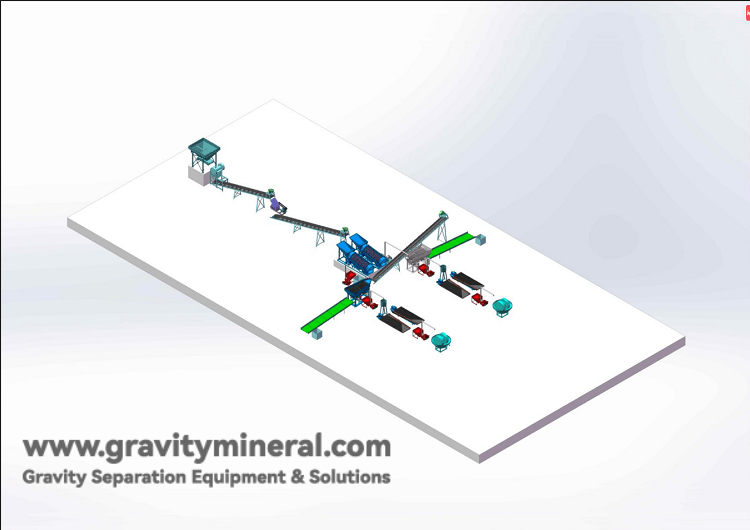
Key Points of the Solution: This is a “combined gravity separation and leaching plant for gold ore” solution, which integrates gravity separation and cyanide leaching into a complete production line. Gravity separation first recovers coarse-grained free gold, while leaching subsequently recovers fine-grained and entrapped gold.
Its core technology is the rock gold gravity separation process—using gravity separation (which separates particles into layers based on density differences) to intercept coarse-grained gold early in the grinding circuit,while the remaining gravity separation tailings are sent to the cyanide leaching process (hydrometallurgy, which uses sodium cyanide to dissolve and recover gold), retrieving the fine-grained gold. The two processes each fulfill their specific roles without interfering with one another.
II. What Problems Does It Solve?
Key Points of the Solution: It addresses the issue of separating coarse and fine gold particles, where a single process often fails to address both effectively, resulting in low recovery rates and excessive chemical consumption.
Gold processing plants handling ore-borne gold often encounter two situations. First, coarse-grained gold is ground into fine particles during the grinding process, making it unrecoverable by gravity separation; it must then be sent to the leaching stage, which is both slow and chemical-intensive. Second, when relying solely on gravity separation, fine-grained gold flows directly into the tailings, preventing the tailings grade from being reduced.
This integrated configuration is best suited for two scenarios: new processing plants seeking to effectively manage both coarse and fine gold from the outset; and retrofits of existing plants aiming to add a gravity separation stage to an existing leaching line for early recovery. For ores with a high proportion of coarse free gold, or rock gold containing a mixture of coarse and fine particles, this approach is often the most reliable.At mining sites like the Zhaoyuan Gold Mine in Shandong, where coarse-grained free gold predominates, this combined approach is commonly adopted.
III. Core Components and Principles
Key Points of the Solution: The entire line is configured in four stages—“crushing and grinding—early recovery via gravity separation—leaching as a backup—dewatering”—with each stage addressing a specific issue.
① Crushing and Grinding Section: The ore first undergoes primary crushing in a jaw crusher, then enters a ball mill. Combined with a spiral classifier (which classifies by particle size and returns coarse particles for regrinding), this forms a closed-circuit grinding system. A key step is embedding the gravity separation equipment within the grinding circuit.
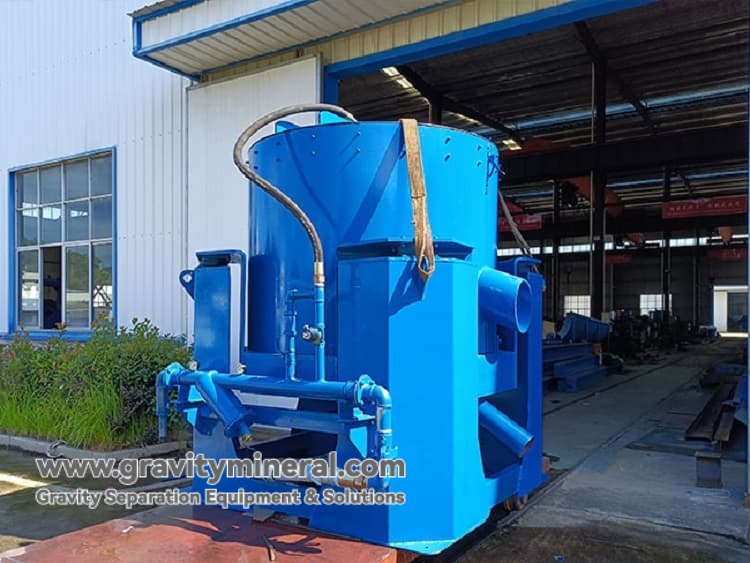
② Gravity Separation and Early Recovery Stage: Classified sand is fed into a sawtooth-wave jig (which uses pulsating water flow to stratify by density) for roughing, followed by scavenging to produce gold concentrate. Coarse gold particles are captured here first, preventing them from undergoing an additional grinding cycle.
③ Leaching Recovery Stage: Gravitational separation tailings enter the cyanide leaching process, typically via CIL (carbon-in-leach, where adsorption by activated carbon occurs simultaneously with leaching) or CIP (carbon-in-pulp, where adsorption follows leaching). Fine-grain and encapsulated gold dissolve in the solution and are concentrated by activated carbon.
④ Dewatering Section: The concentrate and tailings are settled and dewatered, then pressed into filter cakes. The concentrate is prepared for transportation, while the tailings are sent for dry disposal.
As long as the gravity separation stage captures the coarse gold early on and the leaching stage captures the fine gold, this integrated line ensures nothing is missed at either end—the coarse gold is recovered early, and the fine gold is captured at the end.
The traditional approach involves purchasing separate gravity separation and leaching systems and integrating them on your own; the integrated solution, however, provides a complete line from grinding to leaching, with a single team responsible for the coordination between stages—this is where the true value of the complete system lies.
IV. Why Choose It
Key Points of the Solution: Compared to standalone processes, the advantages of this integrated configuration center on four aspects: early recovery to preserve value, comprehensive capture to improve efficiency, reliable process integration, and clear accountability.
① Early recovery via gravity separation prevents overgrinding. Coarse gold particles are intercepted early in the grinding circuit, reducing overgrinding and sludging while saving on the chemical costs that would otherwise be required for leaching.
② Leaching as a safety net, improving overall efficiency. Gravitational separation alone cannot recover fine-grained gold; adding a leaching stage recovers this fine-grained gold as well. The overall recovery rate is several percentage points higher than with gravitational separation alone (depending on ore properties). In plants with high daily throughput, this difference translates to a tangible increase in gold production.
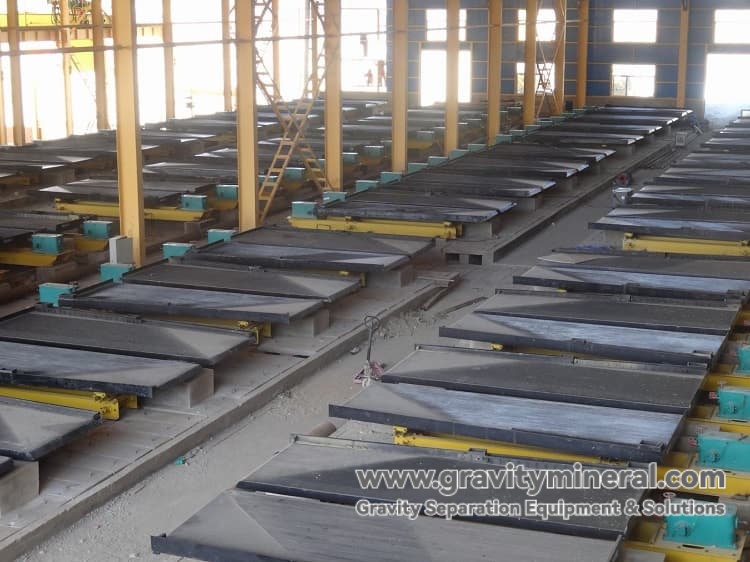
③ Reliable integration. Equipment is designed according to a unified process flow, with aligned processing capacities and compatible interfaces, eliminating disconnects such as “mismatched feed rates between gravity separation tailings and leaching.” The 6-S shaking tables in the medium-to-fine-grain enrichment section and the centrifugal separators in the fine-grain recovery section are all calculated based on the entire line\'s processing capacity.
④ Clear accountability. The process is designed by a single team and the equipment is manufactured at a single facility; if problems arise, there is a clear party to take responsibility, eliminating the need for back-and-forth finger-pointing among multiple parties.
V. Applicable Scenarios and Limitations
Key Points of the Solution: This solution performs best on rock gold ores with a high proportion of coarse-grained free gold and a mixture of coarse and fine particles; for ores primarily consisting of fine-grained encapsulated gold or those with extremely high clay content, pilot testing is required for validation.
Optimal Scenarios: When the ore consists primarily of coarse-grained free gold with good gold liberation, early recovery from gravity separation yields significant returns; when the ore contains a mixture of coarse and fine particles, the process effectively handles both fractions. If the fine-particle stage requires reinforcement, equipment such as pulsating chutes can be used as a supplementary scavenging step.
Situations where this approach is not highly recommended: If the ore consists primarily of fine-grained encapsulated gold with very little free gold, the benefits of the gravity separation stage will be limited, and the focus of the process should shift to leaching; if the raw ore contains a high amount of clay, the process should first prioritize ore washing and desliming.Frankly speaking, this solution is not a one-size-fits-all approach; it addresses the beneficiation of ores characterized by a “mixture of coarse and fine particles, with coarse particles processed first.”
Therefore, before placing an order, it is best to send samples for mineral processing tests and determine the process flow based on comparative data from gravity separation and leaching, rather than proceeding directly based on experience alone.
VI. Implementation Process
Key Steps of the Proposal: From initial communication to production start-up, the process generally consists of five steps—providing ore information, preparing the proposal and quotation, designing drawings, manufacturing and shipping, and installation, commissioning, and training.
Step 1: Provide ore information. Specify the ore type, raw ore grade, target processing capacity (metric tons per day or metric tons per hour), feed particle size, site conditions (including water and electricity), and budget. There is no charge for this step.
Step 2: Prepare a Selection Proposal and Quote. Determine the process flow based on ore sample analysis or test results, and provide a list of selected equipment and a transparent quote. A single document will clearly outline “the process flow, the equipment configuration, and the total cost.”
Step 3: Design Drawings. We deliver all necessary documents in one go: process flow design, equipment configuration, plant layout, civil engineering requirements, and technical briefings. The locations for gravity separation and leaching feed conditions must be finalized during this stage.
Step 4: Manufacturing and Shipping. Production scheduling at our own manufacturing facility, factory acceptance testing, and logistics coordination ensure the equipment arrives safely at the destination port.
Step 5: Installation, Commissioning, and Training. Engineers are stationed on-site to guide installation, conduct integrated commissioning tests with actual feed material, and train operators. You may organize local civil construction and general installation workers, with the supplier\'s engineers overseeing technical standards—thereby saving on labor costs.For the dewatering section, we recommend equipping the facility with a high-efficiency thickener and a plate-and-frame filter press to ensure both dry tailings disposal and concentrate transportation are properly addressed.
Consultation and Cooperation
Key Points of the Proposal: Send us your ore data so we can first discuss feasibility and then determine whether to request samples for testing.
If you have this type of ore or wish to add a gravity separation stage to an existing production line, simply send us the grade, particle size, gold occurrence, and processing capacity. If suitable, we\'ll proceed directly to equipment selection and pricing; if verification is needed, please send samples for testing.The configuration of a combined gold ore gravity separation and leaching plant hinges on whether the ore and process are a good match. Only when the process is correctly defined can recovery rates and cost control be reliably supported.