







How to Choose Between Rock Gold Gravitational Separation and Cyanidation Processes? High-Efficiency Gold Extraction Solutions to Help You Reduce Costs and Improve Efficiency
There is an inescapable dilemma in gold extraction from rock ore: coarse-grained gold cannot be leached using cyanide, while fine-grained gold cannot be recovered through gravity separation. When relying on a single process, recovery rates often hit a bottleneck and fail to improve, resulting in more gold lost in the tailings than recovered in the concentrate.A combined gravity separation and cyanidation process for rock gold can solve this problem, but how to configure and fine-tune the process—and where to allocate funds—are the factors that truly determine the payback period. Below, following actual production logic, we\'ll break down the approach to selecting a high-efficiency gold extraction solution into several key sections.
I. First, Assess the Ore Characteristics: Where Is Your Gold Trapped in the Particle Size Distribution?
The decision to use a rock gold gravity separation + cyanidation process isn\'t made on a whim; the first step is to examine the state of gold occurrence. There are three common scenarios:
A high proportion of coarse, free gold. The gold particles are relatively coarse and well-dissociated as individual particles. This type of gold leaches slowly in the cyanide leaching tank; if the retention time is insufficient, it will be lost with the tailings. Gravity separation can capture it early on, which is the primary reason for the combined gravity separation and cyanidation process.
Fine-grained, encapsulated gold predominates. The gold is encapsulated by gangue or sulfides, and the particle size is too fine for gravity separation to detect. This fraction must be processed via cyanidation or by grinding to a finer size before leaching.
A mixture of both. This is the actual condition in most rock gold deposits, where the gold particle size distribution is broad, and a single process will inevitably fail to fully recover a particular particle size fraction. In such cases, the value of the rock gold gravity separation plus cyanidation process is most evident: gravity separation handles the coarse particles, while cyanidation handles the fine particles. By having each stage manage a specific particle size range, there is room for improvement in the overall recovery rate.
The assessment method is straightforward: conduct sieve analysis to determine the distribution of gold across different particle sizes, and perform gravity separation tests to determine how much coarse gold can be recovered. Until these two sets of data are available, any equipment selection is merely an estimate. The selection of gravity separation equipment relies heavily on three parameters: density difference, particle size distribution, and clay content. Without test data from representative ore samples, there is no basis for determining the optimal configuration.
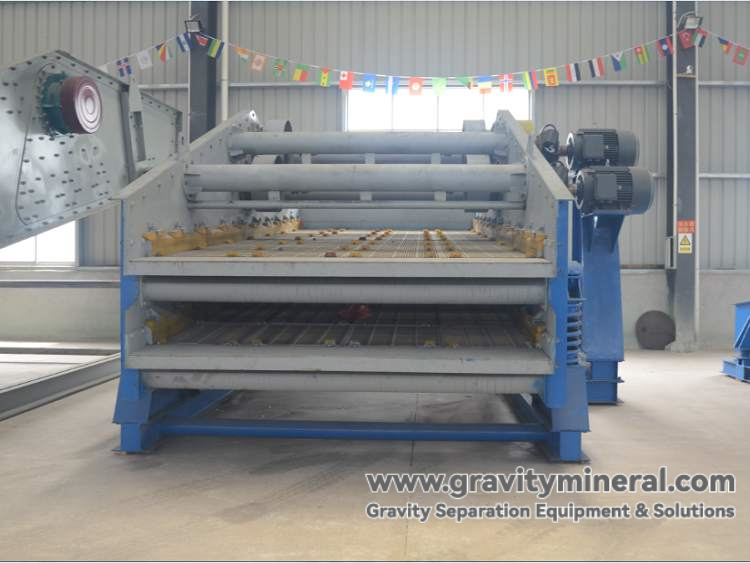
II. How to Configure the Gravity Separation Stage: Equipment Selection Determines How Much Coarse-Grained Gold Can Be Recovered
Gravity separation serves as the core of the pre-treatment stage for the rock gold gravity separation and cyanidation process. Its mission is to “recover as much as possible as early as possible” within the grinding circuit, thereby preventing coarse gold from being overground and turned into fine particles—a situation where recovery is poor at both ends of the process.
Comparison of Gravitation Separation Equipment Configurations
| Equipment Combinations | Applicable Scenarios | Features | Investment Scale |
|---|---|---|---|
| Centrifugal Mineral Separator | High processing capacity; significant proportion of coarse-grain gold | Enhanced separation via centrifugal force field, with relatively thorough recovery of fine-grain particles | High |
| Sawtooth Jig + 6-S Shaking Table | Small- to medium-scale operations, or roughing in grinding circuits | Intuitive operation; flexible configuration of stages | Low |
| Spiral Chute + Shaking Table | High throughput, low grade | No power consumption; suitable for roughing and tailings disposal | Moderate |
The advantage of the centrifugal concentrator lies in the centrifugal force field. Since gold has a much higher density than gangue, heavy minerals settle against the wall of the high-speed rotating enrichment cone, while light minerals are flushed out by the counter-current water. The separation efficiency is one order of magnitude higher than that achieved in a natural gravitational field.When small- and medium-sized processing plants are facing financial constraints, a sawtooth-wave jig can be used for roughing at the sand trap of a classifier, followed by a 6-S shaking table for scavenging; this setup can still be operational, though there will be noticeable losses in the fine-grain fraction, and someone must be present to monitor and adjust the stroke and water flow.
The recovery rate of gravity concentrate is very low—typically less than one-thousandth—which means the volume requiring subsequent separate processing is minimal.Using a small-volume leaching tank to process the gravity concentration separately requires minimal investment but allows this portion of the gold to be “recovered” rather than “lost with the tailings.” If this step is omitted, the value of the gravity separation stage is significantly diminished.
III. How to Connect to the Cyanidation Stage: Direct Leaching or Pretreatment First
Feeding gravity separation tailings into the cyanidation process constitutes the downstream stage of the rock gold gravity separation + cyanidation process. The method of integration depends on whether the gold is sufficiently exposed.
When the grinding fineness is adequate and the gold is well liberated, direct cyanide leaching of the gravity separation tailings is feasible.The leaching time should be set at 24–36 hours, with the leaching concentration controlled at around 40%. The pH should be adjusted to 10.5–11 using lime, and activated carbon should be added at a density of 10–15 g/L.
If the ore has a high sulfide content, or if the gold is tightly encapsulated by pyrite or arsenopyrite, the direct leaching recovery rate will drop significantly.In such cases, there are two approaches: first, regrinding to improve liberation; second, adding leaching aids during the leaching stage. The initial investment for the leaching aid route is typically lower than that for an oxygenation system, making it more suitable for small- and medium-scale processing plants; however, the specific consumption of chemicals must be factored into long-term cost calculations, and one should not focus solely on the initial savings in equipment costs.
Both carbon-in-leach (CIL) and carbon-in-pellet (CIP) methods are suitable for this stage. The choice between them depends primarily on the content of impurities and organic matter in the slurry, as well as the availability of supporting desorption and electrolysis equipment.If gravity concentrate is processed separately, the sodium cyanide concentration can be slightly higher than in the main process, as the smaller throughput and higher grade mean that leaching rate takes priority over reagent costs.
IV. Cost Structure and Cost-Saving Potential of High-Efficiency Gold Extraction Solutions
“Cost reduction and efficiency improvement” in high-efficiency gold extraction schemes is not just a slogan; it must be broken down into specific cost items.
Reference for Investment Breakdown
| Item | Approximate Percentage | Description |
|---|---|---|
| Equipment Purchases | Approximately half | Crushing and grinding account for the largest share, followed by gravity separation and cyanidation equipment |
| Installation and Civil Engineering | Around 20% | Leaching tank foundations, thickener basins, and plant buildings |
| Environmental protection facilities | Over 10% | Cyanide removal system, tailings pond lining, return water piping |
| Electrical and Automation | Less than 10% | PLC control, online pH/ORP monitoring |
Specific costs vary significantly depending on processing scale, equipment brands, and local construction conditions, so it is not appropriate to apply fixed figures. However, the cost breakdown provides useful reference: equipment procurement is always the largest expense, and within that, crushing and grinding account for the lion\'s share.This implies that the potential for cost reduction lies not in the gravity separation equipment itself, but in the rationality of the process design—if the grinding fineness is set too high, electricity and steel consumption will increase over the long term; if set too low, neither the gravity separation nor the cyanidation stages will achieve complete recovery.
Three Variables Affecting Operating Costs
Electricity consumption. For every increase in the grinding fineness by one grade, electricity consumption rises significantly. The design principle for the rock gold gravity separation plus cyanidation process is “more crushing, less grinding.” By incorporating gravity separation equipment into the grinding circuit to recover coarse-grained free particles early on, the residence time of useful minerals in the mill is reduced.
Chemicals. The specific consumption of sodium cyanide is greatly influenced by ore properties; sulfide content, the degree of gold particle exposure, and leaching time all affect specific consumption. Leaching aids can accelerate the process but add another chemical cost, so a comprehensive cost analysis is required.
Environmental Treatment. The cost of cyanide deactivation for cyanide tailings is often underestimated in budgets. In regions with strict environmental regulations, the costs of cyanide deactivation reagents and online monitoring equipment must be factored in early; one cannot wait until commissioning to discover that tailings disposal does not comply with regulations.
Profitability depends on the extent to which recovery rates improve and the level of gold prices. If recovery rates are raised from a bottleneck level to a reasonable range, the daily profit increase can be quantified; however, since gold prices themselves fluctuate, it is more prudent to validate the break-even point by applying a certain percentage decline to the gold price during calculations rather than relying solely on current prices.
V. Common Misconceptions Regarding the Rock Gold Gravity Concentration + Cyanidation Process
Do not process gravity concentration separately. Mixing concentrates from centrifuges or shaking tables directly back into the cyanide feed is tantamount to rendering the gravity separation process ineffective. Coarse gold particles will still fail to dissolve in the cyanide tanks; they simply move to a different location where they continue to be lost. Concentrates must be leached separately or sold to external smelters.
A one-size-fits-all approach to grinding fineness. For ore with a high content of coarse-grained gold, grinding it too finely actually breaks the gold into flake-like particles, making it difficult to process via both gravity separation and cyanidation. Gravity separation tests should be conducted first to determine the upper limit of coarse-grained gold particle size, and the grinding fineness should then be determined by working backward from that limit.
The number of gravity separation stages does not match the feed particle size. Mismatches between the processing capacities of jigs and shaking tables result in either material buildup or idle operation at intermediate stages. Gravity separation processes are highly sensitive to particle size continuity; recovering coarse particles while allowing fine particles to escape entirely is the most common consequence of a haphazard, pieced-together process.
Failure to account for fluctuations in ore properties.Ore properties are not constant; grade and particle size distribution vary by mining area. When designing the process, allow for adjustment—adjustable stroke and frequency for jigs, adjustable slope for shaking tables, and spiral chutes with interchangeable pitch models—and conduct comparative tests with different ore samples during the trial phase to clearly define the adaptability limits.
VI. Equipment Selection Recommendations: Conduct Testing Upfront
Whether the rock gold gravity separation plus cyanidation process is suitable for your ore does not depend on equipment quotations, but on three factors: the proportion of coarse-grained gold, the fineness achievable in grinding, and whether the cyanide leaching recovery rate of the tailings meets the required standards.
The recommended sequence of actions is as follows: First, take representative ore samples to conduct screening and gravity separation tests to obtain data on the distribution of gold across different particle sizes and gravity separation recovery rates; then, based on these results, determine the gravity separation equipment configuration and grinding fineness; finally, conduct cyanide leaching tests using the gravity separation tailings to verify the leaching rate and reagent consumption per unit.Only when this set of data is complete can a well-founded equipment list and investment budget for a high-efficiency gold extraction plan be established.
GravityMineral\'s service offering for the rock gold gravity separation plus cyanide leaching process begins with mineral analysis: ore sample testing, recoverability tests, and process validation. Only after the test report is issued are the process flow and equipment configuration finalized.Core gravity separation equipment is manufactured at our in-house production facilities, while process design, equipment selection and configuration, and plant layout are handled by our in-house design team. During the installation and commissioning phase, our engineers visit the site to lead individual and integrated equipment testing until the production line is running smoothly and performance indicators are stable.With equipment, design, and on-site operations managed by a single, integrated team, there are no gaps in responsibility for interface compatibility and production capacity alignment.
If you are evaluating the feasibility of a gravity separation plus cyanidation process for gold extraction from rock, we recommend first sending us ore samples for a round of feasibility testing. Deriving the process flow from test data is more reliable than simply replicating competitors\' configurations, and it serves as the starting point for developing a cost-effective and efficient gold extraction solution.