







How to Choose Equipment for Gravitational Separation of Alluvial Gold Deposits? High-Efficiency Recovery Solutions to Help You Boost Profits
I. Challenges in Selecting Gravitational Separation Methods for Alluvial Gold Deposits: Significant Variability in Ore Conditions Means Equipment Cannot Be Applied Out of Context
The separation logic for alluvial gold deposits differs fundamentally from that of bedrock gold deposits. While bedrock gold deposits rely on crushing and grinding to liberate individual gold particles, alluvial sand gold has already been liberated through natural transport, making gravity separation the most direct and economical recovery method. However, the variability in ore conditions within alluvial deposits is far greater than one might imagine.
Even within the same river valley, the silt content can vary significantly between the upstream and downstream sections; it is not uncommon for gold particles to transition from coarse flake gold to fine-grained gold. Simply copying the equipment list from a neighboring mining area or placing an order based on a generic configuration is often the first step toward failing to meet recovery rate targets.
Selecting equipment for the gravity separation of alluvial gold deposits essentially involves answering three questions: how to treat the silt; what equipment should be used to capture coarse-grained and fine-grained gold, respectively; and how to purify the coarse concentrate. The answers to these three questions correspond to the equipment configurations for the ore washing, roughing, and concentrating stages, respectively.
For alluvial gold projects with a processing capacity of a certain scale, conducting full-process simulation tests using representative ore samples is a necessary prerequisite for finalizing equipment parameters. Skipping these tests and proceeding directly to equipment selection often results in significant deviations in recovery rates, and the resulting losses typically exceed the cost of the tests.
II. Ore Washing Section: Mud Content Is the First Determining Factor for Equipment Configuration
Clay is the primary interfering factor in the gravity separation of alluvial sand gold. It coats gold particles, preventing gravity separation equipment from effectively identifying the gold; it also compacts the bed layer, interfering with the separation efficiency of jigs and sluices. If the clay content is high and adequate pre-washing is not performed, the overall gold recovery rate will be significantly compromised.
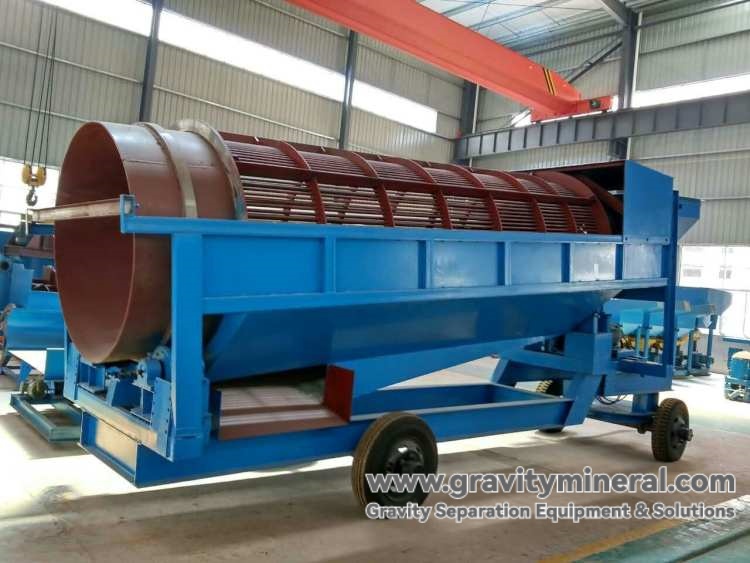
Equipment configuration can be determined based on clay content. When clay content is low, the process can begin with screening, using a trommel screen or vibrating screen to remove large gravel. When clay content is moderate, a trough-type or cylindrical ore washer must be added for pretreatment.In mining areas with high clay content—especially those where clay levels rise significantly during the rainy season—a combined washing and screening machine paired with high-pressure spraying is essential. If clay is not thoroughly stripped away, subsequent gravity separation equipment cannot function effectively.
The selection of a drum washing machine depends on two parameters: the drum diameter determines the maximum feed particle size, and the drum length determines the residence time of the material inside the drum. The stickier the clay, the longer the drum should be.In some projects, rotational speed is increased to reduce the equipment\'s overall length, resulting in insufficient tumbling of the gravel inside the drum. Clay clumps are discharged before they break apart, compromising the washing efficiency. This detail must be clarified with the manufacturer at the time of ordering.
Cylindrical ore washers are available in several specifications based on drum diameter, with processing capacities ranging from tens of metric tons to nearly 200 metric tons per hour. When selecting a model, the matching of drum length and rotational speed should be determined by an engineer based on data regarding the clay content in the ore sample, rather than simply selecting a model from a catalog.
III. Roughing Stage: Gold Particle Size Distribution Determines the Type of Main Equipment
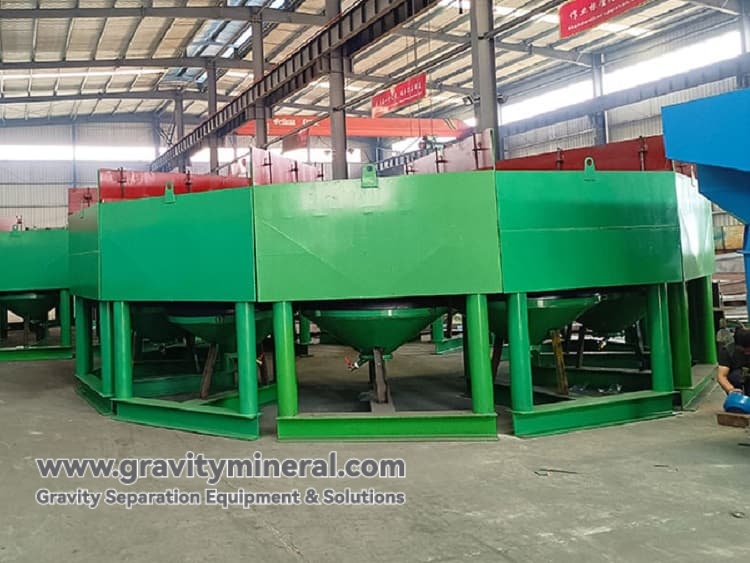
The task of the roughing stage is to remove most of the gangue at a relatively low cost and concentrate the gold in the heavy sand. Roughing equipment for alluvial gold deposits is primarily divided into three categories, with the selection based on the distribution of gold particles.
| Equipment Type | Applicable Gold Particle Size Range | Key Advantages | Selection Considerations |
|---|---|---|---|
| Sawtooth Jig | Primarily coarse particles, with +0.074 mm being the predominant size | High throughput; high tolerance for feed rate fluctuations | Screen aperture size, stroke length, and stroke frequency are adjusted according to the gold particle size distribution |
| Agitated Chute | Medium- to fine-grained material, 0.1 to 2 mm | Periodic agitation prevents bed panel caking; fine-grain gold recovery is more effective than with fixed chutes | Agitation frequency must be adjustable; different frequencies correspond to different clay content levels |
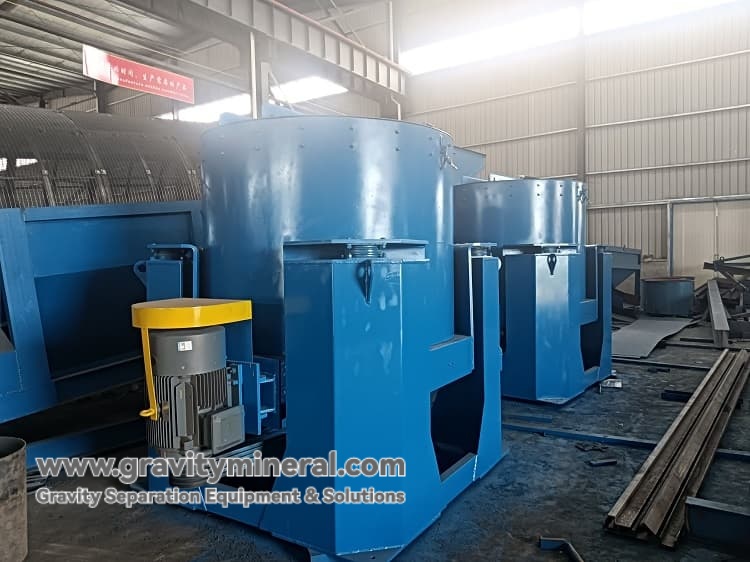
| Centrifugal concentrator | Ultrafine particles, with a high proportion of particles smaller than 0.074 mm | Enhanced gravity field for recovering fine-grain gold that is difficult to capture using conventional gravity separation | Concentrate discharge cycles must be short to prevent gold loss due to bed compaction |
It is not practical for a single piece of equipment to cover the entire particle size range. A more reliable approach is a two-stage roughing process: the jig handles the first stage, recovering coarse-grained gold and most heavy minerals; the jig tailings are fed into a agitation chute or centrifuge for scavenging to capture fine-grained gold.For alluvial deposits where gold particles are predominantly medium to fine-grained, the combination of jig roughing followed by agitation chute scavenging has demonstrated good stability in multiple overseas projects.
When gold particles are predominantly ultrafine, the centrifuge should be positioned earlier in the process; it may even be considered to replace the jig in the first stage of roughing. However, since the processing capacity of a single centrifuge is lower than that of a jig, sufficient units must be provided.The lower limit of feed particle size for centrifugal concentrators can be as low as approximately 0.03 mm, with processing capacities ranging from several metric tons to over 100 metric tons per hour; the number of units should be determined based on test data.
IV. Concentration Stage: Shaking Tables as the Main Equipment; Feed Size Must Be Matched
The heavy sand gold concentrate produced in the roughing stage typically has a gold grade in the range of 100 grams per metric ton and contains a significant proportion of heavy minerals. The task of the shaking table is to separate gold from heavy sands such as magnetite, ilmenite, and zircon.Shaking tables offer the highest separation precision among gravity separation equipment, with a substantial enrichment ratio.
The key to selecting the appropriate shaking table lies in matching the table surface type to the feed particle size. Coarse-sand tables process coarse particle sizes, fine-sand tables process medium particle sizes, and silt tables process very fine particle sizes.If rough concentrate is fed directly to the shaking table without prior classification, coarse particles will disrupt the separation zone for fine particles, thereby compromising both the concentrate grade and recovery rate. Therefore, a hydraulic classifier or hydrocyclone is typically installed upstream of the shaking table to separate the rough concentrate into coarse and fine particle sizes for separate processing.
In mining areas with a high content of associated magnetite, a magnetic separation stage is added before the shaking table. Magnetite has a high density and occupies the bed surface of the shaking table, compressing the gold enrichment zone. Removing magnetite through magnetic separation beforehand increases the shaking table\'s processing capacity and results in a clearer separation zone.
The stroke and frequency of the shaking table must be adjustable, and the bed type should be selected based on the screening results of the coarse and fine concentrates; coarse sand beds and fine sand beds must not be used interchangeably. These parameters should be specified when ordering the equipment, rather than being improvised during on-site commissioning.
V. A Reference Configuration for Gravel Gold Mine Gravity Separation Equipment
The following configuration is suitable for alluvial gold deposits with moderate processing scale, moderately high clay content, predominantly medium- to fine-grained gold particles, and a small amount of associated magnetite. Specific parameters must be adjusted based on test reports.
| Process Step | Equipment | Specification Reference | Key Function |
|---|---|---|---|
| Feeding and Screening | Vibrating Grid Screen | Screen aperture size is determined by the size of the largest gravel pieces | Removes large gravel and debris |
| Mineral Washing and Desliming | Trommel washer combined with a hydrocyclone unit | Drum diameter selected based on processing capacity | Crush and break up clay, and remove fine silt |
| Primary Concentration Stage | Serrated-wave jig | Jigging area sized according to processing capacity | Recover coarse gold; discard tailings |
| Second roughing stage | Vibrating Chute | Adjustable agitation frequency | Recovers medium- and fine-grain gold from the jig tailings |
| Third Stage of Roughing | Centrifugal Separator | Drum diameter determined by the proportion of fine particles | Recovery of ultrafine gold |
| Classification | Hydraulic Classifier | Matched to the shaking table\'s processing capacity | Coarse and fine concentrate are separated into coarse and fine grain fractions |
| Enrichment | Shaking tables (one for coarse sand and one for fine sand) | 6-S shaking table or equivalent | Produces high-grade gold concentrate |
| Auxiliary | Drum-type magnetic separator (as needed) | Configured based on magnetite content | Removes magnetite before the shaking table to reduce load |
The key to this process lies in classification and stage separation: coarse-grain gold does not enter the centrifuge, avoiding the occupation of its processing capacity; fine-grain gold does not rely solely on jigging, preventing recovery losses; magnetite is not fed directly to the shaking table, preventing table congestion.When process design and equipment manufacturing are carried out by the same team, parameters such as the jig\'s stroke and frequency, the shaking table\'s slope, and the chute pitch are set based on test data, minimizing conflicts between equipment interfaces and production capacity.
Taking an alluvial gold mine in Yunnan as an example, the raw ore has a moderately high to high clay content,and the gold particles are predominantly medium to fine-grained. A combined process of ore washing, jigging, agitated chutes, and shaking tables was adopted. The recovery performance in the roughing stage was relatively stable, and after shaking table concentration, the gold concentrate grade reached a considerable level; the overall recovery rate remained within controllable fluctuations even when the clay content increased during the rainy season.The experience from this project demonstrates that the key to selecting gravity separation equipment for alluvial gold deposits lies not in how advanced the equipment itself is, but rather in whether the capacities of the ore washing, roughing, and concentrating stages are well-matched to the specific ore conditions.
VI. Common Technical Issues in Selecting Gravitational Separation Equipment for Alluvial Gold Deposits
Can one choose between a jig and a centrifuge?
This depends on the gold particle size distribution. When the proportion of fine-grained gold is low, a jig can handle the roughing stage, and a chute can handle the scavenging stage to complete the process.When the proportion of fine-grained gold is relatively high, relying solely on a jig results in excessive losses, so a centrifuge or at least a vibrating chute must be installed. Adding equipment means higher electricity and maintenance costs, but compared to the cost of losing fine-grained gold, it is more cost-effective in most cases.
What are the troubleshooting steps if the grade of the shaking table concentrate is unsatisfactory?
First, check the feed particle size; a common cause is feeding unclassified coarse concentrate directly to the shaking table. Next, check the feed concentration—if it is too high, stratification is unclear; if too low, the processing capacity is insufficient. Finally, check the wear on the bed\'s striations; once the striations are worn flat, stratification effectiveness drops significantly, so they should be replaced promptly.
How should equipment be configured for mining areas where clay content fluctuates seasonally?
Take separate samples for the dry season and the rainy season. If the clay content is significantly higher during the rainy season than during the dry season, configure the washing section based on the rainy season peak, and configure the roughing section based on normal dry-season ore conditions. The excess washing capacity can be utilized by reducing the rotational speed during the dry season to avoid waste. Configuring the system the other way around may lead to process blockages during the rainy season.
Can the gravity separation process adapt to significant fluctuations in ore properties?
Allow for adjustment flexibility in the process design: jig stroke and frequency should be adjustable, shaking table incline should be adjustable, and spiral chutes should be interchangeable with different pitch models. When fluctuations exceed the adjustment range, operating parameters or specific process steps must be adjusted. Adaptability limits should be evaluated through comparative testing of different ore samples and clearly communicated to the operating team during the commissioning and training phases.
How should one choose between gravity separation and flotation?
Gravity separation is low-cost, environmentally friendly, and free of chemical contamination; it is suitable for ores with distinct density differences and coarser grain sizes.Flotation offers high separation precision and is suitable for fine-grained and complex mixed ores. Alluvial placer gold can be processed primarily by gravity separation; when associated sulfide minerals are present or the grain size distribution is fine and complex, a combined process of gravity roughing and tailings rejection followed by flotation concentration may be considered.
VII. Selection of Equipment Supply Methods: Individual Unit Procurement vs. Turnkey Production Line Delivery
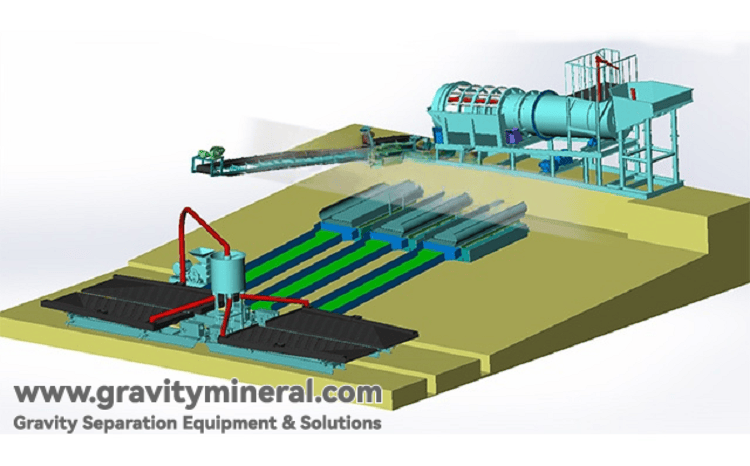
The equipment list for gravity separation of alluvial gold deposits is relatively short, consisting of just a few core units: jigs, chutes, centrifuges, shaking tables, and ore washers. However, there is a significant gap between simply acquiring the equipment and ensuring the production line runs smoothly—this gap lies in the art of process integration.It is not uncommon for individual pieces of equipment to perform well on their own, yet hinder each other when connected: mismatched processing capacities between the jig and the shaking table can lead to material blockages or idle operation in intermediate stages; incomplete ore washing can cause clay clumps to clog the chute bed.
When the same team handles both the manufacturing of gravity separation equipment and the process design, mechanical engineers are fully aware of upstream feed rates and downstream separation requirements during equipment manufacturing. A single responsible party ensures that the interfaces between crushing, ore washing, gravity separation, and dewatering are properly aligned and that production capacities are coordinated.For alluvial gold projects with highly variable ore conditions and complex on-site environments, a complete chain of responsibility is more practical than price differences between individual pieces of equipment. In medium- to large-scale projects, completing the design phase in-house can reduce expenses associated with hiring external design firms.
When selecting equipment for gravity separation in alluvial gold deposits, the decision ultimately hinges on ore sample data.Only when the three key data points—silt content, gold particle size distribution, and associated heavy minerals—are complete can a well-founded equipment list be established. Submitting ore screening data and silt content reports to a manufacturer with expertise in gravity separation processes to obtain a tailored equipment configuration list and recovery efficiency estimates for alluvial gold ore is a practical approach to managing equipment selection risks.For further information on the design of alluvial gold ore gravity separation processes and equipment configuration, please submit your ore sample data and project specifications to receive customized solution recommendations.