







How to Choose Placer Gold Grading Equipment? Key Solutions for High Recovery Rates and Low Operating Costs
I. What Is the Problem?
Let\'s look at it case by case: First, determine whether your placer gold site is stuck in a situation where “recovery rates are low and operating costs won\'t go down.”
Why can\'t the recovery rate go up, and why can\'t operating costs go down? A typical scenario in placer gold processing looks like this: plenty of ore is being dug up, and the sluices and jigs are running, yet gold still slips through the tailings; meanwhile, water pumps, electricity bills, and labor costs are eating into profits day after day, and the cost per metric ton of ore remains stubbornly high.
It\'s true that gold recovery rates can be high, but the process is demanding. If the ore contains even a small amount of silt, mud clumps will carry gold particles downstream, and no matter how hard the gravity separation equipment works, it can\'t retain them; if gold particles are a mix of coarse and fine sizes, a single set of equipment can only cover one size range, causing the rest to be lost;if the equipment isn\'t properly configured, it either runs at full capacity without making progress or idles, wasting electricity. When these three factors combine, both the recovery rate and costs fall short of expectations.
II. Why Does This Problem Occur?
It depends on the situation: Low sand gold recovery rates and high costs usually stem from three main causes.
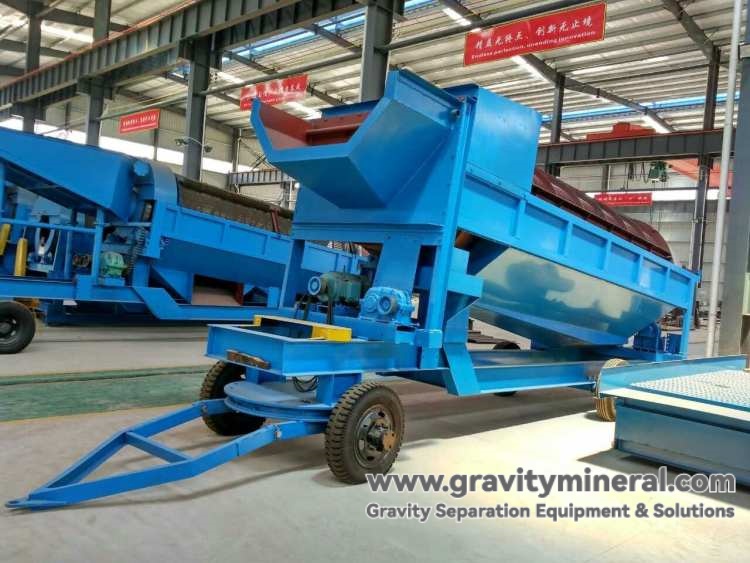
Reason 1: Incomplete de-silting during ore washing. The silt content in placer gold fluctuates significantly; if a cylindrical ore washer isn\'t used in the initial stage to separate the silt, the subsequent sluices and jigs are essentially processing slurry. When there is too much silt, the bed layer becomes disorganized, preventing the gold from settling—resulting in wasted water and electricity.
Reason 2: Lack of size-based segregation. Gold particles in sand vary widely in size; if coarse gold isn\'t recovered early enough and fine gold isn\'t captured at the bottom, with no intermediate buffer, losses accumulate. This is the primary reason recovery rates fail to improve.
Reason 3: Mismatch between equipment capacity and ore volume. This is the key factor driving high operating costs.If the equipment is oversized and not operating at full capacity, electricity consumption per metric ton of ore and depreciation costs will be higher; if it\'s undersized, it clogs up as soon as it starts, and the constant stopping and starting costs even more. Profits from placer gold are inherently spread out over volume; if the equipment-to-ore ratio is off, the numbers just don\'t add up.
Quick Reference Chart: Problems—Causes—Solutions
| Problem Symptoms | Root Cause | Countermeasure |
|---|---|---|
| Gold in tailings is not being recovered | Incomplete ore washing and desliming | Upstream cylindrical ore washer; drum screening of gravel |
| Loss of Fine-Grained Gold | Lack of Coarse-Fine Segregation | Segregation by particle size; add fine-grain recovery equipment |
| Cost per metric ton of ore is too high | Mismatch between equipment capacity and ore volume | Select equipment based on actual processing capacity; don\'t go for oversized units |
The root of the problem isn\'t where you\'re looking—gold loss and financial waste in placer gold mining usually stem from issues with desliming, classification, and process ratios, rather than faulty equipment.
III. What Are the Solutions?
It depends on the situation: When selecting heavy media separation equipment for placer gold, the key principles are “prioritize ore washing, segment processing by particle size, and scale equipment to capacity,” ensuring both recovery rates and operating costs are effectively managed.
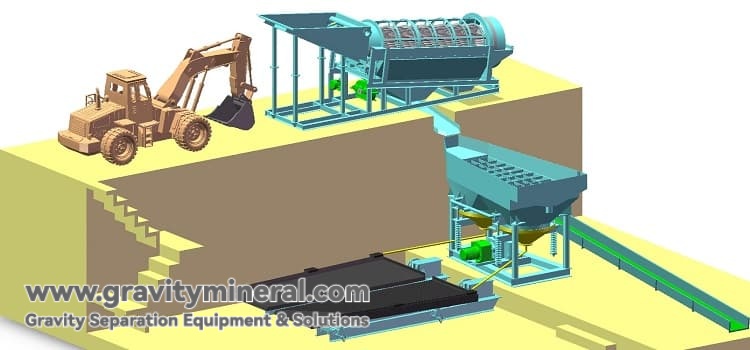
First is the ore washing and screening stage. For sand gold with high mud content, use a cylindrical ore washer in the initial stage to break up mud clumps, then use a trommel screen to separate out the gravel; only the undersize material should proceed to gravity separation. Only by thoroughly executing this stage can subsequent processes be efficient and save water and electricity.
Next is the coarse-grain gravity separation stage. Coarser free gold is processed by a jig (which uses pulsating water flow to separate particles by density), allowing for early recovery and capturing large particles first; chute-type equipment, with its high throughput and simple structure, is suitable for coarse screening and initial processing.
Next is the fine-grain recovery section. Medium- and fine-grain gold is processed using 6-S shaking tables for concentration, while fine and ultrafine grains are recovered using centrifugal concentrators. This stage is critical for recovery rates; even if coarse-grain recovery is excellent, it\'s all for naught if fine-grain gold is lost.
Finally, there is the dewatering stage. Both concentrate and tailings are dewatered; this facilitates the transportation of concentrate and allows for dry disposal of tailings, which is essential for controlling operational costs related to transportation and environmental protection.
Put together, this forms a “ore washing—coarse-grain gravity separation—fine-grain recovery—dewatering” gravity separation line. The overall framework can be based on a sand gold gravity separation production line design, with adjustments made according to your specific ore volume.
Changing your mindset is better than changing equipment—success in placer gold mining doesn\'t depend on the number of machines, but on ensuring each stage is precisely configured to balance recovery rates and costs.
IV. How to Implement the Plan
It depends on the situation: proceed step by step from feasibility studies to production—don\'t rush to procure everything at once.
Stage 1: Understand the ore characteristics. Take representative ore samples and perform a particle size analysis to determine the size distribution of gold particles and the clay content—this forms the basis for equipment selection. Skipping this step means the rest of the process is purely a matter of luck.
Second Stage: Configure ore washing and screening. If the ore has a high clay content, use a cylindrical ore washer; if it contains a lot of gravel, use a trommel screen. This stage forms the foundation of the entire line—get it wrong, and the whole operation is doomed.
Third stage: Configure the main gravity separation units. Determine the specifications of the jig and sluice boxes based on the ore volume. If coarse particles predominate, prioritize jigging; if fine particles are abundant, prioritize shaking tables and centrifuges. Add a buffer unit in the middle to stabilize the feed rate.
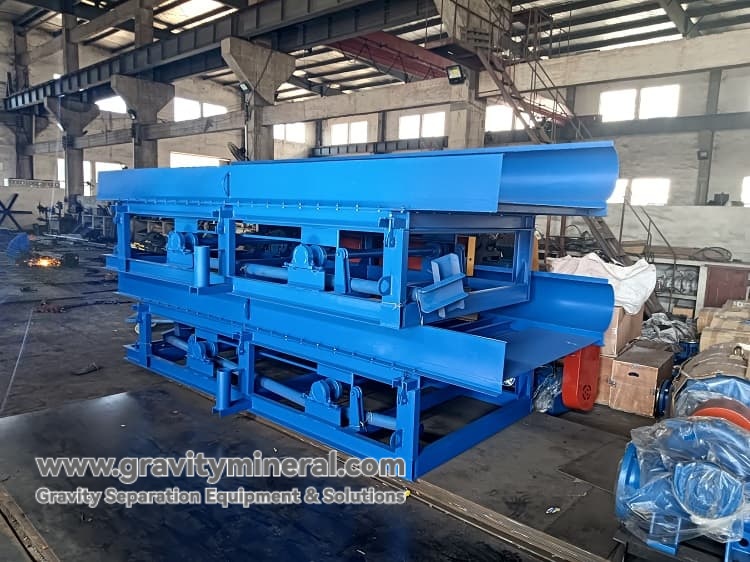
The fourth stage handles the fine-grain recovery. For operations with low throughput where fine particles are prone to loss, a suspended vibrating belt can be added as a scavenging step to recover the most easily lost gold, resulting in a significant drop in tailings grade.
Stage 5: Dewatering and transportation. Concentrates must be dewatered via thickening and filter press to keep transportation costs under control. Do not underestimate this stage; in placer gold mining, profits are often lost due to these seemingly insignificant details.
V. How Effective Is It?
It depends on the situation: After streamlining the process according to the “desliming—segmentation—blending” principle, the results depend on the nature of the ore.
For placer gold, once the ore washing process is thoroughly optimized and the coarse-fine separation stages are properly configured, the overall recovery rate typically improves significantly—by several percentage points (depending on the ore\'s properties). Consequently, the gold grade in the tailings decreases, while the concentrate grade remains stable.In terms of operating costs, since the equipment configuration is tailored to the actual ore volume—avoiding the waste associated with “using a sledgehammer to crack a nut”—electricity and water consumption per metric ton of ore can also be reduced.
Actual results depend on three factors: whether the desliming process is thorough enough, whether the classification stages are properly configured, and whether the equipment is appropriately matched to the ore volume. Once these factors are optimized, the two objectives—high recovery rates and low operating costs—are not mutually exclusive but can, in fact, be achieved simultaneously.
At sites with large volumes of tailings, the dewatering section must be equipped with high-efficiency thickeners in conjunction with plate-and-frame filter presses for dry discharge; only then can transportation and environmental protection requirements be effectively met. Once these processes are optimized, the profitability of placer gold gravity separation becomes sustainable.
Let\'s look at it on a case-by-case basis: Send us your ore data, and we\'ll first assess the compatibility between the ore characteristics and the ore volume before discussing equipment and configuration.
The key to selecting the right equipment for placer gold beneficiation lies in ensuring that the ore characteristics align with the scale of operations. If you have a placer gold deposit ready for development, or if you wish to improve recovery rates and reduce costs in your existing production line, please provide us with data such as grade, particle size distribution, clay content, and target processing capacity.Based on this information, we will analyze process matching and equipment selection. If necessary, we will request samples to conduct mineral processing tests and use the resulting data to determine the optimal gravity separation equipment solution. Only when the process and ore volume are properly aligned can high recovery rates and low operating costs be reliably achieved.